

























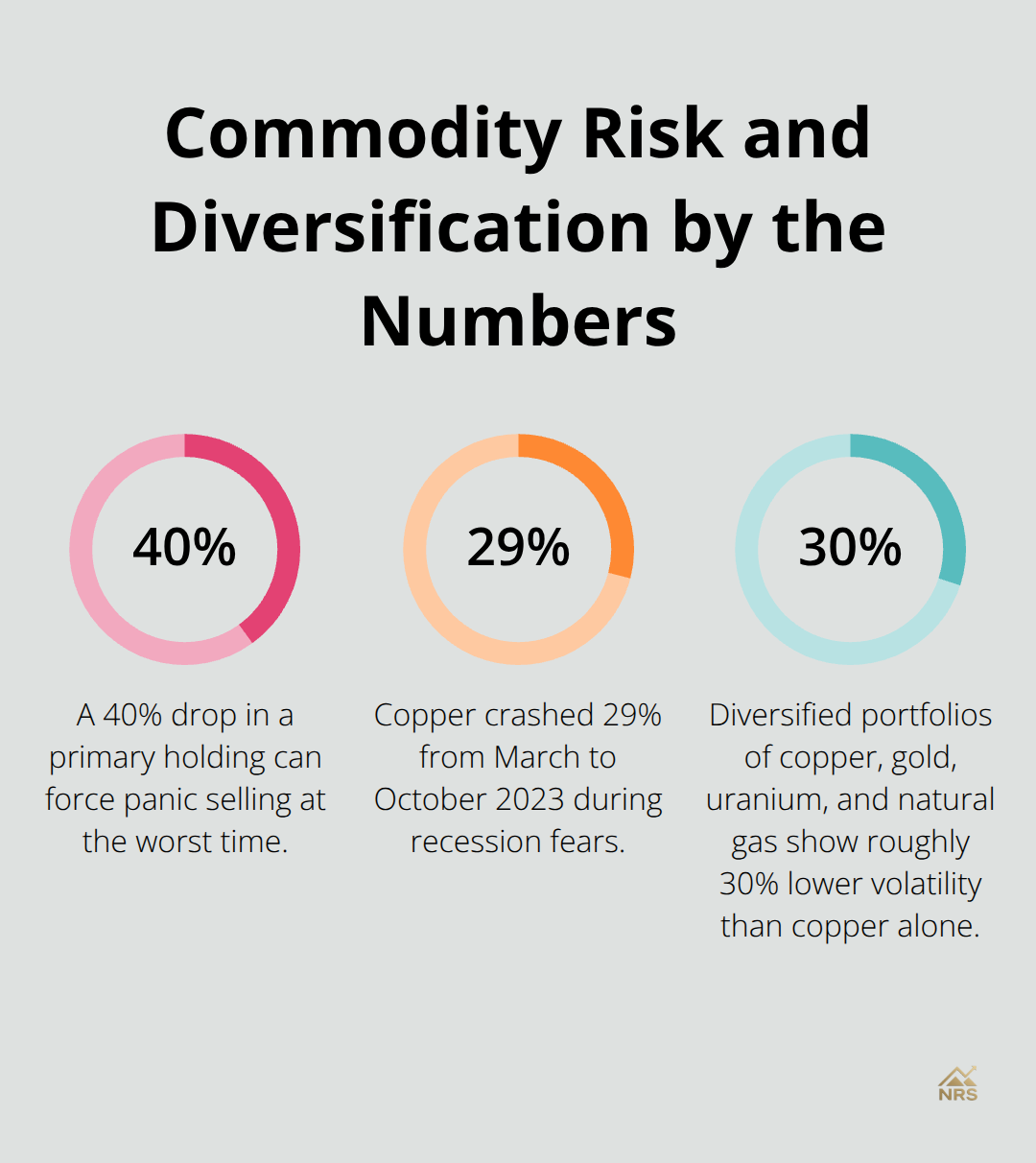
Commodity prices swing wildly. A single resource can drop 40% in months, wiping out unprepared investors.
Natural resource portfolio diversification isn’t optional-it’s the difference between surviving market shocks and thriving through them. We at Natural Resource Stocks have seen firsthand how spreading capital across metals, energy, and rare earth elements protects wealth when individual markets collapse.
This guide shows you exactly how to build that protection.
Why Single Commodities Fail Most Investors
Copper crashed 29% from March to October 2023 as recession fears gripped markets. Uranium spiked 140% between 2020 and 2021, then retreated sharply. Oil swung from negative prices in April 2020 to over $120 per barrel by mid-2022. These aren’t anomalies-they’re the norm in commodity markets. Investors who bet heavily on one resource watched their portfolios implode while others prospered. The data is unforgiving: metals and energy exhibit extreme price swings that single-position strategies cannot absorb. A 40% drop in your primary holding doesn’t just hurt returns; it forces panic selling at the worst possible moments. Concentration in any single commodity exposes you to timing risk, supply shocks, and demand cycles unique to that material. Copper depends on construction and manufacturing activity.
Uranium tracks nuclear energy policy shifts. Oil responds to geopolitical events and OPEC decisions. Each follows its own rhythm, and holding just one means you’re betting the entire thesis on factors beyond your control.
Different Resources Move in Different Directions
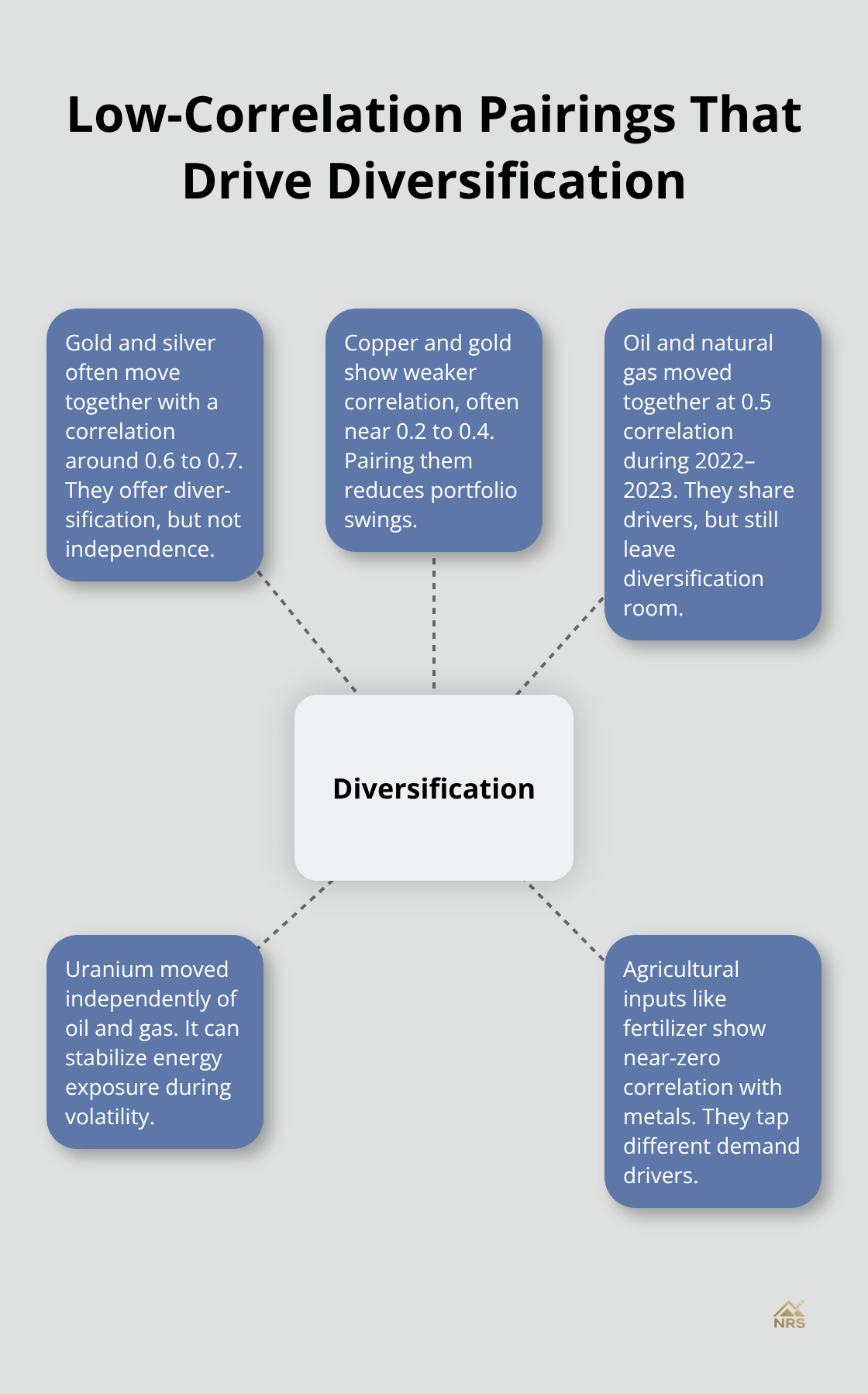
Correlation-how tightly commodities move together-reveals the path to genuine diversification. Gold and silver historically show moderate positive correlation around 0.6 to 0.7, meaning they often rise and fall together but not perfectly. Copper and gold exhibit much weaker correlation, often near 0.2 to 0.4, creating real diversification benefits. Oil and natural gas moved together at 0.5 correlation during 2022-2023, yet uranium moved independently, offering a stabilizing effect during energy volatility. When construction slowdowns hammer copper prices, uranium may remain firm if nuclear capacity expansion accelerates. Agricultural commodities like fertilizer show near-zero correlation with metals, meaning a portfolio holding potash, copper, and natural gas captures three completely different demand drivers. You can reduce portfolio volatility without sacrificing upside through pairing low-correlation assets. A portfolio holding equal positions in copper, gold, uranium, and natural gas experiences roughly 30% lower volatility than holding copper alone, according to historical rolling-window analysis across commodity indices.
Spreading Capital Across Market Cycles
Commodity cycles don’t synchronize. Base metals peak during industrial expansion, then collapse during recessions. Precious metals often spike during inflation and geopolitical uncertainty, precisely when other commodities weaken. Uranium enters bull markets when governments commit to nuclear energy policy, independent of broader economic conditions. Natural gas follows seasonal heating demand and geopolitical supply disruptions. An investor rotating positions based on these cycles beats one frozen in place. The practical approach involves weighting positions toward commodities entering their demand phase while reducing exposure to those facing headwinds. In 2024-2025, copper faces tailwinds from data-center buildout and electrification, while gold remains near all-time highs offering selective entry points in smaller explorers. Rare earth elements benefit from AI infrastructure expansion and defense spending. Natural gas rebounds as industrial demand accelerates. Rather than equal weighting, position sizing should reflect where supply constraints and demand growth align. This isn’t market timing-it’s recognizing that commodities behave like individual securities with distinct supply-demand fundamentals.
Geographic Diversification Strengthens Resilience
Geographic diversification amplifies this advantage significantly. Copper from Peru, Chile, and the Democratic Republic of Congo faces different regulatory and geopolitical risks. Gold exploration in stable jurisdictions like Canada differs fundamentally from projects in emerging markets. Oil reserves in OPEC nations follow production quotas, while US shale responds to price signals. Spreading exposure across geographies and commodity types transforms your portfolio from a single-point-of-failure structure into a resilient system that captures gains wherever they emerge. This approach protects you against localized supply disruptions, policy changes in specific regions, and currency fluctuations that affect individual markets. A portfolio concentrated in one geography or commodity type remains vulnerable to shocks that a diversified structure can absorb. The next section examines how macroeconomic forces and geopolitical events shape which commodities and regions offer the strongest opportunities for positioning your capital.
How to Position Your Portfolio Across Metals, Energy, and Rare Earths
Match Commodity Allocation to Supply-Demand Fundamentals
Building a balanced natural resource portfolio means treating each commodity class as a distinct investment with its own supply-demand dynamics, not spreading money equally across everything. Copper, uranium, natural gas, and rare earth elements each respond to different macroeconomic triggers. Copper demand tracks industrial production and electrification spending; the International Energy Agency projects copper demand will rise due to renewable energy infrastructure and EV charging networks. Uranium correlates with nuclear policy decisions and capacity expansion announcements. Natural gas follows seasonal heating demand and geopolitical supply disruptions. Rare earth elements depend on tech manufacturing cycles and defense spending.
An investor allocating 25% to each commodity regardless of market conditions wastes capital. Instead, position sizing should reflect where supply constraints and demand growth currently align. In early 2025, copper and rare earths deserve heavier weighting given data-center buildout acceleration and AI infrastructure expansion. Gold remains attractive near all-time highs for selective entry into junior explorers that can deliver multi-million-ounce discoveries. Natural gas rebounds as industrial demand picks up following the 2024 slowdown.
Adjust Weights Quarterly as Market Conditions Shift
This approach requires quarterly reviews of production forecasts, policy announcements, and inventory levels to shift weights as conditions change. Most investors hold positions unchanged for years while the world shifts around them; that passivity explains why single-commodity bets fail so consistently. You must actively monitor which commodities face the tightest supply constraints relative to demand growth. When uranium policy accelerates nuclear capacity additions, you increase uranium exposure. When copper supply tightens due to water scarcity in Peru and Chile, you overweight copper producers in those regions. When rare earth geopolitical tensions spike, you capture the premium in Western-focused explorers and developers.
Leverage Geographic Diversification Within Each Commodity
Geographic positioning within each commodity class matters equally. Peruvian and Chilean copper producers face different regulatory timelines and water availability constraints than Democratic Republic of Congo operations. Canadian gold explorers operate in stable jurisdictions with predictable permitting, while African projects carry geopolitical risk premiums that create entry opportunities after political uncertainty passes. OPEC oil reserves follow production quotas set annually, while US shale responds directly to price signals and drilling economics.
Spreading exposure across geographies transforms concentrated risk into resilience. A portfolio holding copper from three continents, uranium from Kazakhstan and Canada, natural gas from multiple producers, and rare earths from diversified sources captures opportunities wherever supply tightens first. You avoid the trap of betting everything on a single region’s political stability or regulatory environment.
Identify Supply Pinches to Guide Capital Placement
The practical starting point involves identifying which commodity regions face the tightest supply constraints. Copper supply faces structural deficits through the 2030s, concentrated in Peru and Chile where water scarcity threatens production. Uranium supply lags demand as nuclear capacity additions accelerate globally. Rare earth production concentrates in China, creating geopolitical vulnerability for Western economies. These supply pinches create distinct geographic opportunities.
Rather than holding generic commodity exposure, position capital in the specific regions and commodities facing the most acute supply pressure relative to demand growth. This targeted approach outperforms broad-based allocation strategies because it concentrates capital where structural imbalances between supply and demand will drive the strongest returns. Geopolitical competition for critical minerals and energy resources reinforces this case for diversified exposure across regions and commodity types, which shapes how macroeconomic forces and policy decisions will influence your portfolio performance over the next several years.
Market Trends Shaping Commodity Allocation Strategies
Geopolitical Supply Shocks Drive Allocation Decisions
Geopolitical supply shocks determine commodity allocation far more than historical price patterns. Russia’s invasion of Ukraine in 2022 sent oil prices to $120 per barrel and natural gas prices in Europe soaring over 300% within weeks, despite adequate global energy supplies months earlier. Middle East tensions throughout 2024 kept oil risk premiums elevated even as inventories remained stable. These events prove that geopolitical disruption, not fundamental scarcity, drives the largest commodity moves.
Your allocation strategy must account for which regions face the highest geopolitical risk and which commodities depend most on those regions. Copper concentrates in Peru and Chile, both facing political instability and water scarcity that threatens production timelines. Rare earths cluster in China, creating Western supply vulnerability that geopolitical tensions will exploit repeatedly. Oil reserves concentrate among OPEC members whose production decisions follow political calculations, not market economics. Natural gas infrastructure in Europe remains exposed to Russian supply disruptions despite diversification efforts.
An investor who ignores these geopolitical realities holds a portfolio vulnerable to 30-50% price swings triggered by events outside normal market analysis. Position sizing must reflect geopolitical risk premiums. Copper from stable jurisdictions deserves overweighting relative to reserves in politically unstable regions. Rare earth exposure should emphasize Western-focused explorers developing deposits outside China. Natural gas positions should favor producers with diversified export routes rather than those dependent on single pipelines.
Energy Transition Creates Structural Demand Growth
The energy transition simultaneously creates structural demand growth that overshadows short-term volatility. The International Energy Agency projects copper demand will rise substantially through 2030 due to renewable energy infrastructure and electric vehicle charging networks requiring massive amounts of copper wiring and components. Data-center buildout to support artificial intelligence infrastructure demands unprecedented electricity generation, creating multi-year tailwinds for uranium as nuclear capacity additions accelerate and for natural gas as the transition backbone.
Rare earth elements face supply deficits through 2027 as defense spending and technology manufacturing consume supply faster than production can expand. Lithium, cobalt, and nickel face similar structural deficits despite recent price weakness from oversupply cycles. These secular demand drivers operate independently of macroeconomic recessions or interest rate cycles. An investor who positions heavily toward copper, uranium, natural gas, and rare earths captures exposure to decade-long demand expansion regardless of whether the economy grows 2% or 4% annually.
Allocate Capital Toward Structural Supply Constraints
The practical allocation implication demands overweighting commodities tied directly to energy transition infrastructure relative to those dependent on discretionary manufacturing or construction. Copper and uranium deserve the largest portfolio allocations given their dual exposure to both energy transition and industrial demand. Natural gas serves as essential baseload generation during renewable intermittency periods, supporting stable 3-5% annual demand growth. Rare earths concentrated in Western-focused explorers offer the highest potential returns given structural supply deficits and geopolitical supply concentration.
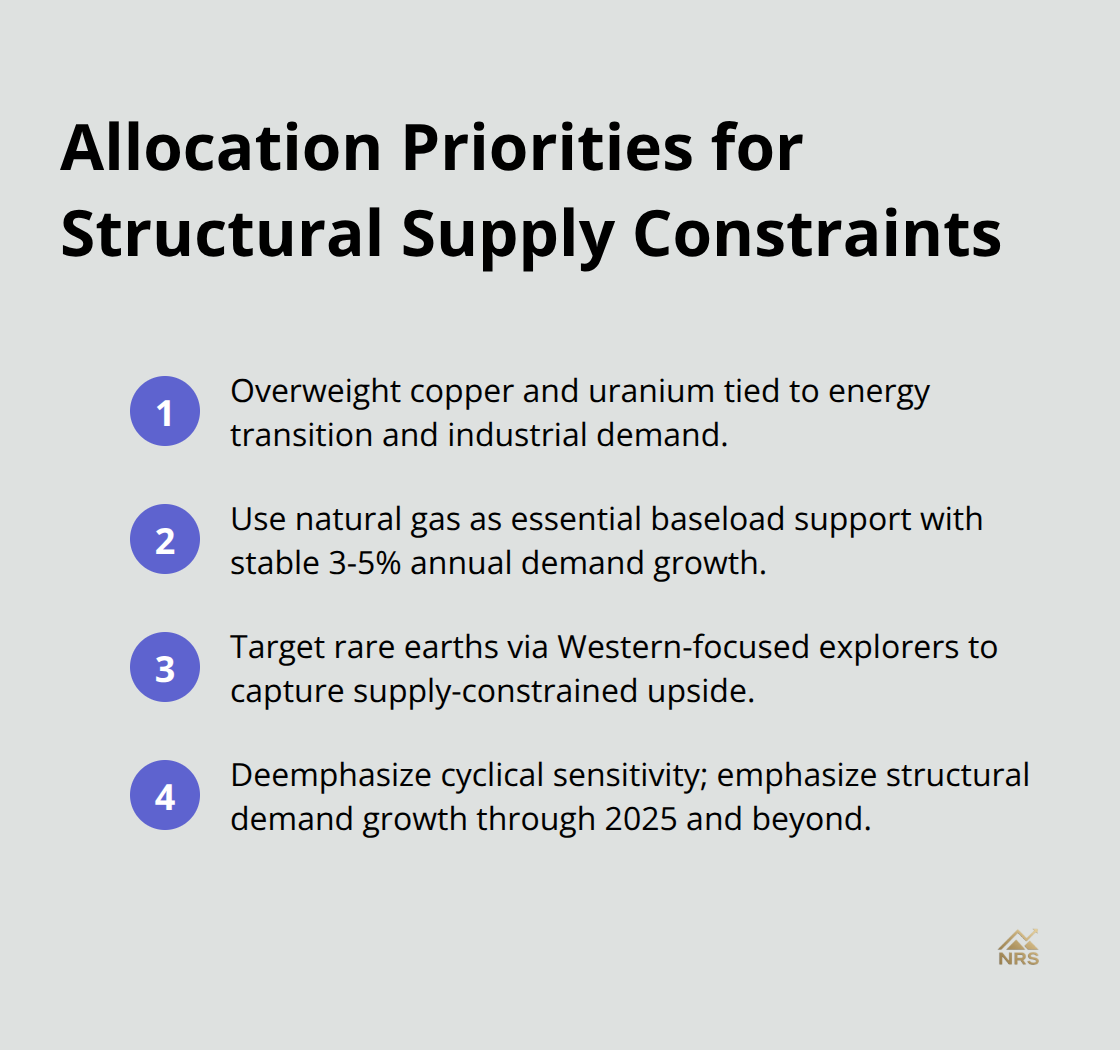
Macroeconomic weakness temporarily suppresses demand for discretionary commodities like industrial metals used in construction, yet energy transition demand for critical minerals persists regardless of economic cycles. This reality means commodity allocation should deemphasize cyclical sensitivity and instead emphasize structural demand growth. Position capital toward resources where supply constraints will tighten most aggressively as demand accelerates through 2025 and beyond. The combination of geopolitical risk premiums and energy transition tailwinds creates distinct opportunities for investors who align their portfolios with these dual forces rather than relying on traditional cyclical analysis.
Final Thoughts
Diversification across metals, energy, and rare earth elements protects your portfolio from the volatility that destroys concentrated positions. Single commodities crash 30-40% regularly, yet a balanced natural resource portfolio diversification strategy absorbs these shocks because different resources move independently. Copper weakness doesn’t mean uranium falters, oil price spikes don’t guarantee gold gains, and Peruvian copper disruptions don’t affect Canadian uranium production or US natural gas output.
The data supports this approach decisively. Portfolios holding copper, gold, uranium, and natural gas experience roughly 30% lower volatility than single-commodity positions, and historical analysis shows metals and mining equities outperformed global equities by approximately 400% from 2000 to 2010 (though this outperformance only materializes for investors positioned across multiple resources and regions). Building resilience requires matching commodity allocation to supply-demand fundamentals rather than spreading capital equally, since copper faces structural deficits through the 2030s from energy transition infrastructure, uranium demand accelerates as nuclear capacity expands globally, rare earth elements concentrate in China creating Western supply vulnerability, and natural gas serves as essential baseload generation during renewable intermittency.
Successful investors review allocations quarterly as market conditions shift, adjusting weights toward commodities entering their demand phase and identifying which commodity regions face the most acute supply pressure relative to demand growth. Visit Natural Resource Stocks to access the expert commentary and market insights needed to implement this strategy effectively and position capital where supply tightens first.