























View Full Liberty Gold Black Pine Charts & PDF Here
Summary:
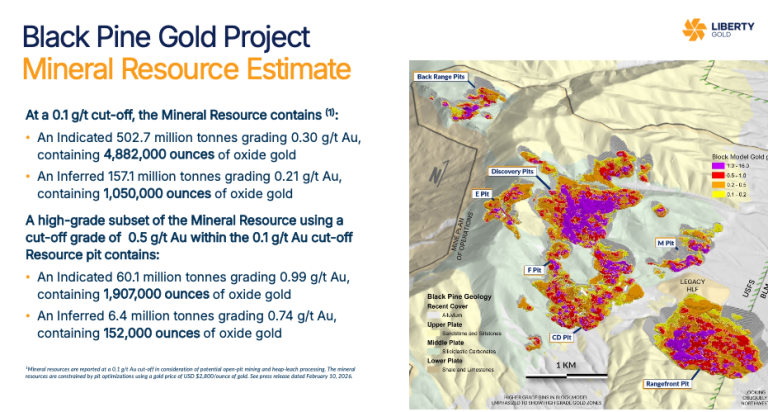
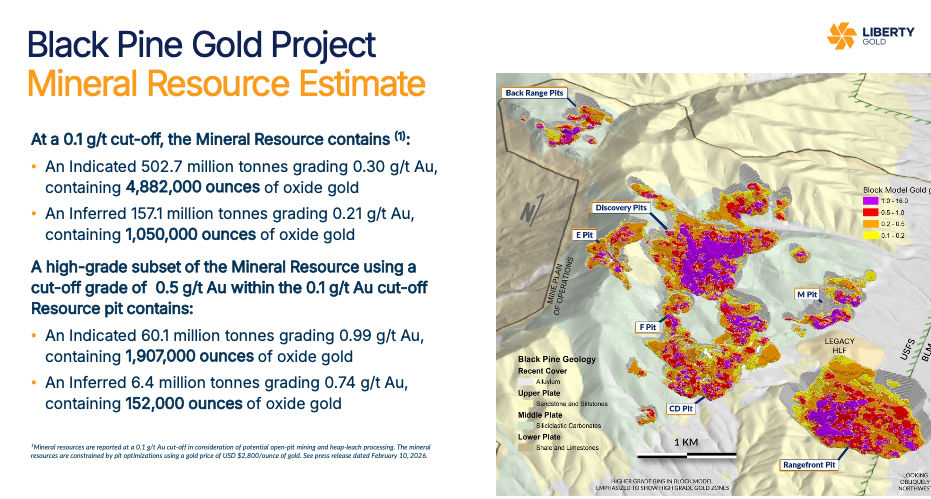
Liberty Gold’s Black Pine Gold Project (Idaho, USA) has delivered an updated 2026 Feasibility Mineral Resource Estimate (MRE) focused on oxide gold that is expected to be suitable for open-pit mining with heap-leach processing. The estimate is constrained by conceptual pit optimizations using a US$2,800/oz gold price and a 0.10 g/t Au cut-off.
At this 0.10 g/t cut-off, the project now hosts 4.882 Moz of indicated oxide gold (502.7 Mt grading 0.30 g/t Au) plus 1.050 Moz of inferred oxide gold (157.1 Mt grading 0.21 g/t Au)—a total of ~5.93 Moz in the two categories combined. The company also highlights a higher-grade subset (still within the broader resource pit) at a 0.50 g/t Au cut-off, totaling 1.907 Moz indicated at 0.99 g/t Au and 0.152 Moz inferred at 0.74 g/t Au, underscoring meaningful higher-grade inventory within the overall oxide resource.
Management frames this as continued resource growth since the 2024 PFS. The presentation states the updated MRE is higher by +719,000 indicated ounces and +338,000 inferred ounces versus the 2024 MRE baseline, and its waterfall chart attributes the change to a mix of conversion of ounces into indicated and new ounces added through ongoing work. (The deck also reminds investors that feasibility-level reserves/resources can still change as detailed mine planning, scheduling, stockpiling and cut-off optimization are finalized.)
Operationally, the resource is concentrated in the project’s two key areas—Rangefront and Discovery—with the presentation noting over 80% of the mineral resource sits within those pits. Rangefront is described as having high average recoveries, close proximity to the leach pad, and a low expected waste:mineralization ratio, while Discovery is described as having the highest weighted average gold grade and “high leverage” to gold price that could support rapid payback. Together, these points position Black Pine as a large, predominantly oxide, heap-leach-style resource with a growing indicated base and meaningful higher-grade zones—while still carrying the usual development, permitting, and commodity-price risks typical for advanced-stage gold projects.