

























Gold prices are climbing higher in 2026, driven by inflation concerns, geopolitical instability, and shifting central bank policies. The question isn’t whether to invest in gold-it’s how to do it smartly.
At Natural Resource Stocks, we’ve analyzed the market conditions and emerging opportunities that matter most to investors right now. This guide gives you the gold investment insights you need to build a confident allocation strategy.
What’s Driving Gold Higher in 2026
Real Interest Rates Set the Pace
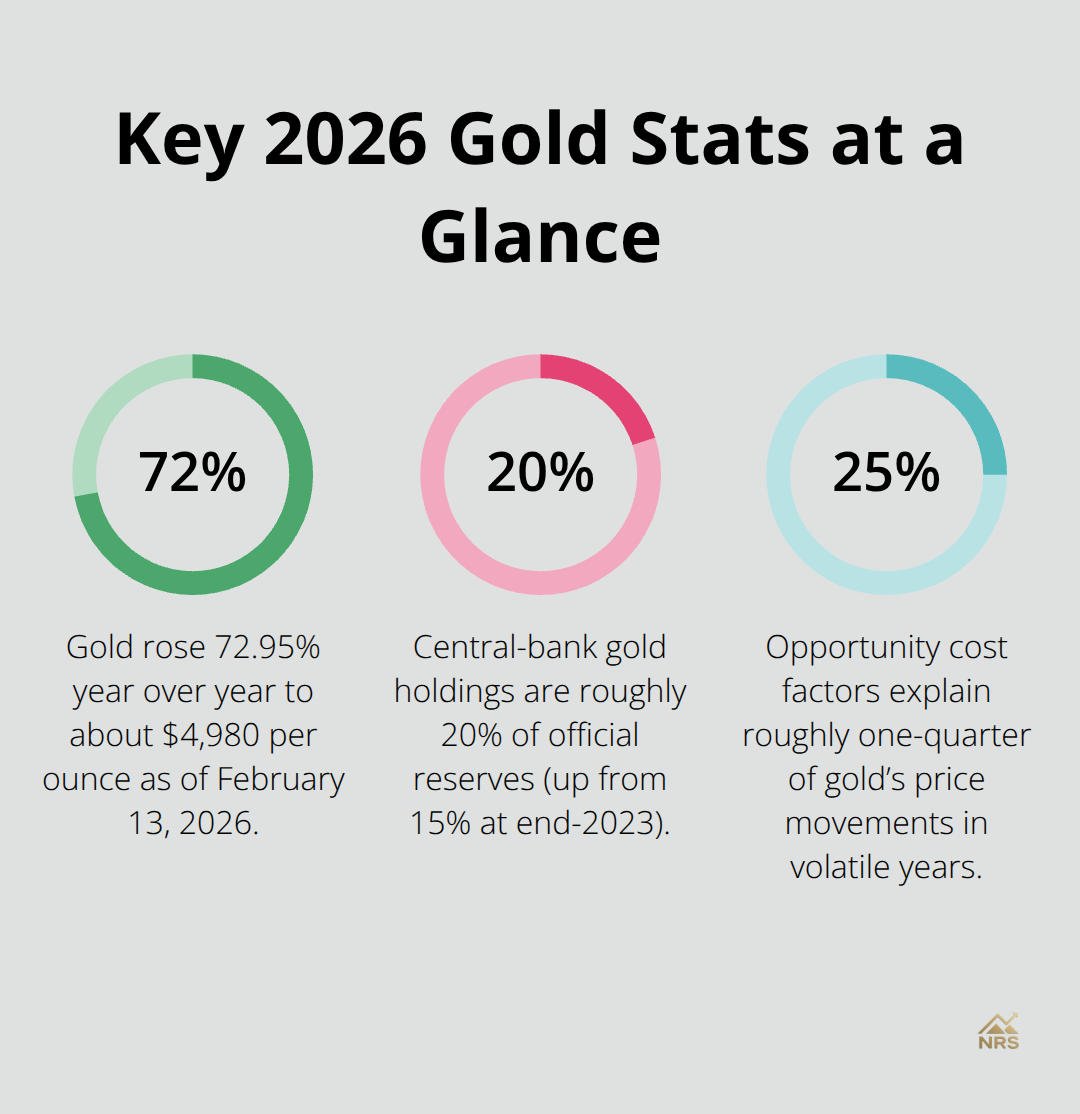
Real interest rates form the primary force moving gold prices in 2026, and the math is straightforward. The Federal Reserve held rates at 3.75% in January 2026, but markets price in at least two reductions of 25 basis points in 2026, with June considered the most likely starting point. When the Fed cuts, real interest rates fall-meaning the opportunity cost of holding non-yielding gold drops sharply. JPMorgan Global Research projects gold to average $5,055 per ounce in Q4 2026 and climb toward $5,400 by end-2027, with a weaker dollar amplifying these moves. Gold has already climbed 72.95% year over year as of February 13, reaching $4,980 per ounce.
Watch the Fed’s rate-cut calendar closely. If cuts arrive earlier than expected, gold likely accelerates higher. If inflation data forces the Fed to hold steady longer, expect pullbacks toward $4,650 support. The World Gold Council’s analysis shows that opportunity cost-driven by yields and currency movements-accounts for roughly one-quarter of gold’s price movements in volatile years like 2025, so this isn’t theoretical noise.
Central Banks Provide Structural Support
Central banks form the second pillar supporting gold, and their purchases are concrete, not speculative. Brazil purchased 15 tonnes in September 2025 and 16 tonnes in October. The Bank of Korea publicly discussed additional purchases. Globally, central banks will buy around 755 tonnes in 2026, still elevated versus pre-2022 averages. IMF COFER data show central-bank gold holdings sit near 36,200 tonnes, roughly 20% of official reserves as of end-2024, up from 15% at end-2023.
This shift matters significantly. A 2020 BIS study found emerging-market central banks with less than 10% gold allocations benefit substantially by raising holdings above 20%. If just these institutions increased their gold share to 10%, implied notional demand could reach $335 billion at $4,000 per ounce.
Geopolitical uncertainty reinforces this trend. Rising tail-risk signals in equity markets (tracked through higher kurtosis in stock index returns) push institutions toward gold as a genuine diversifier. BlackRock’s geopolitical risk dashboard confirms tension levels remain elevated heading into 2026.
The Convergence That Matters
For your portfolio, central-bank demand provides a structural floor under gold prices even if sentiment turns negative. The combination of rate-cut expectations, dollar weakness, and ongoing official-sector purchases creates a backdrop where gold above $5,000 becomes the working assumption rather than an exception. This convergence of factors sets the stage for understanding which allocation strategies actually work in this environment.
How to Build a Gold Allocation That Works in 2026
Core Holdings: Physical Gold vs. ETFs
The structural support we outlined-rate cuts, central bank buying, currency weakness-creates a favorable environment for gold, but favorable conditions don’t translate into returns without a deliberate strategy. Most investors approach gold allocation wrong. They either avoid it entirely because gold produces no yield, or they chase it after sharp rallies when risk-reward has already shifted. Instead, build a three-part allocation that reflects market conditions in 2026 and your actual risk tolerance.
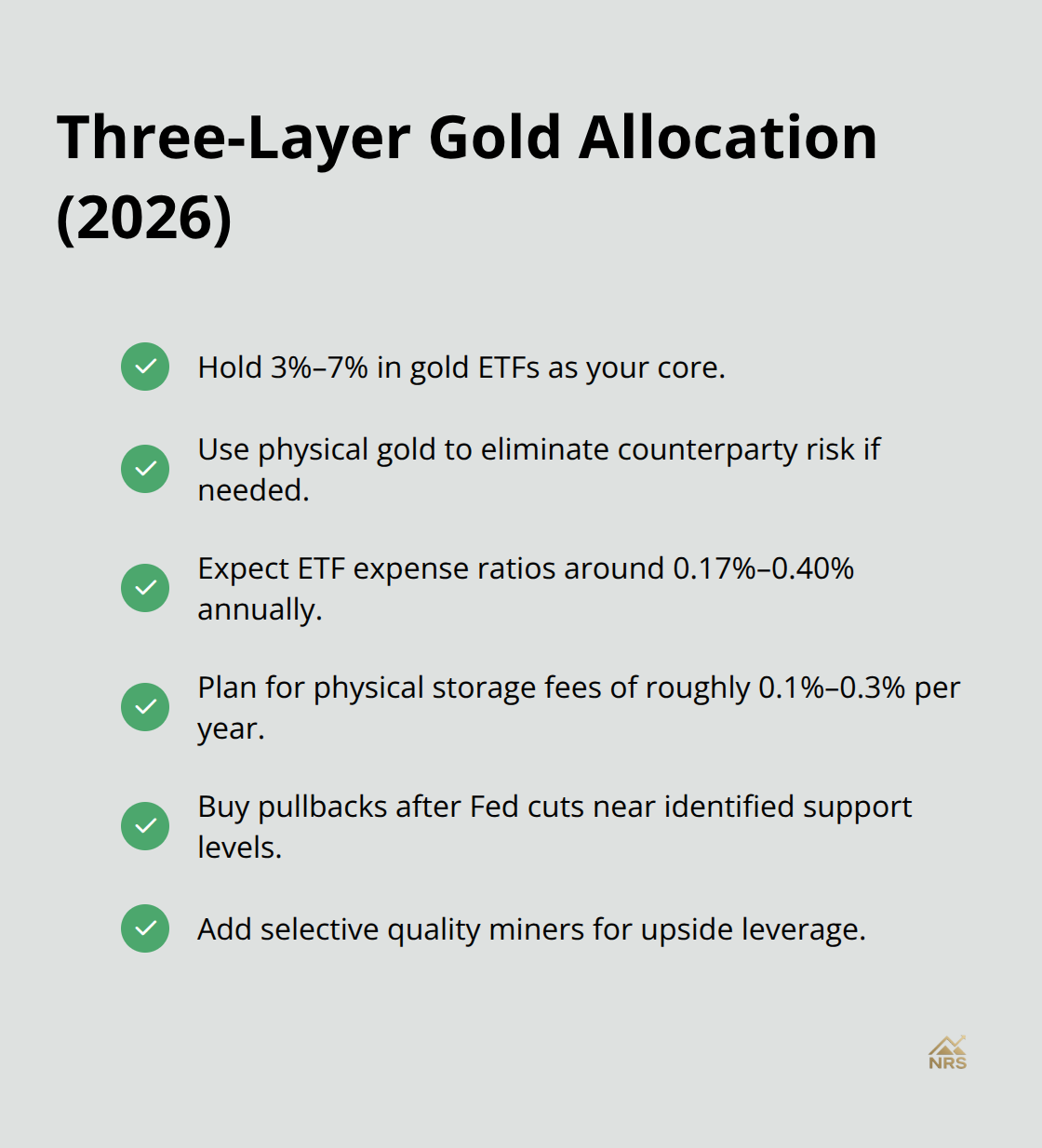
Start with physical gold or gold ETFs as your core holding. Physical gold stored in allocated vaults eliminates counterparty risk, though you’ll pay storage fees of roughly 0.1% to 0.3% annually. Gold ETFs eliminate storage hassles and offer immediate liquidity, but they carry fund expense ratios typically between 0.17% and 0.40% per year. For most investors, gold ETFs make more sense because the liquidity advantage outweighs the small fee difference.
Global gold ETF inflows reached US$89 billion in 2025, the largest on record, adding substantial holdings. This momentum suggests continued institutional capital flows into ETFs rather than physical storage. Try a 3% to 7% allocation to gold ETFs as your baseline position-enough to provide meaningful diversification without creating carry costs that drag returns. This range reflects what institutional investors actually hold; gold’s share of total investor assets under management reached 2.8% by September 2025, with potential to rise toward 4% to 5% according to JPMorgan Global Research.
Timing Entry Points Around Fed Rate Cuts
Your second layer involves timing entry points around predictable volatility. Gold tends to dip briefly after Federal Reserve rate cuts, then resume rising in the fourth month following the cut. With the Fed likely cutting in mid-2026, expect a shallow pullback in late June or early July toward the $4,650 support level identified by technical analysts. This creates a concrete buying opportunity rather than chasing rallies.
The convergence of major bank forecasts around $6,000 to $6,300 by year-end, combined with allocation guidelines suggesting 5–15% in gold or silver to improve diversification and reduce drawdowns, provides a clear risk-reward framework. A 20% pullback from current levels still leaves gold within its long-term uptrend, giving you a meaningful buffer if sentiment shifts temporarily. This isn’t about timing the exact bottom-it’s about positioning through a range of probable outcomes.
Mining Stocks: Selective Exposure Only
The third layer is selective exposure to gold mining stocks, but only if you have conviction on a specific producer. Mining stocks amplify gold price moves (a 10% gold rally typically generates 15% to 20% gains in quality producers), but they introduce operational and geopolitical risk that pure gold exposure avoids. If you want mining exposure, focus on established producers with strong balance sheets and defined expansion projects rather than exploration plays.
These three layers work together because they address different investor needs. Your ETF core provides stability and diversification. Your timing discipline captures pullbacks when risk-reward improves.
Your selective mining exposure captures upside acceleration when gold breaks through key resistance levels like $5,415 and $5,600. The next section examines how supply and demand dynamics in 2026 will test these allocations and reveal which producers stand to benefit most from the structural tailwinds we’ve identified.
Supply and Demand Dynamics Shape Gold’s 2026 Path
Gold mine supply remains the constraint that makes 2026 interesting for investors. Global gold production is relatively inelastic, meaning mines cannot rapidly expand output when prices spike. This structural reality directly impacts your allocation strategy because it prevents supply surges from capping prices during strong demand periods. According to JPMorgan Global Research, about 350 tonnes of net quarterly demand moves gold prices by roughly 2% quarter-over-quarter. Each additional 100 tonnes beyond that baseline adds another 2% in quarterly gains. In Q3 2025, investor and central-bank demand totaled about 980 tonnes, over 50% above the four-quarter average, demonstrating how concentrated demand episodes drive material price appreciation.
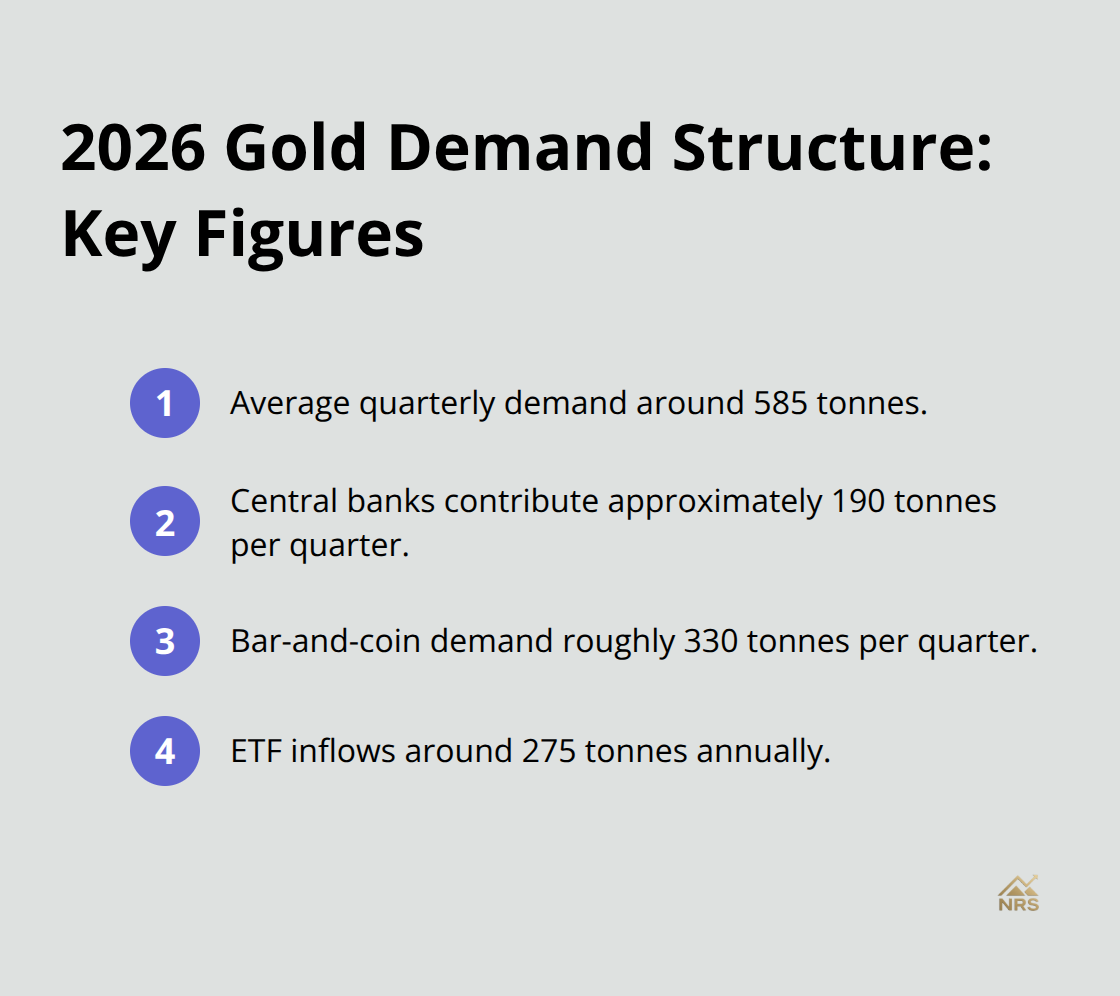
For 2026, JPMorgan projects quarterly demand around 585 tonnes on average, with central banks contributing approximately 190 tonnes per quarter, bar-and-coin demand at roughly 330 tonnes per quarter, and ETF inflows around 275 tonnes annually. This demand structure gives you confidence that even if gold prices moderate from January 2026 highs near $5,608 per ounce, underlying purchasing power from institutions will support prices above $5,000. The World Gold Council’s research reveals that global ETF holdings rose substantially in 2025 but remain below peak cycles from earlier years, indicating room for further growth if sentiment remains supportive heading into 2026.
Established Regions Drive Production Growth
Production growth will occur primarily in established mining regions rather than from dramatic new discoveries. China, Australia, the United States, South Africa, Russia, Peru, and Indonesia collectively dominate global gold output, and these established producers have limited capacity to expand without multi-year project development. Technological advances in extraction methods improve efficiency at existing operations rather than enable rapid production increases. Heap leaching and carbon-in-pulp processing continue to optimize recovery rates at major operations, but these incremental gains translate to low single-digit annual production increases at best.
The practical implication for your portfolio is straightforward: supply constraints support gold prices even during periods of weakening investor sentiment, as long as central bank demand persists. India’s gold market provides a concrete example of demand resilience. More than 200 tonnes of jewelry were pledged as collateral in the formal sector during 2025, with similar activity suspected in the informal sector, according to the Reserve Bank of India. This recycling mechanism creates an alternative supply source that doesn’t depend on new mine production, further limiting upside price risk from supply shocks.
New Institutional Buyers Reshape Demand
Emerging institutional buyers reshaping gold demand will reshape gold markets in ways that benefit specific producers and investment vehicles. These long-term buyers often operate under mandates to diversify reserves away from dollar-denominated assets, creating structural demand independent of short-term price movements.
For your 2026 strategy, selective exposure to gold mining stocks focused on producers serving these institutional markets makes sense. Quality producers with operational expertise in Asia-Pacific regions and strong environmental compliance records will capture premium valuations as these new institutional buyers enter markets. The convergence of major bank forecasts around $6,000 to $6,300 by year-end, combined with structural demand from central banks and emerging institutional investors, creates a two-year runway where supply constraints become increasingly binding. This timeline gives you confidence that your core ETF allocation will compound steadily, while selective mining stock positions can capture operational leverage if demand surprises persist beyond 2026.
Final Thoughts
Gold investment insights for 2026 rest on three concrete realities: real interest rates are falling, central banks are buying, and supply cannot expand quickly enough to meet demand. These factors create a structural environment where gold above $5,000 per ounce becomes the baseline assumption rather than an outlier. Your allocation strategy should reflect this backdrop without overcommitting capital to an asset that produces no yield.
The three-layer approach we outlined gives you a practical framework that acknowledges both the bullish structural drivers and the real volatility gold experiences. Start with a 3% to 7% core position in gold ETFs, which matches institutional allocation patterns and provides meaningful diversification without excessive carry costs. Time your additional purchases around Federal Reserve rate cuts, when gold typically dips before resuming its uptrend, and add selective mining stock exposure only when you have conviction on specific producers with strong balance sheets and operational advantages in key regions.
Major bank forecasts cluster around $6,000 to $6,300 by year-end, but reaching those levels requires patience through pullbacks and discipline around entry points. Central bank demand averaging 190 tonnes per quarter provides a structural floor that prevents catastrophic downside even during periods of weakening investor interest. Visit our detailed gold investment insights and macroeconomic analysis at Natural Resource Stocks to execute this strategy with confidence and navigate resource markets effectively.