






















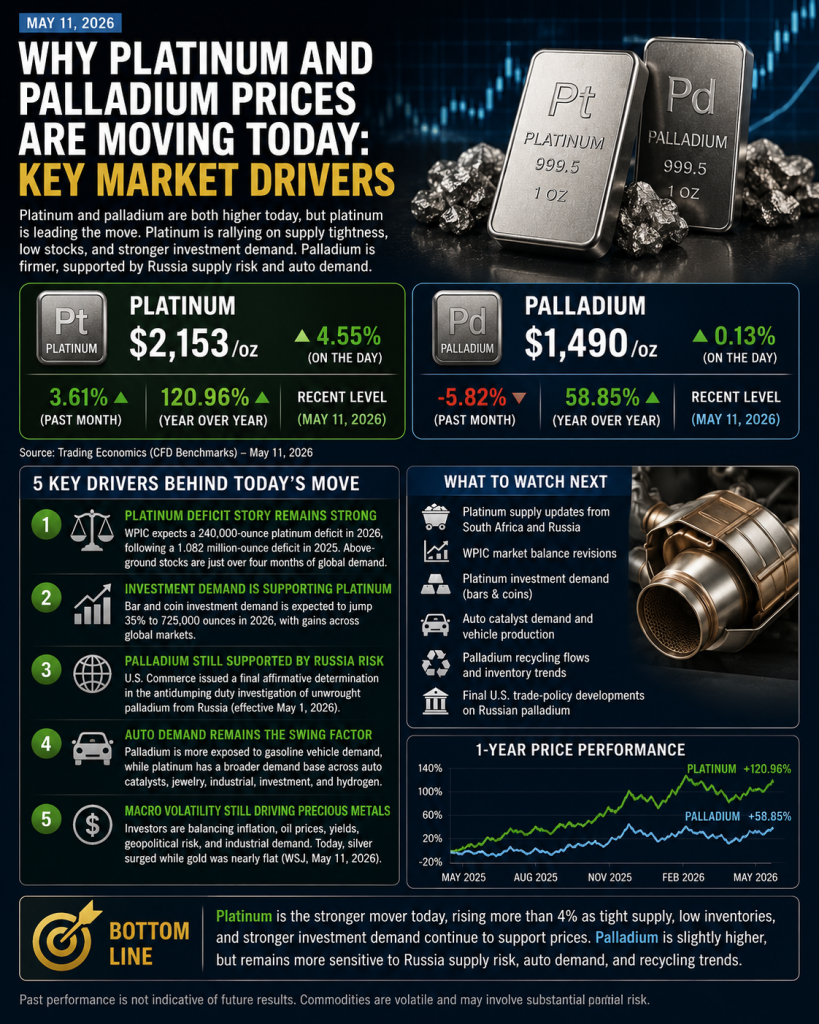
Platinum and palladium are both higher today, but platinum is clearly leading the move. Platinum is rallying sharply as investors continue to price in a tight supply-demand balance, low above-ground stocks, and stronger investment demand. Palladium is also firmer, but its setup remains more tied to Russia supply risk, trade-policy headlines, auto demand, and recycling trends.
Today’s pricing snapshot
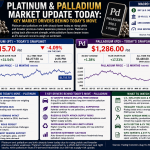
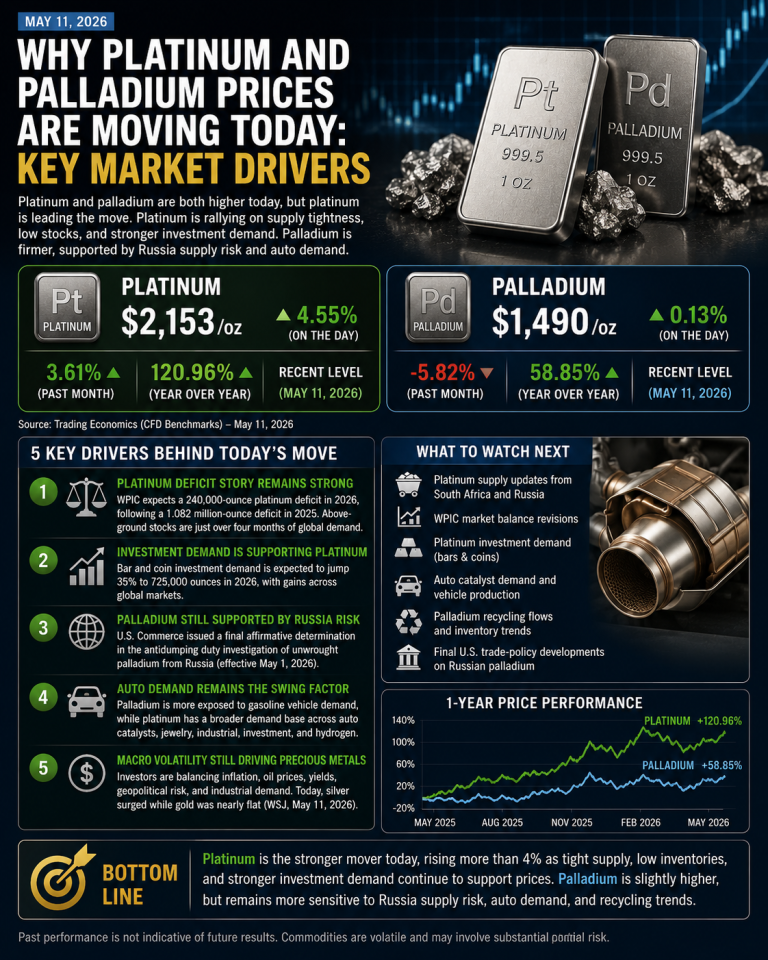
According to Trading Economics CFD benchmarks, platinum rose to about $2,153/oz on May 11, 2026, up roughly 4.55% on the day. Platinum is also up about 3.61% over the past month and roughly 120.96% year over year, keeping it one of the strongest-performing major metals over the past 12 months.
Palladium rose to about $1,490/oz on May 11, 2026, up roughly 0.13% on the day. Palladium is still down about 5.82% over the past month, but remains up roughly 58.85% year over year, showing that supply risk and trade-policy concerns are still supporting the market despite recent weakness.
5 key drivers behind today’s move
1) Platinum is leading because the deficit story remains strong
The biggest driver behind platinum’s strength is the market’s tight supply-demand outlook. The World Platinum Investment Council expects a 240,000-ounce platinum deficit in 2026, following a much larger 1.082 million-ounce deficit in 2025. WPIC also says above-ground stocks are expected to remain depleted at just over four months of global demand through 2026.
That deficit backdrop helps explain why platinum is outperforming palladium today.
2) Investment demand is helping platinum
Platinum is also benefiting from stronger investor interest. WPIC expects bar and coin investment demand to jump 35% to 725,000 ounces in 2026, with gains expected across global markets.
That matters because investor demand can amplify price moves when physical supply is already tight.
3) Palladium is still being supported by Russia supply risk
Palladium’s move is smaller today, but the market remains sensitive to Russian supply headlines. On April 28, 2026, the U.S. Department of Commerce announced a final affirmative determination in the antidumping duty investigation of unwrought palladium from Russia.
The Federal Register notice, effective May 1, 2026, said Commerce made a final affirmative determination that unwrought palladium from Russia was being, or was likely to be, sold in the United States at less than fair value.
4) Auto demand remains the swing factor
Both platinum and palladium are used in catalytic converters, so auto demand remains a major driver. Palladium is more exposed to gasoline vehicle demand, while platinum has a broader demand base across auto catalysts, jewelry, industrial use, investment products, and hydrogen-related applications.
If hybrid and internal-combustion vehicle demand stays stronger for longer, palladium could remain supported. If EV adoption accelerates faster than expected, palladium could face more long-term demand pressure.
5) Precious metals are still reacting to macro volatility
Today’s move is also part of a broader precious-metals market where investors are balancing inflation concerns, oil prices, Treasury yields, geopolitical risk, and industrial demand. WSJ reported today that silver surged while gold was nearly flat, with investors favoring “growth metals” that have industrial exposure.
That backdrop helps platinum, which trades as both a precious metal and an industrial metal.
What to watch next
Traders will be watching platinum supply updates from South Africa and Russia, WPIC market-balance revisions, platinum investment demand, auto catalyst demand, palladium recycling flows, and final U.S. trade-policy developments involving Russian palladium.
For palladium specifically, the key catalysts remain Russia-related trade actions, U.S. import flows, gasoline and hybrid vehicle production, recycling supply, and whether recent monthly weakness attracts bargain buying.
Bottom line
On May 11, 2026, platinum is the stronger mover, rising more than 4% as the market continues to price in tight supply, low above-ground inventories, and stronger investment demand. Palladium is also slightly higher, but its move is more cautious because traders are still weighing Russia supply risk against auto-demand uncertainty and recycling growth.
Platinum looks like the cleaner structural-demand story today, while palladium remains the more headline-driven and supply-risk-sensitive trade.