























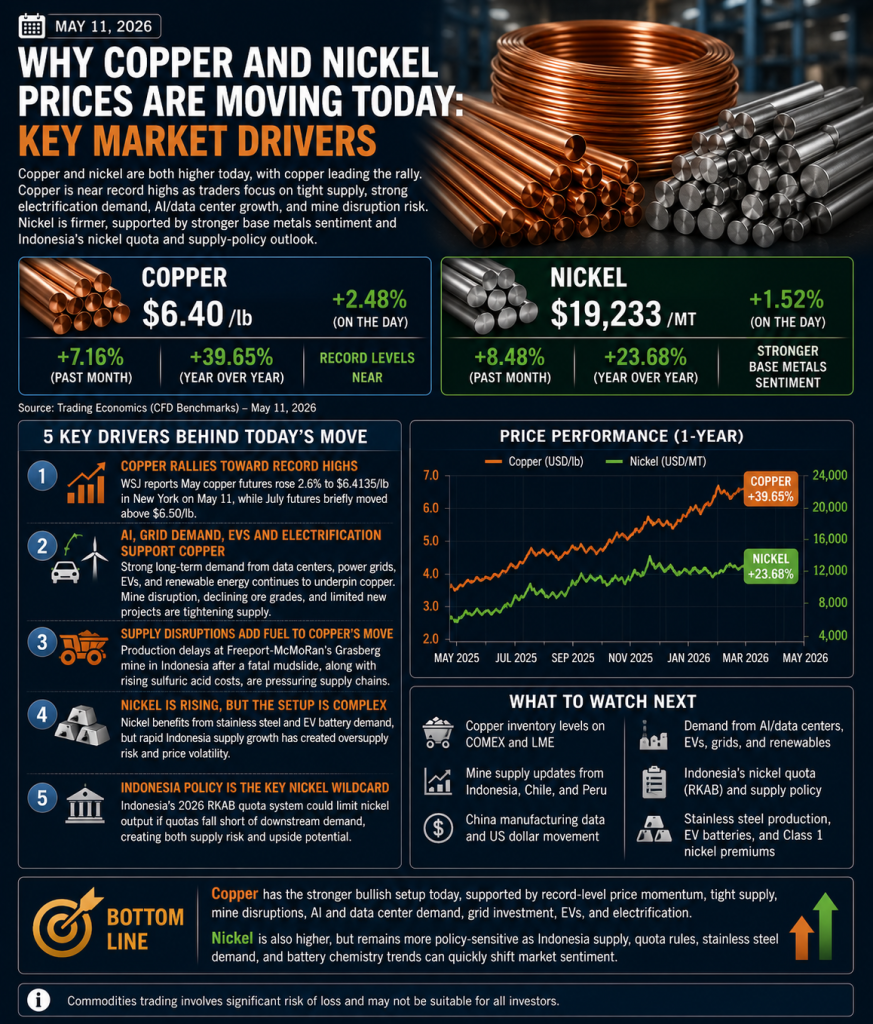
Copper and nickel are both higher today, with copper leading the broader industrial-metals rally. Copper is pushing toward record levels as traders focus on tight supply, strong electrification demand, AI/data-center growth, and mine disruption risk. Nickel is also firmer, helped by stronger base-metal sentiment and renewed attention on Indonesia’s nickel quota and supply-policy outlook.
Today’s pricing snapshot
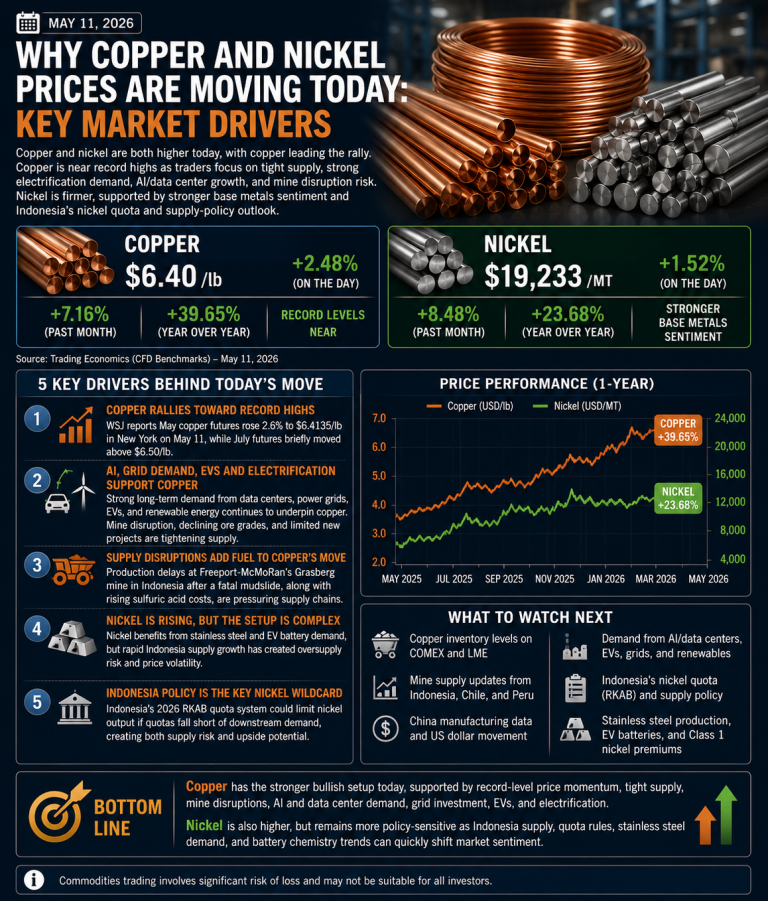
According to Trading Economics CFD benchmarks, copper rose to about $6.40/lb on May 11, 2026, up roughly 2.48% on the day. Copper is also up about 7.16% over the past month and roughly 39.65% year over year, keeping it near historically elevated levels.
Nickel rose to about $19,233/metric ton on May 11, 2026, up roughly 1.52% on the day. Nickel is also up about 8.48% over the past month and roughly 23.68% year over year.
5 key drivers behind today’s move
1) Copper is rallying toward record highs
Copper is leading the move because the market is still pricing in a powerful combination of strong demand and tight supply. WSJ reported that May copper futures rose 2.6% to $6.4135/lb in New York on May 11, while July futures briefly moved above $6.50/lb.
That puts copper back near record territory and keeps the metal firmly in focus for resource investors.
2) AI, grid demand, EVs, and electrification are supporting copper
Copper’s long-term demand story remains one of the strongest in the metals complex. Investors continue to connect copper demand to electric vehicles, renewable power, grid upgrades, AI data centers, and broader electrification.
TradingKey’s 2026 copper outlook points to tightening refined copper supply as mine disruption, declining ore grades, and limited new project pipelines restrict output.
3) Supply disruptions are adding fuel to copper’s move
The copper rally is not just about demand. Supply concerns are also important. WSJ highlighted production delays at Freeport-McMoRan’s Grasberg mine in Indonesia following a fatal mudslide, along with rising sulfuric acid costs, as factors adding pressure to copper supply chains.
That matters because copper markets can move quickly when supply risks appear while demand expectations remain strong.
4) Nickel is rising, but its setup is still more complicated
Nickel is higher today, but its long-term story remains more mixed than copper’s. Nickel still benefits from stainless steel demand, EV batteries, and critical-minerals policy, but the market has been heavily influenced by Indonesia’s rapid supply growth.
Mining Terminal’s 2026 nickel outlook describes the market as being shaped by Indonesian supply dominance, battery-grade demand, and the premium between Class 1 and Class 2 nickel.
5) Indonesia policy is the key nickel wildcard
Indonesia remains the biggest swing factor for nickel. Recent market commentary has focused on Indonesia’s 2026 quota system, with SMM noting that the country’s nickel production could face pressure if quota limits fall short of downstream project demand.
That creates a two-sided setup for nickel: oversupply concerns can cap rallies, but policy tightening or quota disruptions can quickly support prices.
What to watch next
Copper traders will be watching COMEX and LME inventory levels, mine-supply updates from Indonesia, Chile, and Peru, sulfuric acid supply costs, China manufacturing data, U.S. dollar moves, and demand signals from AI/data centers, power grids, EVs, and renewable energy.
Nickel traders will be watching Indonesia’s RKAB quota system, stainless steel production, EV battery demand, Class 1 nickel premiums, LME inventory trends, and any new policy moves from China, Indonesia, the U.S., or the EU.
Bottom line
On May 11, 2026, copper and nickel are both moving higher, but copper has the cleaner bullish setup. Copper is being supported by record-level price momentum, tight supply, mine disruptions, AI/data-center demand, grid investment, EVs, and electrification. Nickel is also gaining, but its outlook remains more policy-sensitive because Indonesia supply, quota rules, stainless steel demand, and battery chemistry trends can quickly shift market sentiment.
Copper is acting like the stronger structural-demand metal today, while nickel remains the more supply-policy-driven trade.