

























Copper and nickel are both slightly lower today, with copper easing after its recent record-setting rally and nickel slipping as traders continue to weigh supply growth, Indonesia policy, stainless steel demand, and battery-market trends. The bigger picture is still different for each metal: copper remains supported by a powerful long-term demand story, while nickel remains more exposed to supply-policy shifts and inventory pressure.
Today’s pricing snapshot
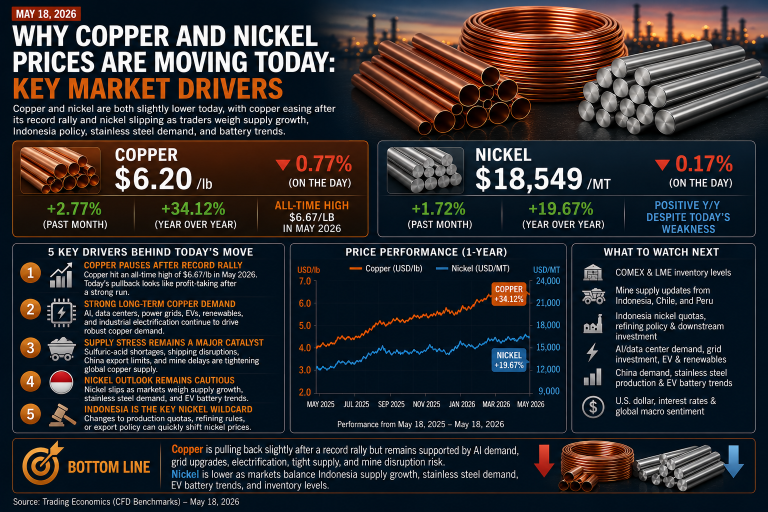
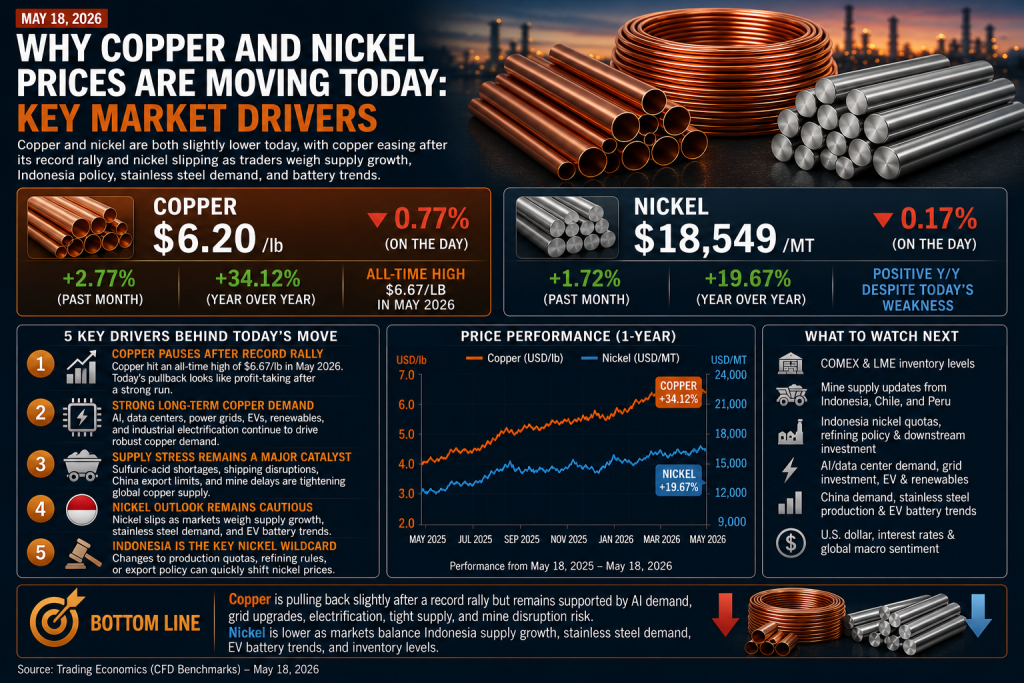
According to Trading Economics CFD benchmarks, copper fell to about $6.20/lb on May 18, 2026, down roughly 0.77% on the day. Even with today’s pullback, copper is still up about 2.77% over the past month and roughly 34.12% year over year. Trading Economics also notes that copper reached an all-time high of $6.67/lb in May 2026.
Nickel fell to about $18,549/metric ton on May 18, 2026, down roughly 0.17% on the day. Nickel remains up about 1.72% over the past month and roughly 19.67% year over year, showing that the metal is still positive on a longer-term basis despite today’s weakness.
5 key drivers behind today’s move
1) Copper is cooling after a record rally
Copper’s small pullback today looks like a pause after a major run. Prices recently hit record territory, with Trading Economics listing copper’s all-time high at $6.67/lb in May 2026.
After a move that strong, some profit-taking is normal, especially when traders are also watching the U.S. dollar, rates, and broader commodity volatility.
2) AI, data centers, grids, and electrification still support copper
The long-term copper story remains strong. MarketWatch recently reported that copper prices reached record highs, with AI infrastructure demand, electrification, and supply constraints all helping drive the rally. The report also noted that the most actively traded July futures contract settled around $6.53/lb, up roughly 15% year to date.
That means today’s weakness does not erase the larger copper thesis: the metal remains central to power grids, data centers, EVs, renewables, and industrial electrification.
3) Supply stress remains a major copper catalyst
Copper’s rally has also been driven by supply-side pressure. MarketWatch highlighted sulfuric-acid shortages, restricted shipping through the Strait of Hormuz, China export limits, and delays around Freeport-McMoRan’s Grasberg mine as key factors tightening the copper market.
Those issues matter because copper supply is already difficult to grow quickly. New mines take years to permit and build, while declining ore grades continue to challenge output from existing operations.
4) Nickel is lower as the market stays cautious
Nickel is also lower today, but the move is smaller than copper’s. Trading Economics shows nickel down slightly on the day while still up nearly 20% year over year.
The market remains cautious because nickel’s long-term demand story is being balanced against supply growth, especially from Indonesia, and uncertainty around stainless steel and EV battery demand.
5) Indonesia remains the biggest nickel wildcard
Nickel’s outlook is still heavily tied to Indonesia. The country plays a major role in global nickel supply, so any change in production quotas, refining rules, export policy, or downstream investment can quickly affect pricing.
LME data also showed 3-month nickel around $18,497/metric ton, down 2.13% on a day-delayed basis for May 15 data, confirming that the market has recently been under pressure.
What to watch next
Copper traders will be watching COMEX and LME inventory levels, sulfuric-acid availability, mine-supply updates from Indonesia, Chile, and Peru, China demand, AI/data-center power demand, grid investment, EV growth, and U.S. dollar moves.
Nickel traders will be watching Indonesia production quotas, stainless steel production, EV battery demand, Class 1 nickel premiums, LME inventories, and policy developments from Indonesia, China, the U.S., and the EU.
Bottom line
On May 18, 2026, copper and nickel are both slightly lower, but copper still has the stronger structural story. Copper is pulling back after a record-setting rally, but it remains supported by AI/data-center demand, grid upgrades, electrification, tight supply, and mine disruption risk. Nickel is holding positive year-over-year gains, but its outlook remains more complicated because Indonesia supply, stainless steel demand, battery chemistry, and inventories can quickly shift market sentiment.
Copper remains the cleaner long-term demand story today, while nickel remains the more supply-policy-sensitive trade.