
























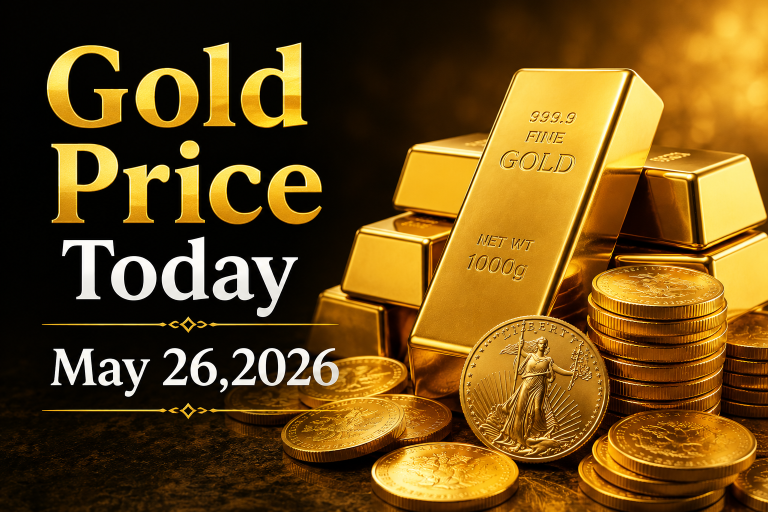
As of May 26, 2026 at 9:10 AM AM EDT, the live Gold spot price for 1 ounce of Gold in U.S. dollars (USD) is $4,529.47, 1 gram of Gold is $145.62 and 1 kilogram of Gold is $145,624.34. Gold spot price can fluctuate by the second, driven by investment supply and demand, and other factors.
Gold Spot Prices
Gold Price | Price | Change |
Gold Price Per Ounce | $4,529.47 | −$140.45 |
Gold Price Per Gram | $145.62 | −$4.51 |
Gold Price Per Kilo | $145,624.34 | −$4,515.38 |
Live Metal Spot Prices (24 Hours) Last Updated: 05/26/2026 at 11:51 AM EDT
Current Gold Price May 26, 2026: Market Snapshot
The current gold spot price on May 26, 2026 reflects a sharply lower session, with the metal pulling back roughly 3% from the previous close. Gold futures (GCM6) were last quoted at $4,544.85, down $140.45 (−3.00%) on the day, after opening at $4,655.40 and a prior close of $4,685.30.
For traders tracking the gold price May 26, 2026 in USD per ounce, the intraday range tells the story of a volatile session. Gold has traded between a daily low of $4,515.95 and a high of $4,670.00, with trading volume reaching 136,792 contracts. Despite today’s drop, the gold price rally of 2026 remains broadly intact on a longer horizon — the metal is still up roughly 40.9% over the past year and sits well within its 52-week range of $3,235.30 to $5,626.80.
This pullback places the gold spot price per ounce on May 26, 2026 firmly in the spotlight for the wider precious metals market, as investors weigh whether this is a healthy correction or the start of a deeper consolidation phase.
Gold Price Drivers in May 2026
Several converging forces explain why the gold price on May 26, 2026 is trading lower today. Understanding these gold price drivers in May 2026 is essential for anyone positioning around the current move.
1. A Firmer U.S. Dollar and Higher Yields
A stronger U.S. dollar continues to weigh on bullion. When the dollar firms, gold becomes more expensive for buyers holding other currencies, dampening international demand. Alongside this, elevated Treasury yields raise the opportunity cost of holding a non-yielding asset like gold, encouraging some investors to rotate back into income-generating assets. This dynamic is a recurring headwind for the precious metals market in 2026.
2. Easing Geopolitical Risk Premium
Gold’s safe-haven appeal has cooled as the U.S.–Iran ceasefire has reduced the geopolitical risk premium that fueled earlier buying. With markets assessing the prospect of a more durable truce, some of the crisis-driven demand that previously supported prices has unwound. Profit-taking by large portfolios that benefited from gold’s powerful 2025 advance has added to the selling pressure.
3. Technicals: Gold Coiled Before a Breakout
From a charting perspective, gold has been coiled in a tight range in recent sessions, with analysts pointing to a band roughly between $4,500 and $4,560 as bulls face a “macro wall” of resistance. The breakdown today below the lower edge of that range suggests the long-awaited breakout has resolved to the downside — at least for now.
Technical signals on Investing.com currently read Strong Sell across the 30-minute, hourly, 5-hour and daily timeframes, while the weekly outlook is Neutral and the monthly remains Strong Buy. That split underscores a market in short-term retreat but still constructive over the longer cycle. Key support to watch sits near the $4,500 psychological level and the day’s low around $4,515; a sustained break below could open the door toward the $4,460 zone, while reclaiming $4,560 would put the prior range back in play.
4. Central Bank Demand Remains a Structural Floor
Even amid today’s weakness, official-sector buying continues to provide a structural floor under the gold price rally of 2026. Central banks across emerging markets have treated gold as core balance-sheet insurance rather than a tactical trade — a theme that supports the bullish long-term case despite short-term volatility.
Global Supply Update: Uzbekistan Resumes Gold Exports
A notable development on the supply side reinforces gold’s central role in global markets. Uzbekistan has resumed gold exports after a roughly six-month halt, exporting approximately $1.5 billion worth of non-monetary gold in the first four months of 2026, with most of those sales occurring in April, according to the country’s National Statistics Committee.
Uzbekistan — which produces around 130 tons of gold annually — had effectively paused exports after September 2025, during which time its central bank became one of the world’s largest gold buyers. Exports stood at zero in January and February, with just $30 million recorded in March, before the April surge. The resumption comes as gold prices reached record levels this year, averaging about $4,800 per ounce, with bullion serving as a critical buffer for the Uzbek economy and a major source of export and budget revenue. Russia, another major producer, has also stepped up its gold sales.
For the broader precious metals market, the return of a significant producer to the export channel is a reminder that supply dynamics — not just safe-haven demand — help shape where the gold spot price settles.
Corporate Spotlight: ESGold Signs Gold Purchase Deal with Ocean Partners
On the corporate side, ESGold Corp. (CSE: ESAU | OTCQB: ESAUF | FSE: Z7D) announced it has entered into a definitive gold and silver doré purchase agreement with Ocean Partners, an institutional global metals group.
Under the agreement, Ocean Partners will purchase 100% of the gold and silver doré produced from ESGold’s Montauban Project in Quebec — derived from tailings and potential crown pillar material — with minimum delivery commitments totaling 50,000 ounces of gold and 1,000,000 ounces of silver over the term of the deal. Pricing is tied to prevailing LBMA or COMEX market prices, with Ocean Partners paying for 99.8% of contained gold and 99% of contained silver, subject to standard refining charges.
The deal also provides ESGold with access to a non-dilutive working capital facility of up to C$9 million, strengthening and de-risking the company’s transition toward anticipated production as it advances mill construction and commissioning. For investors tracking natural resource and mining equities, such offtake agreements illustrate how producers lock in revenue visibility while the current gold price remains historically elevated.
What Today’s Gold Price Means for Investors
The gold price on May 26, 2026 captures the central tension of this year’s market: a powerful structural uptrend punctuated by sharp, sentiment-driven corrections. Today’s near-3% decline is significant, but it sits against a one-year gain of roughly 41% and a 2026 backdrop where institutional forecasts have repeatedly floated scenarios toward and beyond $5,000 per ounce.
Key takeaways from today’s session:
- Current gold spot price (May 26, 2026): $4,529.47 per ounce, down sharply on the day.
- Primary drivers: a firmer dollar, higher yields, an easing geopolitical risk premium, and technical selling after gold broke below its tight consolidation range.
- Structural support: ongoing central bank buying and resilient producer economics continue to underpin the long-term gold price rally of 2026.
- Levels to watch: $4,500 support and $4,560 resistance will likely define the next directional move.
For long-term holders, dips toward major support zones have historically attracted allocators who missed earlier legs of the rally. For shorter-term traders, the Strong Sell technical signals warn that momentum is, for the moment, with the sellers.
Frequently Asked Questions
What is the current gold price on May 26, 2026?
The current gold spot price on May 26, 2026, is approximately $4,529.47 per ounce in USD, with gold futures quoted around $4,544.85, down about 3% on the day.
What is the gold spot price per ounce on May 26, 2026?
The gold spot price per ounce on May 26, 2026, is roughly $4,529.47, having traded in an intraday range between $4,515.95 and $4,670.00.
Why did the gold price fall on May 26, 2026?
Today’s decline reflects a firmer U.S. dollar, elevated Treasury yields, a reduced geopolitical risk premium following the U.S.–Iran ceasefire, profit-taking, and technical selling after gold broke below its recent tight trading range.
Is the 2026 gold price rally over?
Not necessarily. Despite today’s pullback, gold remains up around 41% over the past year and well within its 52-week range. Central bank demand continues to provide structural support, and the monthly technical outlook still reads Strong Buy.