



























Rare earth prices are moving fast, and the forces driving them are becoming harder to ignore. Supply constraints, geopolitical tensions, and surging demand from electric vehicles are reshaping the market in real time.
At Natural Resource Stocks, we’re tracking these shifts closely because they matter for your portfolio. This rare earths price forecast breaks down what’s happening now and what comes next.
What’s Really Breaking the Rare Earth Supply Chain
Neodymium prices hit 985,000 CNY/T on July 31, 2026, up 52.12% year-over-year, but the real story isn’t just the numbers climbing. The problem is that rare earth separation and magnet manufacturing have become the actual bottlenecks, not mining itself. Fastmarkets analyst Adrián Godás Della Ripa nailed it: the core issue isn’t scarcity but the difficulty of extracting, processing, and separating rare earths outside China. China controls the downstream capacity that matters most.
Why Separation Capacity Matters More Than Mining
Mining ore is one thing. Turning that ore into usable material is another. Western nations lack the separation expertise China spent decades building, and scaling separation outside China is harder than scaling lithium hydroxide processing. This means new mines coming online won’t automatically solve supply problems if they can’t access separation technology.
The US government recognized this gap and issued a $500 million conditional loan commitment to Phoenix Tailings for its Freedom Facility, expected to begin operations in 2028. That single facility represents years of development just to add one alternative processing route. Meanwhile, Q2 2026 saw rare earth market volatility spike due to Chinese export controls and geopolitical tensions. Buyers in the US and Europe watched their supply lines grow thinner and realized they’re not just buying a commodity-they’re buying access to expertise they don’t have.
A bifurcated market could emerge where Chinese material trades at one price while non-Chinese supply commands a premium purely for security of supply.
The Magnet Manufacturing Crunch
Downstream bottlenecks in magnet manufacturing represent the tightest constraint right now. MP Materials’ agreement with Hitachi Metals, now Proterial, signals how serious Western companies are about building magnet capacity. It’s not a quick fix. IP tensions are already surfacing, with MP Materials suing USA Rare Earth over alleged proprietary grain boundary diffusion magnet formulations. This litigation shows how scarce and valuable magnet-production knowledge has become.
Vertical integration matters increasingly as companies pursue mining, separation, refining, and magnet production to mitigate single-stage dependence. Companies that own the full chain reduce vulnerability. Those relying on fragmented or imported inputs face higher risk and costs.
Clean Energy Demand Accelerates the Race
Clean energy demand accelerates this race. About 76% of global neodymium supply goes into NdFeB permanent magnets, which power wind turbines and electric vehicle motors. The International Energy Agency projects rare earth demand in clean energy could reach 3 to 7 times higher by 2040. That’s not incremental growth-that’s transformational.
Western demand already runs above 6% annually, but this pace won’t sustain unlimited competing projects. Competition for market share will intensify as more mines, separation facilities, and magnet plants come online, with economics vulnerable to shifts in Chinese exports or policy changes. The next section examines how these price pressures translate into concrete forecasts and what opportunities emerge for investors tracking these dynamics.
What Controls Rare Earth Prices Right Now
China’s export restrictions have fundamentally reshaped rare earth pricing power. When Beijing tightens controls, prices spike unpredictably because buyers scramble for alternative sources that barely exist. In Q2 2026, Chinese export sanctions triggered rare earth market volatility and forced US and European buyers to confront a hard reality: they depend on a single country for material critical to defense, wind energy, and electric vehicle production. This dependency isn’t temporary.
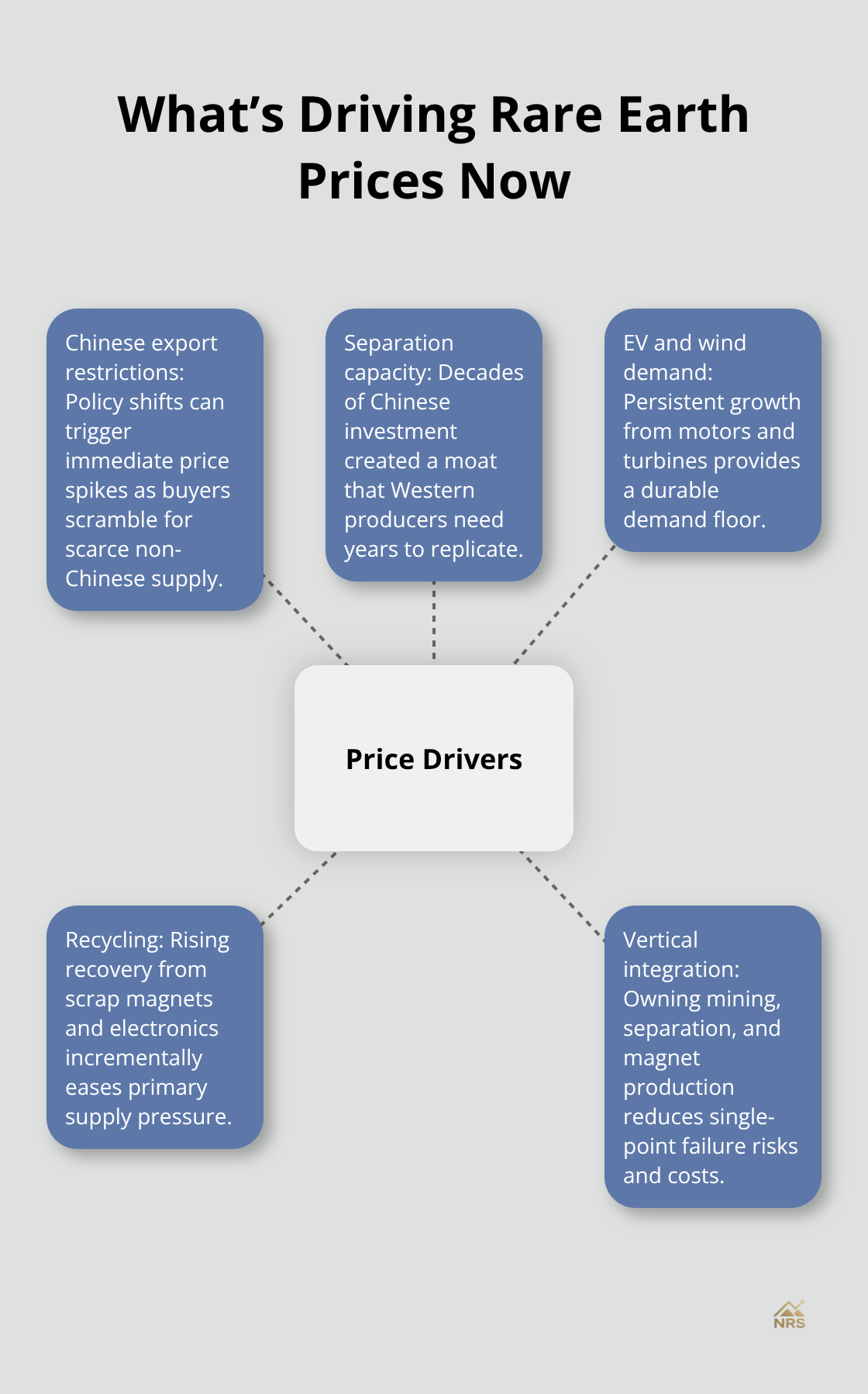
China spent decades building separation capacity, and Western competitors need years to replicate that infrastructure. The result is a bifurcated market where Chinese-origin neodymium trades at one price while non-Chinese supply commands a premium purely for supply security. For investors, this means geopolitical risk translates directly into price premiums on Western-sourced rare earths, creating persistent margin advantages for companies outside China’s control. Tesla and other EV manufacturers already face this reality-they pay more for supply certainty because production delays cost far more than raw material premiums.
Electric Vehicles and Wind Turbines Drive Unstoppable Demand
About 76% of global neodymium supply flows into NdFeB permanent magnets that power EV motors and wind turbines. The International Energy Agency projects rare earth demand in clean energy could reach 3 to 7 times current levels by 2040. That projection rests on concrete data. EV sales hit 14 million units globally in 2023 and continue accelerating, while wind installations added over 86 gigawatts globally in 2023 alone. Each EV motor requires rare earth magnets, and each megawatt of wind capacity requires tons of neodymium and dysprosium. This demand floor keeps prices elevated even during market downturns. Neodymium closed at 985,000 CNY/T on July 31, 2026, up 52% year-over-year, and forecasts suggest 1,084,251 CNY/T by end of 2026 according to Trading Economics. Western demand already grows above 6% annually, outpacing supply diversification efforts. This imbalance means prices stay structurally higher until new separation capacity comes online-and that takes years, not quarters.
Recycling Creates Real Supply Relief
Recycling rare earths from scrap magnets and electronics provides genuine supply relief, not theoretical future benefit. China already recycles more than 20% of its rare earth supply, sidestepping some processing hurdles entirely. Western companies are launching serious recycling programs, but the infrastructure remains underdeveloped. MP Materials and other vertically integrated producers recognize recycling as an essential component of supply resilience. Recycling won’t replace mining or separation capacity in the near term, but it reduces the total volume needed from primary sources and creates a margin advantage for companies that control the full loop. For investors, recycling-focused operations represent lower geopolitical risk than pure mining plays because they reduce Chinese supply dependence incrementally. The practical advantage is clear: a ton of recycled neodymium requires no separation facility access and no export licensing approval from Beijing. As EV penetration deepens and wind installations age, recycling volumes will compound significantly, creating a structural price ceiling that protects downstream manufacturers from extreme volatility. These supply dynamics set the stage for understanding how new mining projects and processing facilities will reshape the competitive landscape over the next two years.
Where Neodymium Prices Head Through 2027
neodymium price forecast band through 2026 will trade between 1,011,073 CNY/T by end of Q3 2026 and 1,084,251 CNY/T by end of 2026, according to Trading Economics global macro models and analyst expectations. This forecast band matters because it signals a modest rebound after recent consolidation, but the real insight lies beneath the numbers. Neodymium closed at 985,000 CNY/T on July 31, 2026, up 52.12% year-over-year but down 0.76% over the prior month. That monthly dip reflects temporary oversupply concerns, not fundamental weakness. The all-time high of 1,520,000 CNY/T in February 2022 remains a reference point for what happens when supply fear dominates.
Between now and end of 2026, expect neodymium to test the 1,011,073 CNY/T level as Q3 demand picks up from downstream manufacturers that build inventory ahead of potential new Chinese export restrictions. The 12-month forecast of 1,084,251 CNY/T reflects sustained EV and wind turbine demand, but this assumes no major geopolitical escalation. If Chinese export controls tighten further, prices could spike 15% to 20% above the forecast band within weeks.
Machine learning models trained on historical rare earth price data show that moving averages MA200 and MA50, plus the Volume-Weighted Average Price indicator, predict price direction with 85% to 90% accuracy over 10 to 20 day horizons. Trading signals from these models suggest consolidation through Q3 before a modest rally into year-end. Investors should monitor separation facility announcements and Chinese policy statements as the primary price drivers, not mining production reports.
Why New Mining Projects Won’t Solve the Price Problem Soon
MP Materials, Lynas Rare Earths, and other Western miners expand capacity, but these projects won’t reach full production until 2028 or later. The harsh reality is that new ore production means nothing without separation capacity constraint limiting rare earth supply to process it. MP Materials already signed an agreement with Proterial for magnet manufacturing capacity, recognizing that mining alone generates no margin advantage.
A mine that produces 10,000 tons of rare earth concentrate annually creates zero competitive advantage if that ore sits in inventory waiting for separation access. This constraint explains why prices remain elevated even as multiple new mining projects announce startup dates. Lynas’ Australian mine shipped record volumes in 2025, yet neodymium prices stayed structurally high because Lynas lacks sufficient separation capacity outside Malaysia, where political risk remains significant.
Companies that invest in mining without secured separation contracts face obsolescence risk. The practical implication for investors is stark: evaluate rare earth stocks based on separation capacity secured through partnerships or owned facilities, not on mining reserves alone. Reserves hold no value without processing access. Competition for market share will intensify as more mines come online, but only vertically integrated players that control the full chain from ore to magnet will sustain premium valuations.
The Phoenix Tailings Freedom Facility Milestone
Phoenix Tailings’ Freedom Facility represents the most significant near-term capacity addition outside China. The US government issued a $500 million conditional loan commitment to fund this midstream facility, which will begin operations in 2028. Each milestone announcement will pressure prices downward as markets price in future non-Chinese capacity, but that capacity won’t materialize for two years. This creates a compressed window where separation bottlenecks sustain elevated pricing.
New mining projects that start production in 2027 and 2028 will compete aggressively for limited separation capacity, driving down ore prices while magnet-grade material stays elevated. This bifurcation creates a squeeze where junior miners can’t achieve profitability while major integrated players capture most margin.
Recycling Infrastructure Becomes a Competitive Advantage
Recycling rare earths from scrap magnets and end-of-life electronics will supply 22% to 25% of Western rare earth demand through 2030, up from negligible levels today. China already recycles over 20% of its supply, and this advantage compounds as EV fleets age and industrial motors reach end-of-life. Companies that build recycling infrastructure now will operate with zero geopolitical exposure and lower processing costs than primary miners.
Recycling rare earths requires no separation facility access and bypasses Chinese export licensing entirely. A ton of recycled neodymium extracted from scrap magnets costs 15% to 25% less to process than primary ore separated from scratch. This cost advantage widens as recycling scales. Investors should prioritize rare earth stocks with announced recycling programs and secured scrap magnet supply contracts over pure mining plays.
The competitive advantage accrues to companies that own collection networks and processing infrastructure, not those that bid competitively for scrap material on spot markets. Recycling will represent a meaningful supply cushion that stabilizes prices and reduces Chinese supply dependency incrementally. This structural shift favors integrated operators positioned to capture margin at multiple stages of the value chain.
Final Thoughts
Rare earth prices will remain structurally elevated through 2027 because separation capacity, not mining reserves, controls supply. Neodymium closed at 985,000 CNY/T on July 31, 2026, and forecasts point toward 1,084,251 CNY/T by end of 2026, reflecting sustained demand from electric vehicles and wind turbines. This rare earths price forecast assumes no major geopolitical escalation, but Chinese export restrictions could push prices 15% to 20% higher within weeks.
For resource stock investors, this reality reshapes how you evaluate rare earth companies. Mining reserves alone mean nothing without secured separation capacity or vertical integration that controls the full chain from ore to magnet. MP Materials, Lynas Rare Earths, and emerging competitors that own or partner for separation facilities will outperform pure mining plays, while recycling infrastructure represents an undervalued competitive advantage because it bypasses Chinese supply chains entirely and costs 15% to 25% less to process than primary ore.
The International Energy Agency projects rare earth demand in clean energy could reach 3 to 7 times current levels by 2040, and Western demand already grows above 6% annually. Phoenix Tailings’ Freedom Facility begins operations in 2028, signaling progress, but that two-year window keeps separation bottlenecks profitable for existing players. Monitor separation facility announcements and Chinese policy statements as primary price drivers, and invest in vertically integrated operators with recycling programs and secured offtakes rather than mining reserves alone.