

























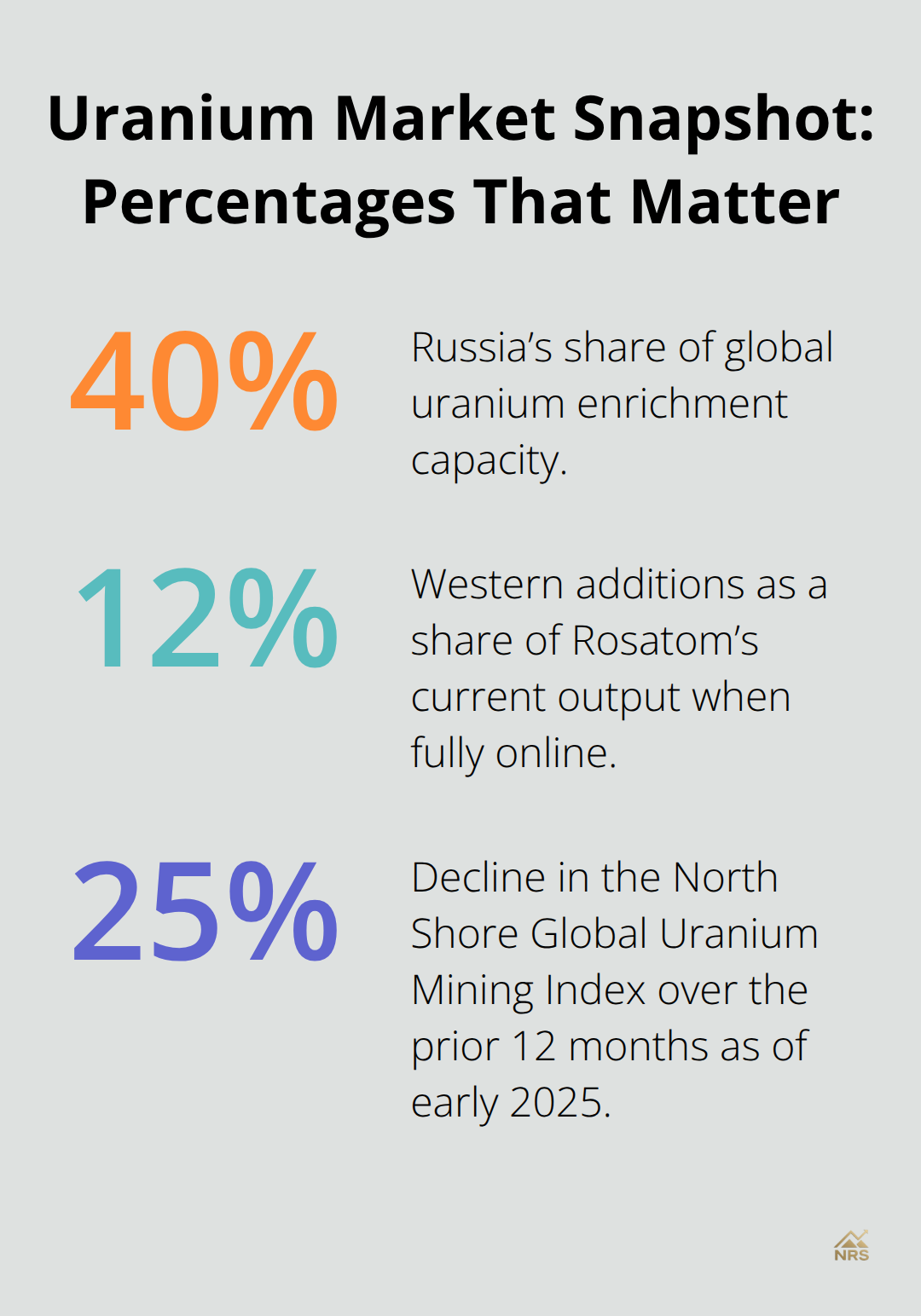
Uranium enrichment policy impacts are reshaping global energy markets faster than most investors realize. Russia controls roughly 40% of global uranium enrichment capacity, making Western nations’ push for independence a defining investment trend.
At Natural Resource Stocks, we’re tracking how these policy shifts create both risks and opportunities for portfolio builders. The next few years will determine which uranium companies thrive and which fall behind.
How Enrichment Policy Rewrites Market Rules
Western Nations Break Free from Russian Dominance
Global uranium enrichment regulations are tightening around one core reality: Western nations will no longer accept Russian dominance in this critical fuel-cycle stage. The Prohibiting Russian Uranium Imports Act targets a phase-out of Russian-enriched uranium by 2028, while Russia’s 2024 export ban on enriched uranium to the West has already fractured supply relationships built over decades. These aren’t theoretical policy shifts-they’re forcing utilities to lock in alternative sources today or face severe cost penalties tomorrow.
Current regulations across the United States, European Union, and allied nations now prioritize domestic and allied enrichment capacity, with the Inflation Reduction Act embedding domestic supply requirements into funding decisions. The practical impact is immediate: utilities operating without long-term contracts to non-Russian enrichers face price volatility and potential supply gaps. As of early 2025, U.S. utilities were roughly 17 million pounds short of forward uranium requirements, according to UxC data, creating acute pressure to secure enrichment agreements before capacity fills up.
Western Capacity Expansion Falls Short
The enrichment market has shifted from a Russian-centric model to a fragmented, competing-suppliers landscape. Orano’s Georges Besse II facility in France expanded by 2.5 million SWU in 2023 and is considering further growth, while Urenco is adding 700,000 SWU at its UUSA plant with first cascades online in 2025 and another 750,000 SWU at Almelo around 2027.
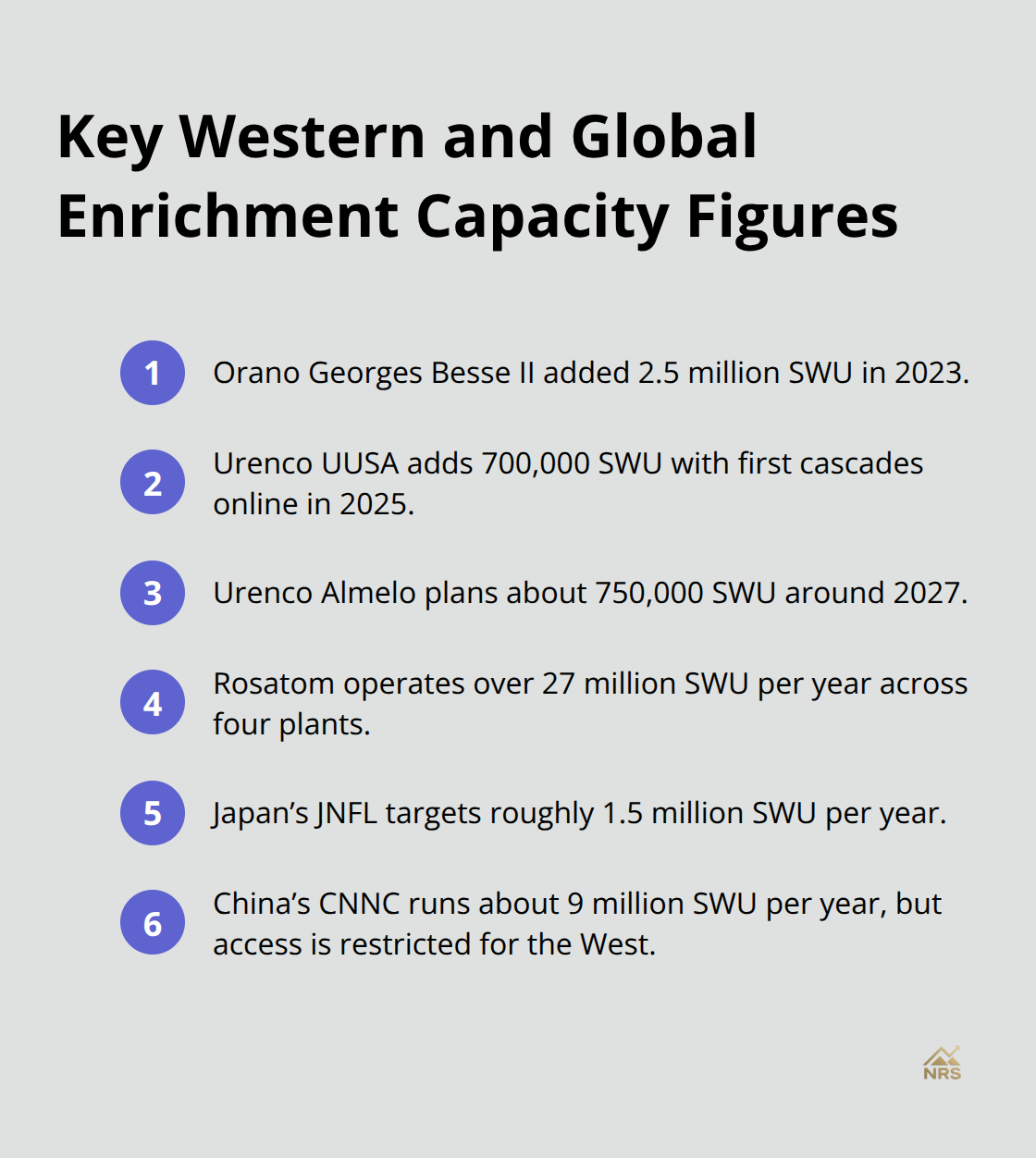
These Western capacity additions are real but insufficient to replace Russian output-Rosatom operates four plants exceeding 27 million SWU/year combined.
Pricing Differentials Create Portfolio Opportunities
The enrichment economics matter directly to your portfolio: energy costs dominate SWU production costs, so utilities sourcing from Western enrichers in high-electricity-cost regions will pay more per unit than those locked into Russian contracts at legacy rates. This pricing differential creates a hedging argument for uranium producers in jurisdictions with lower enrichment costs or those selling into markets willing to absorb Western enrichment premiums.
Additionally, the tariff environment adds another layer-if Canada faces electricity export taxes or contract clauses tied to U.S. tariff policy, Canadian uranium costs could rise, indirectly benefiting U.S.-sourced material. The supply-chain tightness is severe enough that spot prices near $65 per pound in early 2025 represent entry opportunities for investors betting on policy-driven scarcity, particularly as utilities move from spot buying into term contracts once tariff timelines clarify.
Market Tightness Accelerates Procurement Decisions
Western inventories remain tight, with available-for-sale supplies largely depleted, adding risk to any re-acceleration in procurement. Utilities that delay enrichment contracts face the dual threat of rising prices and shrinking availability as competing buyers lock in capacity. The next phase of this market unfolds as tariff policies stabilize and utilities shift from reactive spot purchases to strategic term agreements-a transition that will test which enrichment suppliers can deliver reliable, cost-competitive material at scale.
Russia’s Enrichment Stranglehold and Western Escape Routes
Rosatom’s Dominance and the 2024 Export Ban
Rosatom’s four enrichment plants control over 27 million SWU per year of global capacity, a dominance Russia built through decades of infrastructure investment and cost advantages that priced Western competitors out of long-term contracts. Russian enrichment became embedded into utility fuel plans across Europe and beyond, creating structural dependency that Western nations now actively dismantle. The 2024 Russian export ban on enriched uranium to the West did not create the supply problem-it exposed the vulnerability Western nations had accepted for years. Utilities face an immediate reckoning: contracts signed at Russian rates assumed stable geopolitical conditions that no longer exist, and renegotiating those agreements or finding alternatives costs substantially more. The Prohibiting Russian Uranium Imports Act will terminate on or before January 1, 2028, forcing this transition faster than markets anticipated and creating immediate procurement pressure across utilities.
Western Capacity Expansion Reveals the Math Problem
Western enrichers are expanding, but the numbers show why investors should question near-term supply relief. Orano’s Georges Besse II added 2.5 million SWU in 2023 and explores further capacity, while Urenco’s UUSA plant brings 700,000 SWU online in 2025 with another 750,000 SWU at Almelo around 2027. These additions total roughly 3.2 million SWU annually when fully operational-meaningful but representing only about 12 percent of Rosatom’s current output. Japan’s JNFL upgrades toward 1.5 million SWU per year, though historical delays plague that facility.
China’s CNNC operates roughly 9 million SWU per year, but Western nations cannot reliably access that capacity due to export restrictions and geopolitical risk. The enrichment deficit persists because Western capacity expansion lags demand growth.
Scarcity Drives Premium Pricing and Producer Margins
Utilities across the United States, Europe, and allied nations now compete for limited non-Russian enrichment slots, driving spot SWU prices higher and forcing long-term contract negotiations at premium rates. This scarcity creates a direct benefit for uranium producers positioned to supply enrichers in Western jurisdictions-those companies capture margin uplift as enrichment costs rise. The pricing differential between Russian legacy contracts and Western alternatives widens further as utilities lock in new agreements, making uranium sourced from cost-advantaged regions increasingly valuable to end-users willing to absorb enrichment premiums.
Iran’s Enrichment Capacity Remains Sidelined
The Iran nuclear deal’s implications for enrichment remain secondary to this Western supply crisis. Even if Iranian enrichment capacity returned to civilian channels, Western nations would reject Iranian material due to sanctions and non-proliferation concerns, leaving the enrichment gap to be filled by trusted suppliers or domestic expansion. This geopolitical reality means utilities cannot count on Iranian capacity as a solution, reinforcing their dependence on Western and allied enrichers operating at full utilization rates.
The Procurement Pressure Intensifies
The enrichment market now forces utilities to make strategic choices about which suppliers they trust and which contracts they can afford. Delays in procurement decisions carry real costs as available capacity fills and prices adjust upward. The next phase of this market unfolds as tariff policies stabilize and utilities shift from reactive spot purchases to strategic term agreements-a transition that will test which enrichment suppliers can deliver reliable, cost-competitive material at scale while meeting Western security and non-proliferation standards.
Where Uranium Stock Gains Hide in Policy Chaos
Supply Positioning Separates Winners from Losers
Policy uncertainty doesn’t create uniform volatility across uranium stocks-it creates winners and losers based on supply positioning and contract timing. Utilities facing the 2028 deadline to replace Russian enrichment move aggressively into term contracts, but this procurement sprint won’t happen smoothly. Tariff volatility, enrichment capacity constraints, and shifting geopolitical alliances force utilities to pay significant premiums for uranium sourced from jurisdictions offering supply security and cost predictability. Uranium producers with long-term contracts already locked in at elevated prices benefit immediately, while those still selling into spot markets at $65 per pound face margin compression as their customers delay purchases waiting for policy clarity.
The real opportunity lies in identifying which producers will capture enrichment-driven demand growth before utilities finish their procurement cycle. According to UxC data, U.S. utilities remained roughly 17 million pounds short of forward requirements in 2024, meaning that supply deficit must be filled over the next 24 to 36 months. Companies positioned to deliver material to Western enrichers operating in high-cost jurisdictions will command pricing power that spot-market competitors cannot match. Conversely, producers dependent on spot sales or lacking long-term offtake agreements will underperform as utilities shift procurement timing to align with tariff policy windows and geopolitical risk assessments.
Timing Catalysts Trump Stock Selection
Timing matters far more than stock selection in this environment because the catalyst cycle is compressed and policy-dependent. Utilities will accelerate procurement once tariff timelines become clear and Russian import bans move closer to enforcement. That transition from wait-and-see posturing to aggressive contracting typically lifts uranium equities sharply, but the window closes quickly once contracts are signed. Investors should watch quarterly term contracting data released by UxC-when that figure climbs above 140 million pounds per year, it signals utilities have moved from defensive positioning into supply-chain build mode, a shift that historically precedes uranium stock rallies.
The North Shore Global Uranium Mining Index declined roughly 25 percent over the prior 12 months as of early 2025, primarily due to policy noise rather than fundamental deterioration in natural resource investment dynamics. This weakness created entry opportunities for investors willing to position ahead of the procurement acceleration phase.
Enrichment Utilization Rates Signal Margin Expansion
Track enrichment capacity utilization rates across Orano, Urenco, and CNNC facilities as a leading indicator. The enrichment deficit persists because Western capacity additions lag demand growth, meaning scarcity will intensify before it resolves. This compressed window creates opportunities where uranium equities can generate outsized returns for investors who time entry around tariff policy announcements and utility procurement acceleration signals.
Final Thoughts
Uranium enrichment policy impacts reshape investment fundamentals faster than most market participants anticipated. The Western push to eliminate Russian enrichment dependency by 2028 creates a compressed procurement window where utilities must secure alternative supply agreements or face severe cost penalties. U.S. utilities remain roughly 17 million pounds short of forward requirements, while global term contracting fell to 116 million pounds in 2024, down from 161 million in 2023-a deficit that forces real capital allocation decisions across the nuclear fuel cycle today.
Western enrichment capacity additions from Orano, Urenco, and Japan’s JNFL total roughly 3.2 million SWU annually when fully operational, representing only about 12 percent of Rosatom’s current output. This scarcity persists because Western capacity expansion lags demand growth, meaning margin expansion will intensify before supply relief arrives. Spot prices near $65 per pound in early 2025 represent entry points for investors positioning ahead of utility procurement acceleration, particularly as the North Shore Global Uranium Mining Index declined roughly 25 percent over the prior 12 months due to policy noise rather than fundamental deterioration.
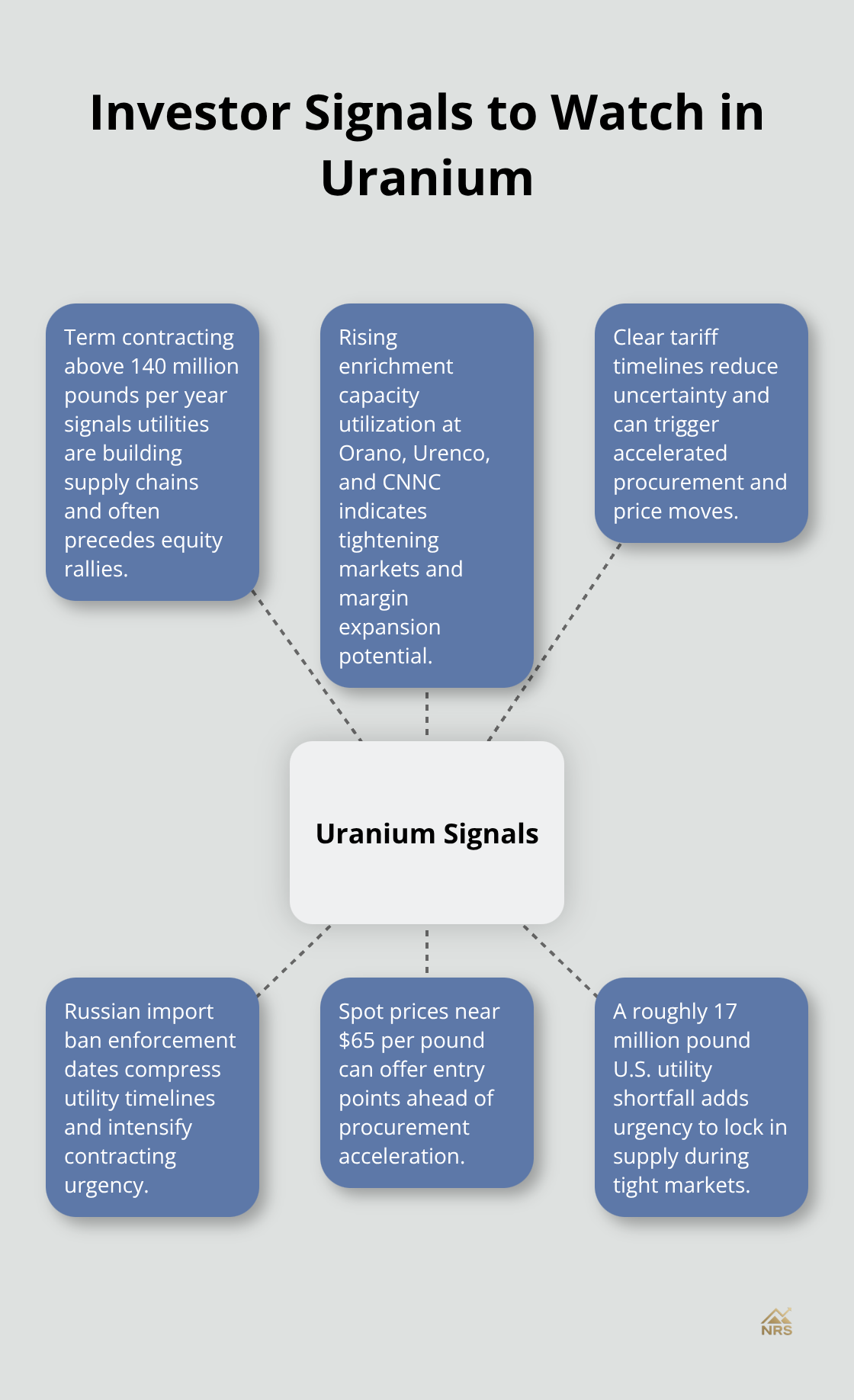
Monitor enrichment capacity utilization rates across Western facilities and quarterly term contracting data from UxC as leading indicators-when that figure climbs above 140 million pounds per year, utilities shift from defensive positioning into supply-chain build mode, a transition that historically precedes uranium stock rallies. Track tariff timeline clarity and Russian import ban enforcement dates as catalysts that compress the procurement cycle. We at Natural Resource Stocks provide expert analysis on how policy shifts and geopolitical developments affect resource valuations.