
























Platinum has spent years in the shadow of gold and silver, yet the fundamentals supporting this metal are shifting dramatically. South African supply constraints, automotive demand recovery, and the hydrogen economy are converging to reshape the platinum market outlook.
At Natural Resource Stocks, we see this convergence as a turning point for investors willing to look beyond the current cycle. This guide walks you through the catalysts, opportunities, and strategic positions that matter right now.
Where Platinum Stands Today
Supply Deficits Lock in Structural Tightness
South Africa controls roughly 80% of global platinum production, and that concentration creates a structural vulnerability that investors cannot ignore. The World Platinum Investment Council reports that the platinum market faces a deficit of 297,000 ounces in 2026 alone, marking the fourth consecutive annual deficit. Above-ground stocks have shrunk to just 1,747,000 ounces by the end of 2026, equivalent to barely three months of global demand. This is not a temporary imbalance. WPIC projects deficits averaging 331,000 ounces annually through 2030, with some forecasts suggesting even larger shortfalls of 348,000 to 620,000 ounces per year depending on the outlook period. The 2023 deficit exceeded 1 million ounces, establishing a pattern of undersupply that has persisted into 2026 and beyond. Mine supply remains flat, offering no relief, while recycling activity rose 9% in 2026 as higher prices incentivized recovery from used catalytic converters and industrial scrap. Limited price elasticity in platinum supply means that even sharp price increases do not trigger meaningful production growth, locking in the deficit structure for years ahead.
Price Action Reflects Supply Tightness
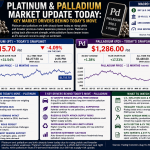
Platinum traded around 1,765.80 USD per troy ounce on August 6, 2026, up 30.8% year-over-year and 6.2% over the prior month. The metal reached an all-time high of 2,923.70 USD per troy ounce in January 2026 before profit-taking and a stronger US dollar compressed prices in the spring. Trading Economics forecasts 1,983.31 USD per troy ounce within 12 months, while JP Morgan projects an average of 1,800 USD per ounce at year-end and Bank of America targets 3,000 USD per ounce in Q4 2026. The wide range of forecasts reflects genuine uncertainty, but the direction remains clear: structural deficits and geopolitical risk support upside. Geopolitical events matter enormously in this thin market. When Iran and Oman partially reopened the Strait of Hormuz in August 2026, platinum futures surged to 1,770 USD per troy ounce as energy prices eased and markets reassessed Federal Reserve tightening. This volatility creates opportunities for investors who monitor entry points carefully.
Demand Shifts Reveal Investment Strength
Industrial and investment demand tell the real story beneath the price noise. Total platinum demand is forecast to fall 9% year-on-year in 2026 to 7,674,000 ounces, as large ETF inflows from 2025 do not recur. Bar and coin investment demand, however, is projected to rise 27% to 718,000 ounces, driven by broad regional growth and a strong first quarter. Industrial demand climbs 9% to 2,238,000 ounces, supported by resumption of glass capacity expansions. Automotive demand declines 2% and jewelry demand falls 12%, reflecting weakness in traditional end-uses offset by strength in investment and specialty industrial applications. This demand mix-where investment and industrial applications offset automotive and jewelry weakness-signals that platinum’s value proposition extends well beyond the automotive sector that once defined the market. The shift matters because it reveals where real growth will come from in the years ahead.
What Drives Platinum Prices Beyond Supply Shortage
Automotive Demand and Palladium Substitution Limits
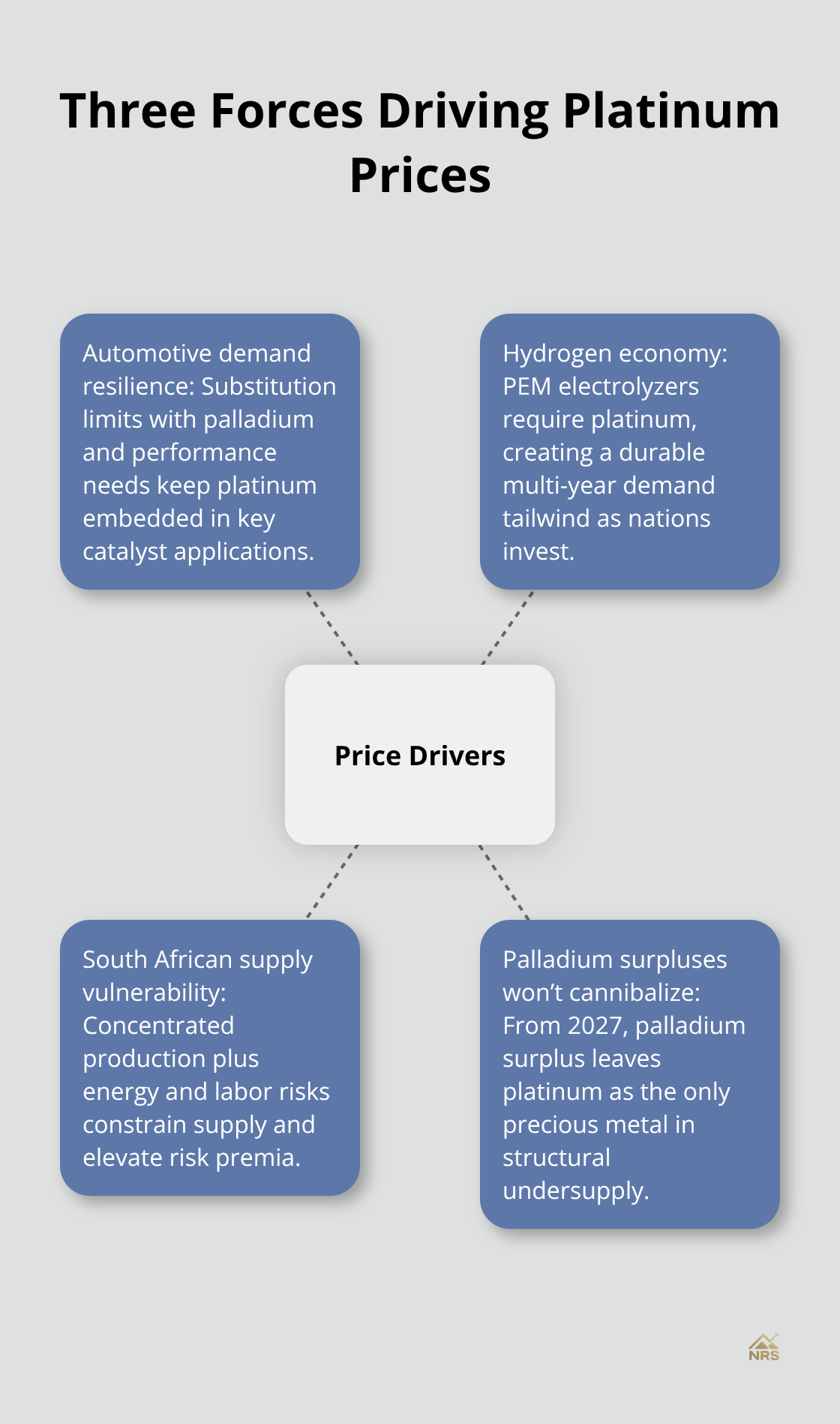
Platinum’s structural deficit forms the foundation, but three distinct forces now accelerate price momentum and reshape demand patterns. The automotive sector remains the largest end-use market, consuming roughly 40% of platinum annually through catalytic converters. Yet the relationship between platinum and palladium substitution reveals hidden upside that most investors overlook. When platinum trades at a significant premium to palladium, automakers face economic pressure to switch catalysts, but this substitution has hard limits. Palladium deficits shift to surplus from 2027 forward according to WPIC forecasts, meaning palladium supply will eventually become abundant while platinum stays tight. Manufacturers cannot simply abandon platinum-based catalysts for applications where performance requirements demand platinum’s superior durability and thermal stability. This structural constraint protects platinum demand even if automotive production remains weak.
Valterra Platinum, the world’s largest primary platinum miner controlling approximately 38% of global supply, recently signaled expected demand growth from artificial intelligence infrastructure. This suggests the market is already pricing in applications beyond traditional catalytic converters. AI-driven data centers and processing facilities require platinum in catalysts for chemical production, refining operations, and specialty industrial applications that support the broader technology ecosystem. The shift matters because it reveals where real growth will come from in the years ahead.
The Hydrogen Economy as a Long-Term Demand Driver
The hydrogen economy represents the most tangible long-term catalyst for platinum demand expansion. Platinum acts as a catalyst in proton exchange membrane electrolyzers that split water into hydrogen and oxygen, making it essential for green hydrogen production at scale. Current hydrogen demand remains modest, but major industrial nations commit to hydrogen infrastructure investment as part of energy transition strategies. This commitment creates a multi-year tailwind for platinum consumption that extends well beyond current automotive applications.
South African Supply Concentration and Geopolitical Risk
South Africa’s supply concentration amplifies geopolitical risk in ways that directly impact pricing. Roughly 70% of global platinum production originates from South African mines, and the country faces persistent energy constraints, labor disputes, and potential sanctions exposure that could disrupt supply without warning. When the Strait of Hormuz partially reopened in August 2026, platinum futures jumped to 1,770 USD per troy ounce as markets reassessed energy inflation and Federal Reserve policy. This demonstrates how geopolitical shocks compress the already-thin platinum market. For investors, monitoring South African political and energy developments becomes as important as tracking platinum supply reports.
The Three-Part Framework for Price Direction
The combination of automotive demand resilience, hydrogen economy positioning, and South African supply vulnerability creates a three-part framework for understanding price direction. Palladium surpluses starting in 2027 will not cannibalize platinum demand; instead, they will leave platinum as the sole precious metal facing structural undersupply. This positioning attracts capital flows from investors seeking supply-constrained assets with industrial utility. As these three forces converge, the investment landscape shifts dramatically-and identifying which platinum producers and exposure vehicles capture this value becomes the critical next step.
How to Build Platinum Exposure Without Direct Mining Risk
Valterra Platinum: Direct Leverage to Supply Deficits
Valterra Platinum controls 38% of global platinum supply, making it the dominant pure-play producer for investors seeking direct exposure to the structural deficit. The company reported sharp interim profit increases driven by firmer platinum-group metal prices, and management explicitly highlighted expected demand growth from AI infrastructure as a durable tailwind beyond the current cycle. For investors comfortable with single-stock concentration risk, Valterra offers direct leverage to the 331,000-ounce annual deficit through 2030 that WPIC projects. However, South African operational risk remains material. Energy constraints, labor disputes, and potential sanctions exposure could disrupt supply without warning, creating volatility that tests conviction.
Streaming and Royalty Companies: Lower-Risk Portfolio Exposure
Streaming and royalty companies present a lower-risk alternative for capturing platinum upside. These vehicles provide exposure to multiple producers without direct operational risk, and they benefit from price appreciation across the portfolio of underlying assets. This structure reduces the concentration risk that single-stock ownership carries while maintaining meaningful leverage to platinum price movements and supply tightness.
Physical Platinum and ETF Options
Physical platinum ownership through bars and coins offers another path, particularly given that bar and coin investment demand is projected to rise 27% in 2026 to 718,000 ounces according to WPIC data. Storage through independent vault providers with external audits protects against counterparty risk while maintaining custody certainty. Platinum ETFs offer liquidity and ease of entry for investors unwilling to manage physical storage, though tracking costs reduce returns compared to direct ownership. The choice between these vehicles depends on your risk tolerance, capital size, and conviction in the multi-year deficit thesis.
Exploration Companies: Longer-Duration Supply Plays
Exploration companies with high-grade deposits in stable jurisdictions outside South Africa represent a longer-duration bet on platinum supply constraints tightening further. These companies typically trade at lower valuations than established producers but carry execution risk and longer timelines to production. Success in this segment requires patience and tolerance for volatility during the exploration and development phases.
Matching Strategy to Market Outlook
The three-part framework of automotive demand resilience, hydrogen economy positioning, and South African supply vulnerability makes platinum exposure strategically valuable across portfolio construction. Direct producer stocks capture near-term price moves, streaming companies offer balanced risk-adjusted returns, and physical ownership provides optionality as the hydrogen economy expands platinum demand beyond current forecasts.
Final Thoughts
The platinum market outlook rests on a structural reality that most investors still underestimate: deficits averaging 331,000 ounces annually through 2030 will persist regardless of short-term price swings. Above-ground stocks covering barely three months of demand leave no buffer for supply disruptions, and South Africa’s 80% production concentration guarantees that geopolitical shocks will remain a pricing factor. Limited price elasticity means higher prices do not trigger meaningful mine expansion, locking in undersupply for years ahead.
The hydrogen economy transforms platinum from a cyclical commodity into a structural growth story. Platinum acts as a catalyst in proton exchange membrane electrolyzers that split water into hydrogen and oxygen, creating demand that extends well beyond automotive catalytic converters. When major industrial nations commit to hydrogen infrastructure, platinum consumption will expand in ways that current forecasts may underestimate, and palladium surpluses beginning in 2027 will reinforce platinum’s position as the sole precious metal facing persistent undersupply with genuine industrial utility.
For resource investors, direct exposure through major producers like Valterra Platinum captures near-term price momentum driven by supply tightness, while streaming and royalty companies offer lower-risk portfolio diversification. Physical ownership through bars and coins aligns with the 27% projected growth in investment demand, and exploration companies in stable jurisdictions outside South Africa represent longer-duration bets on supply constraints tightening further. Our market analysis and expert commentary help investors navigate these dynamics and identify which exposure vehicles align with their conviction in the platinum market outlook.