
























Nuclear power is expanding globally, and uranium demand is climbing faster than supply can keep up. At Natural Resource Stocks, we’re tracking the uranium mining opportunities emerging across Kazakhstan, Africa, Canada, and Australia-regions where new projects are reshaping the sector.
The price pressures and supply gaps creating these opportunities won’t last forever. This guide breaks down where the real growth is happening and what it means for your portfolio.
Why Uranium Demand Is Outpacing Supply Right Now
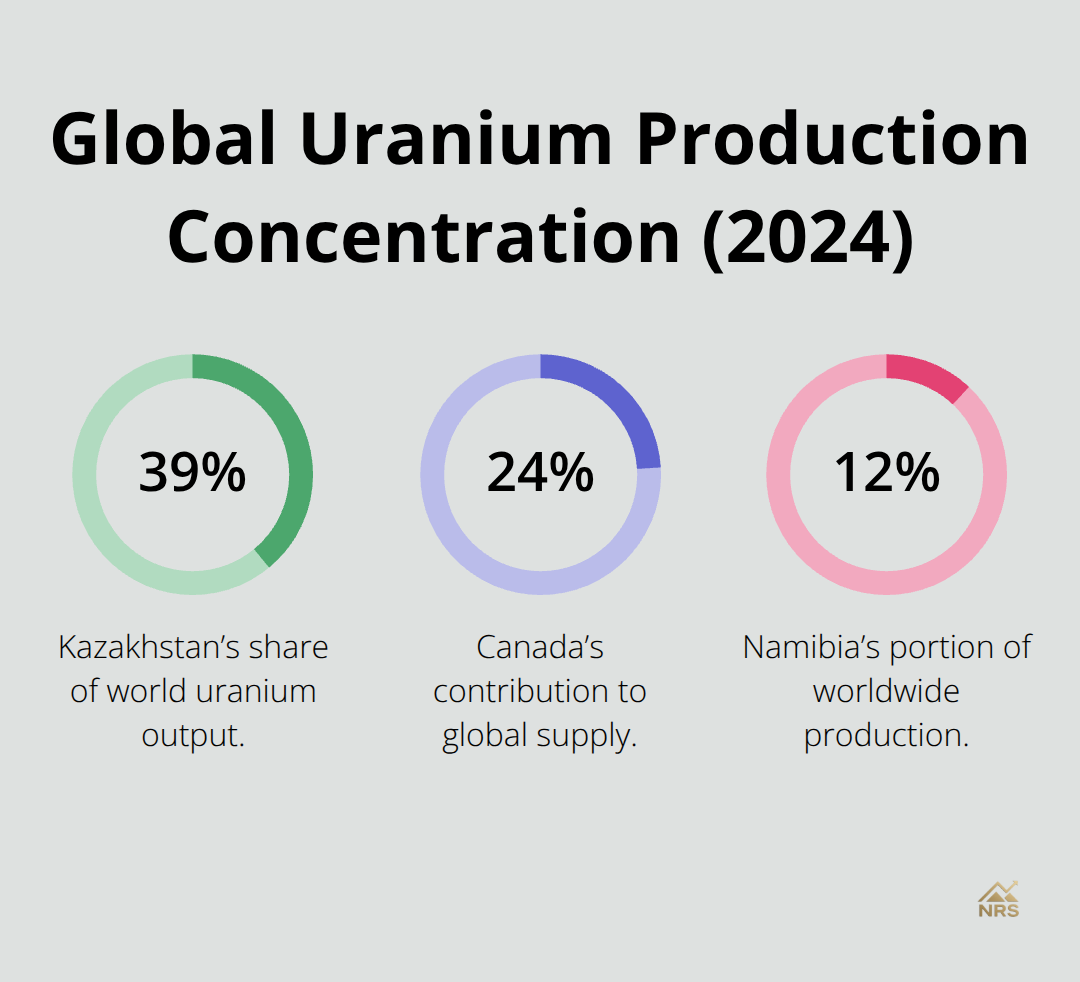
Global uranium demand accelerates faster than mines can deliver. The uranium market reached US$9.73 billion in 2025 and is projected to hit US$13.59 billion by 2033, according to DataM Intelligence, representing a compound annual growth rate of 4.86% through 2033. Three converging forces drive this expansion: governments treat uranium as a strategic energy resource, renewed nuclear capacity buildouts occur across North America and Asia Pacific, and small modular reactors create entirely new demand streams. In 2024, global uranium mine production totaled 60,213 tonnes, according to the World Nuclear Association. Yet utilities sign long-term supply contracts at rates not seen in decades, signaling they expect production to lag behind consumption. The supply gap exists because only three countries control 75% of global output. Kazakhstan produced 39% of world uranium in 2024, Canada contributed 24%, and Namibia supplied 12%, leaving the remaining 25% scattered across a dozen countries with minimal production capacity. This concentration creates both vulnerability and opportunity.
When geopolitical tensions disrupt supply from any major producer, prices spike immediately. When new projects come online in secondary regions, they command premium long-term contracts because utilities desperately need supply diversification.
How concentrated production reshapes investment strategies
The identified uranium resource base totals 5.93 million tonnes at costs up to US$130 per kilogram, with Australia holding 28% of global reserves, Kazakhstan 14%, and Canada 10%. However, resources sitting in the ground mean nothing without active mining. Only 52% of current production comes from in situ recovery, the fastest and cheapest extraction method, while the remaining 48% relies on conventional underground mining that takes longer and costs more to develop. The standby capacity problem compounds the shortage. In the United States alone, end-2025 standby mill capacity reached 3,750 short tons per day, with seven planned in situ recovery plants across South Dakota, Texas, and Wyoming ready to add 10.5 million pounds of annual production capacity once licensing completes. This means supply can ramp rapidly if projects move forward, but regulatory delays push timelines out by years. Enrichment and conversion facilities remain concentrated in a handful of countries, creating bottlenecks even when raw uranium is available. The practical implication is clear: new mining projects in politically stable regions with existing processing infrastructure command the highest valuations because they eliminate uncertainty from the supply chain.
Why geopolitical stability attracts capital
Energy security has become a national priority across North America, Europe, and Asia. The United States uranium industry employed 711 workers in 2025, up 41% from 506 in 2024, with expenditures on exploration and development reaching US$234.7 million. This domestic push reflects determination to reduce reliance on external suppliers.
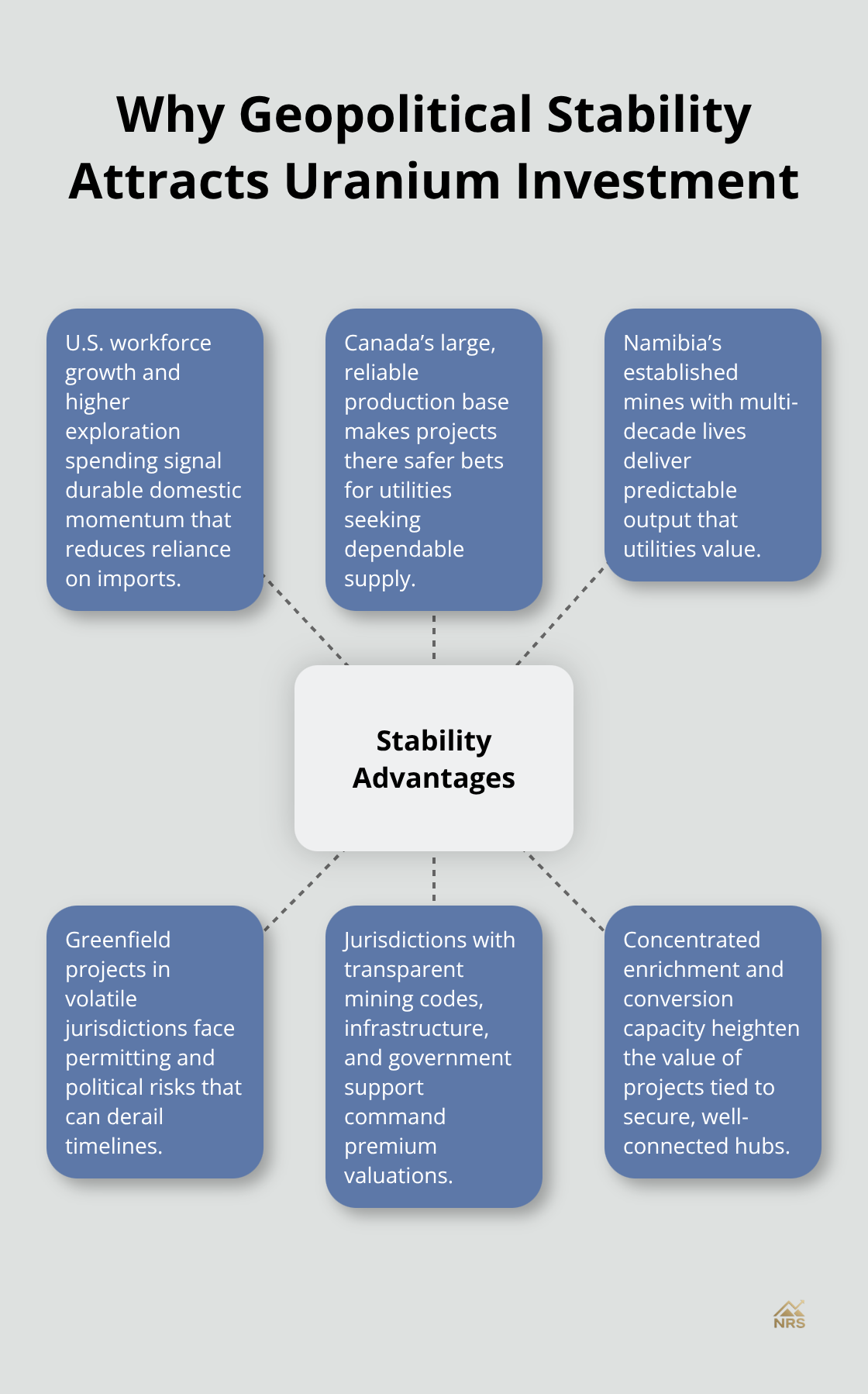
Canada’s McArthur River and Cigar Lake mines produced 14,309 tonnes in 2024, roughly 24% of global supply, making Canadian projects geopolitically safer bets than producers in regions facing sanctions or political instability. Similarly, Namibia’s mines contributed 7,333 tonnes in 2024, with Husab alone producing 4,437 tonnes annually from a deposit containing 280 million tonnes of ore with a potential mine life exceeding 20 years. These established operations with decades of remaining production provide the supply stability utilities demand. The risk lies in new greenfield projects in countries where political systems remain volatile or where permitting timelines stretch indefinitely. Investors should focus on projects in jurisdictions with transparent mining codes, existing infrastructure, and government support for nuclear energy expansion. The next section examines where these conditions align most favorably across Kazakhstan, Africa, Canada, and Australia.
Where New Projects Are Rising Across Kazakhstan, Africa, and Canada
Kazakhstan’s Shift to Faster Extraction Methods
Kazakhstan dominates global uranium production with 23,270 tonnes in 2024, roughly 39% of world supply, yet the country continues expanding capacity through in situ recovery projects rather than resting on existing mines. The Karatau, Inkai, Akdala, South Inkai, and Moinkum/Tortkuduk operations collectively illustrate Kazakhstan’s shift toward faster, cheaper extraction methods that require less capital and shorter development timelines than conventional underground mining. These in situ recovery sites produced over 14,000 tonnes combined in 2024, proving the technology scales effectively at the country level. Kazakhstan’s multinational ownership structures reduce single-country risk while maintaining production stability. New project development in Kazakhstan focuses on brownfield expansions rather than greenfield mega-projects, meaning faster permitting and lower execution risk compared to building entirely new operations from scratch. Projects that expand existing facilities face fewer regulatory hurdles and can reach production within 18-24 months rather than the 5-7 years typical for new mines.
Africa’s High-Growth Opportunity Set
Africa presents the highest-growth opportunity set, though with significantly more complexity than established producers. Namibia produced 7,333 tonnes in 2024, with Husab alone contributing 4,437 tonnes annually from a deposit containing 280 million tonnes of ore and a projected mine life exceeding 20 years. Husab’s ownership structure-a 60-40 joint venture between China’s CGN-Uranium Resources and the China-Africa Development Fund with Epangelo Mining holding 10%-demonstrates how diversified financing accelerates development in the region. Niger ranks as the world’s fifth-largest producer at roughly 2,983 tonnes annually, with Orano operating the Somaïr facility near Arlit processing high-grade ores that require less processing than lower-grade deposits elsewhere. Global Atomic’s Dasa project in Niger plans underground mining with ore delivery to Somaïr, showing how new projects leverage existing infrastructure rather than building standalone mills. Tanzania’s Mkuju River project, operated by Uranium One, holds measured and indicated resources of 36,000 tonnes, positioning it as East Africa’s most advanced development opportunity once market conditions improve. African projects with offtake agreements to established processors like Somaïr command premium valuations because they eliminate conversion bottlenecks that plague standalone operations. Paladin Energy’s planned restart of Langer Heinrich in Namibia mid-decade signals that established operators view African expansion as economically justified despite regional complexity.
North American Production and Emerging ISR Capacity
Canada’s McArthur River and Cigar Lake mines produced 14,309 tonnes in 2024, anchoring North American supply with decades of remaining reserve life. These tier-one operations rarely attract speculative investment because their production is locked into long-term contracts, but their continued operation provides the geopolitical stability that makes secondary projects viable. Australia’s Olympic Dam produced 2,693 tonnes in 2024 as a by-product of copper mining, illustrating how integrated operations provide uranium supply without dedicated mining economics. The real opportunity in North America lies in the seven planned in situ recovery plants across South Dakota, Texas, and Wyoming that would add 10.5 million pounds of annual capacity once permitting concludes. These projects move faster than greenfield operations because they deploy proven technology in jurisdictions with transparent mining codes and existing regulatory frameworks. The speed advantage matters significantly when utilities sign long-term contracts-faster projects capture supply agreements before competitors reach production. This capacity expansion across multiple states creates a pipeline of near-term production growth that investors can track through permitting announcements and development milestones.
Where to Invest in Uranium Mining Right Now
Two categories of uranium stocks deliver fundamentally different risk-return profiles, and understanding which suits your portfolio matters more than chasing the highest volatility. Established producers like Cameco and Kazatomprom control long-term offtake contracts worth billions, meaning their revenue streams remain predictable even if spot uranium prices fluctuate. Cameco’s McArthur River and Cigar Lake operations produced 14,309 tonnes in 2024 and locked in decades of contracted supply, so equity returns track utility demand rather than exploration success. These stocks move slower but rarely collapse because utilities cannot afford supply interruptions.
Established Producers Versus Junior Explorers
Junior explorers and early-stage developers operate differently. Companies drilling in Wyoming, Texas, and South Dakota targeting in situ recovery capacity face binary outcomes: they either reach production and sell long-term contracts at premium prices, or permitting delays push timelines back years and destroy shareholder value. The practical advantage of juniors lies in speed to production. If a South Dakota in situ recovery project receives full permits within 18 months versus a Namibian greenfield requiring 5-7 years, investors in the faster project capture long-term contracts before competitors even reach pre-production. This timing advantage translates to dramatically higher returns when utilities sign multi-year supply agreements at locked prices.
Evaluating Uranium Stock Quality Without Speculation
Avoid companies betting on price appreciation alone. Instead, examine whether management has secured offtake agreements or signed letters of intent with utilities. A junior with 20 million pounds of resources but no buyer commitment trades on speculation. A junior with 15 million pounds and a binding five-year contract deserves higher valuation because revenue is certain.
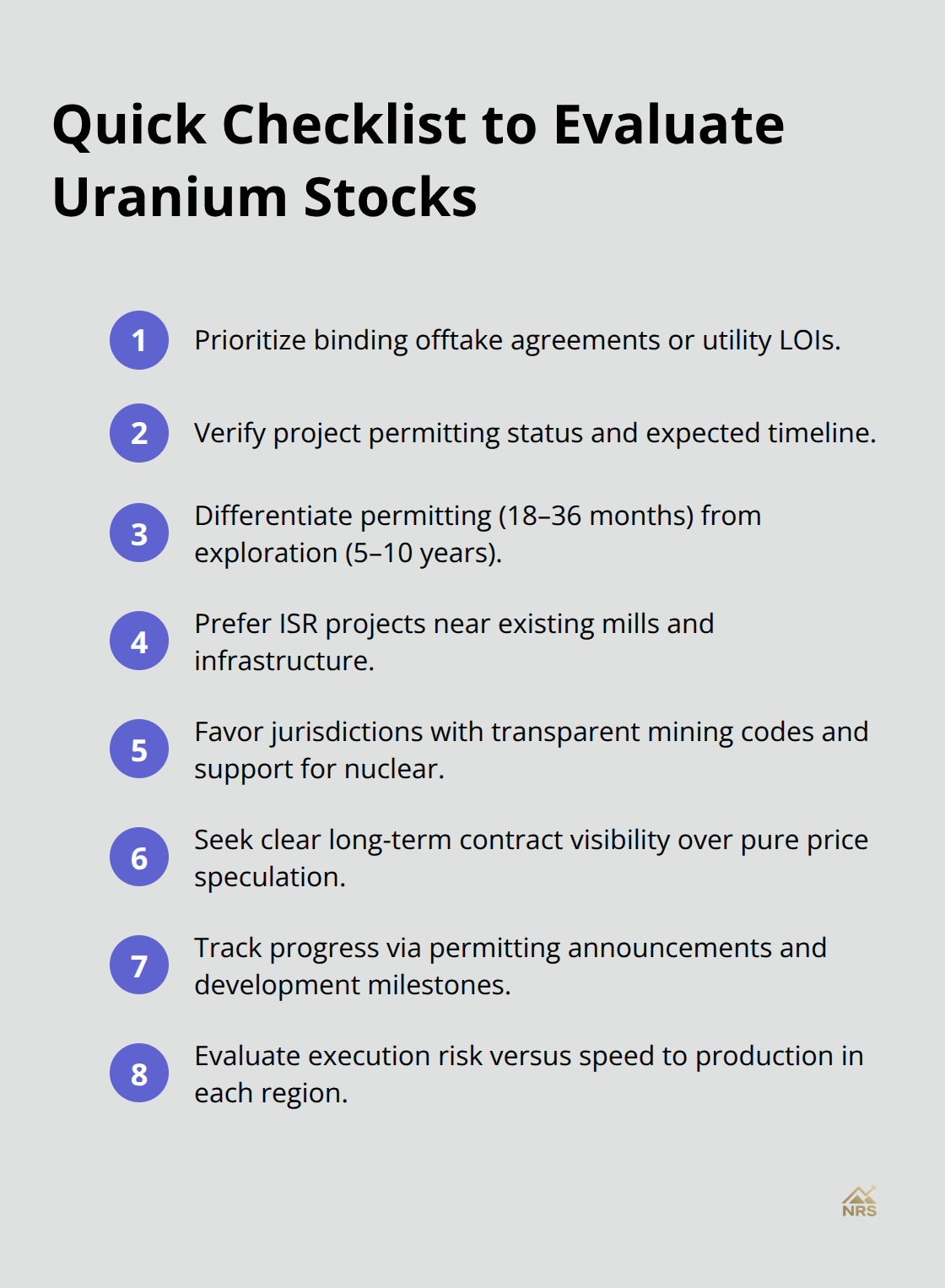
Check permitting status on each project listed in company presentations. Projects in permitting phase take 18-36 months to reach production. Projects in exploration phase take 5-10 years. This distinction determines whether you hold for two years or ten.
Processing Infrastructure and Geographic Positioning
Assess the processing infrastructure available. A Wyoming in situ recovery project near existing mills moves faster than a Niger project requiring new conversion facilities, even if the Niger deposit contains higher-grade ore. Established producers deserve attention during price downturns. When uranium prices drop below US$50 per pound, companies like Cameco and Paladin Energy often suspend development on marginal projects and focus cash on core operations. This discipline attracts long-term contract signings because utilities know the company prioritizes reliable supply over short-term margin expansion.
Balancing Regional Exposure
Geographic diversification matters, but not equally. Kazakhstan presents lower political risk than Africa, but African projects offer higher upside if geopolitical tensions disrupt Kazakhstan supply. A balanced uranium exposure requires holdings across both regions rather than concentrating in a single country. Understanding uranium market outlook trends helps you evaluate uranium stocks across different development stages and geographies.
Final Thoughts
The uranium market reshapes itself around supply scarcity and geopolitical risk, creating uranium mining opportunities across Kazakhstan, Africa, Canada, and Australia for investors who distinguish between speculative plays and projects backed by utility contracts. Global uranium demand will reach US$13.59 billion by 2033, yet production remains concentrated in three countries controlling 75% of output. This imbalance persists because seven planned in situ recovery plants across South Dakota, Texas, and Wyoming will add 10.5 million pounds of annual production only once permitting concludes, while Namibia’s Husab continues operating at 4,437 tonnes annually from a deposit with over 20 years of remaining mine life.
Your investment approach should prioritize projects with offtake agreements over exploration-stage companies betting on price appreciation. A junior with a binding five-year supply contract to a utility deserves higher valuation than a junior with larger resources but no buyer, and geographic diversification matters because Kazakhstan presents lower political risk while African projects offer higher upside if geopolitical tensions disrupt established supply chains. Established producers like Cameco attract long-term contract signings from utilities seeking reliable supply, especially when these companies suspend marginal projects during price downturns.
Governments treat uranium as a strategic resource, utilities sign long-term contracts at rates not seen in decades, and small modular reactors create entirely new demand streams. These forces will persist regardless of short-term price swings, and we at Natural Resource Stocks track these developments through expert analysis to help you identify where capital flows next in the uranium sector.