
























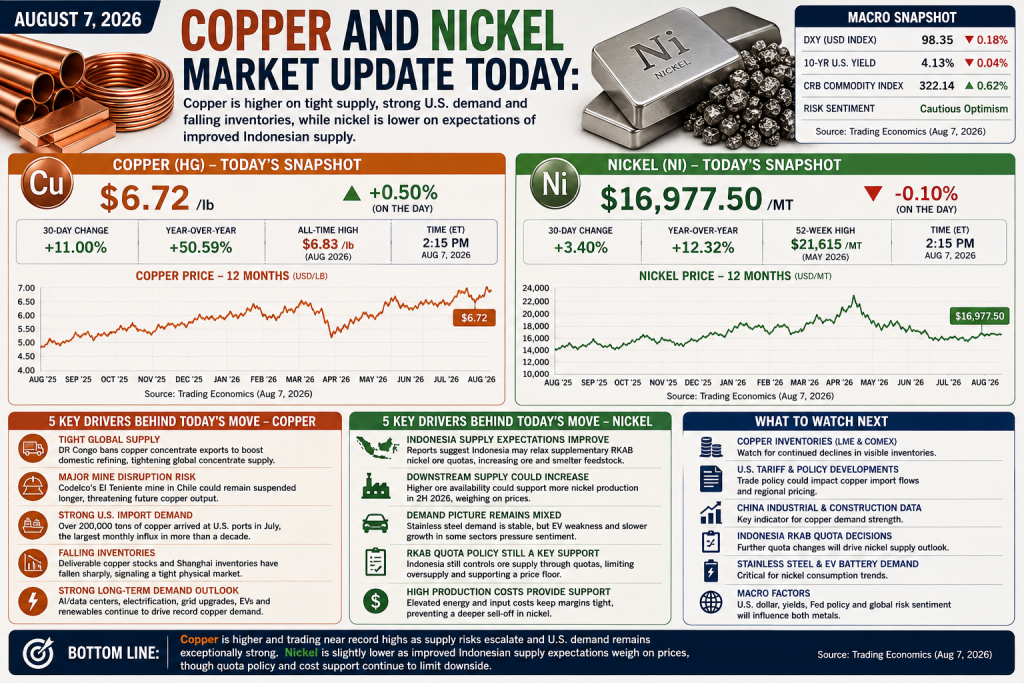
Copper and nickel are moving in opposite directions today. Copper is higher and trading near record territory as traders focus on tight supply, strong U.S. buying, falling visible inventories, and long-term demand from AI/data centers, electrification, and clean energy. Nickel is slightly lower as expectations of improved Indonesian supply weigh on sentiment, although RKAB quota policy and elevated production costs continue to provide some support.
Today’s pricing snapshot
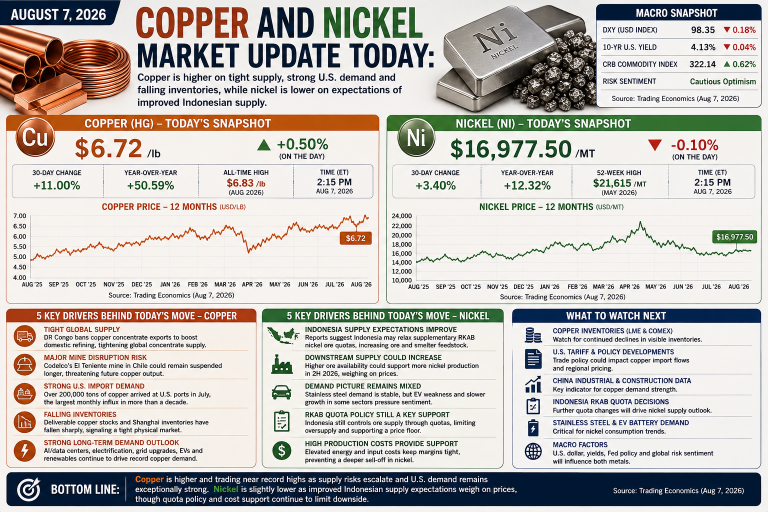
According to Trading Economics CFD benchmarks, copper rose to about $6.72/lb on August 7, 2026, up roughly 0.50% on the day. Copper is also up about 11.00% over the past month and roughly 50.59% year over year. Trading Economics also notes that copper reached an all-time high of about $6.83/lb in August 2026.
Nickel fell to about $16,977.50/metric ton on August 7, 2026, down roughly 0.10% on the day. Nickel is still up about 3.40% over the past month and roughly 12.32% year over year, showing that the longer-term trend remains positive despite today’s softness.
5 key drivers behind today’s move
1) Copper is trading near record highs
Copper remains one of the strongest industrial metals in the market. Prices have moved above the $6.70/lb level, supported by tight supply, falling inventories, strong U.S. buying, and continued investor interest in metals tied to electrification and AI infrastructure.
That keeps copper in focus for resource investors because the metal is increasingly being treated as a strategic infrastructure commodity.
2) Supply concerns are supporting copper
Copper’s supply picture remains tight. The Democratic Republic of Congo announced a ban on exports of copper concentrate, a move aimed at encouraging more domestic refining and processing capacity.
At the same time, development at part of Codelco’s flagship El Teniente mine in Chile could remain suspended for an extended period. Chile is one of the world’s most important copper-producing countries, so disruptions there can quickly affect global copper sentiment.
3) U.S. copper buying and inventory tightness are adding fuel
Copper is also being supported by strong U.S. import demand. More than 200,000 tons of copper reportedly arrived at U.S. ports in July, marking the largest monthly inflow in more than a decade.
Visible stockpiles are also tightening. Deliverable copper stocks and Shanghai inventories have fallen sharply, adding to concerns that the market could remain tight if demand continues to rise.
4) Nickel is lower as Indonesian supply expectations improve
Nickel is slightly lower today as traders react to expectations of improved Indonesian supply. Reports suggest Indonesia may further relax supplementary RKAB nickel ore quotas, which could increase ore availability and support downstream smelter feedstock in the second half of the year.
That puts pressure on nickel prices because Indonesia is the biggest supply-side driver in the global nickel market.
5) Nickel still has support from quota policy and production costs
Even though nickel is weaker today, losses remain limited by Indonesia’s ongoing control of nickel ore supply through RKAB quotas and by elevated production costs.
Nickel’s demand picture is also mixed. Stainless steel remains the largest source of demand, while EV batteries continue to support the longer-term outlook for higher-grade nickel products. However, weaker downstream demand and uncertainty around Indonesian smelter activity remain key headwinds.
What to watch next
Copper traders will be watching LME and COMEX inventories, U.S. copper import flows, possible tariff developments, China industrial demand, mine-supply updates from Chile, Peru, Indonesia, and the Democratic Republic of Congo, AI/data-center power demand, grid investment, EV sales, U.S. dollar moves, Treasury yields, and broader risk sentiment.
Nickel traders will be watching Indonesia’s RKAB quota process, supplementary quota approvals, stainless steel demand, EV battery demand, Class 1 nickel premiums, LME inventories, Indonesian export rules, ore shipments, and whether supply discipline continues through the second half of 2026.
Bottom line
On August 7, 2026, copper is higher while nickel is slightly lower. Copper is being supported by tight supply, strong U.S. buying, falling visible inventories, AI/data-center demand, electrification, and clean-energy growth. Nickel remains positive over the past month and year over year, but today’s move is softer as traders focus on improved Indonesian supply expectations and mixed downstream demand.
Copper remains the cleaner long-term structural-demand story, while nickel remains the more supply-policy-sensitive trade today.