
























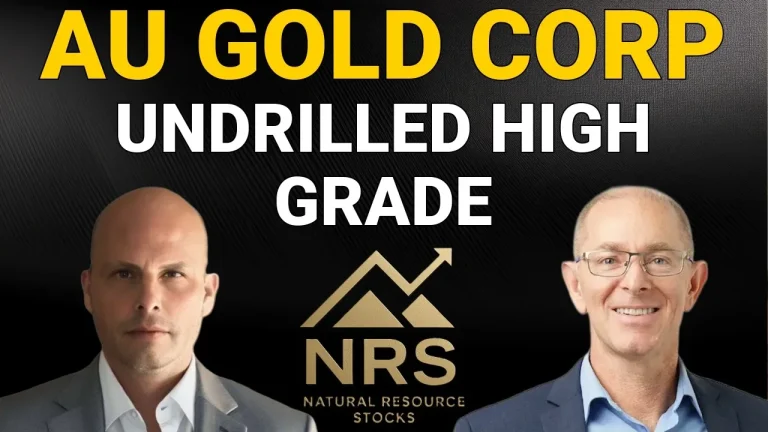

Every so often, a junior mining story is simple enough to explain in one sentence. This is one of them. There’s a nine-kilometer line in central Victoria, Australia, dotted with old gold mines whose historic production averaged roughly 23 grams per tonne — about three-quarters of an ounce of gold per tonne. Individual workings reportedly ran between one and ten ounces per ton. The old-timers followed it down in places to about 500 feet, then stopped.
And in the century or so since, nobody has put a drill hole into that particular line. That’s the pitch Marc Blythe brought to the show, and it’s why Au Gold Corp (TSX-V: AUGC) is worth a look before the rods start turning.
How This One Landed on Our Radar
Full credit where it’s due: this introduction came through Jeff Phillips. When Jeff calls and says he wants you to look at something, you look at his track record and see that he has earned that much. Jeff was early on Southern Cross Gold’s Sunday Creek discovery in Victoria, a company that has since grown into a multi-billion-dollar market capitalization with a dozen rigs turning — and, remarkably, still no mineral resource estimate. That result is a big part of why the Victorian gold-antimony story has investors paying attention again, and why Blythe went shopping in the same neighborhood.
Why Victoria, and Why Gold Plus Antimony
Victoria has produced roughly 80 million ounces of gold over its history. That’s not a frontier — it’s one of the great goldfields on earth, sitting inside a modern, developed country.
Two operations frame the current story:
- Fosterville, owned by Agnico Eagle. The discovery of the Eagle and Swan zones in 2015 transformed it into one of the highest-grade gold mines in the world, and operators have been drilling and mining there to depths of a kilometer and beyond.
- Costerfield, owned by Alkane Resources, produces roughly 50,000 ounces of gold a year and — by Blythe’s own estimate, offered with a “I think” attached — something on the order of 5% of the world’s antimony supply.
Antimony matters here for two reasons. First, it’s a critical mineral with a supply chain that Western governments have grown increasingly nervous about. Second — and this is the geological point — antimony travels with gold in this part of Victoria. Au Gold describes significant antimony alongside gold here as a potential indicator and a reasonable proxy for epizonal gold mineralization: the style of system that carries spectacular grades and can extend for kilometers of vertical depth. That combination is what pulled Blythe to Havelock.
How Au Gold Got the Project
Blythe’s version of events is refreshingly unglamorous, which is usually a sign it’s true.
He visited Costerfield, got interested, and started hunting for lookalikes. He found Havelock — a property with historic gold and antimony production — held by a company that had drilled some decent holes in 2021, gotten no market response for its trouble, lost interest during the ugly junior market of the early 2020s, and moved its attention to a project in Africa.
He walked into that conversation at exactly the right moment and made a deal.
Buying straw hats in winter, as the old line goes. It’s a pattern worth recognizing because the financing environment for juniors has been so brutal that quality assets have changed hands cheaply for several years in a row.
Two Trends, Two Very Different Datasets
This is where the project needs a little unpacking, because Havelock is not a single target — it’s two structural trends that together span more than 10 kilometers. They sit at opposite ends of the information spectrum.
The Shaw–McFarlane Trend: high grade, no drilling
The Shaw–McFarlane Trend is about nine kilometers long, with a four-kilometer stretch in the middle attracting Au Gold’s focus. This stretch features historic, high-grade mines — small, narrow, and often under a meter. Two targets, just 150 meters apart, anchor it.
McFarlane Shaft features gold-antimony quartz reef mineralization with past high-grade production, averaging about 22.5 g/t. Mined to a depth of 400 feet, it ceased operations due to dewatering issues and difficulties separating gold from stibnite. Never drilled; about six tons of stibnite were recovered from dumps.
McFarlane Dam, excavated in 2010, yielded 514 ounces of gold and 23 kg of reef quartz near the surface. The company says this may be the top of a high-grade, in situ quartz reef. It has never been drill tested.
Au Gold warns that the sample selection aims to identify high-grade, not representative, samples to guide exploration at the dam target. Historic and selective figures guide direction but are not resources or averages.
Historically, underground mining reached 500 feet (152 m) due to mining techniques and groundwater conditions. In contrast, Fosterville mines to over a kilometer, and Sunday Creek is drilled to similar depths. Victoria’s mesozonal and epizonal systems extend past 1,000 meters. This indicates a system known for deep extension, yet only the top few hundred feet have been explored, presenting a significant opportunity.
The Leviathan–Mariner’s Trend: where the modern drill data actually is
The second trend covers about three kilometers of historic workings, and this is where that 2021 drilling took place — a detail worth stating plainly, because it’s easy to conflate with the undrilled Shaw–McFarlane story.
The previous operator carried out a diamond drill program with eight holes across a 270-meter section of the trend. Out of these, four holes yielded notable results:
Drill Hole | From (m) | To (m) | Interval (m) | Gold (g/t) |
|---|---|---|---|---|
21LEV002 | 232.05 | 239.15 | 7.10 | 3.06 |
and | 242.40 | 243.51 | 1.11 | 56.40 |
21LEV004 | 241.00 | 245.20 | 4.20 | 4.75 |
21LEV005 | 335.13 | 337.90 | 2.77 | 18.86 |
21LEV006 | 224.50 | 227.74 | 3.24 | 6.91 |
Historic mining on this trend went deeper — 900 feet (274 m). And those 2021 intercepts are the hardest evidence on the property that the system carries real grade at depth, over a tiny fraction of a three-kilometer trend. The prior owner drilled it, got no share-price reaction in a dead market, and walked away.
Full technical details on both trends are in the company’s NI 43-101 technical report on Havelock, filed February 2026.
Rebuilding a Lost Goldfield from Microfilm
This is the part of the interview I found most compelling, and it’s not a geology story. It’s a detective story.
A great deal of the historic record for this field simply vanished. Blythe’s theory — and it’s a plausible one — is that many of the men who understood these mines were drafted into the First World War, and a meaningful number never came home. The knowledge went with them, and the district went quiet for a hundred years.
Au Gold hired a retired research geologist to rebuild the project. He gathered archived newspaper articles online and at the library, using microfilm and microfiche, to compile detailed sections for each mine.
The output isn’t just “there was a mine here.” It’s where inside each mine the high-grade shoots were, and where the best widths sat — because the old-timers stopped when the gold stopped, so their workings map the ore itself.
That’s a targeting dataset most early-stage juniors would kill for. It tells the company where to aim: beneath the best parts of the historic mining. It is also, by construction, a compilation of century-old third-party records rather than verified modern sampling, which is precisely why the drill program matters.
As Brent Cook has argued, a high gold price can’t rescue a mediocre deposit. The corollary is that grade plus a smart target list is what actually moves the needle — and that’s the bet here.
Infrastructure: Boring in the Best Possible Way
Havelock sits near Maryborough, roughly halfway between Bendigo and Ballarat, about an hour and a half’s drive from Melbourne and about an hour from Fosterville. Paved highways, roads, and gravel tracks provide year-round access to the project. Land ownership includes Crown land and private property.
There’s a town next door with hotels and supermarkets. There’s a hardware store on the tenement ground. There’s cell service — occasionally to the point of distraction when you’re trying to concentrate on rocks.
Anyone who has run a remote camp understands why this matters. Every logistical problem you don’t have is money you don’t spend.
The assay lab is an hour away. Alkane’s Costerfield processing plant is less than an hour’s drive.
What a Mine Might Eventually Look Like
Blythe was careful here, and appropriately so. In his own words: “I’m speculating here because we haven’t actually got a resource and we haven’t done any testing.” There is no mineral resource estimate, no metallurgical test work, and no economic study. Everything in this section is conceptual.
These are likely to be steeply dipping, narrow structures — better suited to underground mining than an open pit. Gold and antimony from this style of deposit are typically recovered by froth flotation into a sulfide concentrate, which is then shipped to a smelter. Blythe’s framing of the plant next door was deliberately conditional: Alkane at Costerfield could potentially process this kind of material because Au Gold is looking for a similar system, not because it has found one. There is no offtake agreement, no toll-milling arrangement, and no discussion of either. Someday. Not today. Today, they need to drill holes.
Share Structure and Cash
This is where the story got my attention a second time.
- 58 million shares. For a junior explorer, that is tight.
- Marc Blythe personally owns 7.1 million shares as a founder. Every issuance hurts him too.
- Roughly C$1.5–1.6 million in the treasury, with Blythe noting the burn rate will rise as drilling approaches.
Founders with real skin in the game tend to think differently about the share count. Au Gold runs lean — contractors and consultants brought in for specific expertise rather than a bloated permanent overhead.
It’s the same discipline that separates the juniors who survive from those who dilute shareholders to irrelevance.
One more thing in the company’s favor: Victoria is a cheap place to drill. Based on quotes Au Gold has been receiving from drilling companies, Blythe estimates costs there run roughly half of what you’d pay in the United States. Every dollar in the treasury buys about twice the meterage.
The Drill Program
Au Gold has scoped an initial 2,000-meter program and has the cash to complete it. But Blythe was candid: based on the target work, the company will very likely want to drill more than 2,000 meters, and it doesn’t want a start-stop program. If the right opportunity presents itself, they’ll top up the treasury to make sure there’s runway to keep a rig turning without interruption.
Read that carefully: funded for the program as currently scoped, with a likely expansion that would require additional financing. That is not the same thing as being fully funded through discovery.
A driller had not yet been engaged at the time of the interview — Blythe said the company was in conversations with drill companies.
Two practical things are gating the start date:
- An extremely wet Victorian winter. If you’re working in a farmer’s field, you wait until it dries out. That’s not a permitting problem; it’s a courtesy-and-common-sense problem.
- Private land access agreements. Some of the ground is private property, and the company was still working to finalize those agreements.
Here’s the encouraging part on the regulatory side: in Victoria, work that qualifies as low-impact exploration doesn’t require a permit — you need permission from whoever controls the land. There are exceptions, and Au Gold has some areas that need more work than others, but as jurisdictions go, it’s a straightforward place to drill if you follow the rules.
What to Watch Between Now and Year-End
- Target rationale (roughly October 2026). Blythe expects news within a couple of months explaining the reasoning behind target selection — essentially, the public unveiling of that reconstructed historic goldfield. “The best place to look for a mine is next to an existing mine” is one of mining’s oldest clichés, and this is a fairly literal application of it.
- Drilling. Blythe’s own guidance was Q3 2026, immediately qualified by the wet-weather and land-access conditions above. On the show, I put it at give or take a few weeks, plausibly within 30 to 60 days of recording — that’s my estimate, not his.
- First assays. Blythe’s words: “towards the end of the year or early into the new year” — so late 2026 or early 2027.
For a company with 58 million shares outstanding and a share price that’s been beaten down along with everything else in the junior space, that’s a fairly compressed catalyst calendar.
The Bottom Line
I’ll say plainly what I look for, and it’s only my own approach: very early stage with a tight share structure, or very late stage heading into production. The messy middle is where a lot of capital goes to die.
Havelock is squarely in the first bucket. An untested trend, a world-class address, exceptional historic grades, some genuinely high-grade 2021 intercepts on the neighboring structure, cheap drilling, real infrastructure, a founder holding 7.1 million shares, and a targeting dataset rebuilt from library microfilm that nobody else has.
It’s also, to be clear, an exploration story with no mineral resource, no metallurgy, and no economics. The historic grades are historic, and some of them are selective. Drill holes will decide it — as they always do. Do your own due diligence, know your own risk tolerance, and understand what to check before you buy any junior mining stock.
Where to Follow Along
Au Gold Corp trades on the TSX Venture as AUGC. Blythe said it is Canadian with the Havelock project in Australia, and that a U.S. listing was “not quite there yet” at the time of recording. The company’s website is augoldcorp.com, with full project details on the Havelock page. Blythe says he personally answers many shareholder inquiries — he considers talking to shareholders a core part of the job, within the obvious limits on what a public company can say. We’ll follow up as the drill progresses. For more conversations like this one, browse the full Natural Resource Stocks podcast archive.
For the latest insights, check Natural Resource Stocks for expert analysis and industry updates. Our team provides resources to help investors understand market trends. For questions or more information, contact us at andy@naturalresourcestocks.net. Stay informed by following our daily market updates covering the latest developments across the commodities sector.