


























Most investors either hold too much gold or too little. Getting your gold position sizing right means the difference between a portfolio that weathers storms and one that lags behind.
At Natural Resource Stocks, we’ve seen firsthand how poor allocation decisions cost investors thousands. This guide walks you through the exact strategies to calibrate your gold holdings based on your risk tolerance and financial goals.
How Much Gold Should You Own
Assess Your Tolerance for Price Swings
Your gold allocation depends on three concrete factors: your ability to tolerate price swings, your financial timeline, and what gold actually does in your portfolio.
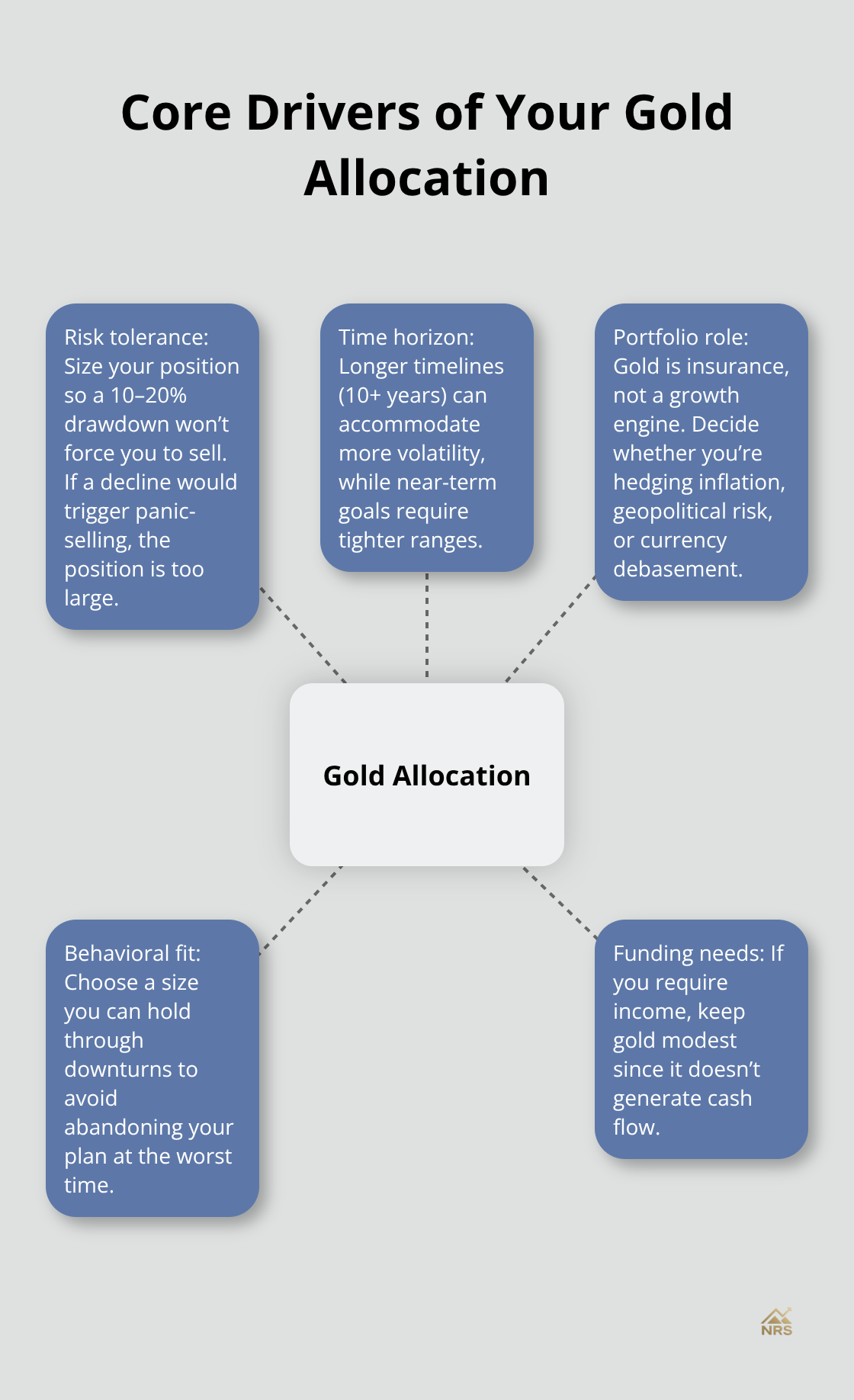
Most investors guess. Calculate instead. Start by asking yourself how much of a 10% or 20% gold price drop you can stomach without abandoning your strategy. If a sudden decline forces you to sell, you’ve sized too large. Your risk tolerance isn’t theoretical-it’s the difference between staying invested during downturns and panic-selling at the worst time.
Match Allocation to Your Time Horizon
Next, match your allocation to your time horizon. Investors with 10+ years ahead can hold 5–10% in gold and weather volatility. Those within 5 years should consider 3–5%. Short-term traders need different positioning entirely, using position sizing tied to account risk rather than portfolio weight. Your financial goals matter equally. Gold protects purchasing power during inflation and geopolitical stress, but it doesn’t generate income. If you need cash flow, gold shouldn’t dominate your holdings. If you’re protecting against currency debasement or systemic risk, a larger weighting makes sense.
Learn From Historical Gold Performance
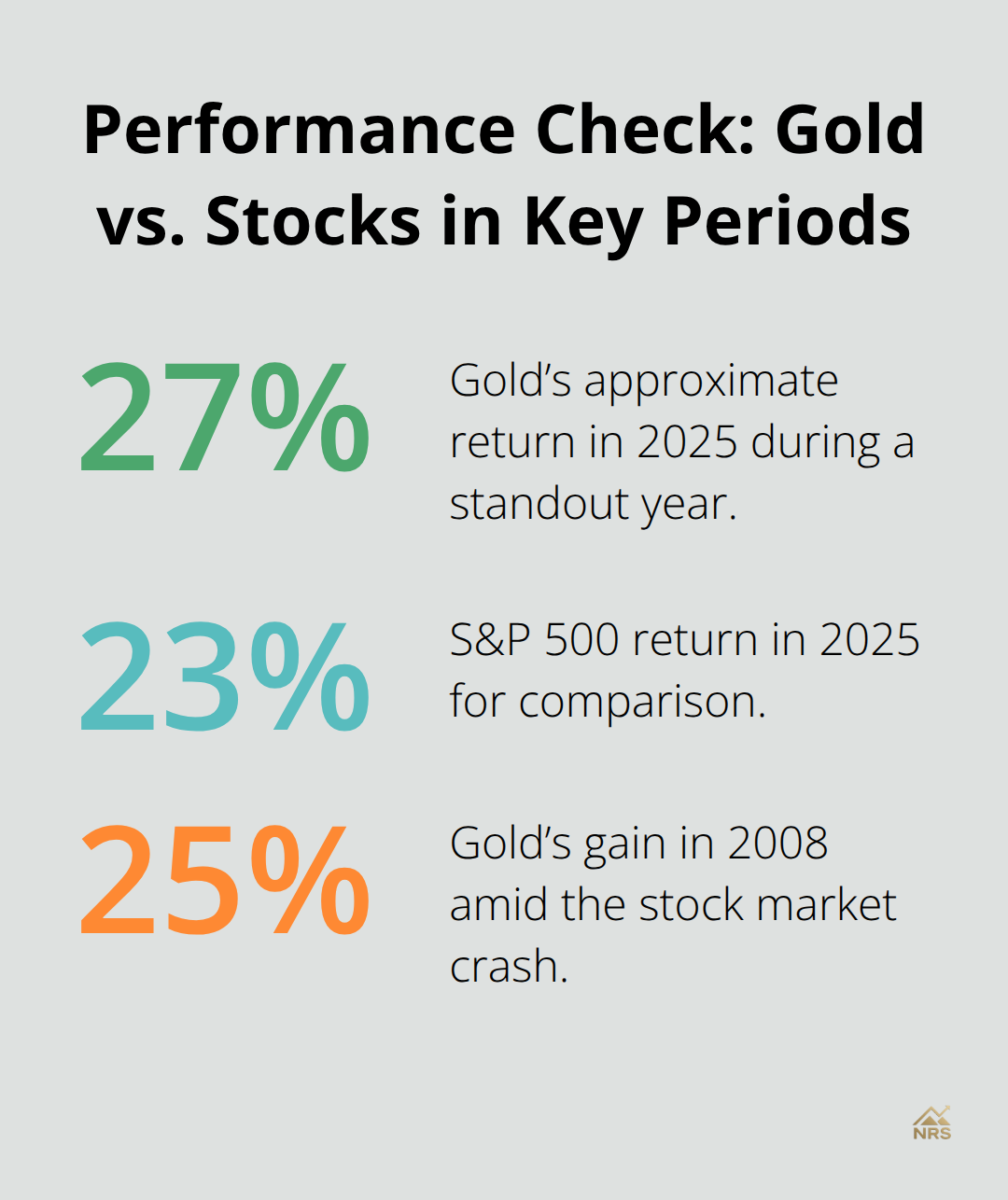
Historical data shows gold delivered real returns during specific periods. According to the World Gold Council, gold set more than 50 all-time highs in 2025, reflecting strong performance during inflationary and uncertain economic conditions. Over longer periods, gold typically returns 2–4% annually including dividends reinvested, though this varies dramatically by decade. The real value of gold appears during crises: it gained 25% in 2008 when stocks crashed, and it rallied sharply in 2020 during pandemic uncertainty. This pattern suggests gold works best as portfolio insurance rather than a growth engine.
Set Your Target Allocation Range
The practical recommendation: hold 5–7% in physical gold or gold-backed securities if inflation concerns you, or 3–5% if you’re primarily hedging geopolitical risk. Anything above 10% typically means you’re betting on gold instead of protecting with it. Anything below 2% offers minimal hedging benefit. Your exact number depends on your specific circumstances-but it should be a deliberate choice, not an accident.
Build Your Position With Strategy
Once you’ve determined your target allocation, the next step is deciding how to build and maintain that position over time. Market moves will test your discipline, and the strategies you choose now determine whether you stay on track or drift from your plan. The methods you select-whether percentage-based allocation, dollar-cost averaging, or rebalancing tactics-separate investors who hit their targets from those who miss them entirely.
Building Your Gold Position Over Time
Split Your Entry Into Multiple Purchases
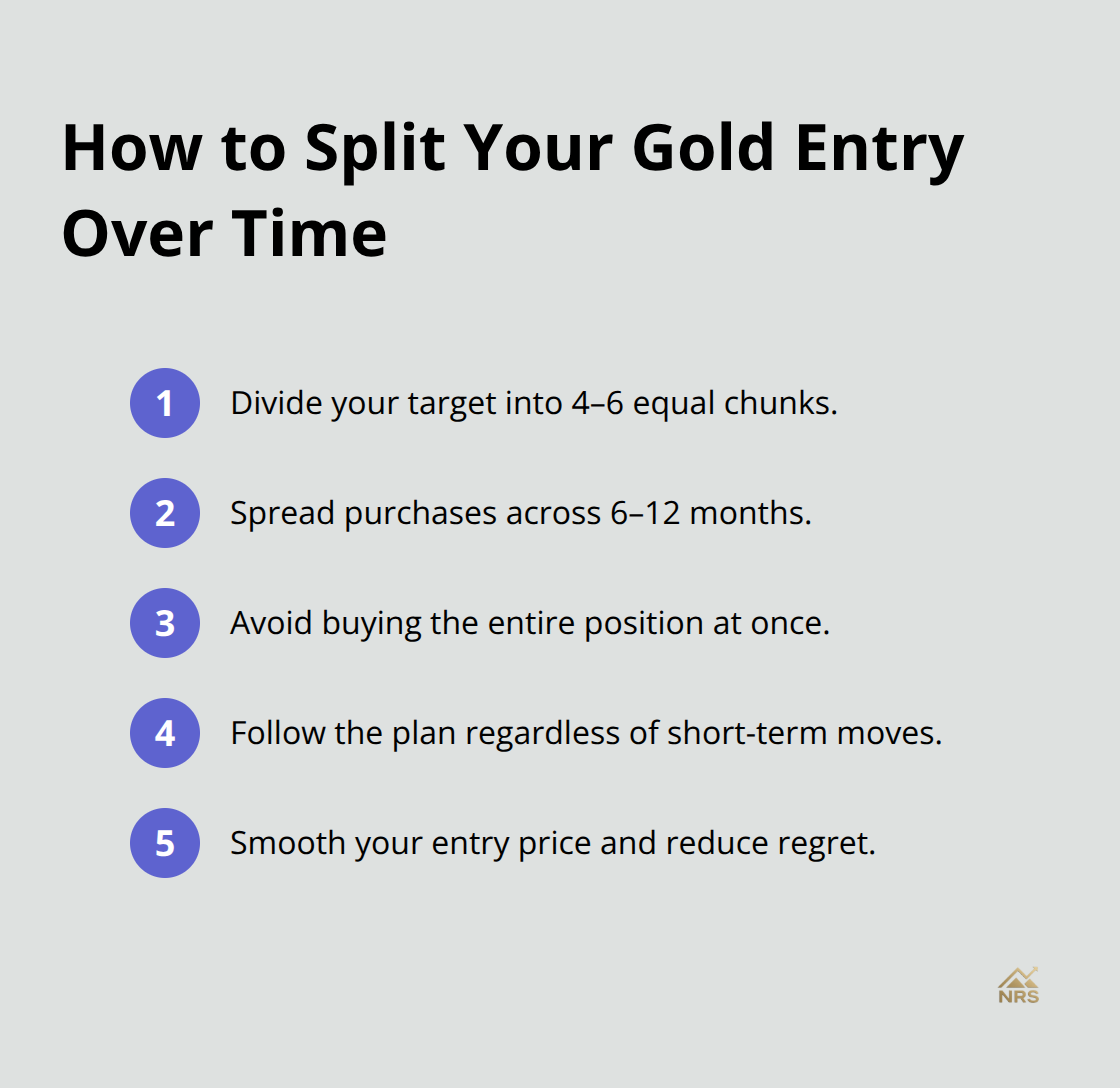
The percentage-based allocation method works best when paired with a disciplined entry strategy. If your target is 5% of your portfolio in gold, don’t buy it all at once. Market timing gold is nearly impossible-even professional investors miss the bottom. Instead, divide your target allocation into 4–6 equal chunks and purchase them over 6–12 months. This approach removes emotion from entry decisions and protects you from buying everything before a price dip.
For a $100,000 portfolio targeting 5% in gold, that’s $5,000 total. Split it into five $1,000 purchases over time rather than committing all $5,000 on day one. The advantage is mathematical: if gold drops 10% after your first purchase, your remaining four purchases capture that lower price. If gold rises immediately, you’ve already started building your position.
Use Dollar-Cost Averaging to Smooth Volatility
Dollar-cost averaging into gold holdings smooths out volatility and eliminates the paralysis of waiting for the perfect entry price. You purchase the same dollar amount at regular intervals-monthly or quarterly-regardless of the current gold price. This method protects you from the psychological trap of holding cash while waiting for a crash that may never come. Over time, you accumulate gold at an average price that typically beats the price you would have paid if you’d tried to time the market perfectly.
Rebalance on a Fixed Schedule
Once your position reaches your target allocation, the real discipline begins: rebalancing. Most investors set a target and then ignore it. Markets move, and gold’s volatility means your allocation will drift. If gold rises sharply and moves from 5% to 8% of your portfolio, you’re now overexposed to gold price risk.
The solution is mechanical rebalancing on a fixed schedule-quarterly or semi-annually works well for most investors. When gold exceeds your target by 1–2 percentage points, sell the excess and redeploy it into underweighted positions. When gold falls below your target, buy more with cash reserves or proceeds from other sales. This forces you to sell high and buy low without emotional second-guessing.
Execute Rebalancing Without Debate
Set calendar reminders for rebalancing dates and execute the trades without debate. The data supports this discipline: investors who rebalance systematically outperform those who chase momentum or hold static positions over 10-year periods. Your target allocation exists for a reason-to balance growth, protection, and stability. Drifting from it means abandoning your original strategy when markets test your conviction most severely.
The next challenge emerges when external forces-geopolitical tensions, inflation spikes, or policy shifts-threaten to derail your carefully constructed plan. Understanding how these forces move gold prices helps you distinguish between temporary noise and genuine signals that warrant a portfolio adjustment.
Where Gold Sizing Goes Wrong
The Overweighting Trap
Overweighting gold is the first mistake we see constantly. Investors who fear inflation or distrust currencies pile into gold until it represents 15%, 20%, or even 30% of their portfolio. The emotional appeal is understandable-gold feels safe when headlines scream about economic collapse. But oversizing gold creates a different problem: opportunity cost. A $100,000 portfolio with 20% in gold ($20,000) sacrifices exposure to dividend-paying stocks, energy infrastructure, or emerging market opportunities that may deliver 6–8% annual returns. Gold set more than 50 all-time highs in 2025 according to the World Gold Council, yet even during its strongest year in recent memory, gold returned roughly 27% while the S&P 500 returned 23%. Overweighting a single asset-even a strong performer-means you bet rather than diversify.
Most investors who hold 15%+ in gold do so because they panic-bought after reading doomsday headlines, not because they calculated it fits their actual risk tolerance and timeline.
Missing Macro Drivers and Volatility Shifts
The second critical error is underestimating how geopolitical events and policy shifts move gold prices, then failing to adjust position size accordingly. Gold does not move randomly. When the Federal Reserve signals rate cuts, gold rallies because lower real yields make non-yielding assets more attractive. When geopolitical tensions spike-Middle East conflicts, Taiwan concerns, or sanctions escalation-gold jumps as investors seek safety. Investors who do not track these drivers often hold static positions without recognizing that gold’s volatility changes with macro conditions. If you hold 5% in gold during a period of stable rates and low geopolitical risk, that same 5% during heightened tensions or policy uncertainty may expose you to sharper price swings than you intended.
The Hidden Correlation Problem
The third mistake compounds these errors: ignoring how gold correlates with the rest of your holdings. Many investors treat gold as a separate universe, unaware that gold’s diversification benefit weakens during stock market crashes when investors need it most. During the 2008 financial crisis, gold’s correlation with stocks sometimes failed to maintain its expected negative correlation with equities. But during normal market conditions, gold sits at near-zero correlation with stocks. If you hold 5% gold alongside 95% equities and 40% of those equities are energy stocks, you have actually created hidden concentration risk-gold and energy stocks both respond to inflation expectations and currency weakness. A truly diversified portfolio requires understanding these relationships. Map how each position responds to macro factors like inflation, rates, geopolitical risk, and currency movements. Only then can you size positions correctly. Most investors never do this work. They buy gold because they read an article, size it based on feel, then wonder why their portfolio does not behave as intended.
Final Thoughts
Effective gold position sizing comes down to three concrete decisions: determining what percentage of your portfolio gold should occupy, building that position with discipline, and maintaining it through rebalancing. We at Natural Resource Stocks have watched investors succeed and fail based on whether they treated these decisions as calculations or guesses. Your target allocation should reflect your actual risk tolerance, not your fears-a 5–7% position in gold provides meaningful portfolio protection without sacrificing growth opportunities, while anything above 10% typically signals you’re betting on gold rather than hedging with it.
Once you’ve set your target, split your entry into multiple purchases over months rather than committing everything at once. Dollar-cost averaging removes the paralysis of waiting for perfect timing and protects you from buying entirely before price dips. Then comes the hardest part: rebalancing on a fixed schedule without emotion, which forces you to sell high and buy low when gold rises above or falls below your target allocation.
The mistakes we see most often stem from ignoring how macro conditions affect gold’s volatility and failing to understand how gold correlates with the rest of your holdings. Start by reviewing your current gold holdings against your stated financial goals and time horizon-does your allocation match your risk tolerance, or did you build it based on headlines? For deeper insights into how macroeconomic factors and geopolitical events drive gold prices and inform your gold position sizing strategy, explore Natural Resource Stocks for expert analysis and market commentary that helps you align your holdings with broader market conditions.