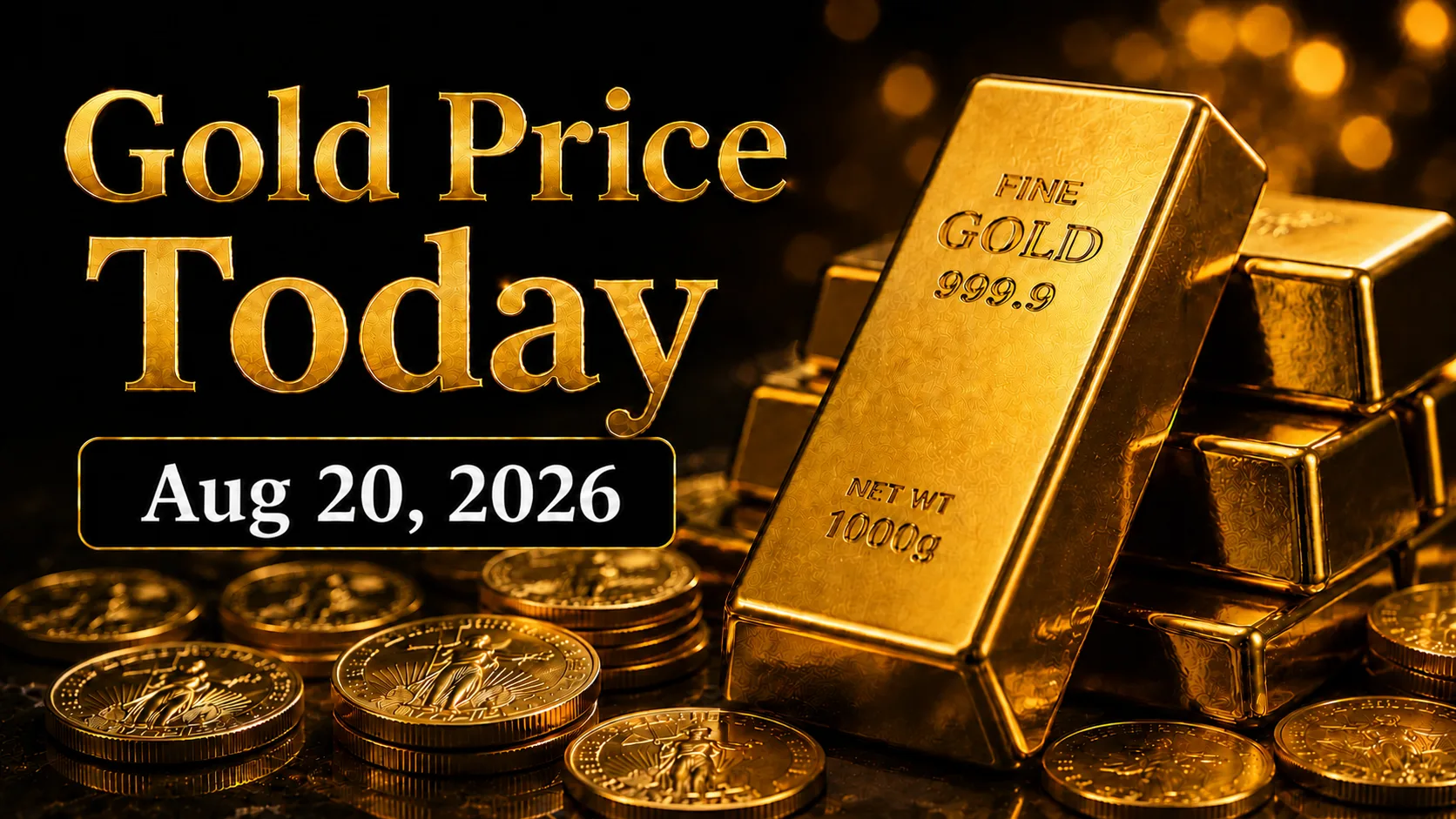























As of Aug 14, 2026, at 3:05 AM EDT, the live Gold spot price for 1 ounce of Gold in U.S. dollars (USD) is $4,338.72, 1 gram of Gold is $139.49, and 1 kilogram of Gold is $139,493.09. Gold spot price can fluctuate by the second, driven by investment supply and demand, and other factors.
|
Gold Spot Prices |
Gold Price |
Change |
|
Gold Price Per Ounce |
$4,338.72 |
-$18.83 |
|
Gold Price Per Gram |
$139.49 |
-$0.61 |
|
Gold Price Per Kilo |
$139,493.09 |
-$605.40 |
|
Live Metal Spot Prices (24 Hours) Last Updated: 08/14/2026 at 3:05 AM EDT |
Gold Price Aug 14, 2026: Quick Market Summary
The current gold price Aug 14, 2026 stands at approximately $4,338.72 per ounce, down $18.83 over the latest 24-hour period. Gold is trading below the closely watched $4,400 level after retreating from a recent 10-week high.
The pullback follows a strong run in the precious metals market. Investors are now balancing softer U.S. inflation data, shifting Federal Reserve expectations, profit-taking, Treasury market movements, and uncertainty surrounding talks to reopen the Strait of Hormuz.
Although the gold price on Aug 14, 2026, is lower on the day, the broader 2026 gold rally remains important. The market has continued to attract attention from investors looking at interest-rate trends, currency risk, geopolitical uncertainty, and portfolio diversification.
Current Gold Spot Price Aug 14, 2026
The current gold spot price Aug 14, 2026 is $4,338.72 per troy ounce at the time shown above. A troy ounce, the standard unit of measurement in precious metals markets, equals approximately 31.1035 grams.
Based on the same spot price:
- One troy ounce of gold is worth approximately $4,338.72
- One gram of gold is worth approximately $139.49
- One kilogram of gold is worth approximately $139,493.09
The gold price Aug 14, 2026 USD per ounce represents the wholesale market value of unfabricated gold. It is not necessarily the final price consumers will pay for a coin, bar, or piece of jewelry. Physical products usually include dealer premiums, manufacturing costs, shipping expenses, and differences between buying and selling prices.
Why Is Gold Lower Today?
Gold moved lower as traders took profits following its climb to the highest level since early June. According to the day’s market coverage, gold was down during Asian trading as some investors reduced positions after the recent advance.
The retreat does not necessarily signal the end of the gold price rally 2026 Aug precious metals market trend. Instead, it shows how quickly bullion can react when traders reassess the strength of short-term catalysts.
Three factors are especially important today:
Profit-Taking After the Recent Rally
Gold recently approached and briefly traded around the $4,400 area. After such a sharp move, some traders chose to secure gains rather than increase their exposure.
This selling contributed to the decline in the gold spot price per ounce Aug 14, 2026. Profit-taking is common after a rapid rally, especially near psychologically important price levels such as $4,400.
Changing Federal Reserve Expectations
Softer U.S. inflation data has reduced pressure on the Federal Reserve to raise interest rates again in the near term. Market pricing cited by Reuters showed the estimated probability of a September rate hike fell to approximately 35%, down from 55% one week earlier.
Lower expectations for an interest-rate increase can support gold because bullion does not pay interest. When rates or inflation-adjusted yields are expected to decline, the opportunity cost of holding gold may become less restrictive.
However, the reaction has not been one-directional. Gold is still facing short-term selling as investors question whether the shift in rate expectations is strong enough to sustain another immediate move higher.
Strait of Hormuz Developments
Uncertainty surrounding efforts to reopen the Strait of Hormuz remains another market consideration. Progress toward reopening the shipping route could reduce some geopolitical risk premiums, while stalled talks or renewed tensions could increase demand for perceived safe-haven assets.
Gold’s response may depend on whether developments affect energy prices, inflation expectations, the U.S. dollar, and broader investor risk appetite.
Gold Price Drivers Aug 14, 2026
The leading gold price drivers Aug 14, 2026 include monetary policy expectations, Treasury yields, movements in the U.S. dollar, geopolitical uncertainty, and investor positioning.
U.S. Inflation Data
Recent inflation readings have eased concerns that the Federal Reserve will need to pursue a more aggressive rate path. Softer inflation may support gold if it eventually leads to lower bond yields or a weaker dollar.
Nevertheless, softer inflation alone does not guarantee that gold will rise. Bullion may require confirmation from Treasury yields, currency markets, exchange-traded fund flows, or increased physical demand.
Treasury Yields
Gold competes with interest-bearing assets such as government bonds. When Treasury yields rise, some investors may favor bonds because they provide income. When yields fall, gold can become relatively more attractive.
The relationship is particularly sensitive to real yields, which account for inflation. Persistent strength in real yields may limit gold’s upside even when nominal rate-hike expectations decline.
U.S. Dollar Direction
Because international gold prices are generally quoted in U.S. dollars, changes in the dollar can influence demand. A weaker dollar makes gold less expensive for buyers using other currencies, while a stronger dollar can create a headwind.
Investors watching the gold price today Aug 14, 2026 should therefore monitor the U.S. Dollar Index alongside bullion prices.
Geopolitical Risk
Gold is often considered during periods of geopolitical or financial uncertainty, but its response can vary. Investors may buy gold as a defensive asset, while other market participants may sell it to raise cash or cover losses elsewhere.
Developments involving Iran and the Strait of Hormuz remain relevant because they may influence global energy supplies, inflation expectations, and market sentiment.
Central Bank and Institutional Demand
Central-bank purchases have been an important part of the longer-term gold market narrative. Sustained official-sector demand can provide structural support, although daily price movements are usually more sensitive to futures positioning, interest rates, currencies, and breaking geopolitical developments.
Gold’s 2026 Rally Remains in Focus
Despite today’s decline, gold has experienced a substantial advance over the past year. Investing.com’s gold futures data showed a year-over-year increase of roughly 29% at the time of review, although performance varies depending on the contract and comparison period.
The rally has been supported at different times by:
- Expectations for changes in Federal Reserve policy
- Concerns about inflation, currencies, and government debt
- Central-bank gold purchases
- Geopolitical uncertainty
- Demand for portfolio diversification
- Movements in Treasury yields and the U.S. dollar
The August advance pushed gold toward $4,400 before the latest pullback. This makes the $4,400 area an important level for traders assessing whether the rally can regain momentum.
Key Gold Price Levels to Watch
$4,400 Resistance
Gold’s move back below $4,400 puts this level at the center of the near-term outlook. A sustained move above it could indicate renewed buying momentum. Repeated failures to hold above it may encourage additional profit-taking.
$4,300 Support Area
The $4,300 region is another level investors may monitor. Holding above this area could suggest that buyers remain active during pullbacks. A decisive break below it could shift attention toward lower support zones.
These levels are general market reference points, not guaranteed turning points. Gold can move through technical levels quickly when economic data or geopolitical headlines change.
Gold Spot Price vs. Gold Futures Price
The spot and futures prices should not be treated as identical.
The gold spot price Aug 14, 2026 reflects the approximate price for immediate delivery. Gold futures represent contracts for delivery at a future date. Futures prices may trade above or below the spot price depending on interest rates, storage costs, market expectations, and the contract’s expiration date.
At the time reviewed, Investing.com displayed December 2026 gold futures near $4,375 per ounce, while the spot-market figure used in this article was $4,338.72. Readers should check the label, contract month, and timestamp before comparing gold quotes.
What Could Move Gold Next?
Gold’s next meaningful move may depend on several upcoming developments:
- Additional U.S. inflation and employment data
- Federal Reserve statements and rate expectations
- Changes in Treasury and real yields
- Movement in the U.S. dollar
- Progress or setbacks involving the Strait of Hormuz
- Institutional and central-bank demand
- Investor flows into gold-backed funds
- Buying or selling around the $4,300 and $4,400 levels
A combination of lower yields, a weaker dollar, continued official-sector buying, or renewed geopolitical stress could support gold. Higher real yields, dollar strength, reduced risk concerns, or continued profit-taking could pressure prices.
Gold Price Outlook for Aug. 14, 2026
The current market picture is mixed. Softer inflation and fading expectations for a near-term Federal Reserve rate increase offer underlying support. At the same time, profit-taking and uncertainty about whether gold can remain above $4,400 are limiting the rally.
For now, the gold price Aug 14, 2026, current trend shows a short-term pullback within a much stronger, longer-term market. Investors should distinguish between intraday volatility and the broader forces influencing gold throughout 2026.
Follow Natural Resource Stocks for additional gold market updates, precious metals news, mining-sector coverage, and commodity analysis.
Frequently Asked Questions
What is the current gold price on Aug. 14, 2026?
As of 3:05 AM EDT, the current gold price was approximately $4,338.72 per troy ounce, $139.49 per gram, and $139,493.09 per kilogram.
What is the gold spot price per ounce Aug. 14, 2026?
The gold spot price per ounce was approximately $4,338.72 at the stated update time. Live prices can change by the second.
Is gold up or down today?
Gold was down approximately $18.83 per ounce at the time of the update. Traders were taking profits after the metal’s recent rally toward $4,400.
Why is the gold price falling today?
The decline reflects profit-taking, changing expectations for Federal Reserve policy, and uncertainty surrounding geopolitical developments and efforts to reopen the Strait of Hormuz.
Is the 2026 gold rally over?
A one-day decline does not establish that the broader rally has ended. Gold’s next direction will depend on interest rates, Treasury yields, the U.S. dollar, geopolitical risk, central-bank demand, and whether prices can reclaim the $4,400 level.