






















Precious metal prices move constantly, and missing key shifts can cost you money. At Natural Resource Stocks, we’ve seen investors make poor decisions simply because they weren’t watching the right metrics.
This guide shows you exactly how to monitor precious metal prices with the tools and strategies that actually work.
How to Track Precious Metal Prices Effectively
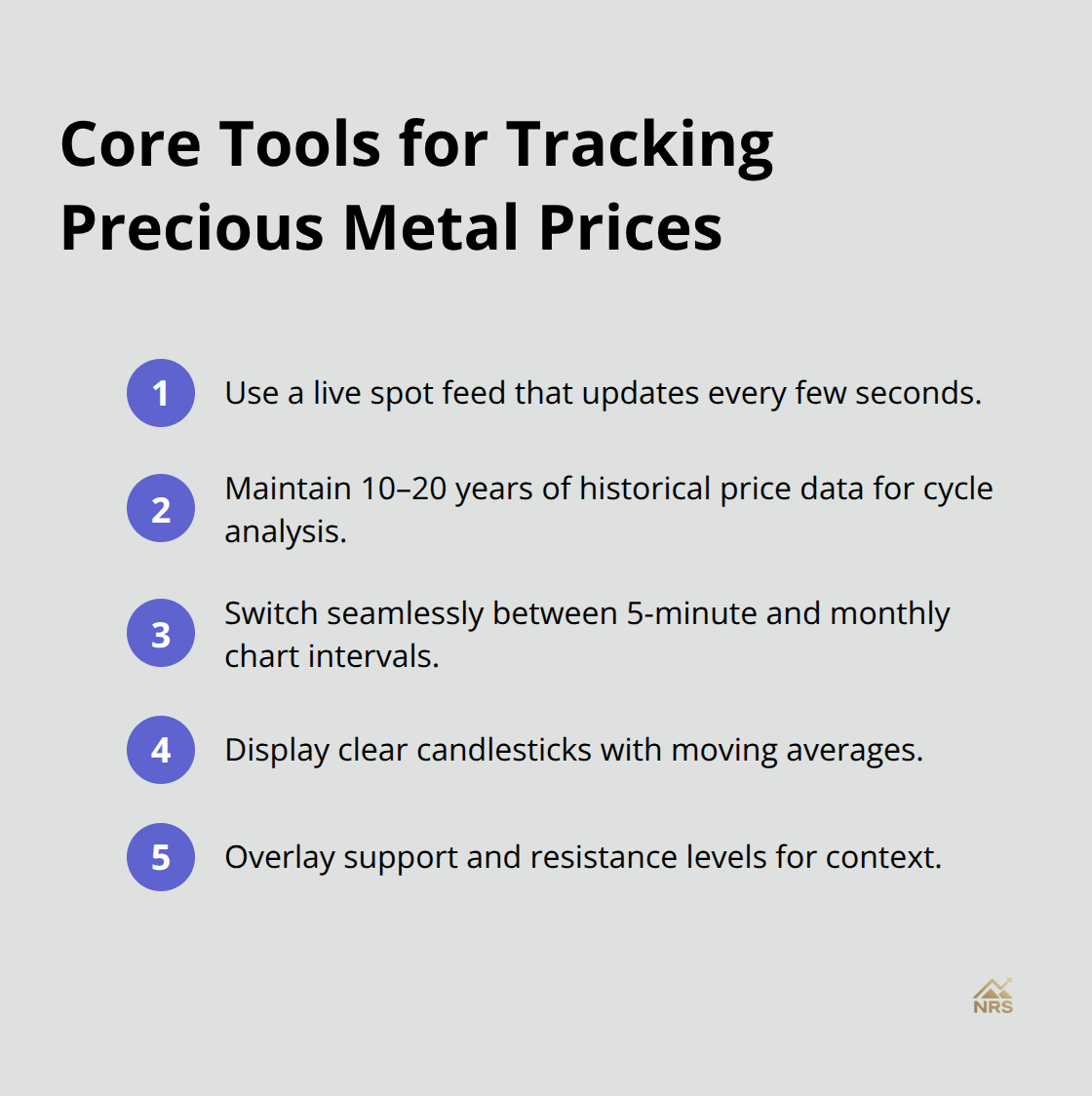
The London Bullion Market Association sets global benchmark prices for gold and silver through daily auctions, and these LBMA prices influence spot prices worldwide. Access to live spot price feeds matters because gold and silver trade 24/7 and react to Federal Reserve decisions, geopolitical events, and currency moves before stock markets even open. A feed that updates every few seconds, not hourly, catches the rapid moves that matter most. You need historical data spanning at least 10 to 20 years so you can pull exact dates and understand price cycles. As of December 21, 2025, gold and silver prices trade around $4,390 per ounce and $69 respectively, with platinum at $2,054, but these figures shift constantly.
The Gold/Silver Ratio and Technical Signals
The gold/silver ratio acts as a practical signal for tactical decisions. When the ratio hits extreme highs, it often indicates an opportunity to swap gold for silver, while low ratios suggest buying gold instead. Candlestick patterns show opening versus closing prices and the period’s highs and lows, which helps you spot reversals. Moving averages smooth out daily noise and reveal direction: when price trades above a moving average, that signals bullish momentum; below signals bearish pressure. Trading volume tells you whether interest is strong or weak, and this guides whether a price move has real conviction behind it.
Charting Software That Fits Your Strategy
Charting software must let you view both 5-minute intervals for tactical timing and monthly views for long-term strategy without forcing you to switch platforms. The best tools display candlestick patterns clearly and allow you to layer in moving averages and support/resistance levels. You can then identify optimal entry and exit points based on technical signals rather than emotion. This flexibility separates platforms that serve only day traders from those that work for long-term investors as well.
Mobile Apps and Real-Time Alerts
Mobile apps that work on iPhone, iPad, Mac, and web browsers let you monitor 24/7 without being chained to a desk. Price alerts set for fixed targets, percentage changes, or specific thresholds notify you instantly when metals hit your levels, removing the need to stare at screens constantly. The best platforms integrate real-time prices, ratio tracking, multi-currency quotes, and 30-year historical patterns alongside macro context on Fed policy and inflation. Watchlists that include not just gold and silver but also stocks, Bitcoin, and bonds help you understand how precious metals correlate with other assets-this context matters for portfolio timing.
Building Your Personal Price-Tracking Workflow
An order history feature lets you analyze past purchases against prices, which refines your entry strategy over time. Secure checkout functionality means you can act immediately when price targets are reached, capturing opportunities before they slip away. Dollar-cost averaging becomes practical when combined with live data and clear trend signals rather than guessing blindly. These tools work best when you combine them into a consistent routine that fits your schedule and investment timeline.
Understanding which tools to use sets the foundation, but the real challenge lies in knowing what to watch for. The next section covers the market factors that actually move precious metal prices-and how to track them.
What Actually Moves Precious Metal Prices
The Dollar’s Direct Impact on Metal Values
The U.S. Dollar Index determines whether precious metals rise or fall, and this relationship is predominantly inverse. When the dollar strengthens, gold, silver, and platinum tend to fall; when it weakens, they tend to rise. This happens because precious metals are priced in dollars globally, so a stronger dollar makes metals more expensive for foreign buyers and reduces demand. The dollar itself moves based on debt levels, interest rates, unemployment, consumer confidence, inflation, and oil prices. Track the U.S. Dollar Index daily through your charting software alongside your metal prices. When the dollar dips, that’s often your signal to buy, not sell.
Federal Reserve Decisions and Rate Policy
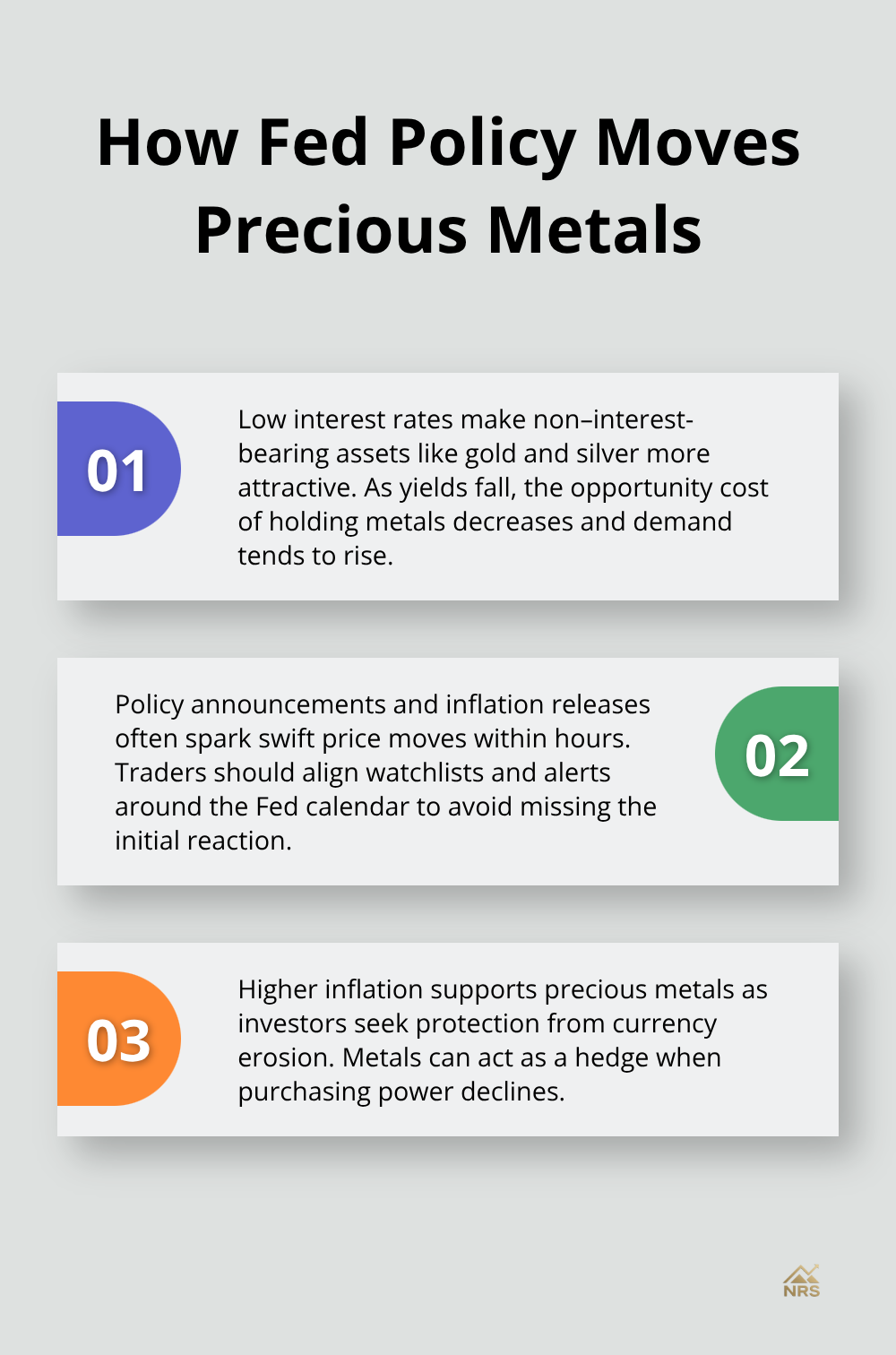
Federal Reserve decisions matter more than most investors realize. When interest rates are low, gold and silver shine brighter because they do not compete with interest-bearing assets. Watch the Federal Reserve’s policy announcements and inflation data releases closely because these trigger notable price moves within hours. November 2025 CPI data showed 2.7 percent year-over-year inflation with core at 2.6 percent according to the Bureau of Labor Statistics. Higher inflation supports precious metal prices as investors seek hedges against currency erosion.
Central Bank Demand and Price Targets
Central banks hold gold as reserve assets and can liquidate it during economic unrest, influencing global demand and prices. Major banks like JP Morgan have published targets suggesting gold could move toward $5,055 by late 2026 and up to $5,400 by 2027, driven by central bank buying and geopolitical risk. Central bank demand spikes during periods of financial stress or currency instability, which further supports prices. These institutional moves create measurable price catalysts that active trackers can monitor and act upon.
Geopolitical Events and Supply Disruptions
Geopolitical instability and supply disruptions create the volatility that rewards active trackers. Tensions in mining regions, trade sanctions, or political conflict restrict metal supply and push prices higher overnight. Dollar-cost averaging works best when you understand these macro catalysts because you can time larger purchases around dollar weakness, Fed policy shifts, or inflation acceleration rather than purchasing on a random schedule. Set your price alerts not just at fixed targets but at key technical levels where reversals often occur, and combine those alerts with a news feed that covers Federal Reserve announcements, inflation data, and geopolitical developments.
This combination of live price data, macro context, and technical signals removes guesswork from your tracking routine and lets you act with confidence when opportunities appear. The next section shows you how to build a personal strategy that ties all these factors together into a practical system.
Building Your Personal Tracking System
Start With Gold and Set Strategic Alerts
Start with a single metal and master it before expanding. Gold is the logical choice because it has deepest historical data and the most active 24/7 market, with clear correlation to Fed policy and dollar movements. Set three price alerts, not one: a target where you commit to buying, a technical level where you expect a reversal, and a threshold that signals a major shift in market conditions. For example, with gold currently at $4,390, you might set alerts at $4,200 for accumulation, $4,100 as a key support level where reversals often occur, and $4,500 as a signal that momentum has shifted decisively upward.
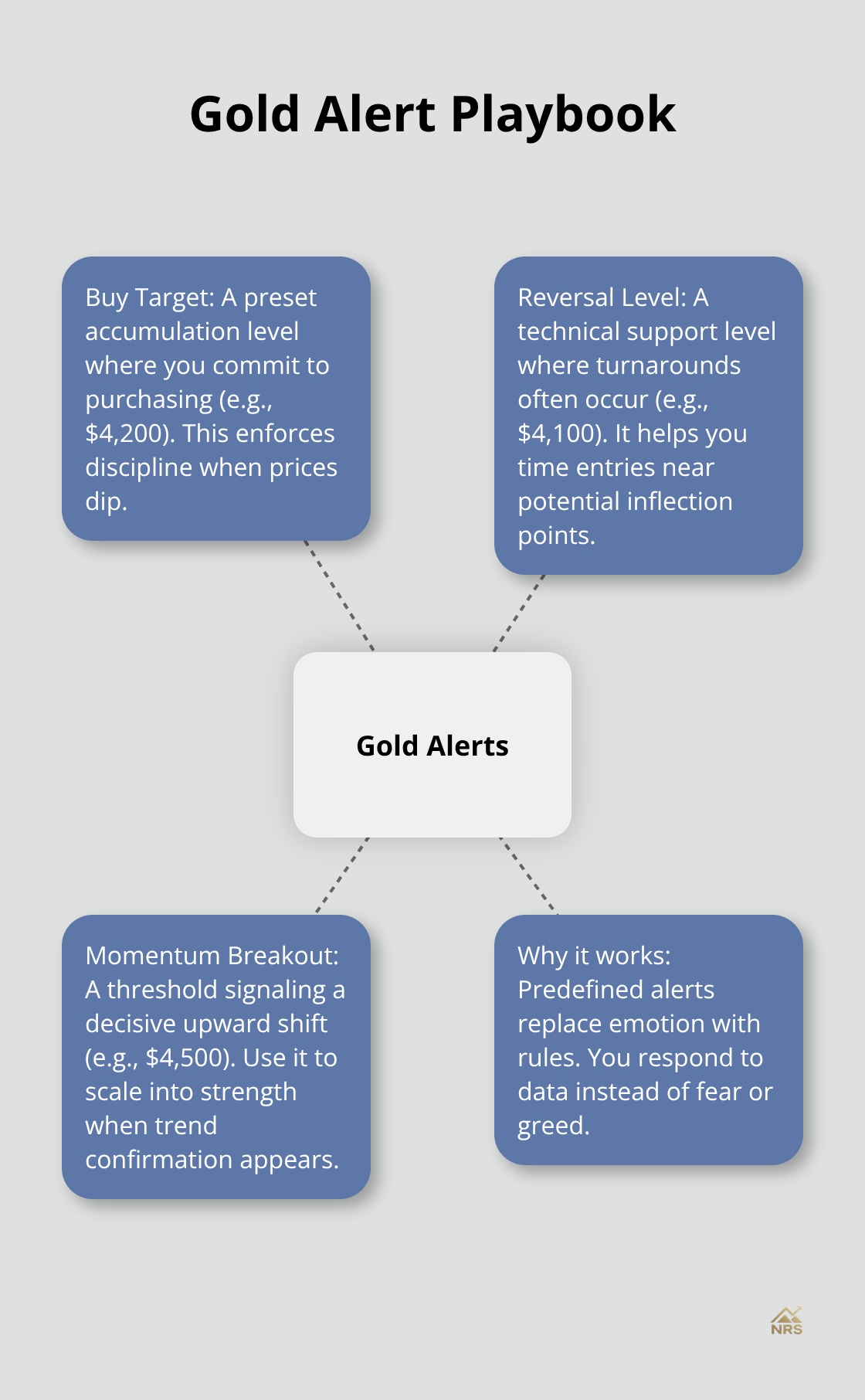
These alerts remove emotion from the equation because you respond to data, not to fear or greed. Most traders fail because they watch prices obsessively and react to noise; instead, let your alerts do the watching while you focus on the macro factors that matter.
Compare Dealer Prices and Track Total Costs
The gap between spot price and dealer markup varies significantly, so compare the same product across at least three dealers before purchasing. A 1 oz Gold Eagle might cost $4,468 at one dealer but $4,485 at another, representing a 0.4 percent difference that compounds over multiple purchases. Check the dealer’s shipping costs and insurance fees because these often hide the true total cost. Some dealers charge flat shipping while others charge by weight; some include insurance in the price while others bill it separately.
Once you identify a reliable dealer with transparent pricing, stick with them for consistency and to build a relationship that may yield better terms over time.
Add Silver and Use the Gold-to-Silver Ratio
After mastering gold, add silver as your second metal because the gold-to-silver ratio provides tactical signals you cannot ignore. Track this ratio weekly alongside your individual price alerts; when it spikes above 80:1, silver becomes the better buy, and when it falls below 50:1, gold offers better value.
This single metric eliminates the paralysis of choosing between metals and replaces it with a mechanical decision rule.
Monitor Dealer Premiums and Time Your Purchases
Comparing prices across markets means more than checking three dealers once; it means tracking the same dealer’s premiums weekly to spot patterns. A dealer who offers tight spreads during high-volume trading days might widen them on weekends when fewer traders are active. Document the exact time you check prices because the time-of-day matters significantly in a 24/7 market. Prices at 2 AM EST differ from prices at 2 PM EST due to Asian and European market activity.
If you consistently purchase at the same time each week, you build a personal dollar-cost averaging schedule that aligns with your tracking system rather than fighting against it. This removes the temptation to time the market perfectly and instead forces discipline through routine.
Final Thoughts
Effective price monitoring rests on three habits: you track live data consistently, you understand the macro factors that move precious metal prices, and you act on signals rather than emotions. The tools exist-real-time feeds, charting software, mobile alerts, and historical data spanning decades-but discipline separates successful trackers from those who lose money. You now know that precious metal prices respond predictably to dollar strength, Federal Reserve policy, central bank demand, and geopolitical shifts, and that the gold-to-silver ratio guides allocation decisions while dealer premiums vary enough to matter over time.
Build your routine around a single metal first, then expand to others. You check dealer prices at the same time each week so your dollar-cost averaging aligns with your tracking system, and you document what you observe-the time of day prices shift, which dealers offer the tightest spreads, how the gold-to-silver ratio behaves during Fed announcements. This data becomes your personal playbook, replacing guesswork with evidence that you can trust.
At Natural Resource Stocks, we provide expert analysis on how macroeconomic factors, geopolitical developments, and policy shifts affect resource prices across metals and energy sectors. Our platform combines video content, market analysis, and community insights that help you connect precious metal price movements to larger investment themes. Start tracking today, build your routine this week, and let the data guide your decisions forward.