

























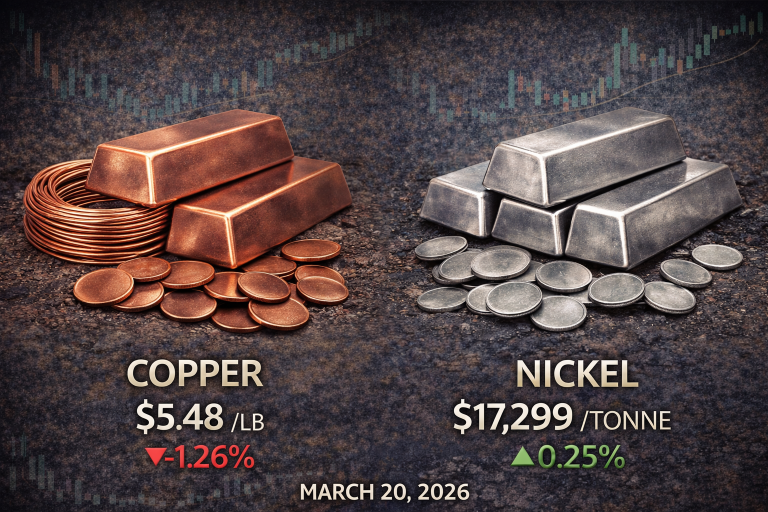
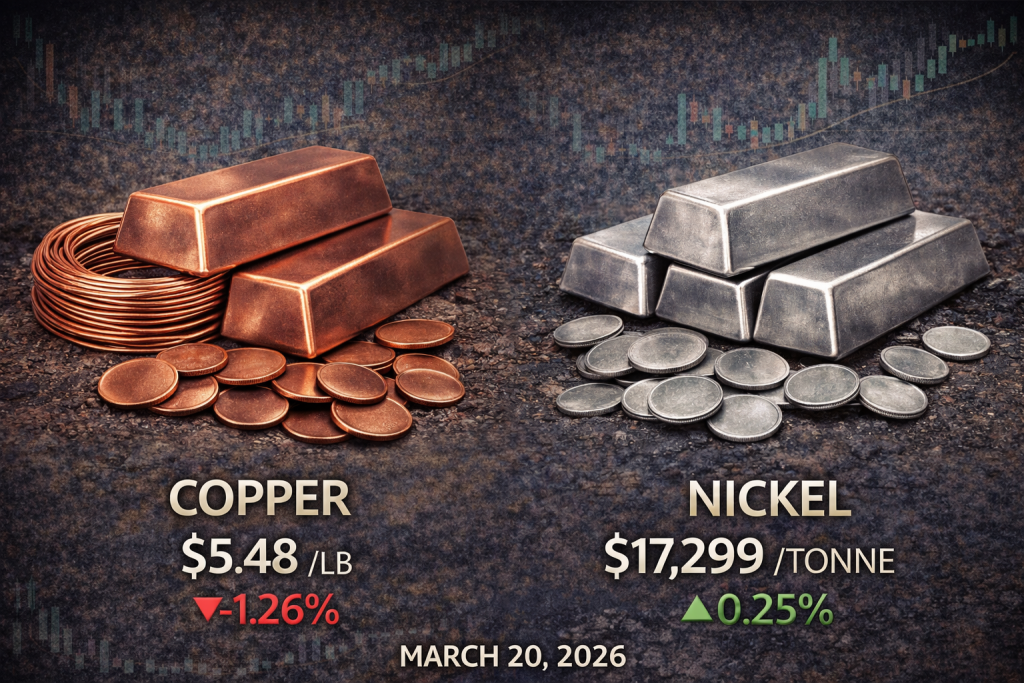
Copper and nickel are coming into March 20 with a softer, cautious tone after a volatile week for industrial metals. The freshest public Trading Economics commodity pages show copper at $5.48/lb on March 19, down 1.26% on the day, while nickel’s latest public quote is $17,299/tonne on March 18, up 0.25% on that session. Trading Economics’ broader commodities table was last updated on Thursday, March 19, 2026, so the latest publicly posted nickel data appears to lag copper by about a day.
Today’s pricing snapshot
Copper has fallen 6.08% over the past month, though it is still 7.87% higher than a year ago, according to Trading Economics. Nickel has been steadier on a month-over-month basis, with the latest public quote showing it essentially flat over the past month and still about 5.39% higher year over year. That leaves copper under more immediate pressure, while nickel still has a firmer medium-term floor from the supply side.
5 key drivers behind today’s move
1) Copper still has a real concentrate shortage underneath the market
One of copper’s biggest structural supports remains the squeeze in concentrate supply. Reuters-reported coverage says Antofagasta and a Chinese smelter agreed on 2026 treatment and refining charges of $0 per metric ton and 0 cents per pound, versus $21.25/tonne and 2.125 cents/lb for 2025. That kind of TC/RC collapse is a strong sign that smelter feedstock remains extremely tight, even when spot copper prices are under pressure.
2) High visible inventories are still capping copper’s upside
Copper’s near-term problem is that the market can still see a lot of metal in storage. Recent reporting says global exchange inventories rose above 1 million tonnes for the first time since 2004. That visible stock overhang helps explain why copper can have a bullish long-term supply story while still struggling in the short term.
3) Indonesia’s quota cuts are still the main nickel story
Nickel’s core support remains Indonesia’s tighter ore policy. Trading Economics reported that Indonesia approved 2026 nickel ore quotas of 260–270 million tons, down sharply from 379 million tons in 2025, with the aim of curbing oversupply and supporting prices. Since Indonesia dominates global nickel output, quota cuts of that size remain one of the most important drivers in the market.
4) Nickel is still trading off policy support rather than a clean demand rebound
The same Trading Economics report said nickel futures had risen toward $17,900/tonne after Indonesia confirmed those output cuts, showing how quickly the market reacts when supply restraint looks credible. That matters today because nickel’s support still looks mostly policy-driven, rather than based on a broad surge in stainless steel or battery demand.
5) Both metals are balancing bullish supply stories against weaker short-term sentiment
Copper is being hit harder because inventories are highly visible right now, while nickel is holding up better because its main support comes from deliberate supply restraint. That is an inference from the current pricing pattern: copper is down sharply on the latest public reading even with tight concentrate supply, while nickel’s latest posted reading remains relatively firm because Indonesia’s quota cuts are still anchoring sentiment.
What to watch next
For copper, the key question is whether the concentrate squeeze starts to matter more than the drag from bloated exchange inventories. For nickel, traders will keep watching whether Indonesia maintains tighter quotas and whether actual output lands below those already-lower approved levels. In both markets, the next move likely depends on whether supply tightness can outweigh cautious macro sentiment.
Bottom line
On March 20, 2026, copper still has the clearer long-term scarcity story, but nickel has the more direct policy catalyst. Copper is being weighed down by visible inventories despite tight concentrate supply, while nickel continues to draw support from Indonesia’s quota cuts. That leaves copper looking weaker in the near term and nickel looking more policy-sensitive day to day.