

























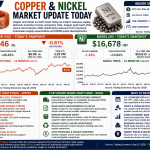


Copper and nickel are mixed today, with copper holding firm near elevated levels while nickel is slipping slightly after a strong one-month move. The split reflects two different stories: copper is still being supported by electrification, grid demand, AI/data-center infrastructure, and supply concerns, while nickel is more tied to Indonesia supply policy, stainless steel demand, EV battery demand, and inventory trends.
Today’s pricing snapshot
According to Trading Economics CFD benchmarks, copper traded around $6.16/lb on May 7, 2026, up about 0.38% on the day. Copper is also up roughly 6.95% over the past month and about 35.52% year over year, keeping it close to historically elevated levels.
Nickel traded around $19,115/metric ton on May 7, 2026, down about 0.44% on the day, but still up roughly 10.78% over the past month and 22.73% year over year.
5 key drivers behind today’s move
1) Copper is holding up because the long-term demand story remains strong
Copper continues to trade like a “growth plus electrification” metal. Even when short-term demand signals soften, investors are still focused on long-term needs from power grids, renewable energy, electric vehicles, AI data centers, and broader electrification.
That long-term demand story is why copper remains elevated despite periodic pullbacks. Trading Economics shows copper is still up more than 35% year over year as of May 7, 2026.
2) Supply concerns are still supporting copper
Copper’s rally is not just about demand. Supply remains a major part of the story. Mine disruptions, declining ore grades, tight concentrate markets, and slower output growth from major copper-producing regions continue to support bullish expectations.
One recent market outlook cited UBS expectations for a 407,000-ton copper deficit in 2026, driven by supply constraints and stronger demand later in the year.
3) China demand is the swing factor
China remains the key short-term demand variable for both copper and nickel. For copper, China’s property sector, industrial activity, power-grid spending, and manufacturing data can quickly change market sentiment.
For nickel, China matters through stainless steel production, battery supply chains, and its role in processing and refining. If Chinese industrial data improves, both metals can catch a bid. If China demand softens, copper and nickel can both face pressure.
4) Nickel is being pulled between EV demand and oversupply concerns
Nickel’s long-term demand story is still tied to electric vehicles, batteries, stainless steel, and clean-energy infrastructure. But unlike copper, nickel has faced repeated pressure from supply growth, especially from Indonesia.
That is why nickel can rally sharply when traders expect supply discipline or policy changes, but it can also fall quickly when oversupply concerns return. Trading Economics shows nickel is still up more than 10% over the past month, even with today’s small decline.
5) Critical-minerals policy is becoming a bigger market driver
Both copper and nickel are increasingly being treated as strategic materials, not just ordinary industrial commodities. Governments are paying more attention to critical-minerals security because of electrification, defense, infrastructure, and supply-chain risk.
Recent reporting has highlighted the global rush to secure critical minerals, including copper and other battery-related materials, as countries try to reduce dependence on concentrated supply chains.
What to watch next
The next major catalysts for copper and nickel are:
- China manufacturing and construction data
- LME, COMEX, and SHFE inventory trends
- U.S. dollar and Treasury yield moves
- Copper mine supply updates from Chile, Peru, and other major producers
- Indonesia nickel policy, production quotas, and export rules
- Stainless steel demand and EV battery demand trends
- Any new U.S., China, or EU critical-minerals policy headlines
Bottom line
On May 7, 2026, copper is trading slightly higher while nickel is slightly lower. Copper’s strength reflects its cleaner long-term setup: electrification, grid investment, AI/data-center demand, and ongoing supply tightness. Nickel still has a strong strategic-material story, but its price action is more complicated because Indonesia supply, stainless steel demand, EV battery chemistry, and inventory levels can quickly shift the market balance.
Copper is acting like the stronger structural-demand metal today, while nickel remains the more policy- and supply-sensitive trade.