
























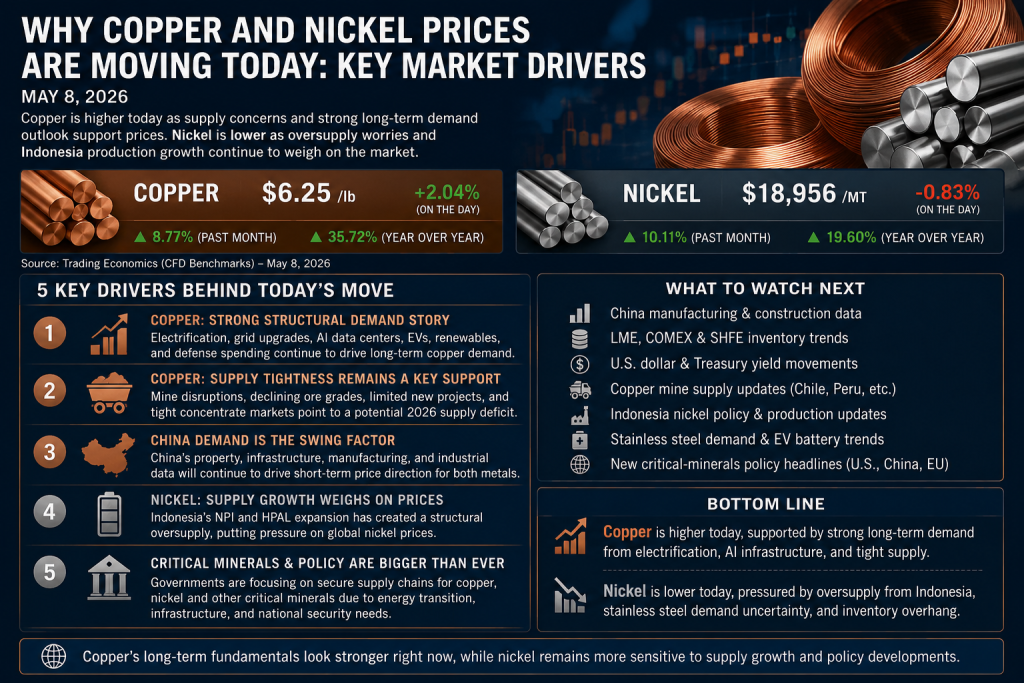
Copper and nickel are moving in different directions today, with copper pushing higher while nickel slips lower. The split shows how differently these two industrial metals are trading right now: copper is being supported by electrification, grid demand, AI/data-center buildout, and supply tightness, while nickel remains more exposed to Indonesia supply growth, stainless steel demand, EV battery trends, and inventory pressure.
Today’s pricing snapshot
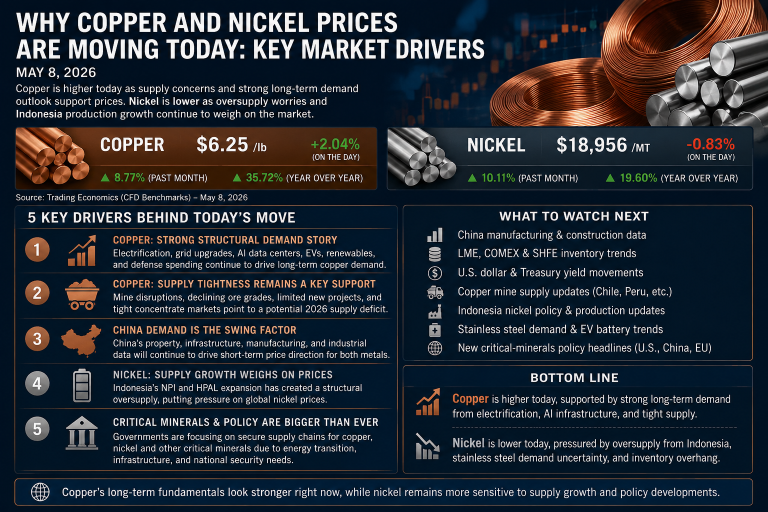
According to Trading Economics CFD benchmarks, copper rose to about $6.25/lb on May 8, 2026, up roughly 2.04% on the day. Copper is also up about 8.77% over the past month and 35.72% year over year, keeping it near historically elevated levels.
Nickel moved the other way, falling to about $18,956/metric ton on May 8, 2026, down roughly 0.83% on the day. Even with today’s decline, nickel remains up about 10.11% over the past month and 19.60% year over year.
5 key drivers behind today’s move
1) Copper is still being treated like a strategic growth metal
Copper is no longer trading only as a traditional construction and manufacturing metal. Investors increasingly view it as a strategic material tied to electrification, AI data centers, grid modernization, renewable power, electric vehicles, and defense-related infrastructure.
That is helping copper hold a premium even when macro conditions are mixed. Sprott recently described copper’s 2026 setup as being driven by tightening supply, strategic demand, policy risk, AI growth, defense spending, and grid modernization.
2) Supply tightness remains a major support for copper
Copper’s strength is also being driven by supply concerns. Mine disruptions, declining ore grades, limited new project pipelines, and tight concentrate markets continue to support expectations for a tighter market.
Recent copper outlooks have pointed to projected supply deficits in 2026, with demand expanding from AI infrastructure, power generation, EVs, renewables, and broader electrification.
3) Nickel is under pressure from supply growth
Nickel’s story is more complicated. While long-term demand from batteries and stainless steel remains important, the market has been weighed down by strong supply growth, especially from Indonesia.
Indonesia’s NPI and HPAL expansion has contributed to a structural oversupply in the global nickel market, which has pressured prices and challenged higher-cost Western producers.
4) EV batteries still matter, but nickel demand is not one-way
Nickel remains an important battery metal, especially for high-nickel cathode chemistries. But EV battery demand has become harder to read because automakers and battery makers continue to adjust chemistry choices, including greater use of LFP batteries in some markets.
That means nickel still has long-term strategic value, but it does not have the same clean demand story as copper right now. Nickel can rally when battery demand, stainless steel demand, or supply policy improves, but oversupply concerns can quickly cap the upside.
5) China remains the swing factor for both metals
China is still the key demand variable for copper and nickel. For copper, investors watch China’s property sector, grid investment, manufacturing activity, and infrastructure spending. For nickel, China matters through stainless steel production, battery supply chains, and refining capacity.
A stronger China demand signal would likely support both metals. Softer industrial data, weaker property activity, or rising inventories could put pressure on the complex.
What to watch next
Copper traders will be watching mine-supply updates, LME and COMEX inventory trends, China industrial data, U.S. dollar moves, and whether AI/data-center power demand continues to drive new copper-demand forecasts.
Nickel traders will be watching Indonesia production policy, stainless steel demand, battery-grade nickel demand, EV sales trends, and whether the market can work through the oversupply created by rapid Indonesian supply expansion.
Bottom line
On May 8, 2026, copper is moving higher while nickel is trading lower. Copper has the stronger near-term setup because investors are focused on electrification, grid modernization, AI infrastructure, and supply deficits. Nickel still has a long-term role in batteries, stainless steel, and critical-minerals supply chains, but its price action remains more vulnerable to oversupply headlines and Indonesia production growth.
Copper is acting like the cleaner structural-demand story today, while nickel remains the more supply-sensitive and policy-driven metal.