






















Platinum and palladium are both under pressure today, but the bigger setup remains different for each metal. Platinum is still supported by a tight supply-demand picture and strong investment demand, while palladium is more tied to auto-sector demand, Russia supply risk, recycling trends, and trade-policy headlines.
Today’s pricing snapshot
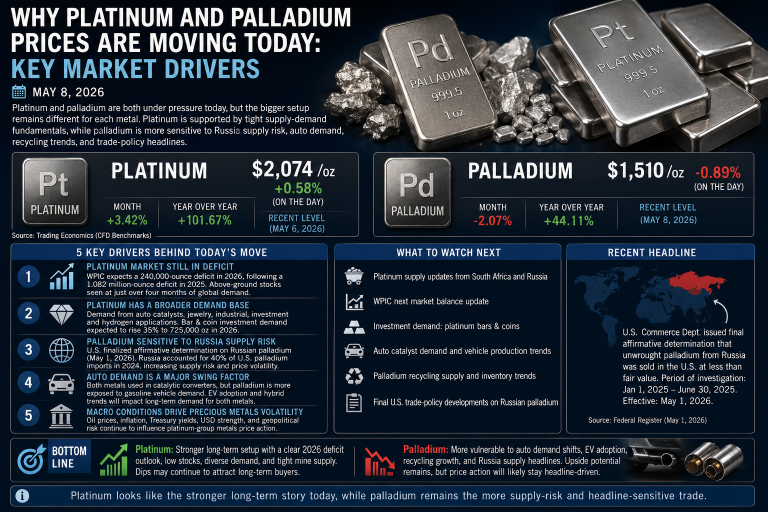
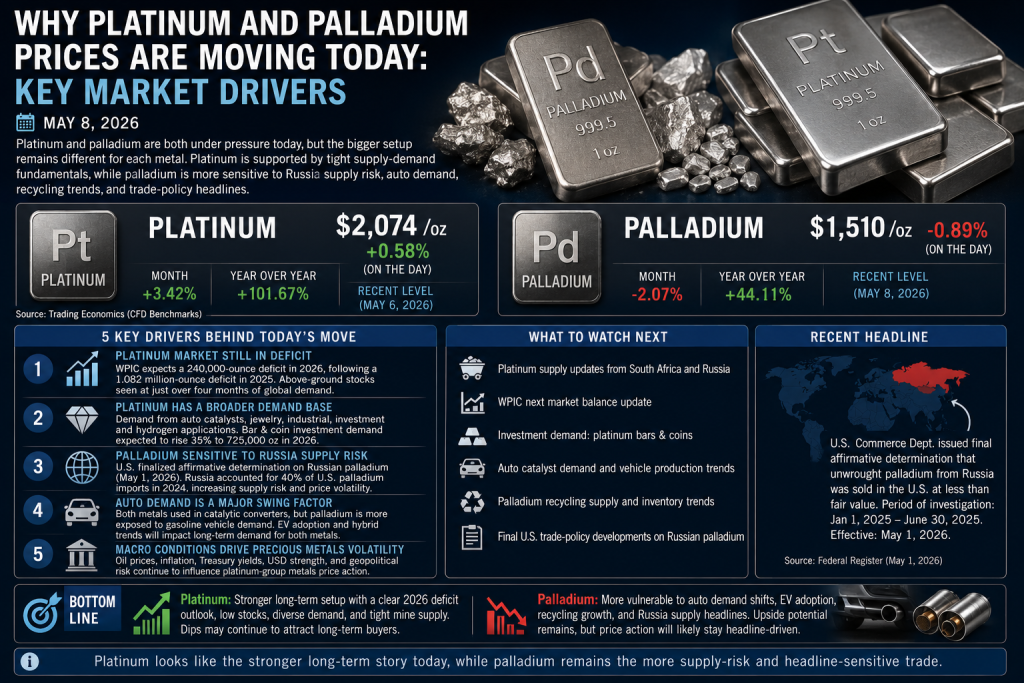
According to Trading Economics CFD benchmarks, palladium fell to about $1,510/oz on May 8, 2026, down roughly 0.89% on the day. Palladium is down over the past month, but it remains sharply higher year over year, showing that traders are still pricing in supply risk and a tighter-than-expected market backdrop.
Platinum recently traded back above the $2,000/oz level after rebounding from late-April weakness. Trading Economics reported platinum around $2,074/oz on May 6, 2026, with the metal supported by structural supply tightness, South African mine constraints, and Russia-related supply risk.
5 key drivers behind today’s move
1) Platinum’s market is still expected to stay in deficit
The biggest support under platinum remains the supply-demand balance. The World Platinum Investment Council expects the platinum market to post a 240,000-ounce deficit in 2026, following a much larger 1.082 million-ounce deficit in 2025. WPIC also said above-ground stocks are projected to remain low, at just over four months of global demand through 2026.
That keeps platinum’s longer-term setup constructive even when the metal pulls back on short-term macro pressure or profit-taking.
2) Platinum has a broader demand base than palladium
Platinum benefits from demand across several categories: automotive catalysts, jewelry, industrial uses, investment bars and coins, and future hydrogen-related applications. WPIC expects bar and coin investment demand to rise 35% to 725,000 ounces in 2026, while industrial demand is expected to rebound 11% to 2.124 million ounces.
That broader demand base gives platinum more ways to hold support compared with palladium, which remains more heavily tied to gasoline vehicle catalytic converters.
3) Palladium is still trading around Russia supply risk
Palladium remains highly sensitive to Russian supply headlines. The U.S. Department of Commerce recently issued a final affirmative determination that unwrought palladium from Russia was being, or was likely to be, sold in the U.S. at less than fair value. The Federal Register notice lists the period of investigation as January 1, 2025 through June 30, 2025, with the determination effective May 1, 2026.
That matters because Russia is a major palladium supplier. WPIC previously noted that Russia accounted for 40% of U.S. palladium imports in 2024, meaning any duty, restriction, or supply-chain shift can quickly affect market sentiment.
4) Auto demand is a key swing factor for both metals
Both platinum and palladium are used in catalytic converters, but palladium is more exposed to gasoline-vehicle demand. Platinum has benefited from substitution in some applications, but both metals remain sensitive to changes in global vehicle production, hybrid demand, EV adoption, and emissions standards.
If hybrid and internal-combustion vehicle demand stays stronger for longer, palladium may find support. If battery-electric vehicles keep taking share faster than expected, palladium faces more long-term demand pressure.
5) Macro conditions are still driving precious metals volatility
Platinum and palladium are industrial precious metals, so they react to both macro and physical-market news. The broader precious-metals complex has recently been influenced by oil prices, inflation expectations, Treasury yields, the U.S. dollar, and geopolitical risk. WSJ reported that gold and silver ended the week higher on May 8, with safe-haven demand and central-bank buying supporting the complex, even as high real yields remained a constraint.
That macro backdrop can create sharp day-to-day moves in platinum-group metals, even when the longer-term supply story remains tight.
What to watch next
Traders will be watching platinum supply updates from South Africa and Russia, WPIC’s next market balance update, platinum bar-and-coin investment demand, auto catalyst demand, palladium recycling flows, and final U.S. trade-policy developments involving Russian palladium.
For palladium specifically, the biggest catalysts are Russia-related trade actions, U.S. import flows, auto production, hybrid vehicle demand, and whether recycling supply grows enough to ease market tightness.
Bottom line
On May 8, 2026, platinum and palladium are both trading with short-term volatility, but platinum still has the cleaner structural story. Platinum is supported by a documented 2026 deficit, low above-ground stocks, broader demand sources, and tight mine supply. Palladium still has upside potential from Russia supply risk and trade-policy headlines, but it remains more vulnerable to auto-demand shifts, EV adoption, and recycling growth.
Platinum looks like the stronger long-term setup today, while palladium remains the more headline-driven and supply-risk-sensitive trade.