























Copper and nickel are both higher today, with copper continuing its record-setting run and nickel rebounding as traders focus on Indonesia supply policy and stronger base-metals sentiment. Copper remains the stronger structural story because of tight supply, AI/data-center demand, electrification, and mine-disruption risk. Nickel is also gaining, but its outlook remains more policy-sensitive because Indonesia production quotas, stainless steel demand, and battery-market trends can quickly shift the balance.
Today’s pricing snapshot
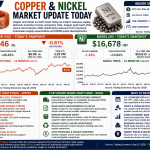
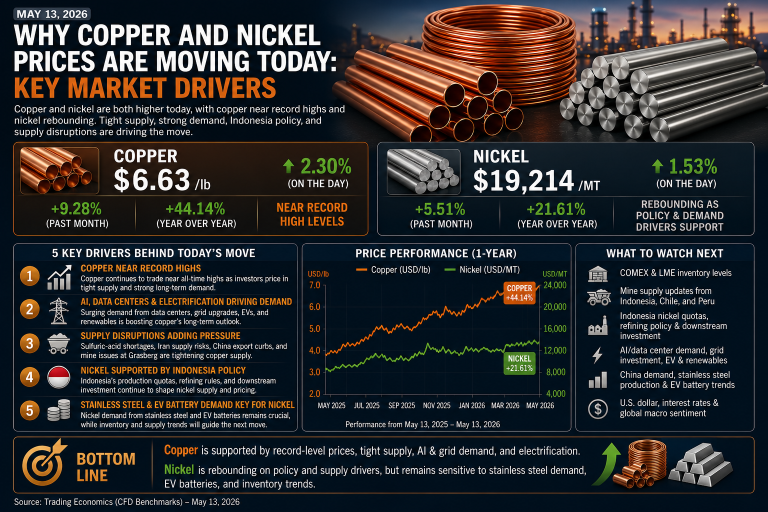
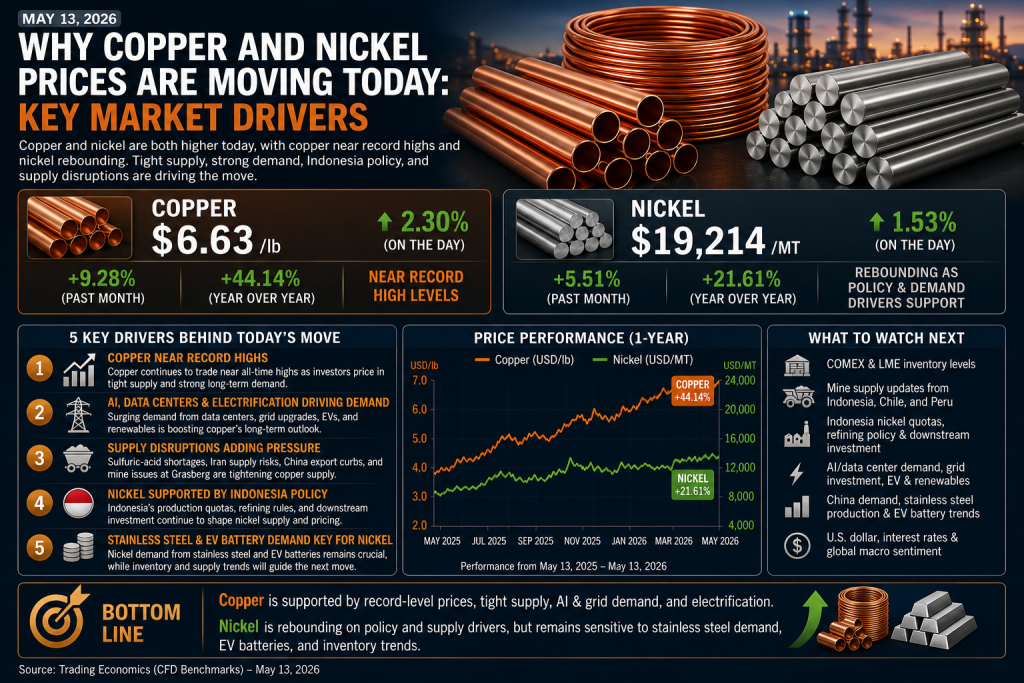
According to Trading Economics CFD benchmarks, copper rose to about $6.63/lb on May 13, 2026, up roughly 2.30% on the day. Copper is also up about 9.28% over the past month and roughly 44.14% year over year, keeping it near record-high territory.
Nickel rose to about $19,214/metric ton on May 13, 2026, up roughly 1.53% on the day. Nickel is also up about 5.51% over the past month and roughly 21.61% year over year.
5 key drivers behind today’s move
1) Copper is still trading near record highs
Copper remains the headline metal today. Prices have been pushing into record territory as investors continue to price in a tight supply picture and stronger long-term demand. MarketWatch reported that copper prices recently reached their highest level on record, with July futures trading around $6.53/lb, driven by both AI-related demand and supply-side stress.
That momentum is keeping copper in focus for resource investors looking for exposure to electrification, infrastructure, power demand, and strategic metals.
2) AI, data centers, grids, and electrification are driving demand
Copper’s demand story is being upgraded. It is no longer just a traditional construction and manufacturing metal. AI data centers, power-grid upgrades, EVs, renewables, and electrification are now major parts of the bullish copper case.
That is important because data centers and grid buildouts require large amounts of reliable electrical infrastructure, and copper remains one of the core metals needed for that expansion.
3) Supply disruptions are adding fuel to copper’s rally
Copper’s move is not just about demand. Supply-side pressure is also helping drive prices higher. MarketWatch highlighted sulfuric-acid shortages, Iran-related supply disruptions, China export restrictions, and concerns around Freeport-McMoRan’s Grasberg mine as factors tightening the copper market.
WSJ also reported that copper futures hit fresh records this week, with most-traded contracts settling above $6.50/lb for the first time.
4) Nickel is higher as Indonesia policy stays in focus
Nickel is also moving higher today, but its setup is different from copper’s. Nickel is more tied to Indonesia supply policy, stainless steel production, EV battery demand, and inventory trends.
A recent report said global nickel prices could rise due to sulfur-shipment disruptions from the Middle East and policy shifts in Indonesia, citing the World Bank’s expectation for nickel prices to rebound this year.
5) Indonesia remains the key nickel wildcard
Indonesia is still the biggest swing factor for nickel. The country dominates global nickel supply growth, so any changes to production quotas, refining rules, export policies, or downstream investment can quickly affect market sentiment.
Earlier this year, Indonesia’s move to cut its 2026 nickel ore production quota fueled supply concerns and pushed prices higher across global markets.
What to watch next
Copper traders will be watching COMEX and LME inventory levels, sulfuric-acid availability, mine-supply updates from Indonesia, Chile, and Peru, China demand, AI/data-center power demand, grid investment, EV growth, and U.S. dollar moves.
Nickel traders will be watching Indonesia production quotas, stainless steel demand, EV battery demand, Class 1 nickel premiums, LME inventories, sulfur-shipment disruptions, and policy developments from Indonesia, China, the U.S., and the EU.
Bottom line
On May 13, 2026, copper and nickel are both higher, but copper remains the cleaner bullish story. Copper is being supported by record price momentum, tight supply, sulfuric-acid shortages, AI/data-center demand, grid upgrades, EVs, and electrification. Nickel is also gaining, but it remains more sensitive to Indonesia policy, stainless steel demand, EV battery chemistry, and inventory trends.
Copper is acting like the stronger structural-demand metal today, while nickel remains the more supply-policy-driven trade.