






















Platinum and palladium are moving in different directions today, with platinum holding stronger while palladium slips lower. The split reflects two different market setups: platinum is still benefiting from tight supply, low above-ground stocks, and strong investment demand, while palladium remains more exposed to Russia supply risk, auto-demand uncertainty, recycling flows, and broader precious-metals volatility.
Today’s pricing snapshot
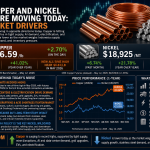
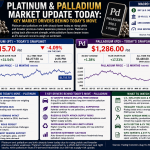
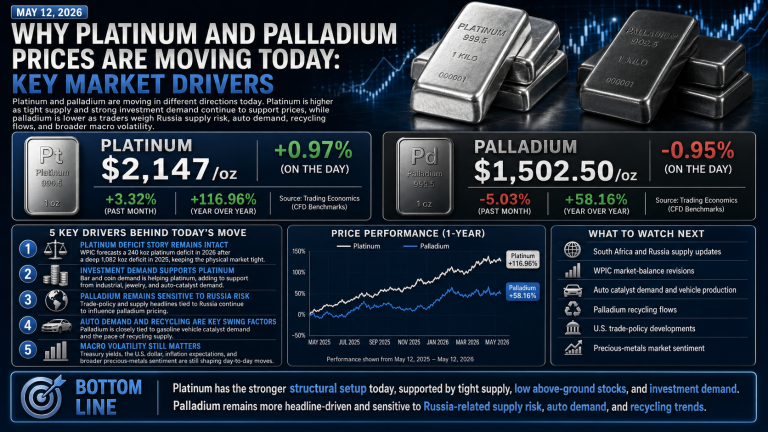
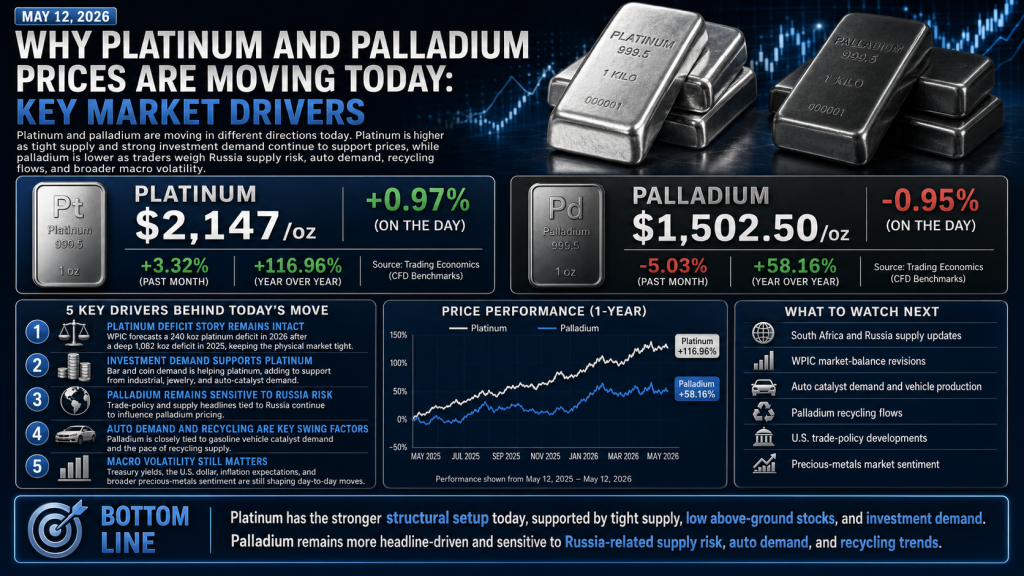
According to Trading Economics CFD benchmarks, platinum rose to about $2,147/oz on May 12, 2026, up roughly 0.97% on the day. Platinum is also up about 3.32% over the past month and roughly 116.96% year over year, keeping it one of the strongest-performing precious metals over the past 12 months.
Palladium fell to about $1,502.50/oz on May 12, 2026, down roughly 0.95% on the day. Palladium is down about 5.03% over the past month, but it remains up roughly 58.16% year over year, showing that supply-risk concerns are still supporting the market despite today’s weakness.
5 key drivers behind today’s move
1) Platinum’s deficit story remains intact
The biggest support under platinum remains the supply-demand balance. The World Platinum Investment Council expects the platinum market to post a 240,000-ounce deficit in 2026, following a much larger 1.082 million-ounce deficit in 2025.
That deficit outlook keeps platinum well supported, especially when investors are already focused on tight physical supply and low available inventories.
2) Platinum is being supported by investment demand
Platinum continues to benefit from renewed investor interest. The WPIC said the 2025 platinum deficit deepened partly because of stronger-than-expected investment demand, helped by the rally in platinum prices. WPIC also reported that total platinum demand reached its highest level in nine years in 2025.
That matters because investment demand can add extra momentum when the physical market is already tight.
3) Palladium is still sensitive to Russia supply risk
Palladium remains heavily influenced by Russia-related supply headlines. Trading Economics noted that palladium supply remains constrained by South African production disruptions and geopolitical risks tied to Russian exports, including sanctions and changing trade dynamics.
That keeps palladium headline-driven. Even when prices fall on the day, any new supply restriction or trade-policy development can quickly shift market sentiment.
4) Auto demand remains the key swing factor
Both platinum and palladium are used in catalytic converters, but palladium is more exposed to gasoline-vehicle demand. Platinum has a broader demand base, including auto catalysts, jewelry, industrial uses, investment products, and future hydrogen-related applications.
If gasoline and hybrid vehicle demand stays strong, palladium may find support. If battery-electric vehicles keep taking share faster than expected, palladium could face more long-term demand pressure.
5) Macro volatility is still driving precious-metals moves
Platinum and palladium trade as both precious metals and industrial metals. That means prices react to supply-demand fundamentals, but also to Treasury yields, the U.S. dollar, inflation expectations, geopolitical risk, and broader commodity sentiment.
Today’s split shows that platinum is trading more on its structural tightness, while palladium is still being pulled between supply risk and uncertain demand.
What to watch next
Traders will be watching platinum supply updates from South Africa and Russia, WPIC market-balance revisions, investment demand for platinum bars and coins, auto catalyst demand, palladium recycling flows, and any new U.S. or global trade-policy developments involving Russian palladium.
For palladium specifically, the biggest catalysts remain gasoline-vehicle production, hybrid demand, Russian supply risk, recycling supply, and whether the recent monthly weakness attracts bargain buying.
Bottom line
On May 12, 2026, platinum is higher while palladium is lower. Platinum has the stronger structural setup because it is supported by a documented 2026 deficit, strong investment demand, low available stocks, and broader demand sources. Palladium still has upside potential from Russia supply risk and trade-policy headlines, but it remains more vulnerable to auto-demand uncertainty, EV adoption, and recycling growth.
Platinum looks like the cleaner long-term story today, while palladium remains the more headline-driven and supply-risk-sensitive trade.