























Geopolitical tensions reshape commodity markets faster than most investors realize. Wars, sanctions, and political upheaval create immediate supply disruptions that send resource prices soaring-and savvy investors who understand these patterns can position themselves ahead of the curve.
At Natural Resource Stocks, we’ve tracked how geopolitical investment effects ripple through oil, metals, and mining stocks. This guide shows you exactly which regions matter, when to act, and how to build a portfolio that withstands political shocks.
How Geopolitical Shocks Move Commodity Prices
Geopolitical risk hits commodity markets through two distinct pathways, and understanding which one is active tells you whether a price move will stick around or fade fast. The first pathway is direct: actual supply disruption. When the Russia-Ukraine conflict’s impact on oil and natural gas prices in February 2022 began, prices spiked immediately because Russian production faced real sanctions and export restrictions. Research examining the conflict shows it created rapid divergence between observed prices and what prices would have been without the war. The second pathway is indirect and often more powerful for longer periods. It works through risk premiums, financing costs, and investor behavior. When geopolitical tension rises, banks and institutions become reluctant to finance resource projects in affected regions. Data from the IMF shows that elevated geopolitical risk correlates with lower private sector credit growth in emerging markets, directly constraining financing for energy and minerals projects. A conflict in one region can dry up capital for mining operations thousands of miles away if investors perceive elevated systemic risk.
Supply chains break at single points of failure
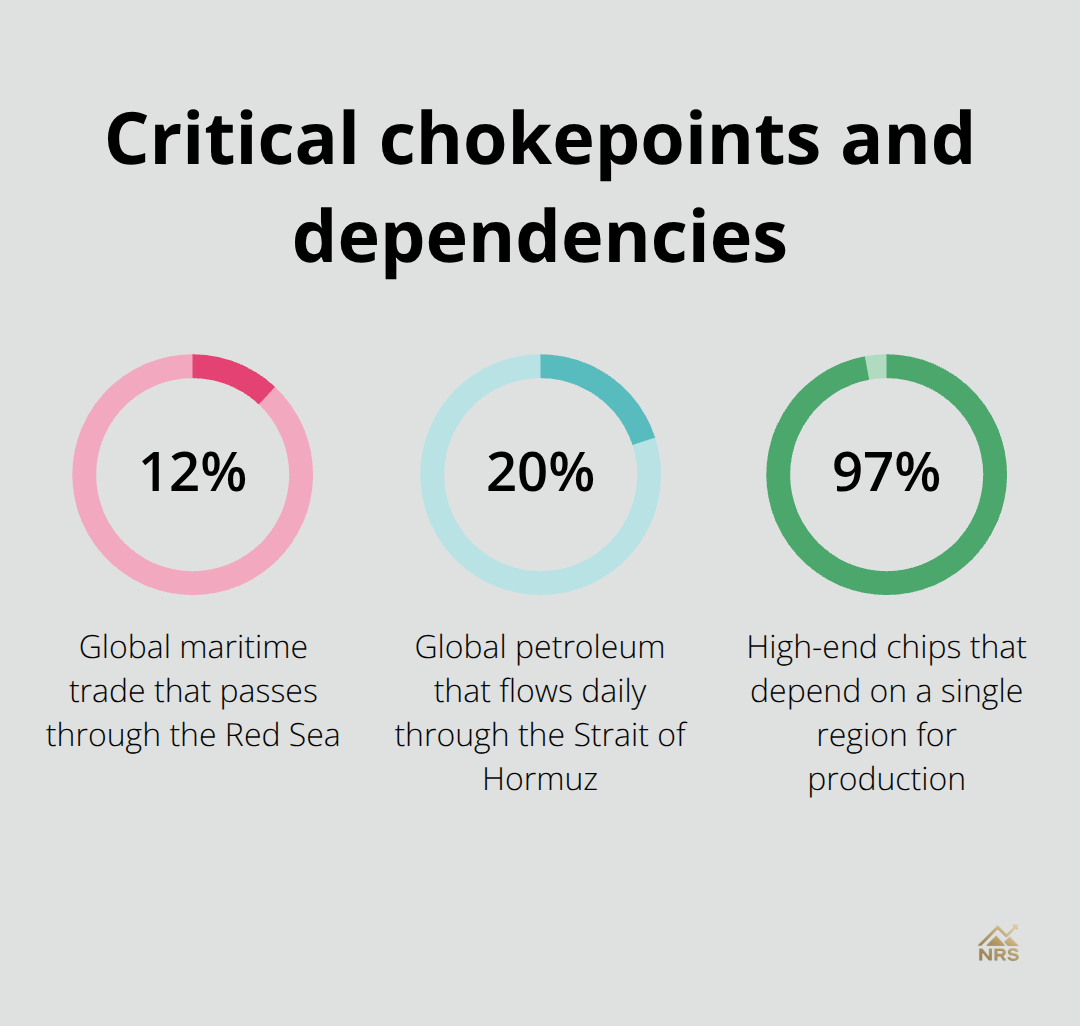
The Red Sea attacks in late 2023 and 2024 exposed how fragile global resource logistics really are. About 12% of global maritime trade passes through the Red Sea, and disruptions there raise freight insurance costs, extend shipping times, and lift inflationary pressures on raw materials. Shipping delays compound across your portfolio. A delay in transporting copper concentrates from Chile to Chinese smelters doesn’t just raise copper prices for three weeks; it creates inventory shortages downstream that persist for months. Taiwan semiconductor production chokepoint and global supply chain vulnerability means approximately 97% of high-end chips depend on a single region, which means a significant portion of U.S. goods spending relies on a single chokepoint. Resource investors should focus on companies with diversified sourcing and production outside contested zones rather than betting on price spikes from disruption alone.
Geopolitical risk affects different commodities differently
Oil, natural gas, gold, and agricultural commodities don’t all respond the same way to geopolitical tension. Research using quantile analysis shows oil and natural gas prices show sensitivity to geopolitical risk primarily in the mid-to-high uncertainty range, while gold prices get affected across the full range of uncertainty. Iron ore reacts to geopolitical risk only during extreme uncertainty at the upper end of the risk spectrum. This matters because a moderate geopolitical event might lift gold and natural gas prices but leave iron ore untouched. Urea prices respond mainly to medium-to-upper uncertainty levels.
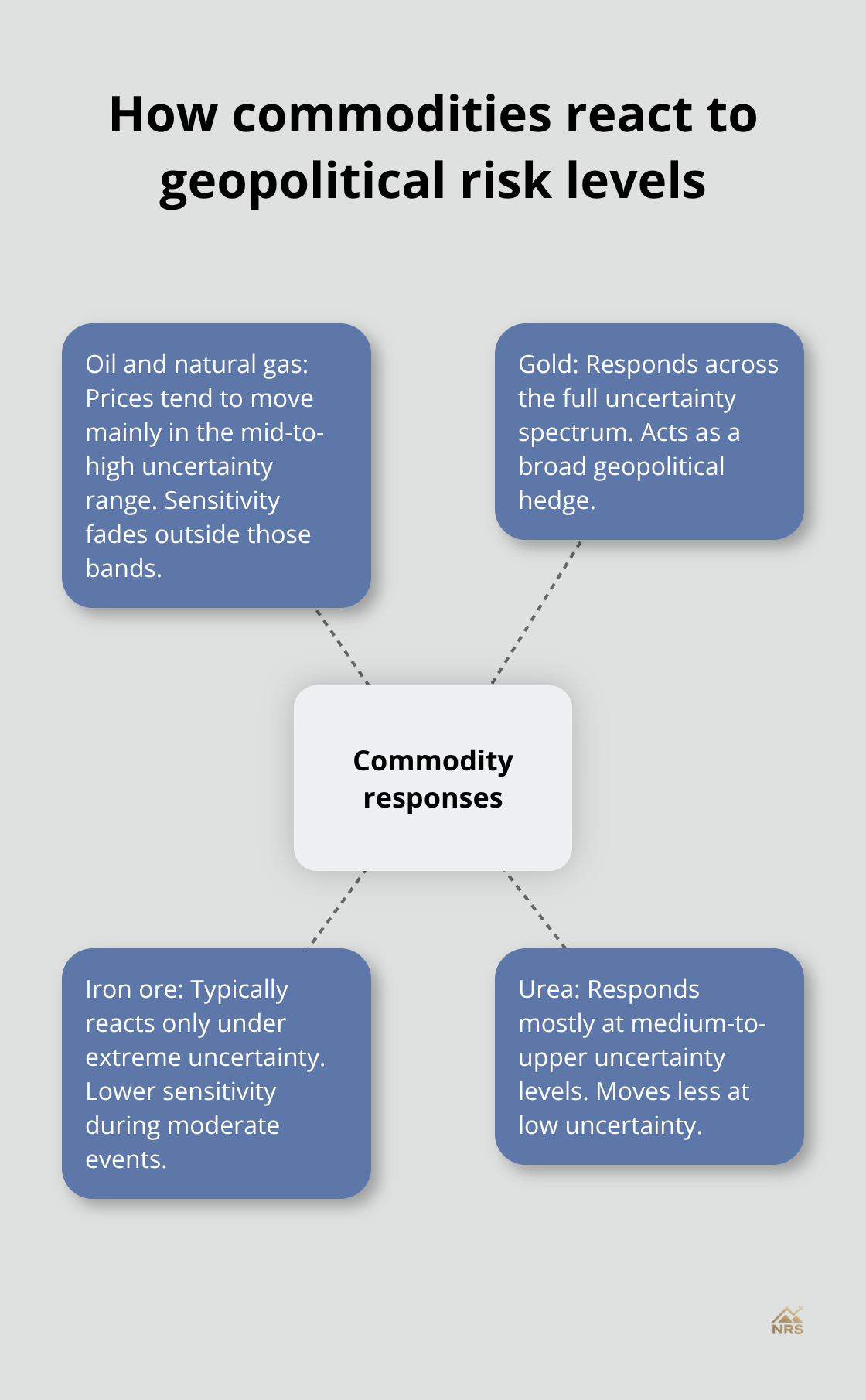
Stop treating geopolitical risk as a universal commodity catalyst. Instead, match specific commodities to specific risk scenarios. If tensions are rising but haven’t reached extreme levels, gold and natural gas offer better upside than iron ore. The Israel-Hamas conflict that began in October 2023 spiked the geopolitical risk index into the top 5% of its history, yet oil prices didn’t surge solely from Middle East tensions because global supply remained relatively stable. Investor sentiment and risk premiums matter more than the actual physical supply constraint in many cases.
Sentiment drives prices when supply stays stable
The distinction between actual supply loss and perceived risk matters enormously for your timing. During the Israel-Hamas conflict, markets feared a wider Middle East disruption that never materialized. Oil prices reflected that fear through a risk premium, but the premium compressed as investors realized Iranian action wouldn’t immediately disrupt global flows. This teaches you to separate headline risk from structural risk. A geopolitical event that threatens supply in a region accounting for 3% of global production creates a different price dynamic than one threatening 15% of supply. Research on the Russia-Ukraine conflict shows that in some periods, prices were lower than what non-war projections would have predicted, meaning geopolitical events can also suppress prices when they reduce demand or create deflationary pressures. Understanding whether a conflict lifts or lowers prices requires you to track both supply-side and demand-side effects simultaneously. This dual analysis separates investors who profit from geopolitical moves from those who chase headlines and lose money when sentiment shifts.
Where Geopolitical Risk Hits Resource Markets Hardest
The Middle East produces roughly 30% of global oil and holds about 48% of proven reserves, making it the single most consequential region for energy investors. When tensions spike there, markets price in supply loss immediately, even when actual disruption hasn’t occurred yet. The October 2023 Israel-Hamas conflict pushed the geopolitical risk index into the top 5% of historical levels, yet oil prices didn’t surge because global supply remained intact. What changed instead was the risk premium investors demanded for holding energy assets. This distinction matters for your portfolio timing. A conflict that threatens 5% of global supply creates temporary volatility; one that threatens 15% reshapes prices for months. Iran controls the Strait of Hormuz, through which roughly 20% of global petroleum passes daily. Any Iranian action there would genuinely disrupt supply, not just sentiment. That’s why the market watches Iran’s moves far more carefully than most Middle East tensions. Focus your attention on whether a conflict directly threatens chokepoint infrastructure or production facilities, not on headline severity.
African mining faces different political risks than energy
African countries produce 64% of global cobalt, 28% of diamonds, and substantial shares of copper, gold, and lithium. Unlike oil markets where supply disruption creates immediate price spikes, mining operations can shut down for months before markets fully price in the loss. The Democratic Republic of Congo produces 70% of global cobalt, yet political instability there hasn’t consistently spiked cobalt prices because buyers maintain strategic stockpiles and shift sourcing. Government changes in mining-heavy countries like Zambia, Mali, and Guinea have disrupted operations, but the impact depends on whether the new government honors contracts or nationalizes assets. Zambia’s debt restructuring and policy shifts affected mining investment more than actual production losses. The real risk in African mining isn’t sudden supply shocks; it’s capital flight and financing withdrawal. When geopolitical risk rises, international lenders pull back from African mining projects regardless of country-specific stability. This creates a lagged effect where financing dries up before production actually falls. Track both local political events and global financing conditions when assessing African mining exposure.
Rare earths and semiconductors reveal true geopolitical leverage
China controls over 80% of global REE processing capacity. This concentration gives China genuine geopolitical leverage that no other resource producer possesses. Taiwan produces nearly all advanced semiconductors despite accounting for only roughly 2% of global exports, and approximately 25% of U.S. goods spending embeds semiconductors. A Taiwan disruption would reshape global supply chains far more severely than any oil shock. Strategic minerals tied to defense and energy transition now matter more than traditional energy commodities for geopolitical risk. Lithium, cobalt, nickel, and rare earths face supply concentration risks in contested or unstable regions. Unlike oil, where alternative suppliers can ramp up within months, rare earth refining takes years to build. An investor who focuses only on Middle East oil misses the genuine structural risks in critical mineral supply. A conflict affecting 5% of oil supply matters less than one affecting rare earth refining capacity that took a decade to build.
These mineral vulnerabilities shape which resource stocks actually move when geopolitical tensions rise-and which ones remain insulated from headline risk.
Investment Strategies During Geopolitical Uncertainty
Diversify Across Regions With Different Risk Profiles
Diversification across regions sounds obvious until you realize most investors diversify wrong. They buy oil stocks from three different countries and call themselves diversified, missing that all three move together when geopolitical risk spikes. True diversification during geopolitical uncertainty means holding resources from regions with fundamentally different risk profiles and supply chain dependencies. A cobalt miner in the Democratic Republic of Congo and a lithium producer in Australia face completely different political risks. When African financing dries up due to elevated geopolitical risk, Australian projects with long-term contracts and stable government relationships keep operating. This approach emphasizes diversification across regions with different risk profiles simultaneously rather than treating them as separate decisions.
Research from Russell Investments shows that median peak-to-trough equity drawdowns after geopolitical shocks reach around 4% over roughly two weeks, but investors who maintain exposure across uncorrelated regions experience smaller portfolio declines than those concentrated in affected areas. The practical action here is brutal: identify which regions your current holdings depend on for financing, supply chains, and production. If three of your five positions rely on emerging market financing and geopolitical risk spikes, you’ll face synchronized losses.
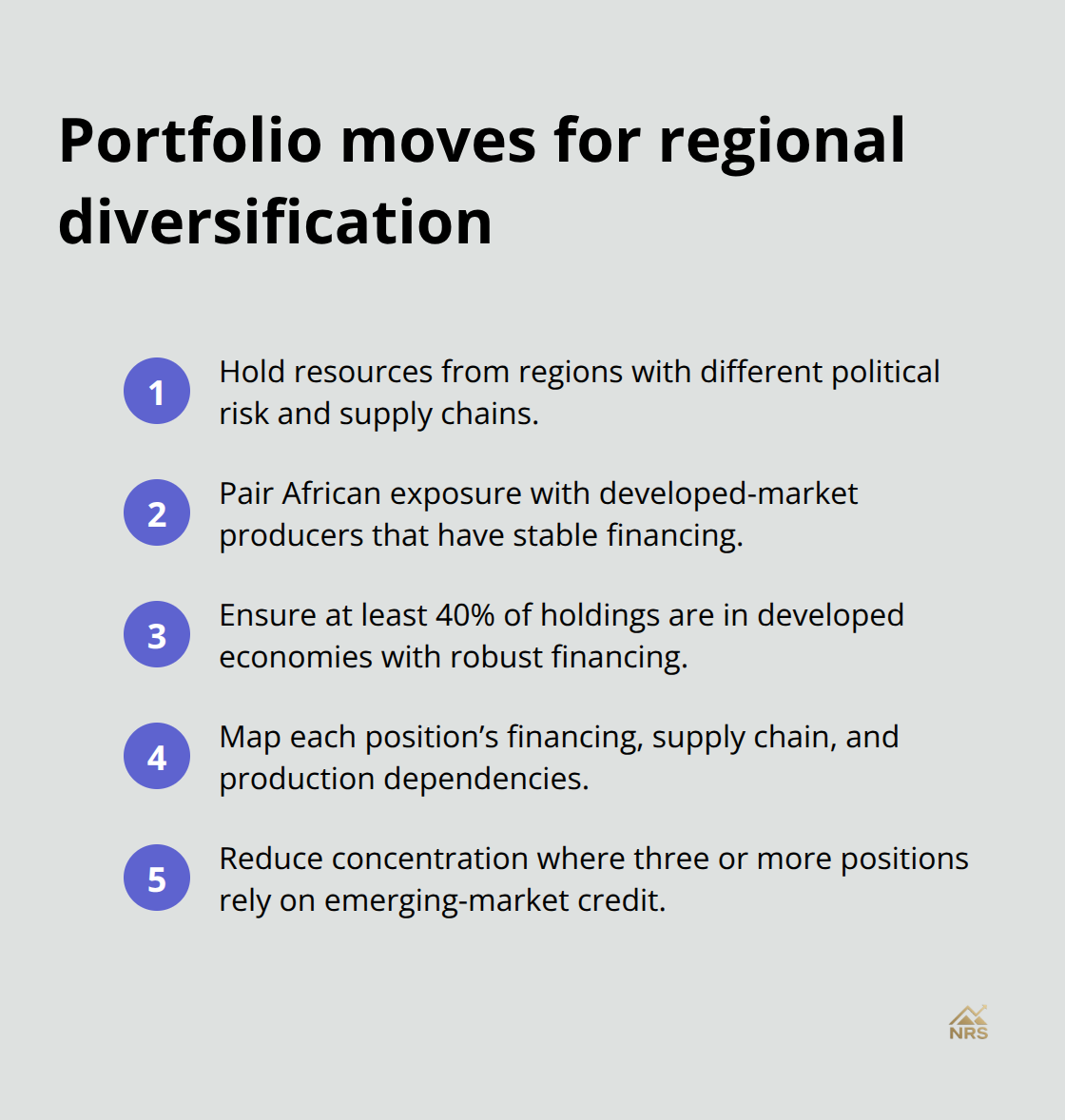
Rebalance so that at least 40% of your portfolio sits in resources from developed economies with established financing infrastructure that doesn’t evaporate during crises.
Time Entry Points After Initial Panic Selling
Timing entry points around geopolitical events requires abandoning the myth that you can predict when tensions will ease. Instead, track the geopolitical risk index built by Caldara and Iacoviello, which counts war and terrorism-related articles across major newspapers and updates continuously. When the index spikes to the 75th percentile or higher, prices have already absorbed most headline risk. The real opportunity arrives after initial panic selling when prices fall below fundamental value but before the market realizes the disruption was temporary.
After the Israel-Hamas conflict spiked the index to the top 5% in October 2023, energy stocks sold off despite stable global supply. Investors who added positions in the following weeks captured rebounds as the market recognized that Iranian action wouldn’t immediately disrupt flows. The opposite timing trap catches investors who wait for geopolitical risk to disappear completely before buying. Russell Investments notes that geopolitical risk is now structurally elevated due to multipolar leadership and rising defense spending, meaning you cannot wait for a risk-free environment. Instead, identify which commodities and regions are oversold relative to actual supply disruption risk. During the Russia-Ukraine conflict, some commodities traded below what non-war projections suggested because demand-side effects overwhelmed supply concerns. These periods create asymmetric opportunities where you pay less for assets than fundamental supply-demand conditions warrant.
Monitor Critical Shipping Routes and Logistics Networks
Shipping routes through the Red Sea and Strait of Hormuz matter more than most investors realize. About 12% of global maritime trade passes through the Red Sea, while 20% of global petroleum flows through the Strait of Hormuz. When disruptions in the Strait of Hormuz spike freight insurance costs and extend shipping times, companies with alternative logistics networks and inventory buffers gain competitive advantage.
This intelligence helps you select which resource stocks actually benefit from geopolitical moves rather than just riding general commodity price swings. Track these chokepoints specifically because they reveal which resource producers face real supply chain vulnerability and which ones operate with sufficient redundancy to weather disruptions.
Final Thoughts
Geopolitical investment effects on resource markets follow predictable patterns once you stop treating every headline as equally important. The distinction between actual supply disruption and perceived risk separates profitable investors from those chasing volatility. Oil and natural gas respond to mid-to-high uncertainty levels, gold reacts across the full spectrum, and iron ore only moves during extreme geopolitical stress. Rare earths and semiconductors now pose greater structural risks than traditional energy commodities because supply concentration in contested regions creates genuine leverage that no alternative supplier can quickly replace.
Taiwan’s near-monopoly on advanced semiconductors and China’s dominance in rare earth refining represent true chokepoints that reshape global supply chains far more severely than oil shocks. Geopolitical risk remains structurally elevated due to multipolar leadership and rising defense spending, so you cannot wait for a risk-free environment to invest. Instead, identify which commodities and regions are oversold relative to actual supply disruption risk, then time entry points after initial panic selling when prices fall below fundamental value. Diversify across regions with fundamentally different risk profiles and financing dependencies rather than spreading capital across similar assets, and monitor critical shipping routes like the Red Sea and Strait of Hormuz because they reveal which resource producers face real vulnerability.
Long-term opportunities exist in politically stable regions with established financing infrastructure that doesn’t evaporate during crises. Developed economies with transparent governance and diversified supply chains offer lower volatility than concentrated producers in unstable regions. Visit Natural Resource Stocks to explore how geopolitical factors influence your investment decisions and discover emerging opportunities in politically stable regions.