
























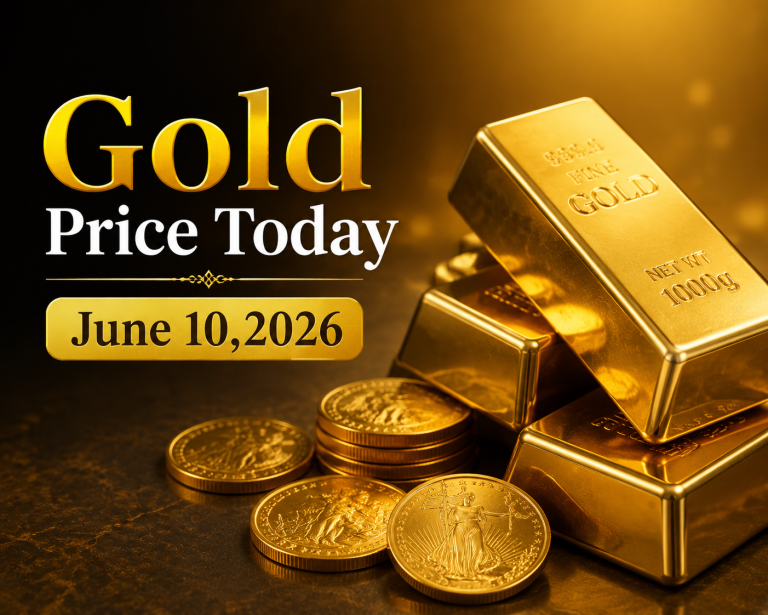
As of Jun 10, 2026 at 9:10 AM EDT, the live Gold spot price for 1 ounce of Gold in U.S. dollars (USD) is $4,181.10, 1 gram of Gold is $134.43 and 1 kilogram of Gold is $134,425.65. Gold spot price can fluctuate by the second, driven by investment supply and demand, and other factors.
Gold Spot Prices
|
Gold Price |
Price |
Change |
|
Gold Price Per Ounce |
$4,181.10 |
–$86.83 |
|
Gold Price Per Gram |
$134.43 |
–$2.79 |
|
Gold Price Per Kilo |
$134,425.65 |
–$2,791.49 |
Live Metal Spot Prices (24 Hours) Last Updated: 06/10/2026 at 8:33 AM EDT
Current Gold Price June 10, 2026: Market Snapshot
The current gold price June 10, 2026 opens softer, with the gold spot price per ounce June 10, 2026 holding near $4,181.10 in USD after a session decline of roughly $86.83 per ounce. The gold price June 10, 2026 USD per ounce sits well below the metal’s January record, reflecting a market that has spent the past several sessions on the defensive as a firmer U.S. dollar and rising rate-hike expectations weigh on non-yielding assets.
For investors tracking the current gold spot price June 10, 2026, the move lower extends a pullback that began after a stronger-than-expected U.S. labor market report. The gold spot price June 10, 2026 now trades in the low-$4,100s to low-$4,300s range across various feeds, with intraday volatility expected to pick up around today’s pivotal U.S. inflation release.
Gold Price Drivers June 10, 2026
Several macro forces are shaping the gold price drivers June 10, 2026. Here’s what’s moving the precious metals market today.
1. The U.S. Inflation Print Takes Center Stage
The single most important scheduled event today is the U.S. Consumer Price Index (CPI) release. Markets have been positioning cautiously ahead of the print, with the U.S. dollar trading near multi-week highs. A firmer-than-expected reading would harden the view that the Federal Reserve has little room to cut rates—a scenario that typically pressures gold by raising the opportunity cost of holding the metal. With petrol prices elevated and wholesale prices having jumped earlier in the spring, another hot inflation number could extend the dollar strength that has weighed on bullion.
The inflation data lands just ahead of a cluster of central bank decisions: the European Central Bank on June 11, the Federal Reserve on June 17, and the Bank of England on June 18. This front-loaded calendar of risk events has kept gold traders defensive, with positioning skewed toward caution heading into the data.
2. A Stronger Dollar and Rising Rate-Hike Bets
The recent leg lower in gold stems largely from a stronger-than-expected U.S. non-farm payrolls report for May, which showed 172,000 jobs added against a consensus near 85,000–90,000. This pushed Federal Reserve rate-hike expectations sharply higher, with CME futures pricing a November increase as roughly a 50/50 probability. The firmer US dollar, which rose alongside the payrolls data, added further pressure on dollar-denominated commodities.
Because gold pays no interest, higher rate expectations and elevated real Treasury yields increase the cost of holding it relative to interest-bearing alternatives—a key headwind feeding into today’s softer price.
3. Geopolitical Risk and Safe-Haven Demand
Ongoing Middle East tensions, including the continuing Iran conflict, have offered only partial safe-haven support for gold. Related inflation concerns also reinforce the case for rates staying elevated, creating a tug-of-war: geopolitical risk underpins gold’s appeal as a hedge, while the inflation it generates argues for tighter monetary policy that pressures the metal.
4. Structural Central Bank Demand
Beneath the near-term volatility, structural support remains intact. Central bank demand, including net purchases of 244 tonnes reported through Q1 2026 – up 3% year on year – provides an underlying support layer, even if it has not been enough to fully offset near-term pressure from real yields and dollar strength. Metals Focus, presenting its Gold Focus 2026 supply and demand report in the first week of June, said the key drivers from 2025 remain intact: US policy uncertainty, persistent concerns about the dollar’s long-term outlook, elevated geopolitical risks, and stretched equity valuations.
Gold Price Rally 2026 June Precious Metals Market: The Bigger Picture
To understand today’s price action, it helps to revisit the extraordinary gold price rally 2026 June precious metals market backdrop. The gold spot price closed 2024 at $2,624.69, then extended a powerful rally through 2025, gaining around 64% across the year before rising further into 2026. Prices broke above $5,000 for the first time on 26 January 2026 amid demand for safe-haven assets, as geopolitical tensions, dollar weakness and heavy central bank accumulation converged. The metal reached an all-time high of $5,595.75 on 29 January 2026.
A sharp reversal followed. Gold fell more than 17% from that peak through March 2026, as the US dollar and Treasury yields climbed on renewed inflation concerns linked to the Iran conflict, while traders unwound extended positions. The metal stabilised and recovered towards $4,890 in mid-April 2026, briefly supported by ceasefire optimism in the Middle East, but faded back below $4,700 as hopes for a lasting resolution cooled. The May jobs report then drove renewed selling, leaving the gold price June 10, 2026 current level meaningfully below its January high but still dramatically higher than where it began the rally.
What Analysts Expect for the Rest of 2026
Despite near-term caution, major banks remain structurally bullish. J.P. Morgan trimmed its 2026 full-year average gold price forecast to $5,243/oz from $5,708/oz, but maintained its base-case year-end target of around $6,000/oz, as it expects demand to re-accelerate in the second half of 2026. Goldman Sachs reaffirmed its $5,400/oz year-end 2026 gold price target, while UBS maintains quarterly markers of $5,200 for June, $5,400 for September, and $5,900 for December 2026.
The common thread: near-term caution over elevated US rate expectations, set against durable structural demand from central banks and geopolitical risk premium.
Spotlight: Domestic Gold Production and Natural Resource Stocks
For investors in natural resource equities, the gold price environment matters well beyond the spot market. A strong gold price supports the economics of domestic development projects—and one closely watched name is U.S. Gold Corp. (NASDAQ: USAU).
The company has been advancing its CK Gold Project in southeast Wyoming, located roughly 20 miles west of Cheyenne. U.S. Gold Corp. announced completion of a feasibility study for its CK Gold Project showing an after-tax net present value of $632 million and a 27% internal rate of return using base case metal prices. The study outlines an 11-year mine life producing 931,000 gold-equivalent ounces, with an average annual production of 85,000 gold-equivalent ounces at total cash costs of $1,748 per ounce.
Crucially in a high-price environment, the project is positioned to move quickly. The project is now fully permitted at the state level, with all required permits in hand and a $5 million reclamation bond posted for initial construction, and is targeting a construction start in 2026, with first production of gold-copper concentrate in late 2027 to 2028. Ongoing technical work—including magnetic survey and exploration activity at the project—continues as the company moves toward a construction decision. With current cash costs near $1,748 per ounce against a gold price above $4,100, the margin backdrop for construction-ready domestic projects like CK Gold remains compelling.
Gold Price Today: Key Takeaways
- The gold spot price June 10, 2026 stands at $4,181.10 per ounce as of 8:33 AM EDT, down roughly $86.83 on the session.
- Today’s U.S. CPI inflation print is the dominant near-term catalyst, with a hot reading likely to extend dollar strength and pressure gold.
- A stronger dollar, elevated Treasury yields, and rising Fed rate-hike expectations are the primary gold price drivers June 10, 2026.
- Structural supports—central bank buying of 244 tonnes in Q1 2026 and persistent geopolitical risk—remain intact beneath the volatility.
- Major banks keep year-end 2026 targets between $5,400 and $6,000/oz despite trimming near-term averages.