
























Gold prices don’t move randomly. They respond to specific catalysts-and understanding what drives them matters for your portfolio.
At Natural Resource Stocks, we’ve identified the key gold price drivers for 2026. Macroeconomic shifts, geopolitical tensions, and market dynamics will shape where gold heads this year. This guide breaks down each catalyst so you can position yourself ahead of the moves.
What Moves Gold Prices in 2026
Real interest rates dominate gold price movements, and the Federal Reserve’s policy path will matter more than almost anything else this year. The consensus expects roughly 75 basis points of Fed rate cuts priced in for 2026, according to World Gold Council analysis. Each cut makes non-yielding gold more attractive relative to bonds and savings accounts. When the Fed cuts rates, gold typically dips briefly after the first reduction, then rallies in the months that follow as investors rotate into alternative stores of value. The key metric to watch is real yields-the inflation-adjusted return on government bonds. If real yields fall, gold wins. If they rise sharply, gold faces headwinds. As of early 2026, core CPI and PCE are expected to fall around 40 to 60 basis points, which should keep real rates manageable and supportive for gold demand.
The Dollar’s Inverse Relationship with Gold
The US dollar index moves inversely to USD-priced gold nearly 100% of the time. A stronger dollar makes gold more expensive for international buyers and reduces demand; when the dollar weakens, gold becomes relatively cheaper for holders of other currencies, which can boost demand and lift prices. World Gold Council data shows the 2026 macro backdrop includes a broadly higher US dollar, which could create a headwind for gold prices unless other catalysts override it. Monitor the DXY (US Dollar Index) weekly alongside gold prices. If the dollar strengthens beyond consensus expectations, expect gold to struggle unless inflation surprises to the upside or geopolitical risk spikes. Currency moves often explain 40 to 60% of gold’s quarterly performance, making the dollar relationship one of the most reliable price indicators available.
Growth Expectations and Tail-Risk Scenarios
Global real GDP growth is expected to run around 2.7 to 2.8% in 2026, according to World Gold Council consensus forecasts. This middling growth backdrop creates a baseline scenario where gold remains rangebound unless a tail-risk event occurs. However, tail risks are rising. Indicators like S&P 500 kurtosis and skew point to more frequent market shocks ahead. Any sharp slowdown in US data could trigger a shallow slip scenario where the Fed cuts faster than expected and gold rallies 5 to 15% during the year. A synchronized global slowdown or geopolitical escalation could push gold 15 to 30% higher as investors flee to safety and ETFs see sustained inflows. The reflation scenario-where fiscal stimulus accelerates growth and inflation-would push the Fed to hold or hike rates, strengthen the dollar, and weigh on gold by 5 to 20%.
What to Monitor for Scenario Shifts
Economic data surprises will determine which scenario unfolds. Watch US employment reports, manufacturing activity, and consumer spending closely. If data softens faster than expected, the shallow slip scenario becomes more likely and gold should benefit. If inflation remains sticky despite rate cuts, the reflation scenario gains traction and gold faces pressure.
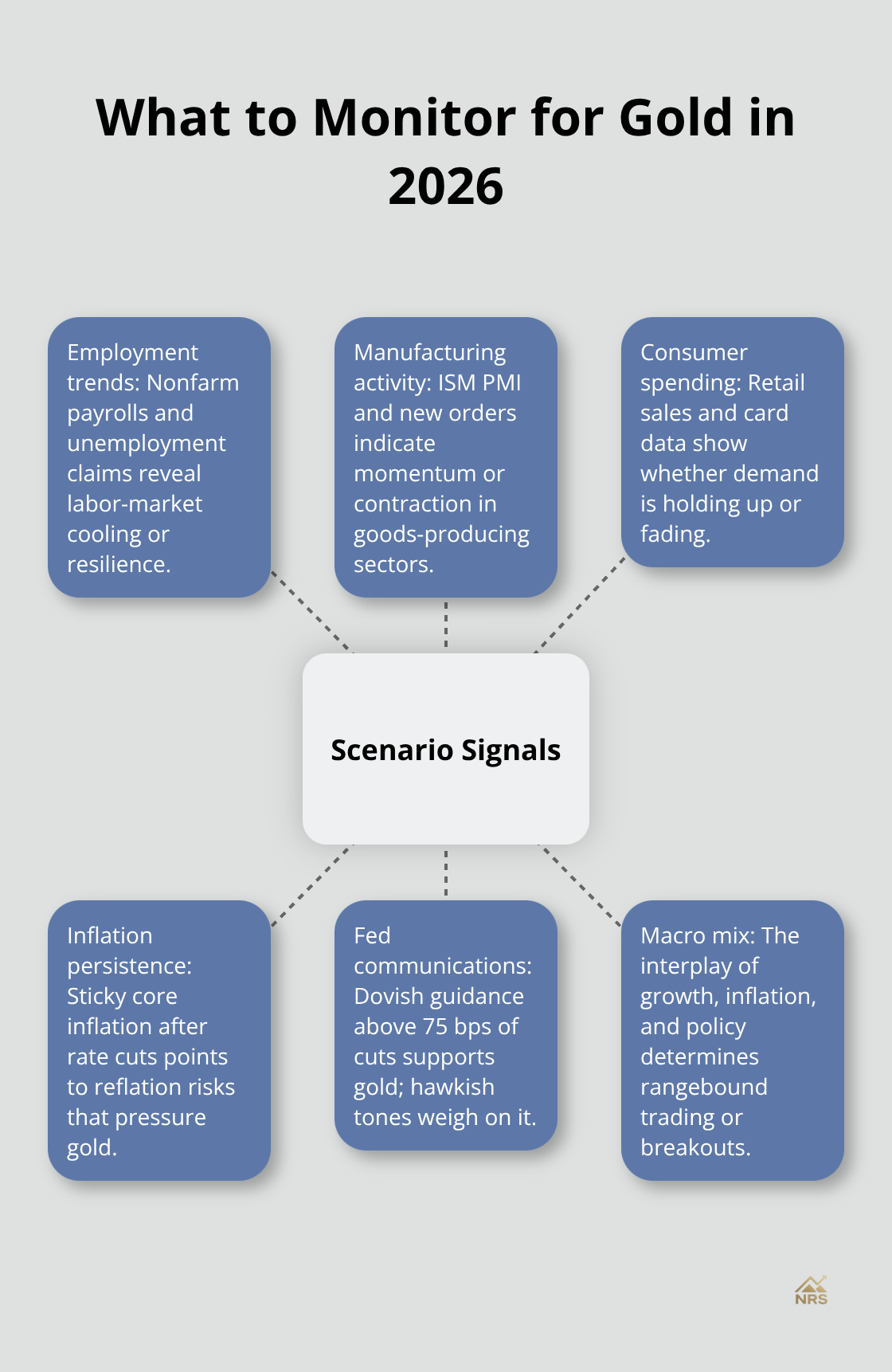
Central bank communications matter equally-any hint that the Fed will cut more aggressively than 75 basis points supports gold, while hawkish signals weigh against it. The relationship between these three factors (growth, inflation, and Fed policy) will shape gold’s direction throughout 2026 and determine whether the metal trades in a narrow range or breaks out to new highs.
Geopolitical tensions and central bank actions will now take center stage as we examine the forces that can override macroeconomic fundamentals and drive gold prices in unexpected directions.
Geopolitical Risk and Central Bank Demand Drive Gold Higher in 2026
Safe-Haven Demand Spikes When Tensions Rise
Geopolitical instability acts as gold’s price floor. When regional conflicts escalate or trade tensions spike, institutional investors and central banks shift capital into gold faster than any other asset class. The 2025 rally that pushed gold up 64 percent according to Yahoo Finance data was driven equally by four factors: high-risk environment, a weaker dollar, price momentum, and economic expansion. The high-risk component matters most for 2026. Tail-risk indicators including S&P 500 kurtosis and skew point to more frequent market shocks ahead, and each shock historically triggers immediate safe-haven demand. If tensions in the Middle East escalate or new trade wars erupt, gold spikes 5 to 15 percent within weeks as portfolios rotate toward non-correlated assets. Position gold exposure before events occur rather than after, since price spikes happen within days of major announcements.
Central Banks Rebalance Reserves Toward Gold
Central banks drive gold prices far more than retail investors do. According to World Gold Council analysis, central banks resumed net buying in April 2026. The IMF COFER data shows global central-bank gold holdings total about 36,200 tonnes, representing roughly 20 percent of official reserves, up from about 15 percent at end-2023. This upward trend reflects a deliberate shift: emerging-market central banks diversify away from US dollar reserves and toward gold as a hedge against currency devaluation and geopolitical risk.
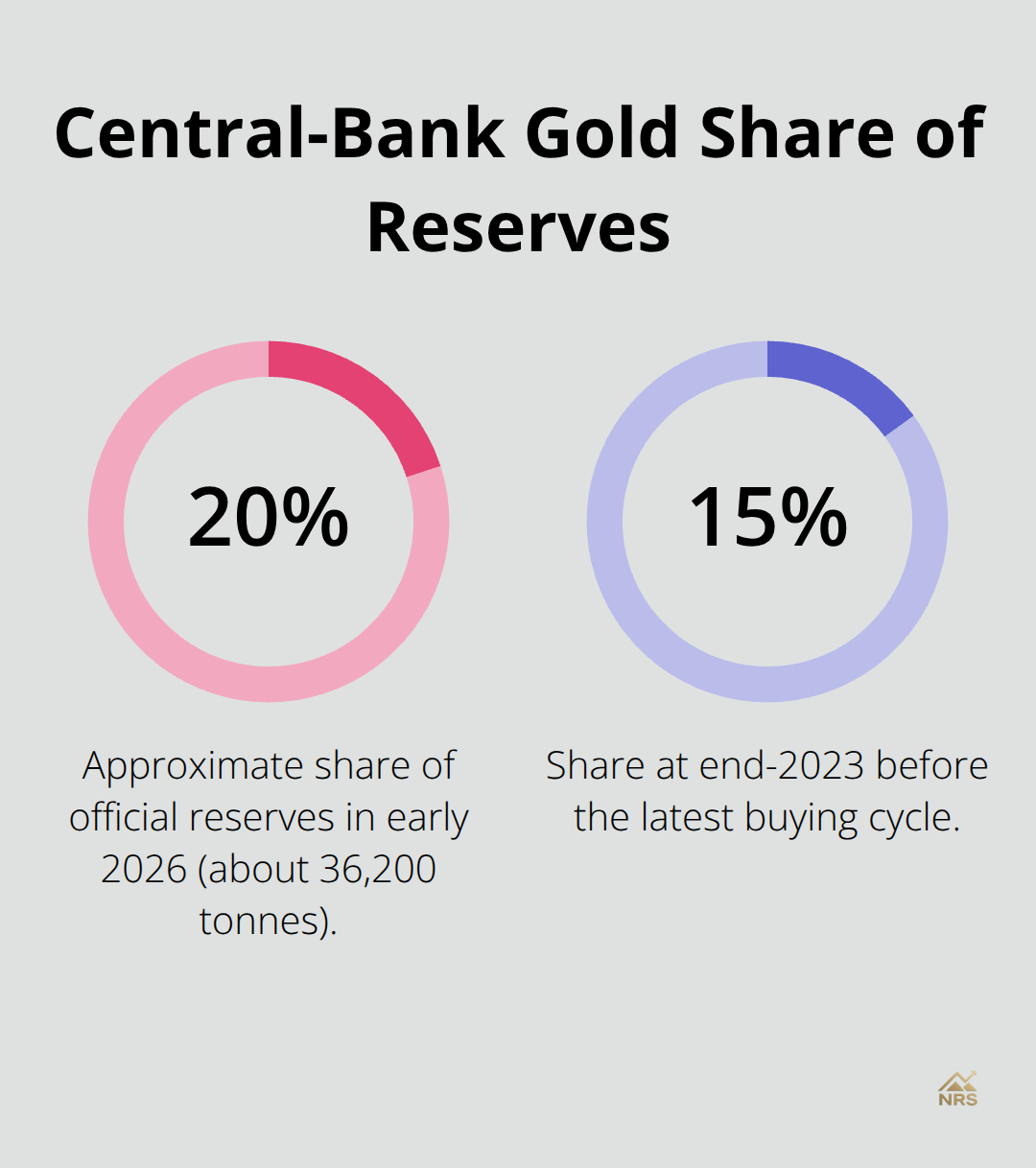
A BIS study notes that gold allocations of five to ten percent can improve portfolio performance, suggesting emerging-market central banks could move toward 10 percent of reserves in gold. This reserve rebalancing is structural policy, not speculation.
Supply Cannot Match Demand Growth
Mine supply is relatively inelastic and slow to respond to higher prices, meaning that sustained central bank demand creates a persistent upside bias. If China, India, or other major emerging markets accelerate purchases, gold prices move higher with near certainty because miners cannot ramp production quickly enough to meet the surge. The structural mismatch between rapid demand shifts and sluggish supply response favors higher prices throughout 2026. Track official sector purchases quarterly through World Gold Council reports and IMF COFER updates. When central bank buying remains robust, gold grinds higher as the year progresses, and supply constraints amplify each tonne of additional demand into measurable price gains.
What Comes Next: Investment Flows and Market Structure
Central bank purchases establish the price floor, but investment flows and ETF holdings determine whether gold breaks out to new highs or consolidates within a range. The next section examines how retail and institutional investors position themselves through ETFs and physical demand, and how these flows interact with central bank activity to shape gold’s trajectory in 2026.
ETF Flows and Mining Supply: The Price Mechanics of 2026
Investment Flows Drive Short-Term Gold Momentum
Investment flows through gold ETFs have become the dominant short-term price driver, and the numbers reveal the mechanics clearly. Global gold ETFs attracted approximately $77 billion of inflows in 2025 according to World Gold Council data, adding more than 700 tonnes to total holdings. Since May 2024, global gold ETF holdings have risen by roughly 850 tonnes, yet current levels remain well below prior cycle peaks. This gap means substantial room exists for further inflows if macro conditions shift. Each 100 tonnes of net quarterly demand above the baseline 350 tonnes needed to support current price levels generates approximately 2 percent quarter-on-quarter price gains. This relationship is mechanical and predictable, making ETF flow monitoring essential for positioning your exposure. The projected 250 tonnes of ETF inflows in 2026 sounds modest until you realize that bar-and-coin demand will exceed 1,200 tonnes annually across the same period.
Quarterly Demand Floors Support Prices Through Volatility
Total quarterly demand is expected to run about 585 tonnes on average, with roughly 190 tonnes per quarter from central banks and 330 tonnes per quarter as bar-and-coin demand. These flows create a demand floor that supports prices even when macro sentiment turns negative. Central banks will maintain the 755 tonnes of annual purchases projected for 2026, providing structural support that retail investors cannot replicate. This combination of official sector purchases and physical demand means gold prices have multiple layers of support built into 2026 fundamentals.
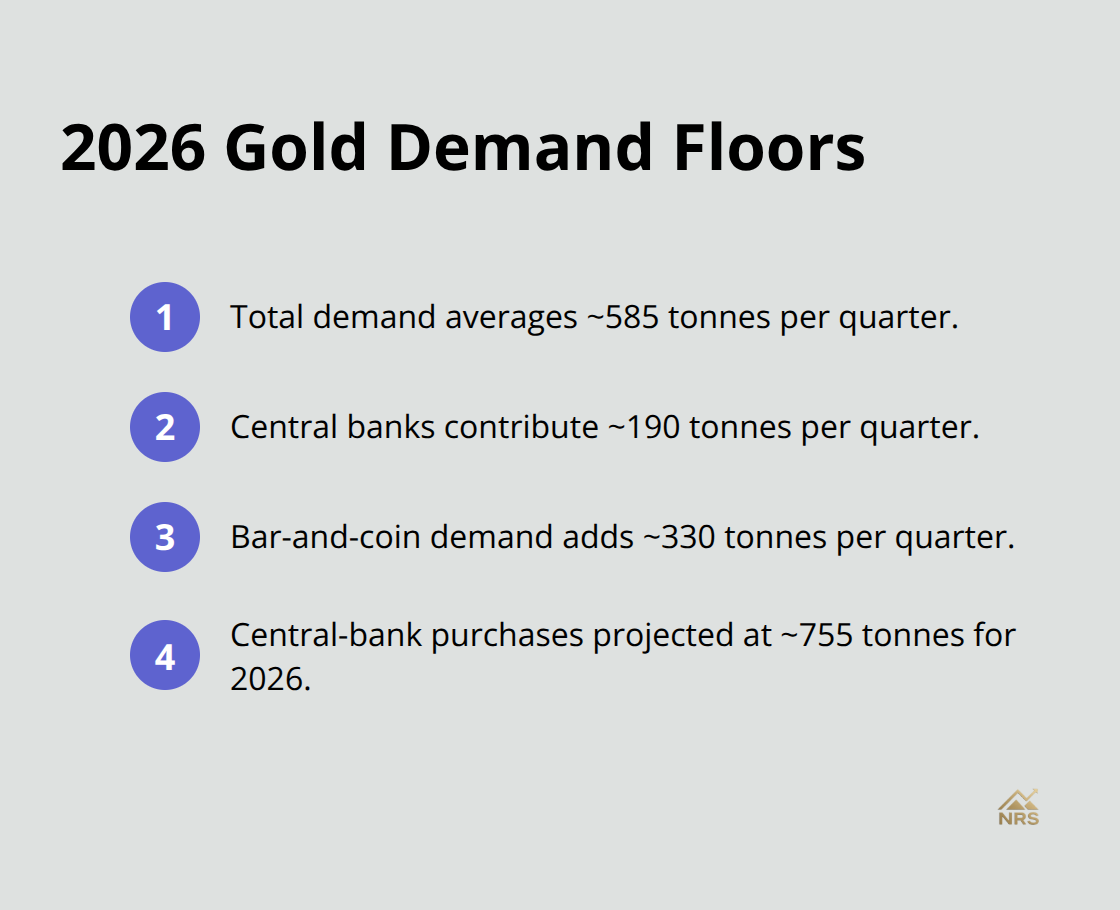
When one demand source weakens, others compensate and prevent sharp declines.
Mining Supply Lags Demand by Years, Not Months
Mine supply is inelastic and lags demand by 18 to 24 months, meaning that current price strength cannot quickly attract new production. Higher gold prices in 2025 did not materially increase 2026 mine output because exploration and development take years to convert into actual ounces. This structural lag creates persistent upside risk whenever demand accelerates. If central banks maintain their projected purchases while ETF inflows accelerate beyond the 250-tonne baseline, miners cannot bridge the gap quickly enough to prevent price spikes.
Hidden Demand From Collateral Financing and AUM Growth
India’s collateral financing trend adds another demand layer worth tracking. Over 200 tonnes of jewelry have been pledged as loan collateral in the formal sector according to Reserve Bank of India data, with evidence suggesting a similar magnitude in the informal sector. This represents demand that would not exist in traditional markets and creates a supply shock that miners must absorb. Gold’s share of total assets under management could rise toward 4 to 5 percent over coming years. If institutional AUM exposure increases by even 1 percentage point, that translates to hundreds of tonnes of additional demand hitting a supply system that cannot respond within months. Position exposure before these flows accelerate rather than after prices spike, because mining supply constraints guarantee that demand surprises translate directly into price gains.
Final Thoughts
Gold price drivers in 2026 converge around three structural forces: real interest rates, central bank reserve rebalancing, and supply constraints that cannot flex quickly enough to meet demand surges. Real yields will remain the dominant macro lever, with each 75 basis points of Fed cuts supporting gold through lower opportunity costs. The US dollar will create headwinds unless geopolitical risk or inflation surprises override currency strength.
Central banks will maintain their structural buying program at roughly 755 tonnes annually, establishing a price floor that retail investors cannot replicate. ETF inflows and physical demand will add another 1,500 tonnes of annual support, while mine supply lags by 18 to 24 months and cannot respond to demand acceleration. This mismatch between rapid demand shifts and sluggish supply response creates persistent upside bias throughout 2026.
Monitor quarterly net demand flows, real yields, and the US Dollar Index weekly to track the gold price drivers 2026 will present. When central bank purchases remain robust and ETF inflows accelerate above the 250-tonne baseline, gold will grind higher with near certainty because supply cannot keep pace. We at Natural Resource Stocks track these flows and macro catalysts continuously through expert analysis and market commentary.