
























Gold prices don’t move randomly. They respond to specific forces that savvy investors need to understand.
At Natural Resource Stocks, we’ve identified the key gold price drivers in 2026 that separate informed decisions from guesswork. This guide breaks down the macroeconomic factors, geopolitical events, and supply-demand dynamics that actually move the metal.
What Moves Gold When Interest Rates and Inflation Shift
Real Yields Drive Gold Valuations
Real yields-the inflation-adjusted return on bonds-dominate gold price movements in 2026. According to PIMCO research, a 100 basis-point rise in 10-year real yields corresponds to roughly an 18% decline in inflation-adjusted gold prices. This relationship matters because the Federal Reserve’s stance on rates directly influences whether gold rallies or retreats.
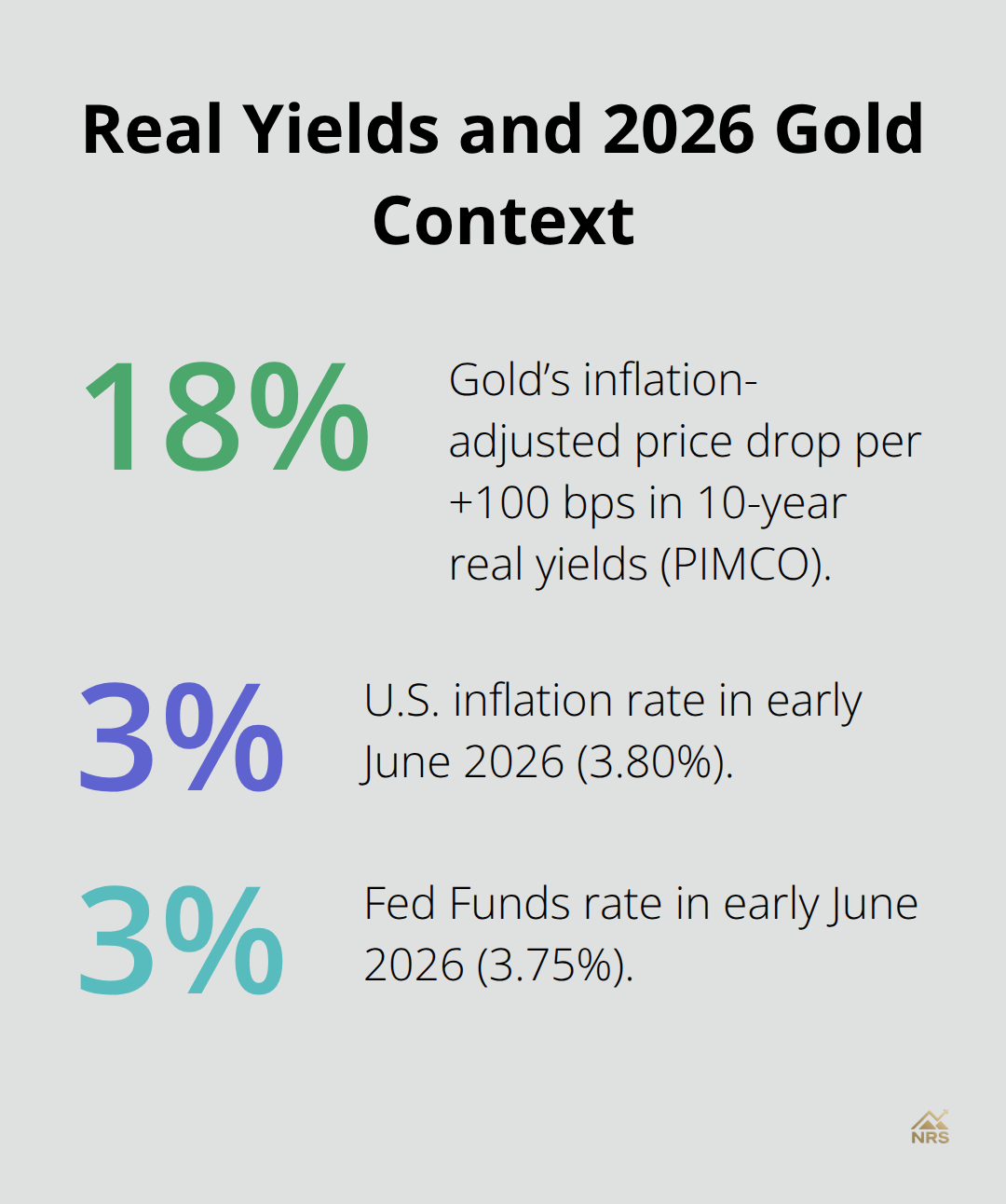
In early June 2026, US inflation sat at 3.80% with the Fed Funds rate at 3.75%, leaving real yields compressed and supporting gold’s appeal as a hedge against currency erosion.
Gold traded around 4,465 USD per ounce on June 4, 2026, down from its all-time high of 5,608.35 USD per ounce in January 2026 as rate-hike expectations grew and real yields tightened. Watch the Cleveland Fed and other policymakers closely. Beth Hammack, Cleveland Fed President, signaled possible rate hikes if inflation pressures persist-a statement that immediately pressured gold. When central banks signal tighter monetary policy, gold becomes less attractive because investors can earn positive real returns elsewhere. Conversely, when real yields fall (either through lower nominal rates or rising inflation), gold becomes the preferred safe-haven asset.
Dollar Strength and Currency Dynamics
The US dollar strength forms the second pillar of gold’s 2026 outlook. A firmer dollar makes gold more expensive for international buyers, which dampens demand. The US dollar index hovered around 99.48 in early June 2026, and stronger-than-expected labor data, with April job openings near two-year highs, kept the dollar resilient. However, this strength came at gold’s expense during the week of June 4, when the metal fell roughly 2% as rate-hike expectations surged.
Energy prices compound this dynamic: crude oil traded between 95–97 USD per barrel and natural gas near 3.2 per unit, fueling inflation expectations that can push real yields higher and weaken gold. Monitor weekly dollar-index movements and correlation shifts. When the dollar weakens-particularly if the Fed cuts rates faster than expected-gold typically accelerates higher. JPMorgan forecasts gold at approximately 5,055 USD per ounce in Q4 2026 and 5,400 USD per ounce by end of 2027, predicated on a moderation in rate hikes and dollar weakness.
Labor Markets Signal Rate Direction
Economic resilience also plays a critical role in gold’s trajectory. If US labor markets cool faster than anticipated, the Fed may pivot to cuts, which would reduce real yields and support gold prices significantly. Trading Economics projects gold at approximately 4,942.87 USD per ounce within 12 months, suggesting modest upside if rate cycles stabilize. Track Fed meeting schedules and real-yield data from US TIPS markets as your primary signals for positioning in gold.
The interplay between inflation, real yields, and currency strength creates the foundation for understanding gold’s near-term price action. These macroeconomic forces set the stage for how geopolitical events and central bank actions amplify or dampen gold’s appeal in 2026.
How Geopolitical Risk and Central Banks Reshape Gold Demand
Geopolitical Instability Accelerates Gold Prices
Geopolitical instability as a safe-haven driver acts as a direct accelerant for gold prices, and 2026 offers no shortage of catalysts. Trade tensions between major economies compound this dynamic. When tariffs spike or international conflicts escalate, institutional investors and central banks simultaneously increase gold allocations as insurance against currency devaluation and financial system stress. This happened in early 2022 when Russia invaded Ukraine and gold prices rose despite higher real yields, proving that safe-haven demand can override traditional yield-based valuation models.
Central Bank Purchases Create Structural Price Support
Central bank gold reserve allocation targets represent the structural shift that matters most for 2026. According to J.P. Morgan Global Research, central banks purchased approximately 755 tonnes of gold in 2026, remaining elevated versus pre-2022 levels. Brazil reported purchases of 15 tonnes in September and 16 tonnes in October 2025, while the Bank of Korea publicly discussed additional gold acquisitions. This behavior reflects a deliberate strategy: emerging-market central banks with commodity-dependent currencies benefit from holding more than 20% of reserves in gold according to BIS research.
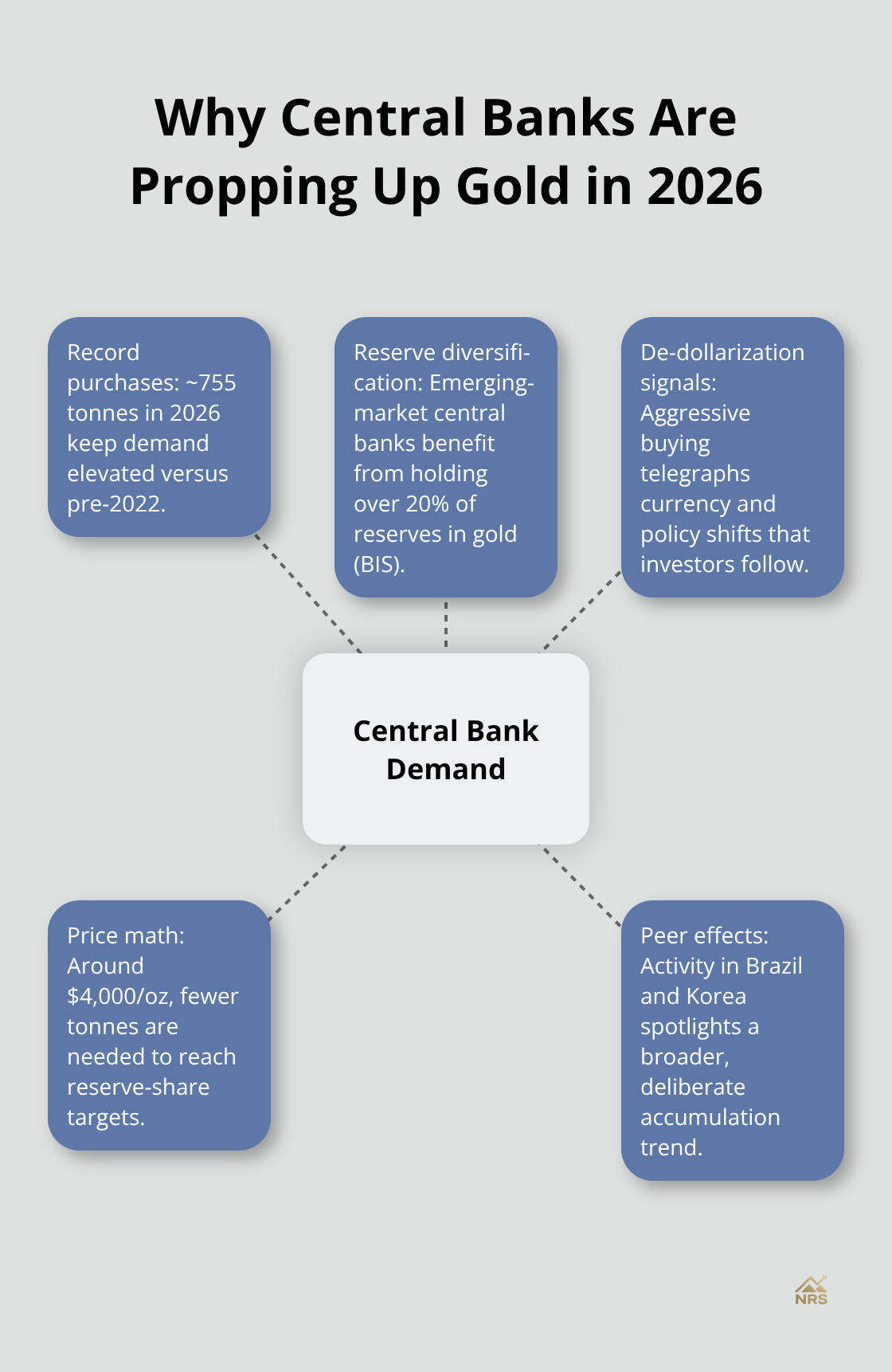
At roughly 4,000 USD per ounce, central banks need fewer tonnes to reach reserve-share targets. The U.S. holds about 8,133 tonnes, China about 2,313 tonnes, and Russia about 2,305 tonnes as of March 2026. If reserve allocations for central banks with gold shares under 10% rise to 10% at current prices, the notional shift would represent approximately 1,200 to 2,600 tonnes of incremental demand. This directly props up prices and creates a structural floor beneath gold. Central bank announcements signal whether de-dollarization trends will accelerate or stall, and when central banks buy aggressively, individual investors typically follow, creating momentum that extends beyond the initial purchase.
ETF Flows and Risk-Off Behavior Drive Institutional Demand
Risk-off market behavior during economic uncertainty amplifies gold’s appeal beyond central bank mechanics. In June 2026, gold’s appeal hinged on whether equity markets would suffer further volatility from rate-hike fears. Gold’s all-time high of 5,608.35 USD per ounce in January 2026 reflected strong safe-haven demand when uncertainty peaked. Physical gold ownership remains modest at roughly 10.8% of the population according to Gallup 2025 data, but institutional allocation through ETFs surged dramatically. U.S. ETF holdings of gold exceeded 150 billion USD by June 2025 and continued expanding into 2026. When stock-market selloffs accelerate, ETF inflows spike because gold provides negative correlation to equities during downturns. J.P. Morgan expects approximately 250 tonnes of ETF inflows in 2026 as institutional allocators rebalance toward alternatives. Monitor equity volatility indexes and central bank policy divergence closely. When the VIX rises sharply or when central banks signal conflicting rate paths, gold typically rallies within days. Energy-driven inflation directly influences whether policymakers tighten further, which either supports or undermines gold valuations depending on whether the tightening stems from growth or stagflation concerns.
Supply and Demand Dynamics in 2026
Mining Supply Constraints Set the Price Floor
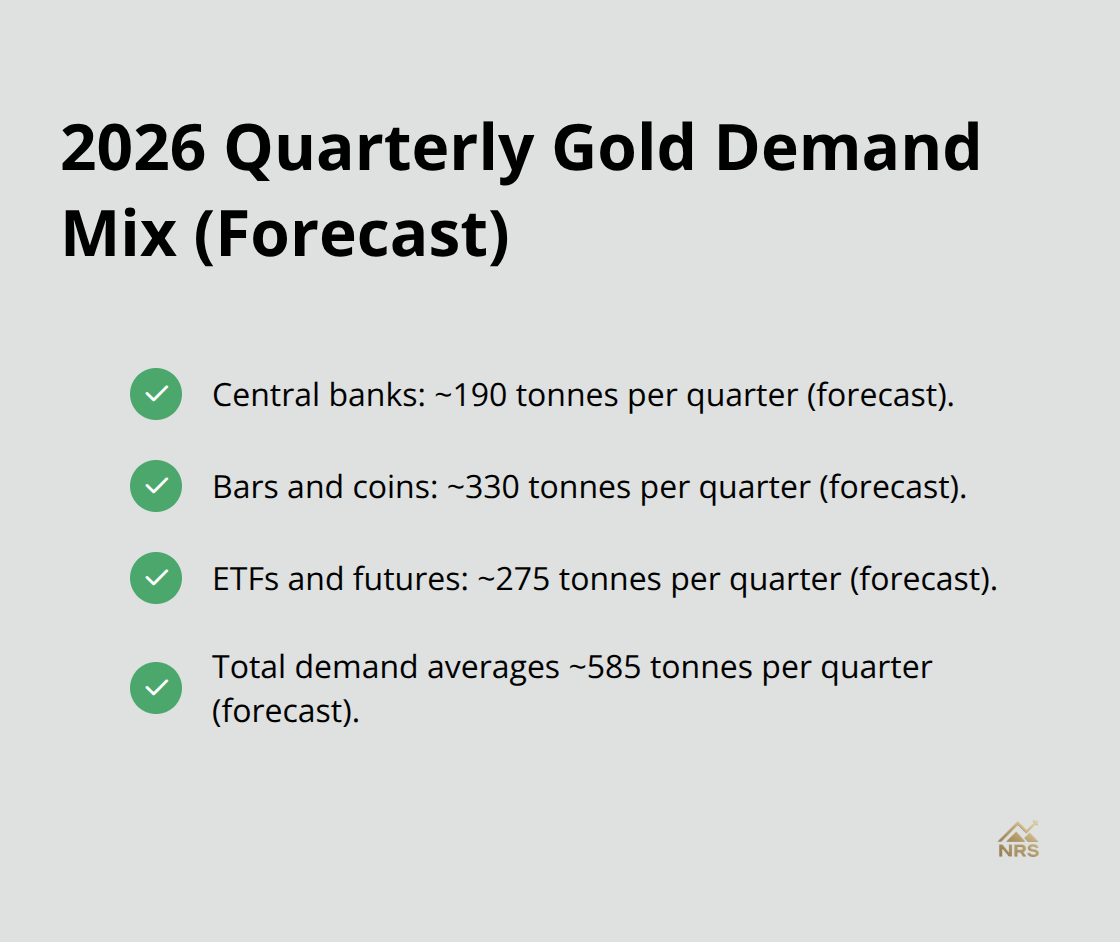
Global gold production remains relatively inelastic-major producers including China, Australia, the United States, South Africa, Russia, Peru, and Indonesia cannot rapidly scale output to match sudden demand spikes. This supply rigidity matters enormously because when central banks, ETF managers, and jewelry manufacturers compete for the same limited ounces, prices move sharply upward. J.P. Morgan forecasts quarterly demand averaging approximately 585 tonnes throughout 2026, with roughly 190 tonnes from central banks, 330 tonnes from physical bars and coins, and 275 tonnes from ETFs and futures contracts. The front-loading of ETF demand early in 2026 already created scarcity signals that pushed prices toward record highs in January.
Jewelry and Industrial Demand Patterns
Jewelry consumption continues to lead overall demand globally, with India, China, the United States, Turkey, Saudi Arabia, Russia, and the UAE driving consumption patterns. However, jewelry demand remains price-sensitive-when gold breaches 5,500 USD per ounce, Indian wedding seasons and Chinese gift-giving cycles show measurable slowdowns. Industrial applications consume a smaller allocation, meaning that investment and central bank demand now dominate price discovery on both the London over-the-counter market and COMEX futures exchanges where standard contracts represent 100 troy ounces.
Institutional Ownership Reshapes Price Discovery
The structural shift toward institutional ownership represents the real game-changer for 2026. Gold’s share of total assets under management reached approximately 2.8% by September 2025, with potential to expand toward 4 to 5% as wealth managers rebalance away from bonds and equities facing rate-hike headwinds. This modest reallocation would inject enormous incremental demand because a 0.5% diversification of foreign US assets into gold could theoretically lift prices toward $6,000/oz given inelastic mine supply.
ETF Inflows and Retail Participation
ETF inflows averaged approximately 250 tonnes expected for 2026 according to J.P. Morgan projections, with physical bar and coin demand projected above 1,200 tonnes annually as economic uncertainty accelerates retail participation. The real insight here: institutional demand now drives marginal price discovery far more than traditional jewelry consumption. When Morningstar guidance suggests limiting gold to roughly 15% of portfolio allocations, it implicitly acknowledges that mainstream financial advisors still underweight gold relative to historical norms. This creates a structural tailwind because as allocators move from 2.8% toward even 3.5% of assets under management, the tonnage required vastly exceeds annual production growth.
Monitoring Institutional Flows for Price Signals
Track quarterly ETF holdings data released by World Gold Council and monitor institutional fund flows through major gold vehicles. When ETF holdings accelerate above historical quarterly averages, expect spot prices to follow within weeks because institutional buying creates momentum that retail investors recognize and chase.
Final Thoughts
Gold price drivers in 2026 boil down to three interconnected forces: real yields, geopolitical risk, and institutional demand. Real yields remain the dominant lever-when the Fed signals rate hikes, gold retreats; when real yields compress, gold accelerates. The dollar’s strength matters equally because a firmer currency makes gold expensive for international buyers and dampens demand across emerging markets, while geopolitical instability acts as the accelerant that overrides traditional valuation models (as happened in early 2022 when gold rallied despite rising real yields during Russia’s invasion of Ukraine).
Central bank purchases and ETF flows now drive marginal price discovery far more than jewelry consumption. With central banks forecast to buy approximately 755 tonnes in 2026 and ETF inflows expected around 250 tonnes, institutional demand creates structural support beneath spot prices. The real opportunity lies in recognizing that gold’s share of assets under management sits at only 2.8% as of September 2025-a modest reallocation toward 4 to 5% would inject enormous incremental demand that inelastic mining supply cannot quickly satisfy.
To monitor these gold price drivers 2026 effectively, track three metrics weekly: the 10-year real yield from US TIPS markets, the US dollar index, and central bank purchase announcements. When real yields fall or central banks signal de-dollarization strategies, position accordingly. Visit Natural Resource Stocks to access the analysis and community insights that separate informed positioning from reactive trading.