
























Gold has weathered every major market crash of the past 50 years. At Natural Resource Stocks, we’ve seen investors who held gold during the 2008 financial crisis, the 2020 pandemic crash, and the 2022 rate hike cycle all protect their wealth when stocks plummeted.
A solid gold investment strategy isn’t about betting on gold alone. It’s about building a portfolio where gold works alongside stocks, bonds, and other assets to reduce losses when markets turn ugly.
Why Gold Protects When Markets Crack
Gold’s track record speaks louder than any theory. During the 2008 financial crisis, while the S&P 500 dropped 57%, gold gained 5.5% that year according to World Gold Council data. In 2020, when stocks initially plummeted 34% in weeks, gold rose 25% for the year.
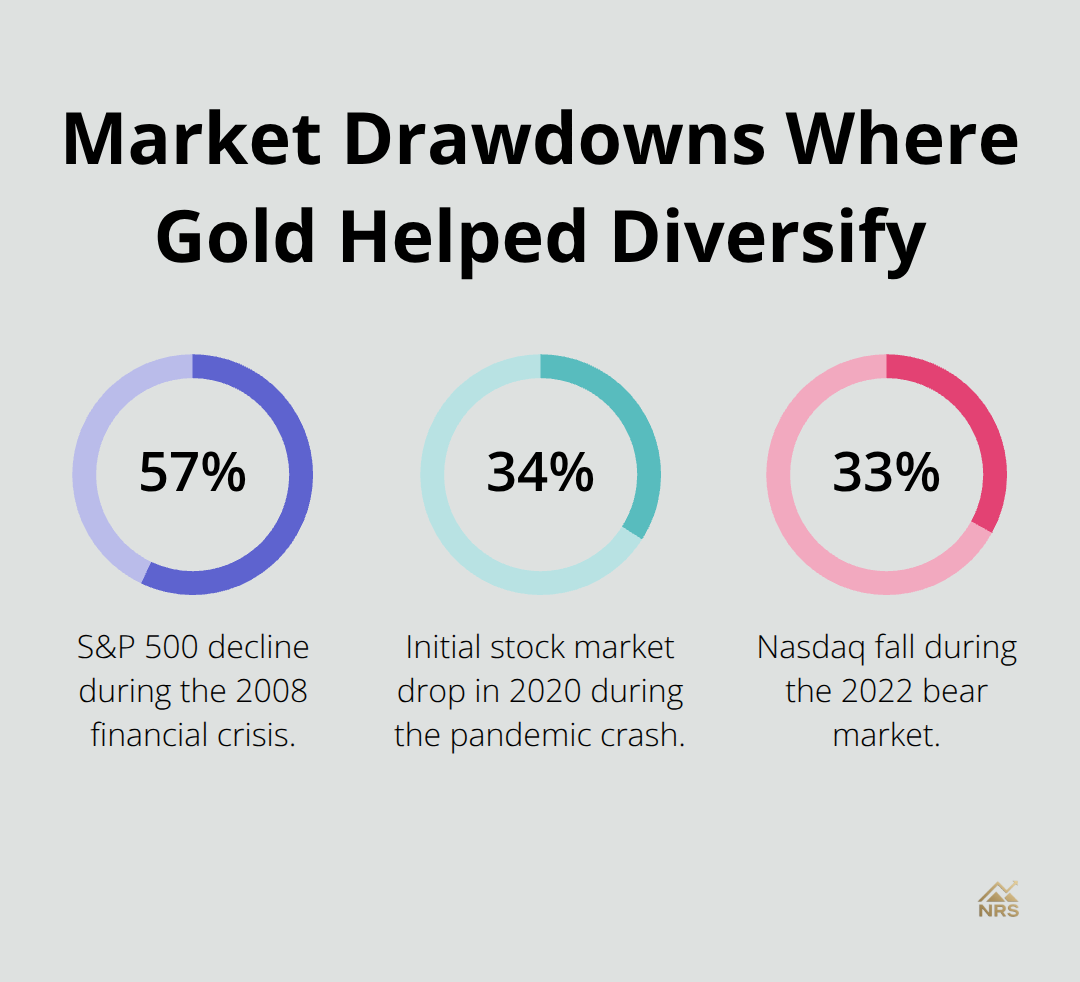
The 2022 bear market saw similar protection, with gold declining just 0.3% while the Nasdaq fell 33%. These aren’t coincidences. Gold moves independently from equities because it responds to different market forces. When investors panic and dump stocks, they often buy gold as a safe harbor. Central banks also purchase gold during uncertainty, creating steady demand that supports prices when everything else sells off. This inverse relationship makes gold genuinely useful in a portfolio, not just a speculative bet.
Inflation eats purchasing power, gold doesn’t
Gold has preserved wealth across centuries because it holds value when currencies weaken. Since 2000, the U.S. dollar has lost roughly 40% of its purchasing power, according to inflation data from the Bureau of Labor Statistics. Gold, meanwhile, appreciated from around $280 per ounce to over $2,400 per ounce by 2024. This isn’t luck. Gold supply grows slowly each year, roughly 1-2%, which prevents the endless dilution that plagues fiat currencies. When central banks print trillions of dollars or euros, gold becomes more valuable relative to that expanding money supply.
You can hold physical gold, gold ETFs like GLD or IAU, or gold mining stocks, and all three benefit from this purchasing power preservation. Physical gold stored safely requires no counterparty risk. Gold ETFs offer liquidity and lower storage costs. Mining stocks provide leverage to gold price movements, though with higher volatility. The choice depends on your comfort with complexity and how much portfolio diversification you already have.
Gold doesn’t move in lockstep with stocks and bonds
Academic research from the World Gold Council shows gold’s correlation with the S&P 500 averaged just 0.15 over the past two decades, meaning gold and stocks rarely move together. When stocks rise, gold sometimes falls. When stocks crash, gold typically climbs. This low correlation is the mathematical reason gold belongs in a diversified portfolio. A 10% allocation to gold reduces overall portfolio volatility without sacrificing expected returns.
Some investors mistakenly believe they should own gold only when they expect a crash. That’s backwards. Gold works best as a permanent, modest allocation that smooths returns across market cycles. This approach means gold doesn’t require you to time markets perfectly. It just sits there, uncorrelated and ready to cushion losses whenever equities stumble. Understanding these three protective mechanisms-crisis performance, inflation resistance, and low correlation-sets the foundation for building an actual allocation strategy that works across different market environments.
How Much Gold Should You Own?
Finding Your Optimal Gold Allocation
The right gold allocation depends on your risk tolerance and existing portfolio composition. Most investors should hold between 5% and 15% of their portfolio in gold. Anything below 5% provides minimal volatility reduction. Anything above 15% starts creating drag during bull markets when stocks outperform.
The sweet spot for most portfolios sits around 10%, according to analysis from the World Gold Council showing optimal risk-adjusted returns. If you already own bonds making up 30% of your portfolio, a 10% gold allocation works well alongside them. If you’re 90% stocks, push gold closer to 15% to genuinely cushion downturns.
Start by calculating your current portfolio value, then commit that percentage to gold in whatever form suits your situation. This isn’t a guess-it’s math based on correlation coefficients and historical volatility data.
Choosing Your Gold Vehicle
Once you’ve settled on your allocation, the next decision becomes far more important: which vehicle actually holds your gold. Physical gold bars and coins offer complete ownership with zero counterparty risk, but they demand secure storage costing roughly 0.5% to 1% annually at a vault service like Brinks or Loomis.
Gold ETFs like GLD or IAU eliminate storage hassles and charge only 0.25% to 0.4% in annual fees, making them superior for most investors who lack proper storage infrastructure. Mining stocks like Barrick Gold or Newmont provide leverage to gold prices-when gold rises 10%, quality mining stocks often climb 15% to 20%-but they carry operational risk and higher volatility that muddles your diversification strategy.
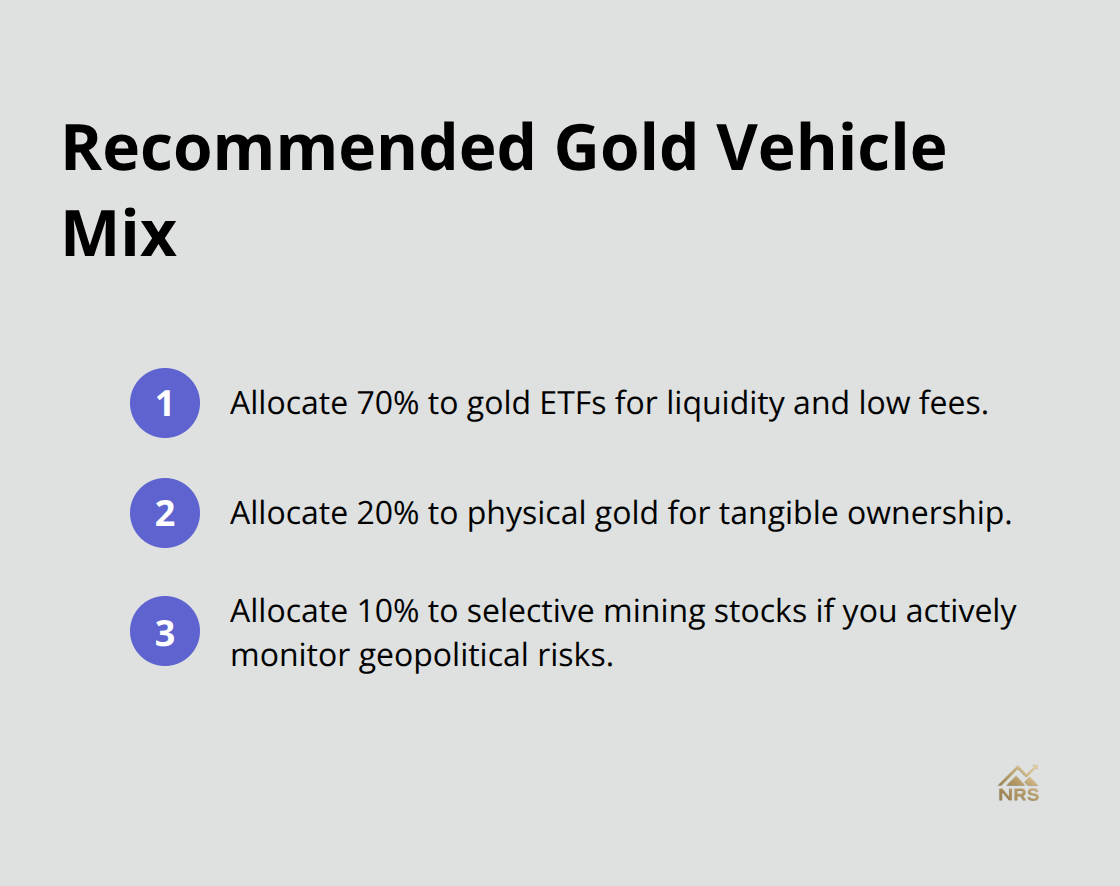
We recommend allocating 70% of your gold position to ETFs for liquidity and low costs, 20% to physical gold if you want tangible holdings, and 10% to selective mining stocks only if you actively monitor geopolitical risks affecting production.
Spreading Risk Across Gold-Producing Regions
Geographic diversification matters more than most investors realize. Canada produces roughly 170 tonnes of gold annually, Australia produces 310 tonnes, and China produces 370 tonnes according to the U.S. Geological Survey. If you own mining stocks, avoid concentrating in a single country’s miners.
A portfolio holding Canadian, Australian, and American miners spreads political and operational risk across continents, protecting you from country-specific mining bans or labor disruptions that occasionally cripple single-nation production. This geographic spread becomes especially important when you consider that tactical rebalancing decisions depend heavily on which regions face geopolitical headwinds at any given moment.
How to Adjust Your Gold Strategy When Markets Shift
Rebalance When Gold Price Cycles Create Opportunities
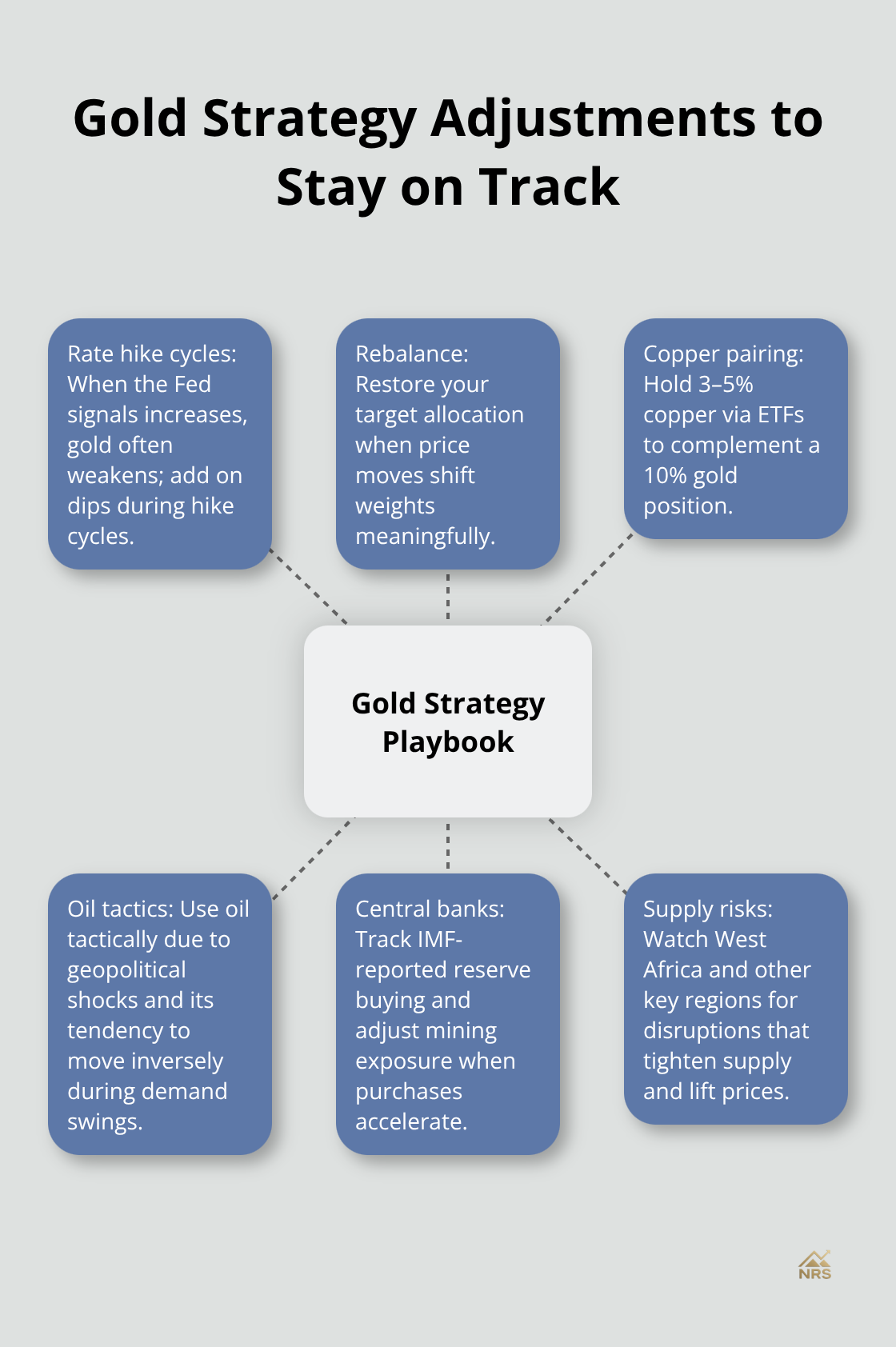
Gold price cycles follow patterns tied to interest rates, dollar strength, and inflation expectations rather than random movements. When the Federal Reserve signals rate increases, gold typically declines as higher yields make non-yielding gold less attractive relative to bonds. If gold drops significantly during a rate hike cycle, that’s the moment to add to your position, not sell it. This disciplined approach removes emotion and forces you to buy low without overthinking market direction.
Set specific price targets before cycles begin. If you allocated 10% to gold at $2,000 per ounce and the price falls to $1,700, that allocation shrinks to 8.5% of your portfolio. Rebalancing back to 10% means buying additional ounces depending on your portfolio size. This systematic method ensures you maintain your target allocation through market volatility.
Combine Gold with Complementary Commodities
Complementary commodities amplify gold’s protective power without introducing redundant risk. Copper serves this role because it responds to economic growth expectations while gold responds to fear. When growth slows, copper falls and gold rises. A portfolio holding 10% gold and 3-5% copper through ETFs provides broader commodity exposure while maintaining true diversification.
Oil behaves similarly, with inverse movements to gold during demand shocks. However, oil requires active monitoring because geopolitical disruptions can spike prices unpredictably, whereas gold benefits from those same disruptions. This asymmetry makes oil a tactical tool rather than a permanent allocation.
Monitor Central Bank Buying and De-Dollarization Trends
Geopolitical tensions matter enormously for gold investors. When tensions escalate between major powers, central banks accelerate gold purchases. Monitor central bank buying patterns through official IMF reporting and adjust mining stock exposure accordingly. Countries increasing reserves signal confidence in gold’s long-term value.
Track Mining Disruptions in Key Producing Regions
Mining disruptions from conflicts in major producing regions like West Africa create supply constraints that push prices higher. Production shutdowns in these regions translate directly into tighter supplies and higher prices within months. Track news from these regions because supply shocks often precede price movements by several months, giving attentive investors time to position accordingly.
Final Thoughts
Building a durable gold investment strategy requires discipline, not prediction. The principles throughout this guide rest on concrete historical data: gold’s consistent performance during crises, its inflation-fighting properties, and its mathematical independence from stocks and bonds. These patterns have repeated across decades of market cycles, and they form the foundation for any serious allocation decision.
Your gold allocation should remain stable unless your life circumstances change dramatically. A 10% position held through bull markets and bear markets outperforms constant tinkering and emotional adjustments. Rebalancing when gold drifts from your target percentage maintains discipline without requiring you to forecast price movements, and this systematic approach removes the temptation to chase performance or panic during downturns.
Market conditions shift constantly, but the reasons gold belongs in your portfolio do not. Interest rates rise and fall, inflation accelerates and moderates, and geopolitical tensions flare and cool-yet gold maintains its protective role because it responds to different forces than equities. Visit Natural Resource Stocks to access expert analysis on macroeconomic factors and geopolitical impacts that help you understand how broader market forces affect your holdings and refine your gold investment strategy as conditions evolve.