
























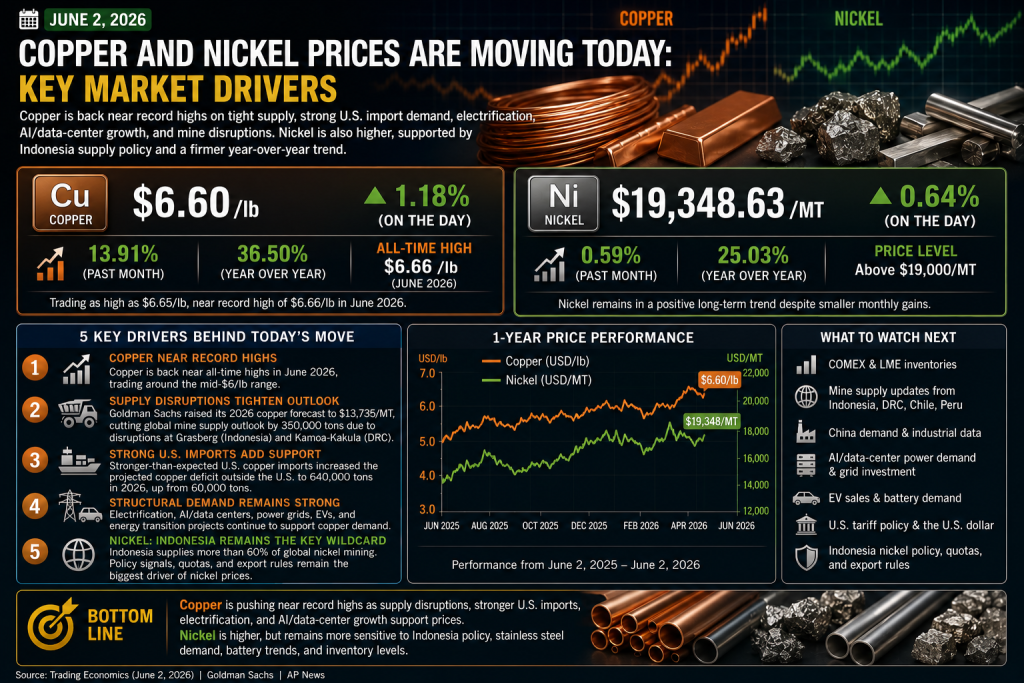
Copper and nickel are both higher today, with copper pushing back into record-high territory and nickel holding firm above $19,000 per metric ton. Copper is being supported by tight supply, strong U.S. import demand, electrification, AI/data-center growth, and recent mine disruptions. Nickel is also higher, helped by ongoing attention on Indonesia supply policy and a stronger year-over-year price trend.
Today’s pricing snapshot
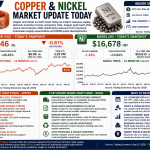
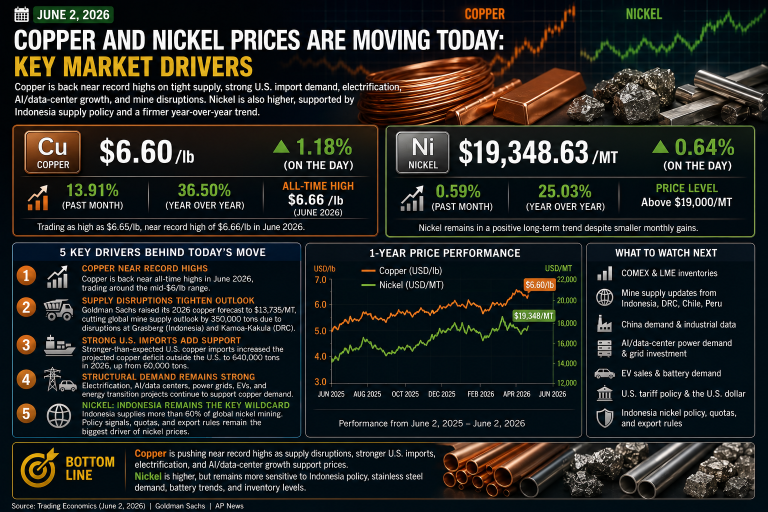
According to Trading Economics CFD benchmarks, copper rose to about $6.60/lb on June 2, 2026, up roughly 1.18% on the day. Copper is also up about 13.91% over the past month and roughly 36.50% year over year. Trading Economics also showed copper trading as high as $6.65/lb, near an all-time high of $6.66/lb in June 2026.
Nickel rose to about $19,348.63/metric ton on June 2, 2026, up roughly 0.64% on the day. Nickel is up about 0.59% over the past month and roughly 25.03% year over year, showing that the longer-term trend remains positive even though nickel’s monthly move is much smaller than copper’s.
5 key drivers behind today’s move
1) Copper is back near record highs
Copper is the stronger mover today because traders are still pricing in a tight global market. Trading Economics shows copper reaching a new all-time high area in June 2026, with prices around the mid-$6/lb range.
That keeps copper in focus for investors looking for exposure to infrastructure, power demand, AI buildout, and electrification.
2) Supply disruptions are tightening the copper outlook
Goldman Sachs raised its year-end 2026 copper forecast to $13,735 per metric ton, citing a weaker supply outlook and tighter market balances outside the U.S. The bank also cut its 2026 global mine supply outlook by 350,000 tons because of disruptions at Grasberg in Indonesia and Kamoa-Kakula in the Democratic Republic of Congo.
That matters because copper supply is difficult to replace quickly. New mines take years to permit and build, so disruptions at major assets can have an outsized effect on market sentiment.
3) U.S. copper imports are adding another layer of support
Goldman also pointed to stronger-than-expected U.S. copper imports, which helped increase its projected copper deficit outside the U.S. market to 640,000 tons from a previous estimate of 60,000 tons for 2026.
That is important because regional tightness can push futures higher even when global demand signals are mixed.
4) AI, data centers, EVs, and grids remain the long-term copper story
Copper continues to benefit from structural demand tied to electrification, energy-transition projects, grid upgrades, EVs, and AI/data-center infrastructure. Goldman expects copper to stay supported by structural demand from electrification and energy-transition projects, while U.S. tariff policy remains a key risk for prices.
That keeps copper trading like a strategic infrastructure metal rather than just a traditional construction input.
5) Nickel is higher, but Indonesia remains the main wildcard
Nickel is also higher today, but its story is more policy-sensitive. Trading Economics shows nickel above $19,000/metric ton and up about 25% year over year.
Indonesia remains the key nickel driver because it controls more than 60% of global nickel mining supply, according to Goldman Sachs. Earlier this year, Indonesia helped drive a nickel rally by signaling potential supply constraints.
What to watch next
Copper traders will be watching COMEX and LME inventories, U.S. import demand, mine-supply updates from Indonesia and the Democratic Republic of Congo, China demand data, AI/data-center power demand, grid investment, EV sales, U.S. tariff policy, and the U.S. dollar.
Nickel traders will be watching Indonesia production quotas, export policy, refining rules, stainless steel demand, EV battery demand, Class 1 nickel premiums, LME inventories, and broader base-metals sentiment.
Bottom line
On June 2, 2026, copper and nickel are both higher, but copper has the stronger momentum. Copper is pushing near record highs as supply disruptions, stronger U.S. imports, electrification, energy-transition demand, and AI/data-center growth support prices. Nickel is also firmer, but its outlook remains more dependent on Indonesia policy, stainless steel demand, battery trends, and inventory levels.
Copper remains the cleaner structural-demand story today, while nickel is still the more supply-policy-sensitive trade.