

























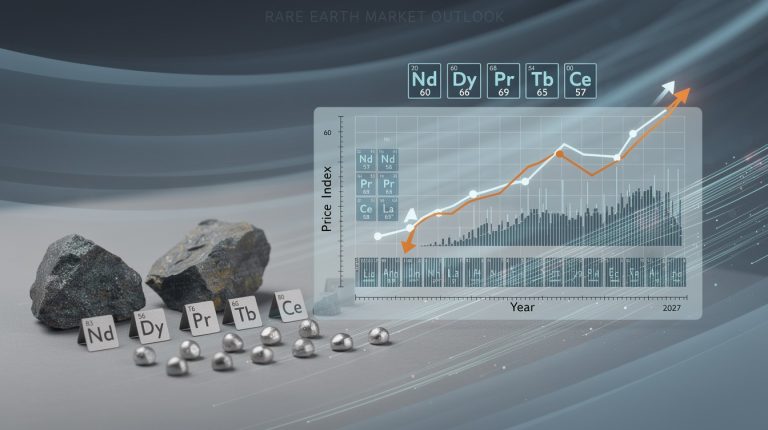
Rare earths price trends are shifting in ways that matter for investors watching 2027. Supply constraints, geopolitical tensions, and surging demand from electric vehicles are reshaping the market fundamentally.
At Natural Resource Stocks, we’ve identified the signals that will drive prices over the next year. This guide walks you through what’s happening now and what to watch.
What’s Breaking the Rare Earth Supply Chain Right Now
Processing Capacity, Not Mining, Is the Real Bottleneck
The rare earth market in 2026 faces a hard reality: processing capacity, not mining, is the actual constraint. China controls more than 90% of global rare earth processing and finished metal production, which means even when ore gets mined outside China, it often travels back to Chinese facilities for processing. This bottleneck drives price premiums across Western markets. According to Trading Economics, neodymium prices reached 935,000 CNY/T on May 29, 2026, up 71.25% year-over-year. The real story isn’t about ore scarcity-it’s about who can process it.
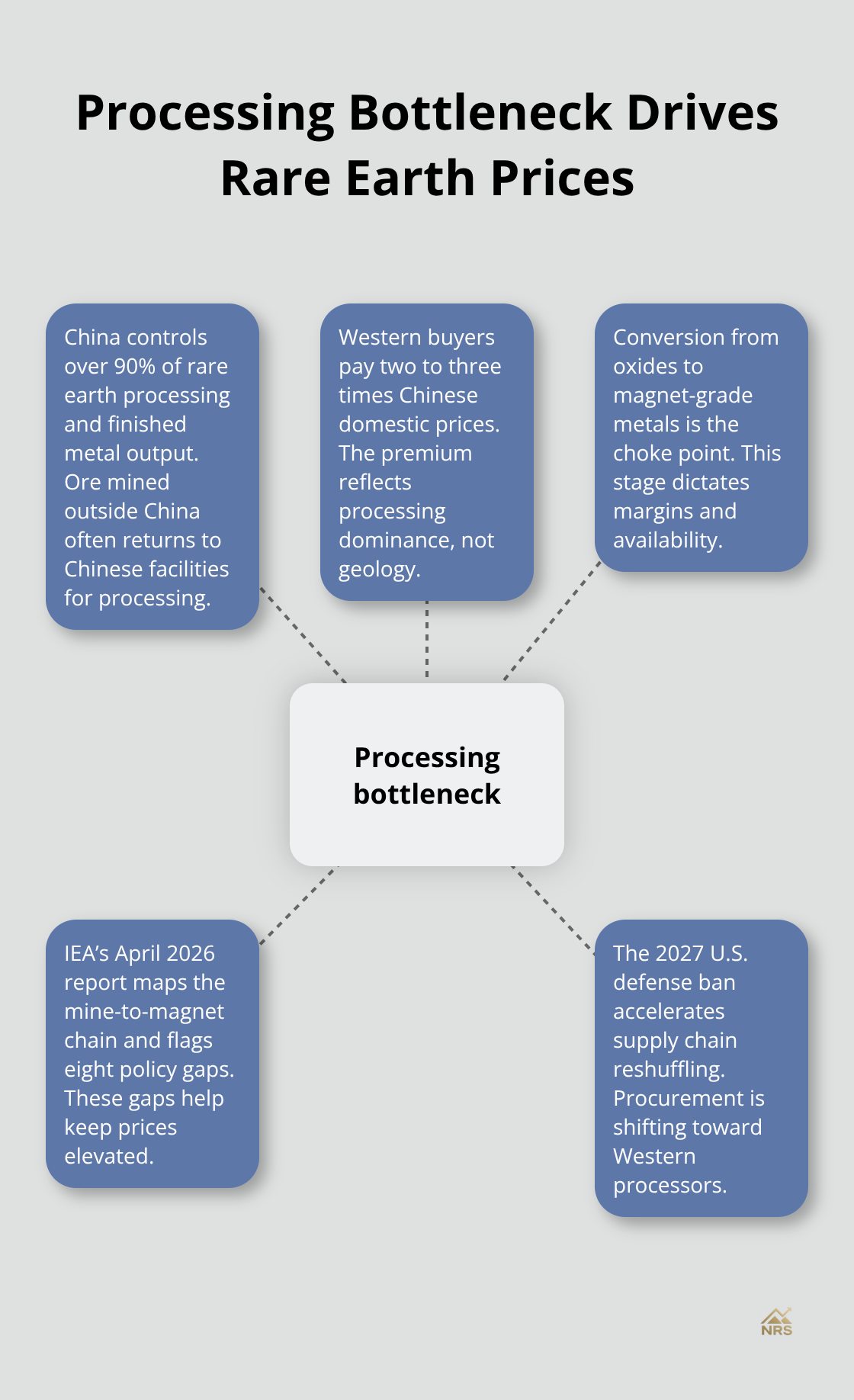
The IEA’s April 2026 Critical Minerals Security report maps the full mine-to-magnet chain and identifies eight specific policy gaps that keep prices elevated. European buyers currently pay 2-3 times more for usable rare earth material than prices quoted inside China, a premium that reflects the processing monopoly rather than geological scarcity.
The January 2027 Deadline Forces Supply Chain Reshuffling
The 2027 U.S. defense ban on Chinese-origin rare-earth materials forces a supply chain reshuffling that accelerates now. REAlloys’ agreement with U.S. Critical Materials Corp. to secure up to 10% of production from the Sheep Creek project in Montana signals how serious this shift has become. Dysprosium, terbium, yttrium, and neodymium-praseodymium now move into Western hands, but the conversion from oxides into magnet-grade metals remains the choke point. This constraint will persist through 2027 and beyond.
Demand Intensifies Across Multiple Sectors
Demand for rare earths intensifies from electric vehicles, renewable energy, and defense applications. The IEA framework explicitly tracks how energy transition technologies depend on rare earth magnets for wind turbines and EV motors, and this dependency is non-negotiable. What matters for 2027 is not whether demand will stay high-it will-but whether Western processing capacity can ramp fast enough to meet it. The Defense Logistics Agency’s contract with Terves LLC to expand samarium and gadolinium production, backed by the Export-Import Bank’s letter of interest for up to $200 million, shows government-backed efforts to build midstream capacity. Saskatchewan Research Council targets separated oxide production by end-2026 for delivery to Ohio metallization facilities, creating the first real North American mine-to-metal chain. These aren’t theoretical projects; they’re concrete investments with timelines and government backing.
Price Signals Point to Sustained Tightness
Current forecasts from DigitalCoinPrice point to USA Rare Earth Inc around $41.99 by end-2027, roughly 32.93% above May 2026 levels. This projection reflects expectations that supply tightness will persist through the transition year. The price signal is clear: scarcity shifts from ore to processing, and that’s where margins and volatility will concentrate through 2027. Understanding where these price pressures originate helps investors position for what comes next.
How Past Rare Earth Price Shocks Predict 2027 Moves
What History Teaches About Rare Earth Volatility
Rare earth prices do not move randomly. The USGS analyzed decades of metal price data and found that international events like wars and recessions drive commodity cycles far more than local supply changes. When the Soviet Union dissolved in the 1990s and China emerged as a dominant consumer, rare earth prices shifted permanently higher. In 2008, when base metals hit historic highs while global stocks fell to near-zero levels, the price volatility showed what happens when supply tightens and demand stays strong. Neodymium specifically mirrors this pattern. Trading Economics data shows neodymium traded at 1,520,000 CNY/T in February 2022, then collapsed, then recovered to 935,000 CNY/T by May 2026. That 71.25% year-over-year gain tells you the market is pricing in sustained scarcity, not temporary disruption.
The Monthly Volatility Signal
The monthly volatility matters too. Neodymium fell 10.53% in the month before May 29, 2026, yet remains far above historical baselines. This pattern signals that investors are nervous about short-term supply but remain convinced prices will not retreat to 2020 levels. The IEA’s April 2026 report emphasizes that policy shifts, tariffs, and mine strikes move prices faster than geology does. China’s rare earth export controls in 2010 triggered a price spike that lasted years. The 2027 U.S. defense procurement ban on Chinese materials will have similar force. REAlloys’ agreement to supply 10% of Montana’s Sheep Creek production creates a concrete supply alternative that reduces Chinese leverage, but only if processing capacity follows. The Export-Import Bank’s $200 million letter of interest for metallization capacity signals government determination to break China’s processing monopoly, which means 2027 pricing will not be set in Beijing alone.
Inventory Levels and Downstream Demand Drive Price Action
What separates smart positioning from reactive trading is recognizing that rare earth prices correlate tightly with two macro signals: inventory levels and downstream demand growth. When global rare earth inventories fall, prices spike within months because separation and metallization capacity cannot expand overnight. The Saskatchewan Research Council targets separated oxide delivery to Ohio facilities by end-2026, which creates a new inventory source outside China and could moderate price spikes in late 2026 and early 2027. However, the real price driver remains the conversion bottleneck. European buyers pay 2-3 times more than Chinese domestic prices because they have no choice. This premium compresses only when Western processing capacity reaches scale.
What Stock Prices Signal About 2027
USA Rare Earth Inc trades around $28.36 as of May 2026, with forecasts pointing toward $41.99 by end-2027. That 32.93% upside reflects analyst expectations that processing capacity will remain the constraint through 2027, not ore supply. Defense demand from electrification and renewable energy ensures that terbium and dysprosium (the heavy rare earths) will command premium prices as long as Western supply remains limited. The practical takeaway is straightforward: monitor quarterly inventory reports from USGS and IEA publications, track Western processing capacity additions from press releases and SEC filings, and watch Chinese export permit volumes. When inventories decline or export permits tighten, prices move within weeks.
The 2027 Defense Ban Forces Action Now
The 2027 defense ban deadline forces these moves now, which is why positioning matters in the second half of 2026. Investors who track these signals early will spot price inflection points before the broader market reacts. The next section examines which specific supply sources will compete for market share and how their production timelines affect price trajectories through 2027.
What Drives Rare Earth Prices in the Next 18 Months
Electric Vehicle Production Accelerates Rare Earth Demand
Electric vehicle production and rare earth demand will consume a significant share of global rare earth demand in coming years. Tesla uses dysprosium and terbium in every EV motor to withstand high-temperature operation, and as manufacturers like BYD, Volkswagen, and Geely expand production, demand for heavy rare earths intensifies. The concrete signal to track is quarterly EV sales data from IHS Markit and production announcements from automakers. When Tesla reports record deliveries or Volkswagen expands Gigafactory capacity, rare earth prices typically follow within 4-6 weeks because processors scramble to secure feedstock.
China’s Export Permits Control the Supply Valve
China’s export permit system creates the second major price lever. China’s export restrictions on heavy rare earths and permanent magnets have triggered disruptions across allied defense and industrial sectors. This contraction directly constrains global supply and pushes buyers toward Western alternatives, but Western capacity remains insufficient. Monitor China’s monthly export permit releases published by the China Chamber of Commerce. When permits fall below 1,000 tonnes per month, prices spike because downstream buyers have no buffer.
Western Supply Projects Remain Structurally Constrained
REAlloys’ Montana Sheep Creek project and the Saskatchewan Research Council’s Ohio metallization chain represent the emerging supply alternatives that will matter most through 2027. Phase 1 of REAlloys targets 525 tonnes per year of neodymium-praseodymium metal, with Phase 2 scaling to 3,000 tonnes NdPr plus 200 tonnes dysprosium and 45 tonnes terbium. These volumes sound large until you compare them to global demand of roughly 180,000 tonnes annually for all rare earth oxides. REAlloys’ total Phase 2 output covers less than 2% of global NdPr demand, which means Western supply remains structurally constrained through 2027.
Heavy Rare Earths Command Premium Prices
The real price action concentrates in dysprosium and terbium, where Western supply is virtually nonexistent today. Lynas Rare Earths’ Seadrift facility in Texas, backed by U.S. Department of Defense funding, targets 3,500 tonnes per year of separated rare earth oxides by late 2027. This matters because heavy rare earth separation outside China has been a gap for a decade. When Seadrift reaches full production, dysprosium and terbium prices should moderate, but the ramp takes time. Dysprosium and terbium will outperform neodymium-praseodymium on a price basis because Western capacity for heavy rare earths remains years behind light rare earth processing. Track production timelines from REAlloys, Lynas, and Terves LLC, which received a Defense Logistics Agency contract to expand samarium and gadolinium production. When these facilities move from construction to production ramp, price momentum shifts. The Export-Import Bank’s letter of interest for up to $200 million in financing signals that U.S. government support is real and committed, which reduces project risk and accelerates timelines.
Monitor Capacity Utilization and Price Signals
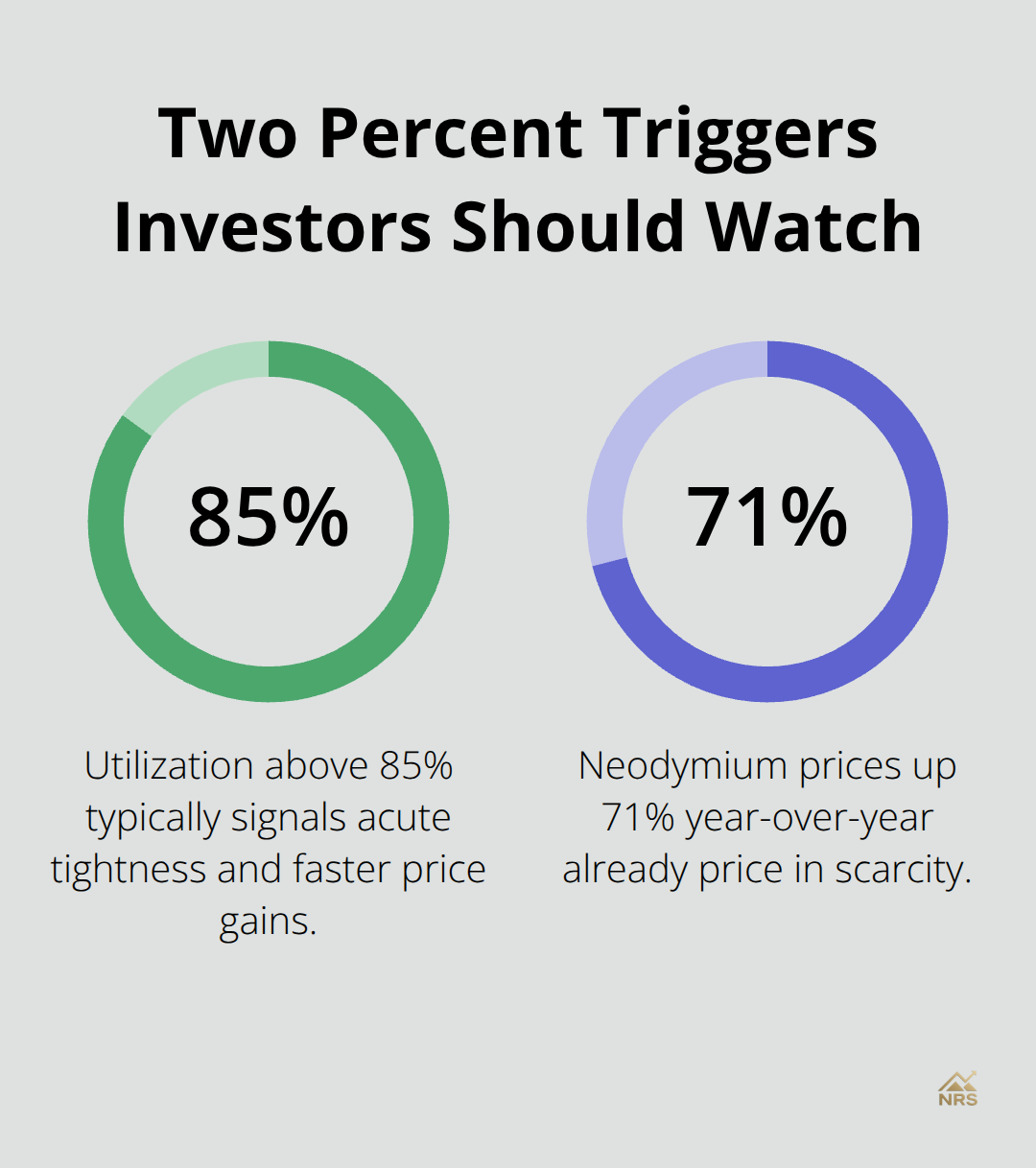
Watch quarterly earnings reports and SEC filings from USA Rare Earth Inc for updates on processing capacity utilization and feedstock sourcing. When utilization climbs above 85%, supply tightness becomes acute and prices accelerate upward. Current neodymium prices at 935,000 CNY/T, up 71% year-over-year, already price in this scarcity. The question for 2027 is whether new Western capacity will compress that premium or whether geopolitical tensions will widen it further.
Final Thoughts
Rare earths price trends through 2027 will respond to three concrete signals that investors must track closely. Western processing capacity additions, Chinese export permit volumes, and downstream demand from electric vehicles and defense applications will determine whether prices accelerate or stabilize. We at Natural Resource Stocks recognize that processing capacity remains the binding constraint, not ore supply, and neodymium prices at 935,000 CNY/T reflect this reality. The 2027 U.S. defense ban on Chinese materials accelerates Western capacity buildouts, but REAlloys’ Montana project and Lynas’ Texas facility will not reach full scale until late 2027 or beyond, which means supply tightness persists through the transition year and supports elevated prices for neodymium-praseodymium and especially for dysprosium and terbium.
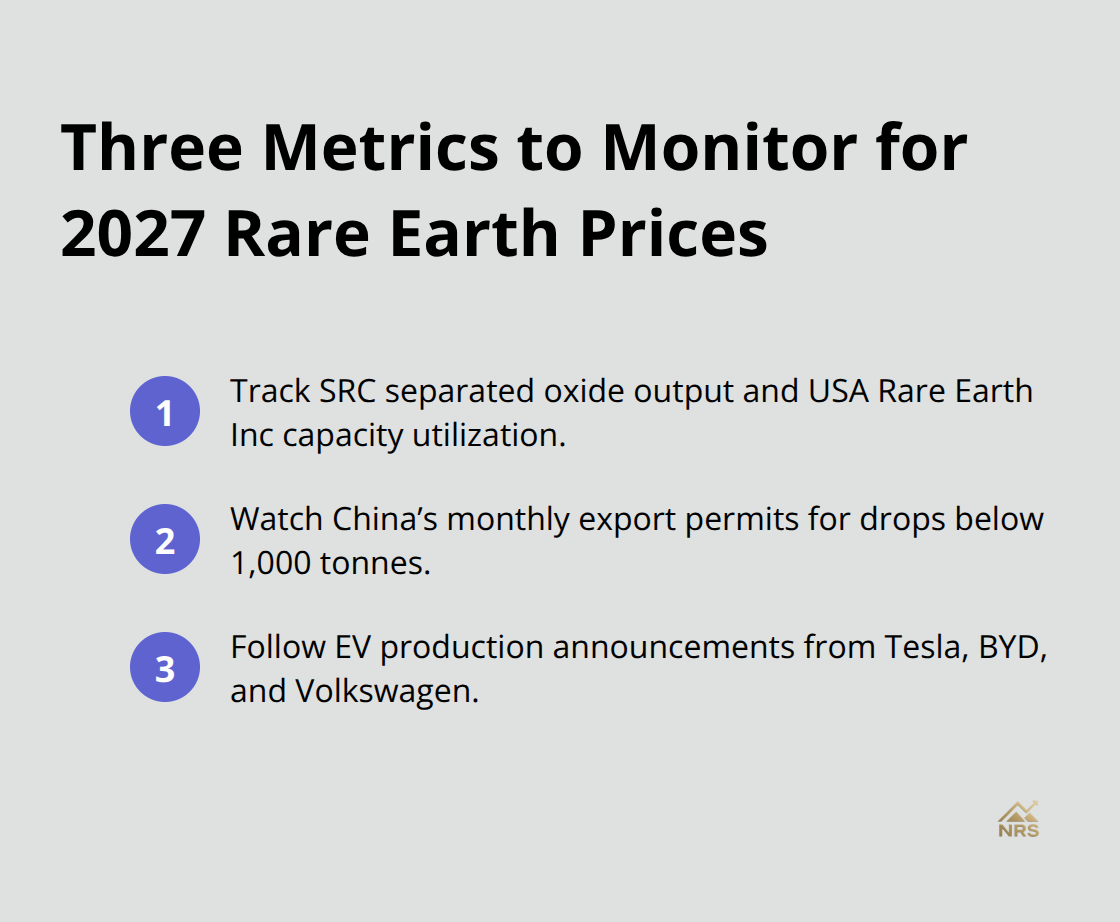
Investors positioning for 2027 should monitor three specific metrics that signal price inflection points. Track quarterly separated oxide production from Saskatchewan Research Council and metallization capacity utilization from USA Rare Earth Inc, since utilization above 85% typically triggers price acceleration within weeks. Watch China’s monthly export permit releases, as permits below 1,000 tonnes signal acute scarcity and trigger price spikes across Western markets. Follow EV production announcements from Tesla, BYD, and Volkswagen, since each percentage point increase in global EV production translates to measurable rare earth demand growth that processors cannot immediately satisfy.
The opportunity lies in recognizing that rare earths price trends will remain volatile but structurally elevated through 2027 as government-backed financing from the Export-Import Bank and Defense Logistics Agency contracts signal sustained policy support for Western capacity. This support reduces project risk and accelerates timelines, but capacity still lags demand, which means investors who understand these supply-demand dynamics will position ahead of price movements. Natural Resource Stocks provides expert analysis and market insights to help you navigate these opportunities and understand the macroeconomic factors shaping rare earth markets.