
























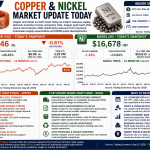
Copper and nickel are moving in opposite directions today. Copper is slightly higher as traders continue to balance tight supply, AI/data-center demand, U.S. tariff uncertainty, and recent profit-taking after record highs. Nickel is lower as weak monthly momentum, Indonesia policy uncertainty, and mixed stainless steel and EV battery demand continue to weigh on sentiment.
Today’s pricing snapshot
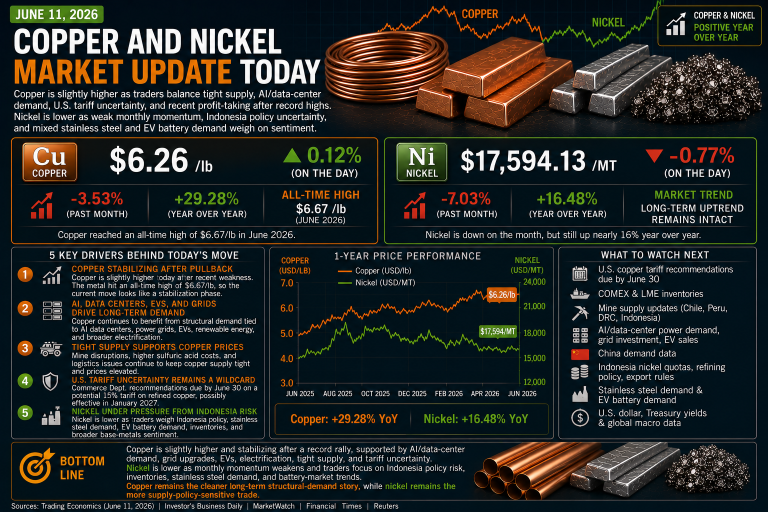
According to Trading Economics CFD benchmarks, copper rose to about $6.26/lb on June 11, 2026, up roughly 0.12% on the day. Copper is down about 3.53% over the past month, but remains up roughly 29.28% year over year. Trading Economics also notes that copper reached an all-time high of $6.67/lb in June 2026.
Nickel fell to about $17,594.13/metric ton on June 11, 2026, down roughly 0.77% on the day. Nickel is down about 7.03% over the past month, but remains up roughly 16.48% year over year, showing that the longer-term trend is still positive even as near-term momentum weakens.
5 key drivers behind today’s move
1) Copper is stabilizing after a sharp pullback
Copper is slightly higher today after recent weakness. The metal recently hit an all-time high of $6.67/lb, so the current move looks like a stabilization phase after a record-setting run.
That keeps copper in focus for traders who are watching whether the market can hold support near elevated levels or whether more profit-taking follows.
2) AI, data centers, EVs, and grids remain the long-term copper story
Copper continues to benefit from structural demand tied to AI data centers, power grids, electric vehicles, renewable energy, and broader electrification. Recent reporting has highlighted copper’s role in data-center construction, EV production, and AI-related power infrastructure.
That demand story remains one of the biggest reasons copper is still up nearly 30% year over year despite the latest monthly pullback.
3) Supply pressure is still supporting copper
Copper’s supply side remains tight. Recent market coverage has pointed to mine disruptions, higher sulfuric acid costs, and logistics issues as key reasons copper prices have stayed elevated.
The Financial Times also reported that industrial metals markets are being squeezed by strong demand for data centers, EVs, and renewable infrastructure, combined with supply disruptions and higher input costs.
4) U.S. tariff uncertainty remains a copper wildcard
Copper traders are still watching possible U.S. tariff action. Investor’s Business Daily reported that copper recently rallied before fading as traders weighed a possible U.S. tariff on refined copper, a stronger dollar, and higher Treasury yields. The Commerce Department is expected to issue recommendations by June 30 on whether to move forward with a potential 15% tariff on refined copper, possibly effective in January 2027.
That uncertainty can keep copper volatile because tariffs could affect U.S. import demand, regional price spreads, and supply-chain behavior.
5) Nickel remains under pressure as Indonesia risk dominates
Nickel is lower today and has weakened more than 7% over the past month. The metal is still positive year over year, but the near-term trend remains soft as traders weigh Indonesia policy, stainless steel demand, EV battery demand, inventories, and broader base-metals sentiment.
Indonesia remains the key wildcard for nickel because policy changes around quotas, refining, exports, royalties, and downstream investment can quickly shift supply expectations.
What to watch next
Copper traders will be watching COMEX and LME inventories, U.S. copper tariff recommendations due by June 30, mine-supply updates from Chile, Peru, Indonesia, and the Democratic Republic of Congo, AI/data-center power demand, grid investment, EV sales, China demand data, sulfuric-acid availability, U.S. dollar moves, and Treasury yields.
Nickel traders will be watching Indonesia production quotas, export-governance rules, refining policy, royalty changes, stainless steel demand, EV battery demand, Class 1 nickel premiums, LME inventories, and broader base-metals sentiment.
Bottom line
On June 11, 2026, copper is slightly higher while nickel is lower. Copper is stabilizing after a record-setting rally, supported by AI/data-center demand, grid upgrades, EVs, electrification, tight supply, and tariff uncertainty. Nickel remains weaker as monthly momentum fades and traders continue to focus on Indonesia policy risk, inventories, stainless steel demand, and battery-market trends.
Copper remains the cleaner long-term structural-demand story, while nickel is the more supply-policy-sensitive trade today.