
























Geopolitical events reshape metal markets faster than most investors realize. When governments impose sanctions, start trade wars, or face regional conflicts, the ripple effects hit commodity prices within days.
At Natural Resource Stocks, we’ve watched geopolitical impact on metals markets create both risks and opportunities for portfolio holders. Understanding these connections helps you position your investments before the next policy shift hits.
How Geopolitical Shocks Hit Metal Prices in Real Time
Trade wars, sanctions, and regional conflicts compress metal price moves into days rather than months. When the US imposed 50% tariffs on steel and aluminum in 2018, prices spiked immediately, forcing US manufacturers to absorb roughly 25% cost increases on finished goods. Today’s tariff environment is even more aggressive. The current 50% Section 232 aluminum tariff keeps US all-in prices above $2.70 per pound as of early April 2026, far above the 15-year average of $1.15 per pound. These aren’t theoretical numbers; they hit beverage cans, aerospace components, and automotive parts right now.
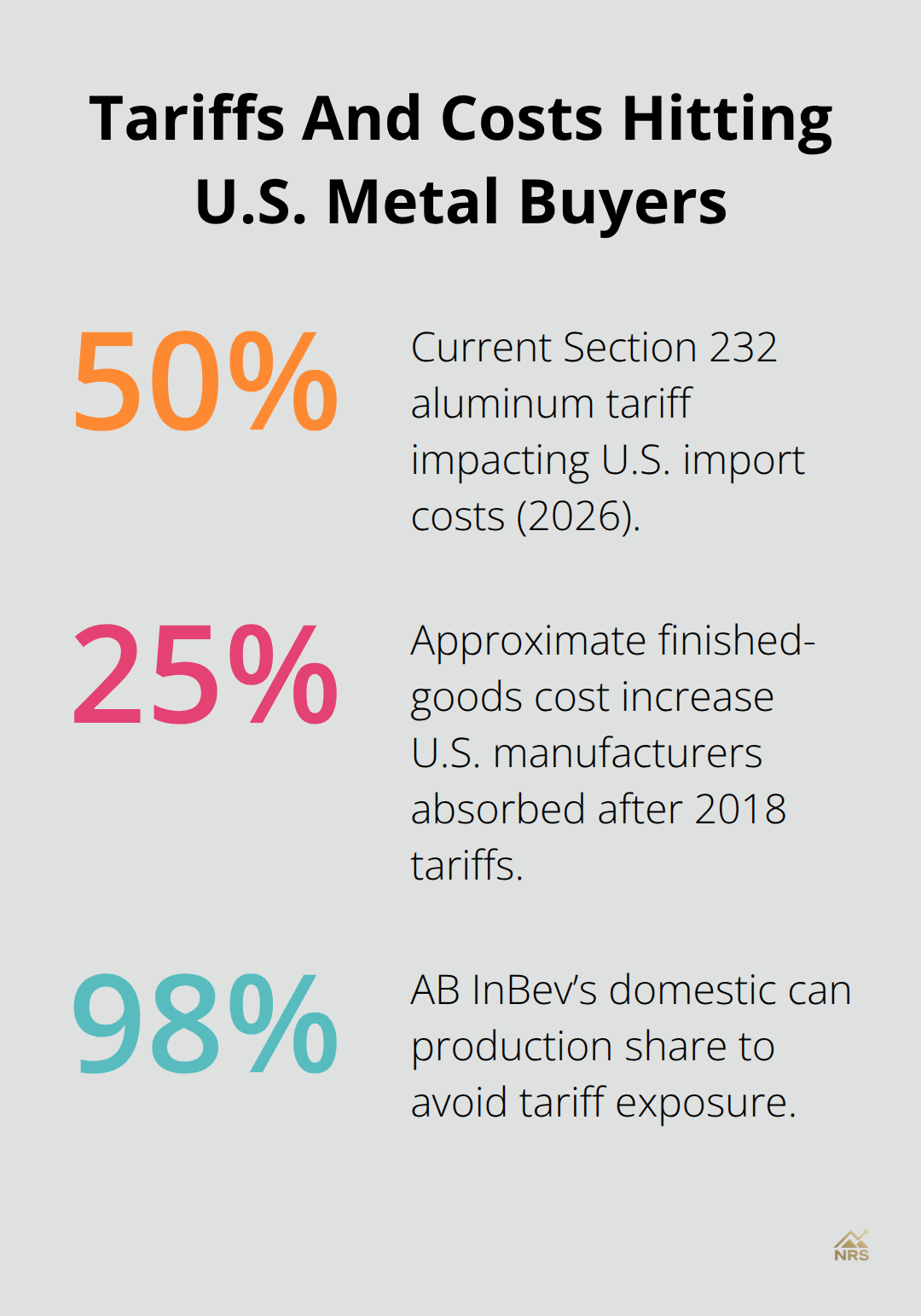
AB InBev shifted to 98% domestic can production to dodge tariffs, while Molson Coors absorbed a $125 million aluminum headwind in a single year. Smaller operators lack that cushion and must choose between raising prices, cutting margins, or both.
Immediate Price Reactions to Supply Disruptions
The Geopolitical Risk Index, which tracks tensions since 1985, shows a direct correlation between spikes and metal price volatility. When Iran struck Emirates Global Aluminium and Aluminium Bahrain in early 2026, roughly 3.2 million metric tons of annual smelting capacity went offline. London Metal Exchange aluminum prices surged to $3,492 per metric ton on March 30, 2026, driven by strikes, China’s 45 million-ton production cap, and strong demand from EVs and solar. Restarting aluminum smelters takes months; EGA projects a full restart will take about 12 months, meaning production gaps persist into 2027.
Supply Concentration Amplifies Price Shocks
Metals with concentrated supply chains react fastest to geopolitical events. Rare earth elements stand out: China controls roughly 70% of global processing and 60% of mining output according to the US Geological Survey. When Japan faced a rare earth export dispute in 2010, dysprosium and terbium prices surged over 400% in weeks. Lithium and cobalt carry similar concentration risk. Roughly 60% of lithium comes from Chile and Argentina, while Congo supplies over 70% of global cobalt.
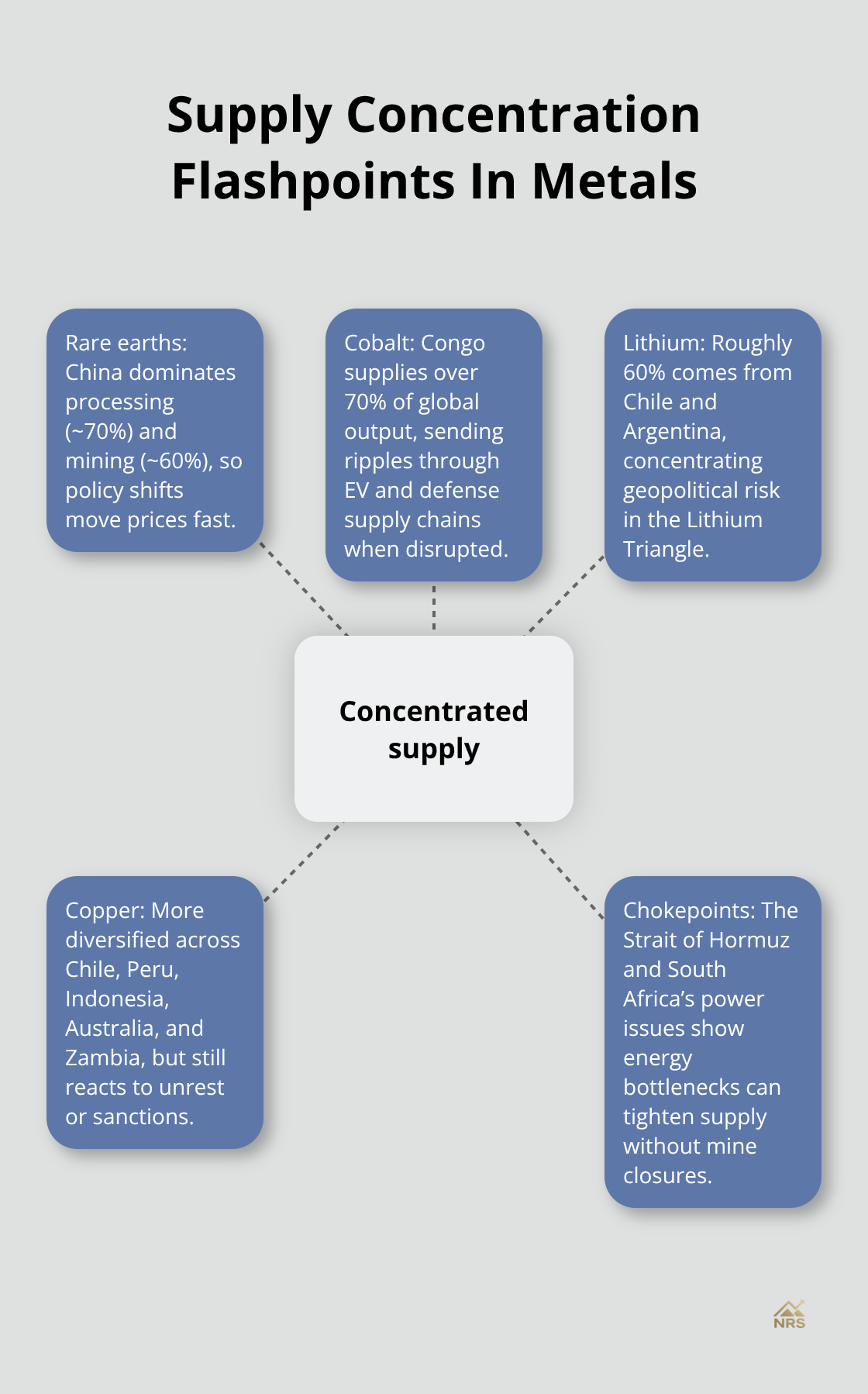
A disruption in either region directly raises EV and energy-storage costs across the industry. Copper offers more geographic flexibility with meaningful production in Chile, Peru, Indonesia, Australia, and Zambia, but even copper prices respond sharply when major producers face unrest or sanctions.
The Strait of Hormuz remains a critical chokepoint for energy shipments that power aluminum smelting and metal refining. South Africa’s electricity crisis and civil unrest reduced platinum output by roughly 8% in 2022, tightening global supplies and lifting prices without a single mine closure. Single-country dominance in any metal creates immediate pricing risk.
How to Position Before the Next Shock
Set price alerts at historical support levels around geopolitical headlines rather than chasing momentum. Copper typically drops 10% on headline risk, creating an entry point if fundamentals remain intact. Scale into positions gradually over three to four weeks instead of deploying capital in a single tranche. Use major supply-contract announcements as timing signals toward stabilization. Examine supplier resilience by reviewing long-term contracts and balance sheets; producers with locked-in offtake agreements and diversified sourcing weather shocks better than peers exposed mainly to spot markets.
Distinguish temporary disruptions from structural supply losses, as this determines your investment horizon. A six-month production halt in one region differs fundamentally from a permanent loss of capacity. Energy prices act as a secondary signal: rising oil supports precious metals via inflation expectations, while falling oil suggests disruption in energy markets rather than structural demand weakness. Monitor the Geopolitical Risk Index for spikes above 200% in the threats component, which historically precedes metal price moves within days. Understanding these signals positions you to act before policy shifts reshape your portfolio-and the next section shows how to build that resilience into your holdings.
How Government Policy Reshapes Metal Demand and Supply
Energy Mandates Lock in Metal Demand Years Ahead
Government policy drives metal demand through energy transition investments far more directly than most investors acknowledge. The US, EU, and China pour hundreds of billions into renewable energy infrastructure, electric vehicles, and grid modernization, creating structural demand for lithium, cobalt, nickel, and rare earth elements that will persist for decades. China’s 45 million-ton aluminum production cap, implemented to reduce emissions and manage supply, tightened global aluminum markets immediately and kept prices elevated throughout 2025 and into 2026. That cap reflects China’s commitment to carbon intensity targets that will not reverse. When governments mandate EV adoption timelines or solar installation quotas, they set metal price floors years in advance. The EU’s Green Deal targets at least 50% emissions reduction by 2030, which translates to mandatory demand for copper wiring, aluminum components, and rare earth magnets in wind turbines and EV drivetrains. Manufacturers lock in supply contracts today to meet 2028 and 2030 mandates, bidding up spot prices now.
Tariff Regimes Redirect Global Supply and Create Regional Pricing Gaps
Tariff regimes amplify policy effects by reshaping where metals flow globally. The current 50% Section 232 tariff on steel and aluminum does not just raise US prices; it redirects global supply away from America toward Europe and Asia, creating regional supply tightness that keeps international prices elevated. Companies like AB InBev responded by onshoring production, but smaller manufacturers lack that option and absorb tariff costs directly, compressing margins across industries from beverage canning to aerospace. The tariff structure matters tactically: derivative articles using entirely US-sourced content face only a 10% tariff versus 50% for imported materials, incentivizing supply-chain reshuffling that takes months to execute and creates temporary pricing dislocations you can exploit. Tariff enforcement began April 6, 2026, and derivative articles face rolling tariff adjustments through December 2027, creating quarterly windows where supply costs reset and prices adjust. Position ahead of those dates rather than reacting after prices have already moved. Geographic diversification becomes essential under tariff regimes because tariffs create regional price disconnects; aluminum priced at $2.70 per pound in the US but $1.90 in Europe creates arbitrage opportunities for companies with cross-border operations and hedging costs for those locked into single markets.
Government Stockpiling Moves Prices as Sharply as Geopolitical Events
Government stockpiling decisions move metal prices as sharply as any geopolitical event because they represent official demand that bypasses normal market signals. The US Strategic Petroleum Reserve and emerging rare earth stockpiling programs telegraph policy intent years ahead of implementation. When the Department of Defense announces procurement targets for cobalt or rare earth elements to support defense manufacturing, spot prices often spike within weeks as traders price in future scarcity. China’s rare earth export restrictions have created an active supply chain crisis with hard regulatory consequences. Dysprosium and terbium remain volatile because traders remain uncertain whether export restrictions will resurface.
Monitor Policy Catalysts for Timing Advantages
Track government energy budgets, emissions reduction timelines, and defense procurement announcements as leading indicators of metal demand. Watch tariff implementation dates and stockpiling programs for near-term pricing catalysts. These signals reveal where policy will push prices before markets fully price in the shift.
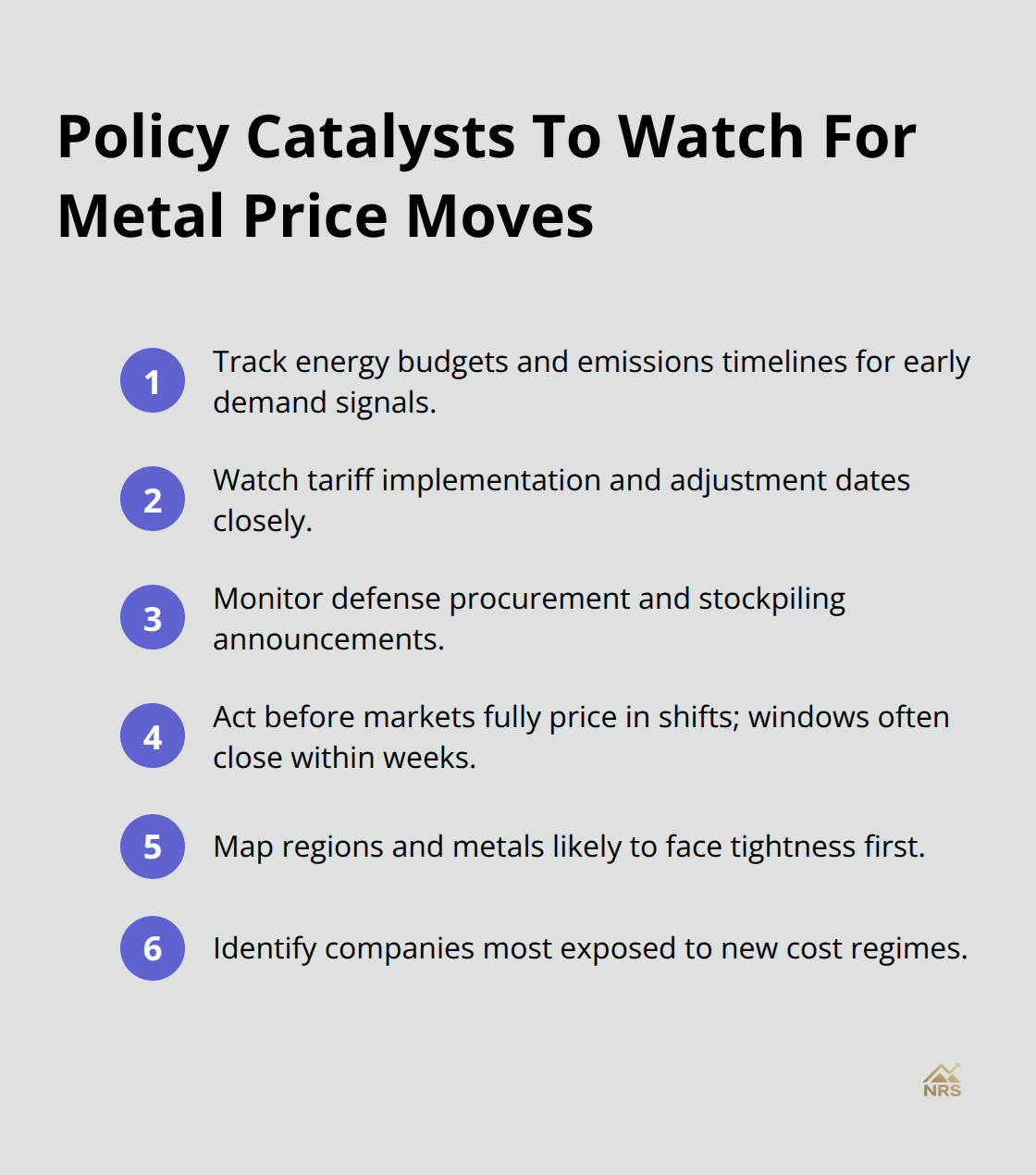
The practical advantage lies in acting on policy announcements before the broader market recognizes their metal-market implications-a window that typically closes within weeks as traders adjust positions and prices move sharply higher. Understanding how government mandates, tariff structures, and stockpiling decisions reshape metal flows positions you to identify which regions and metals will face supply tightness first, and which companies will struggle most under new cost regimes. The next section examines how to build a portfolio that withstands these policy shocks and captures the opportunities they create.
How Past Policy Shocks Shaped Metal Markets
Russia’s Invasion and the Palladium and Nickel Crisis
Russia’s 2022 invasion of Ukraine exposed how quickly geopolitical events reshape entire metal markets. Palladium, used primarily in catalytic converters and electronics, faced immediate supply concerns as Russia produces roughly 40% of global palladium output. Palladium prices jumped over 50% in weeks as automakers and industrial manufacturers scrambled to secure alternative sources or substitute materials. Nickel experienced similar pressure; Russia and Indonesia together supply roughly 45% of global nickel, and the invasion triggered immediate buying panic that drove prices to record highs above $100,000 per metric ton in March 2022 before settling lower.
The practical lesson for investors stands clear: sanctioned metals face not just supply loss but also hedging costs and supply-chain chaos that persist for years. Automakers that locked in long-term nickel contracts at elevated prices suffered margin compression for multiple years, while those with spot exposure endured extreme volatility that made financial planning impossible. The Ukraine conflict demonstrated that a single geopolitical event forces entire industries to rebuild supply chains, and companies slow to act absorb the highest costs.
China’s Rare Earth Export Restrictions and Supply Weaponization
China’s rare earth export restrictions, imposed periodically since 2010, reveal a different but equally damaging policy weapon. Dysprosium and terbium, essential for wind turbine magnets and military applications, face sporadic export quotas that create artificial scarcity and price spikes exceeding 400% during restriction periods. These metals have no practical substitutes for high-performance applications, meaning manufacturers cannot simply switch suppliers or materials.
Defense contractors and renewable energy companies must either stockpile inventory at high cost or accept supply risk that threatens production schedules. China’s processing dominance in rare earth elements means there is no viable alternative, forcing buyers to accept whatever price China sets or face production halts. This asymmetry gives governments enormous leverage over downstream industries, and investors holding companies exposed to restricted metals face unpredictable margin pressure.
The US Tariff Regime: From 2018 to 2026
The US tariff regime imposed in 2018 and expanded through 2026 offers the clearest recent example of how policy directly reshapes metal pricing and competitive advantage. The initial 25% steel tariff and 10% aluminum tariff in 2018 forced US manufacturers to absorb roughly 25% cost increases on finished goods, pushing some smaller operations toward bankruptcy while large competitors like AB InBev invested in domestic capacity to escape tariff costs.
Today’s 50% Section 232 aluminum tariff keeps US prices at $2.70 per pound versus roughly $1.90 in Europe, creating a permanent regional price gap that disadvantages US manufacturers competing globally. Beverage can producers, aerospace suppliers, and automotive parts manufacturers all face the same brutal calculus: absorb tariff costs and lose margin, raise prices and lose volume, or move production abroad and exit the US market entirely.
Molson Coors absorbed a $125 million aluminum headwind in a single year rather than raise prices aggressively, accepting lower profit to protect market share. Smaller craft breweries lacked that option and either raised prices sharply, cutting volume, or shifted product mix toward higher-margin formats to preserve profitability.
Supply-Chain Positioning and Competitive Advantage
The tariff regime also created a secondary effect: derivative articles using entirely US-sourced content face only 10% tariffs versus 50% for imported materials, incentivizing supply-chain reshuffling that takes months to execute. Companies that anticipated this dynamic and built domestic sourcing relationships ahead of tariff enforcement gained significant cost advantages over competitors forced to scramble afterward.
Geopolitical events and policy shifts create winners and losers not based on market fundamentals but on speed of response and supply-chain positioning. Investors should track which companies anticipated policy changes and repositioned supply chains early versus those caught flat-footed, as the difference in margin pressure and competitive position persists for years. The companies that moved fastest captured the most resilient positions, while laggards absorbed stranded costs that compressed returns for extended periods.
Final Thoughts
Geopolitical impact on metals markets will intensify as governments compete for supply control and reshape trade rules. Supply concentration creates pricing power for governments and vulnerability for manufacturers-rare earths, lithium, and cobalt remain flashpoints because single countries dominate production. A disruption in Congo cobalt or Chinese rare earth processing ripples through EV makers and defense contractors within weeks, while tariff regimes create regional price gaps that persist for years. US aluminum at $2.70 per pound versus $1.90 in Europe reflects policy, not fundamentals, and companies positioned for tariff-advantaged sourcing gain durable cost advantages over competitors.
Track the Geopolitical Risk Index for spikes above 200% in the threats component, which historically precedes metal price moves within days. Watch government energy budgets and emissions reduction timelines as leading indicators of structural demand. Review tariff implementation dates and stockpiling announcements for near-term pricing catalysts, as these signals reveal which regions and metals will face supply tightness first and which companies will struggle most under new cost regimes.
Building a resilient portfolio means you cap exposure to any single country or metal, evaluate supplier balance sheets and offtake agreements, and scale into positions gradually rather than deploy capital in one tranche. Producers with locked-in contracts weather shocks better than spot-exposed peers, and you should distinguish temporary disruptions from structural supply losses to determine your investment horizon. Visit Natural Resource Stocks to access the analysis and market insights that help you position ahead of geopolitical impact on metals markets before the next shock reshapes your portfolio.