



























Rare earths have become impossible to ignore for serious investors. These 17 elements power everything from electric vehicles to defense systems, yet supply remains fragmented and geopolitically charged.
At Natural Resource Stocks, we’re tracking the signals that separate opportunity from noise in this volatile market. This guide breaks down what’s moving prices, who controls supply, and where smart investors are positioning themselves.
Where the World’s Rare Earths Actually Come From
The rare earths market operates nothing like gold or oil. There’s no centralized exchange, no standardized pricing mechanism, and no single benchmark that tells you what these elements are worth on any given day. This fragmentation matters enormously for investors because supply disruptions don’t translate into uniform price signals across the market.
Supply Concentration and Processing Dominance
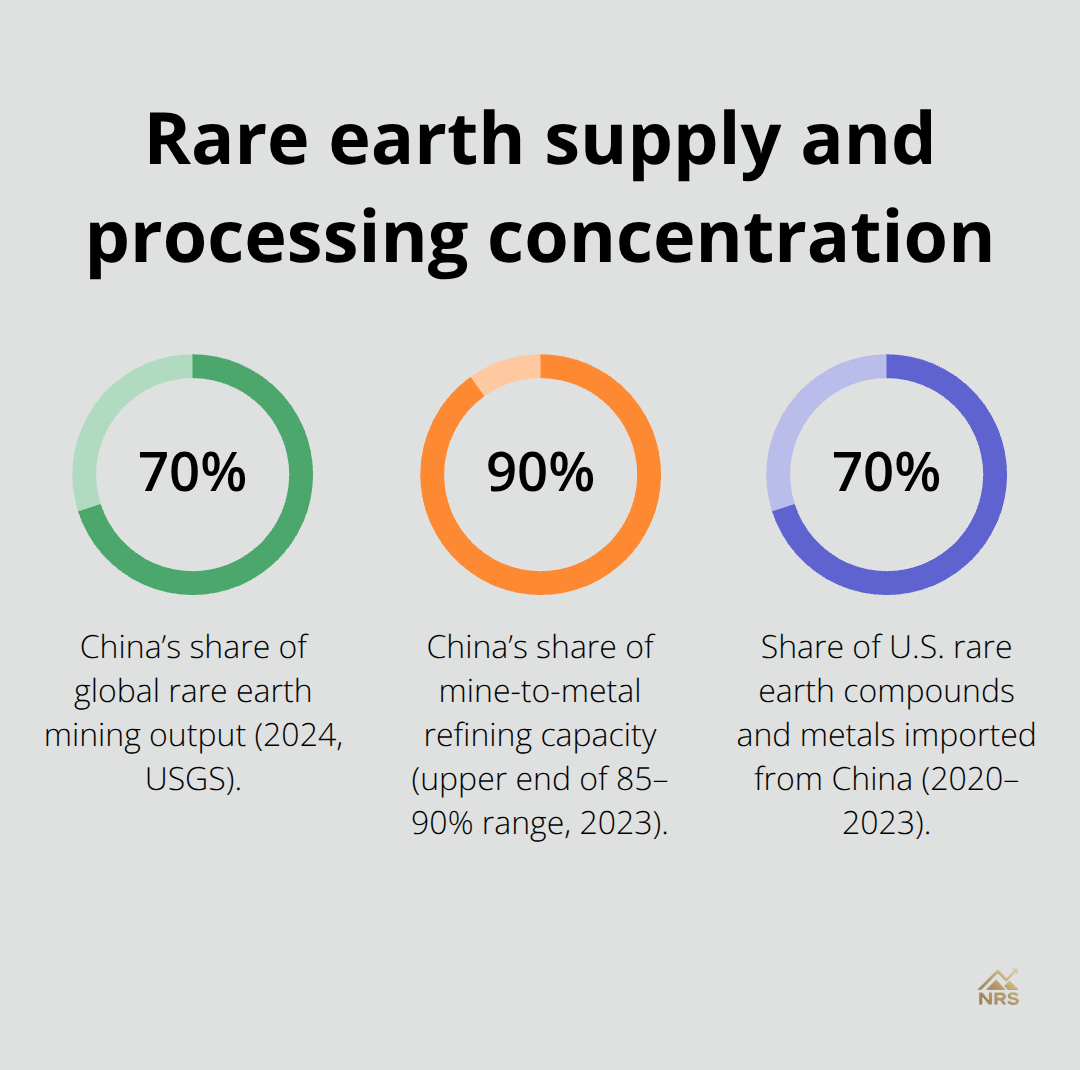
China produced nearly 70 percent of global rare earth mining output in 2024 according to the United States Geological Survey, yet that dominance extends far deeper into the supply chain. Goldman Sachs estimates that China handled 85 to 90 percent of mine-to-metal refining in 2023, meaning raw ore from anywhere on Earth typically travels to Chinese facilities for processing. The United States imported roughly 70 percent of its rare earth compounds and metals from China between 2020 and 2023, a dependency that persists despite years of policy focus on diversification.
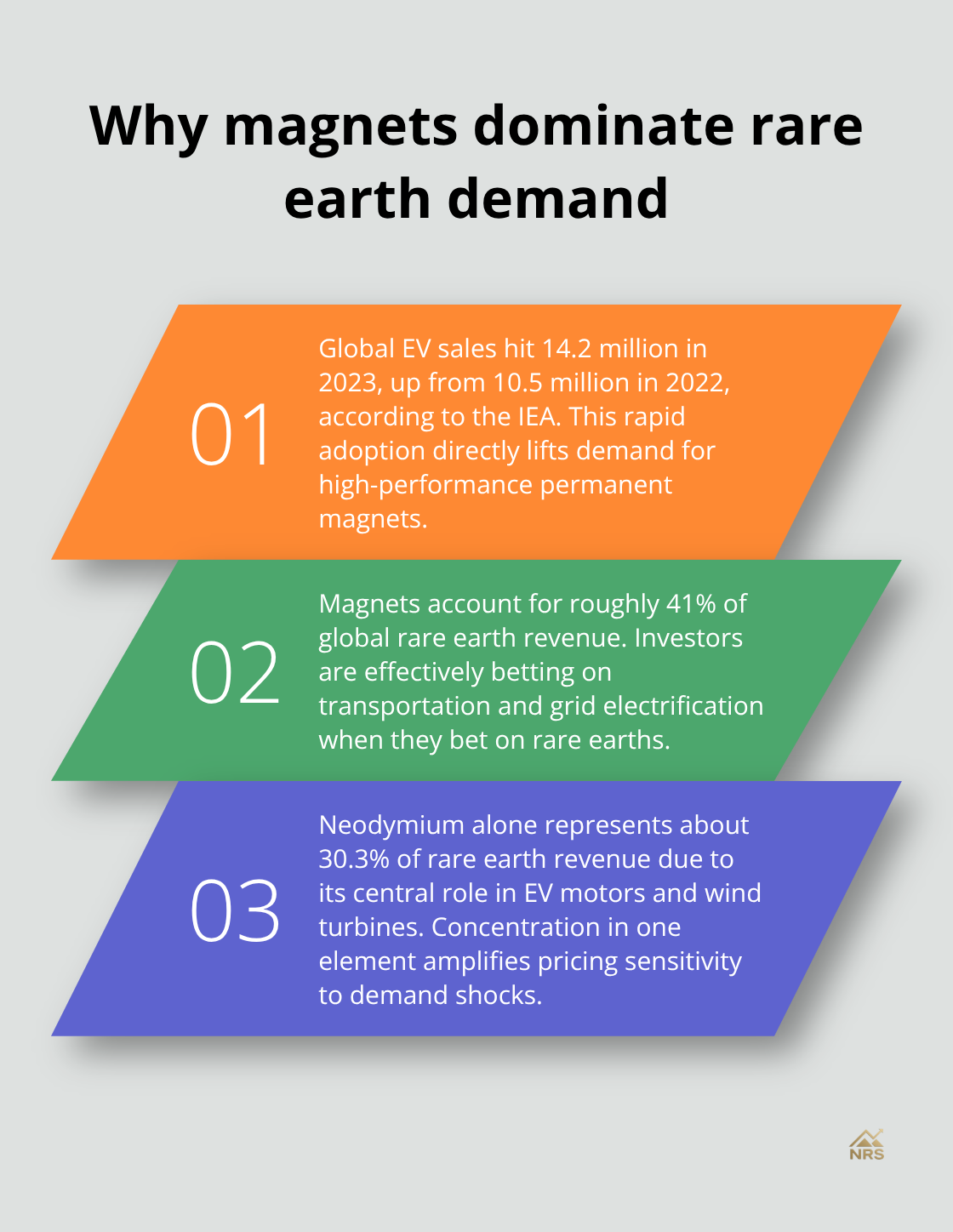
The global rare earths market reached USD 3.95 billion in 2024 and is projected to grow to USD 6.28 billion by 2030 at a compound annual growth rate of 8.6 percent. That expansion masks a critical vulnerability: neodymium represents about 30.3 percent of rare earth revenue and commands the highest demand, primarily for permanent magnets in electric vehicle motors and wind turbine generators.
Magnet Demand Drives the Market
The International Energy Agency reported 14.2 million electric vehicles sold globally in 2023, up from 10.5 million in 2022, and that surge drives magnet consumption directly. Magnets alone account for approximately 41 percent of global rare earth revenue, meaning your exposure to rare earths is fundamentally exposure to the electrification of transportation and energy infrastructure.
The Price Signal Problem
Price volatility in rare earths tells you less than you’d expect. The 2022 spike driven by geopolitical tensions was followed by a gradual decline through 2023 and 2024, yet that downward movement masked tightening fundamentals in specific elements. Shanghai Metals Market data provides the most reliable regional spot prices, but these figures don’t capture the full picture of scarcity because recycling supplies almost nothing.
Only about 1 percent of rare earths are recycled from consumer products globally, according to the Union of Concerned Scientists, despite the United Nations Environment Programme estimating 53 million tons of electronic waste in 2019. Rare earth recycling rates remain low due to high recovery costs, limited collection infrastructure, and limited suppliers, making supply must come from mining. This creates a structural problem: demand for rare earths projected to rise 400 to 600 percent over coming decades, yet praseodymium demand could exceed supply by approximately 175 percent and terbium may also face shortages by 2030.
Emerging Producers Challenge China’s Grip
Major industry players shaping the market include Lynas, Arafura Resources, Alkane Resources, Greenland Minerals, Iluka Resources, and Rare Element Resources, but most remain pre-revenue or early-stage operations. USA Rare Earth announced a USD 100 million investment in early 2026 to build a neodymium magnet facility in Stillwater, Oklahoma, targeting initial capacity of 1,200 tons per year and scaling to 4,800 tons per year by 2026. MP Materials secured USD 58.5 million in April 2024 to advance an integrated rare earth magnet manufacturing facility in Fort Worth, Texas, with commercial production expected by late 2025.
India’s IREL announced plans in 2023 to boost mining capacity by approximately 400 percent over the coming decade, targeting production rising from 5,000 tons to roughly 13,000 tons. These capital commitments signal genuine momentum toward supply diversification, but execution risk remains substantial. China’s temporary export restrictions on key rare earth elements in 2025 demonstrated how policy can trigger supply disruptions within weeks. Geographic concentration creates the real risk for investors: China alone produces about 60 percent of global rare earth output and processes roughly 90 percent of it, meaning even new mines in the United States or Australia still depend on Chinese refining capacity unless integrated processing facilities come online simultaneously. The race to build these facilities outside China will determine which producers capture margin and which ones struggle to compete.
How China Controls Rare Earths Supply and Why the West Is Fighting Back
China’s Processing Monopoly Creates Structural Advantage
China’s stranglehold on rare earths processing creates a structural advantage that no amount of new mining capacity outside China can quickly overcome. China mines about 70 per cent of the world’s rare earth metals and holds 90 per cent of the global processing capacity, giving the country dominance that translates directly into pricing power and supply control. When China implemented temporary export restrictions on key rare earth elements in 2025, it demonstrated how policy decisions in Beijing ripple through global supply chains within weeks. Investors who fixate on new mine announcements in the United States, Canada, or Australia miss the critical reality: ore means nothing without processing capability.
A new rare earth deposit in Montana or Western Australia still requires either Chinese refining or years of capital investment to build domestic processing facilities. This lag between mining and processing creates a window where Chinese policy remains the dominant market signal. Track Chinese government statements on export controls, environmental inspections at processing facilities, and strategic stockpiling announcements through official channels and trade publications, not analyst reports.
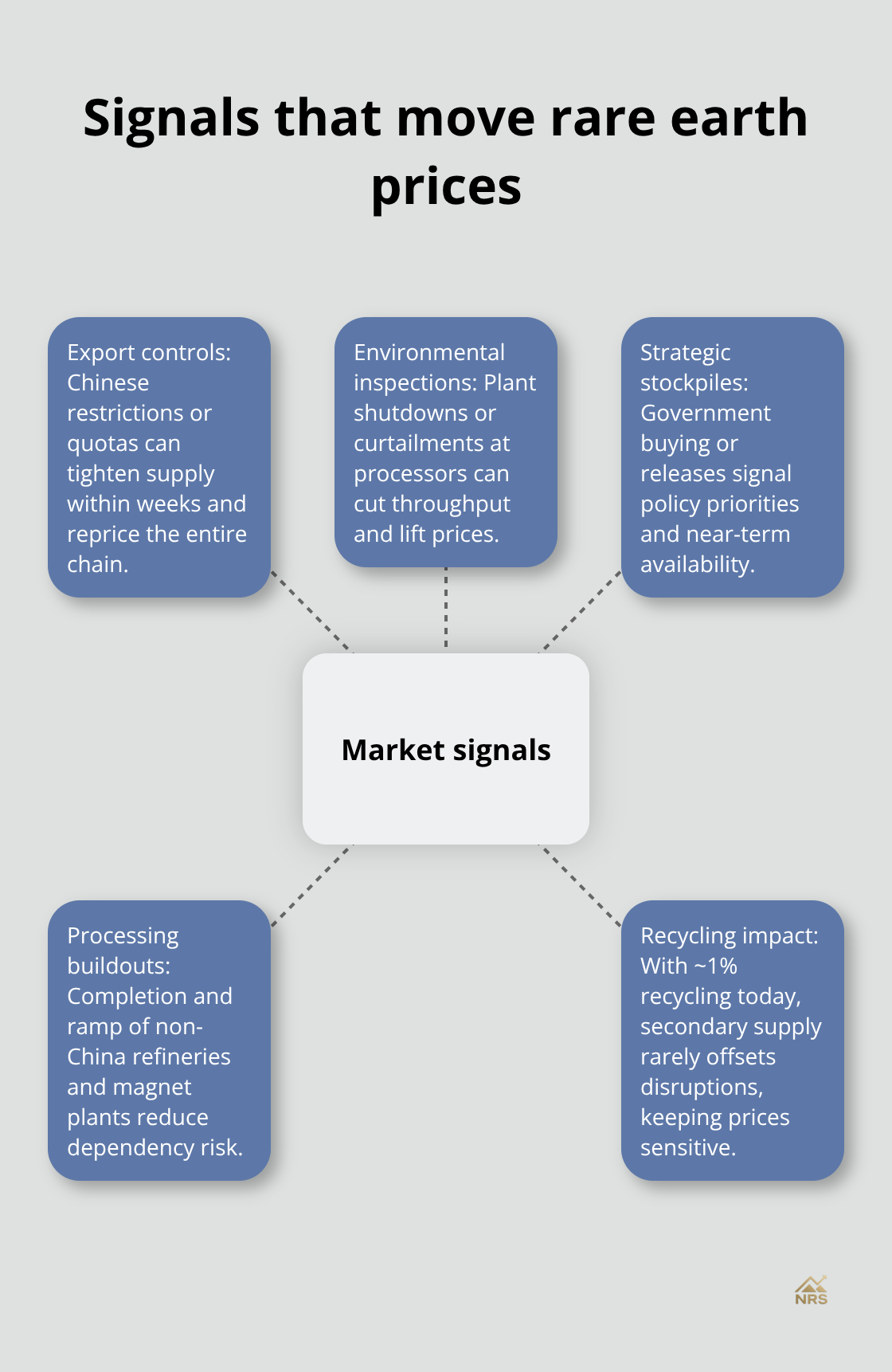
These signals move rare earth prices more reliably than production numbers from emerging miners.
The Dependency Problem Persists
The United States imported 70 percent of its rare earth compounds and metals from China between 2020 and 2023 despite two decades of diversification policy, underscoring how entrenched this dependency remains. Western governments are finally treating rare earth supply as a strategic priority rather than a cost optimization problem. The Biden administration has prioritized developing domestic supply chains for rare earths and critical minerals, shifting investment toward U.S. production and processing.
Western Facilities Begin Closing the Processing Gap
USA Rare Earth achieved a major operational milestone with the commissioning of Phase 1a magnet production at its Stillwater facility in March 2026, while MP Materials is advancing integrated magnet manufacturing in Fort Worth. These investments matter because they begin closing the processing gap, but execution timelines matter more than announcements. Environmental regulations in Western nations slow permitting for new mines and processing plants, creating a genuine tension between decarbonization goals and mineral supply security.
One ton of rare earth production generates approximately 30 pounds of dust, 9,600 to 12,000 cubic meters of waste gas, and 75 cubic meters of wastewater according to environmental research, making environmental reviews lengthy and expensive. India’s IREL plans to boost mining capacity 400 percent over the coming decade, targeting 13,000 tons from 5,000 tons, offering an alternative to China that bypasses some Western regulatory delays.
What Investors Must Monitor
Investors should monitor completion dates for processing facilities, not just mining permits, because a facility with nameplate capacity means nothing if environmental or technical issues delay commercial production. The race to build these facilities outside China will determine which producers capture margin and which ones struggle to compete. Supply diversification remains incomplete, and the next section examines which investment opportunities offer genuine exposure to this structural shift.
Investment Opportunities in Rare Earths
USA Rare Earth’s Operational Milestone
USA Rare Earth’s Stillwater facility represents the most concrete investment signal in the rare earths sector right now. The company achieved Phase 1a magnet production commissioning in March 2026 with a $100 million investment. Phase 1a is expected to ramp to a run rate capacity of 600 mtpa by the end of Q4 2026. This matters because it’s not a promise or a permit approval-it’s operational capacity producing neodymium magnets for actual customers. The stock trades around $24.39 with a market cap near $5.9 billion and trailing returns of 105 percent year-to-date, 158 percent over one year, and 141 percent over three years, according to Yahoo Finance. Valuation appears stretched at a price-to-book ratio of 11.93, but the company holds roughly $1.75 billion in cash against debt-to-equity near 0.07 percent, giving it runway to execute its mine-to-magnet platform without diluting shareholders.
The real test arrives with earnings results expected August 10, 2026, where revenue and production numbers will either validate the upward momentum or expose execution shortfalls. Analyst consensus targets around $30.00 per share with Wedbush assigning an Outperform rating and $35 target, but the negative net income of approximately $440 million and diluted EPS of $4.40 losses mean profitability remains years away. This is a growth-stage bet, not a value play, and requires conviction that magnet demand from electric vehicles and wind turbines will absorb Stillwater’s output at prices that eventually turn losses into profits.
MP Materials and Integrated Manufacturing
MP Materials presents a different risk profile entirely. The company secured $58.5 million in April 2024 for an integrated facility in Fort Worth, Texas, with commercial production expected by late 2025, though that timeline may slip due to typical manufacturing delays. Unlike USA Rare Earth, MP Materials already operates the Mountain Pass mine in California as the only active U.S. rare earth producer, providing cash flow from existing operations. The critical advantage is that integrated magnet manufacturing eliminates the dependency on Chinese processing that constrains other producers.
Investors should demand quarterly updates on Fort Worth facility ramp-up rates-nameplate capacity means nothing if production runs below 50 percent utilization. The company’s existing mine operations provide a foundation that newer entrants lack, reducing execution risk relative to pure-play magnet manufacturers without ore supply.
Geographic Diversification Beyond North America
India’s IREL plans to boost mining capacity over the coming decade and offers geographic diversification away from China and Western regulatory complexity. Execution risk in India remains higher than in North America, but the scale of India’s ambition signals that supply alternatives to China are materializing across multiple regions. This geographic spread reduces the likelihood that any single policy decision or environmental event disrupts the entire supply chain.
Direct Investment and ETF Exposure
Direct rare earth metal investment remains impractical for most investors because spot markets lack transparency and leverage is limited. Rare earth ETFs provide diversified exposure to producers, refiners, and recyclers, but performance depends on underlying company earnings and capital spending, not just raw material prices. Individual REE-exposed stocks often derive only partial revenue from rare earths, requiring deep due diligence to identify firms with meaningful exposure.
The Processing Facility Signal
The most actionable signal for investors is tracking completion dates for processing facilities rather than mining permits-which producers actually achieve integrated production capacity determines winners from losers over the next three years. A facility with nameplate capacity means nothing if environmental or technical issues delay commercial production. The race to build these facilities outside China will determine which producers capture margin and which ones struggle to compete.
Final Thoughts
China’s processing dominance remains the single most important variable for investors, yet Western capacity is finally materializing at scale. USA Rare Earth’s operational milestone at Stillwater and MP Materials’ Fort Worth facility represent genuine progress, not announcements. These facilities will determine whether supply diversification succeeds or stalls over the next three years, and the rare earths market dynamics hinge on execution rather than promises.
Track quarterly production reports from integrated producers instead of nameplate capacity figures, because a facility running at 40 percent utilization tells you far more than a 1,200-ton-per-year design specification. Monitor Chinese export policy statements and environmental inspections at processing plants, since these decisions move rare earth prices faster than supply announcements from emerging miners. Watch completion timelines for processing facilities outside China, because ore without processing capability remains worthless to manufacturers.
The structural demand from electric vehicles and wind turbines will not disappear, and the International Energy Agency’s 14.2 million EV sales in 2023 represent only the beginning of a multi-decade transition. Praseodymium and terbium face genuine supply constraints by 2030, creating pricing power for producers who achieve integrated production capacity. We at Natural Resource Stocks track these signals continuously through expert analysis and market commentary to help investors navigate this volatile sector-visit our rare earth coverage for detailed analysis of producers and the macroeconomic factors shaping mineral supply chains.