
























Silver is reshaping global markets as renewable energy adoption accelerates and industrial demand strengthens. At Natural Resource Stocks, we’re tracking how supply constraints, geopolitical shifts, and central bank policies are reshaping silver valuations.
This silver market analysis examines the forces driving prices today and the opportunities emerging for investors in the months ahead.
Silver Supply and Demand Stand at a Critical Crossroads
Global production lags behind rising consumption
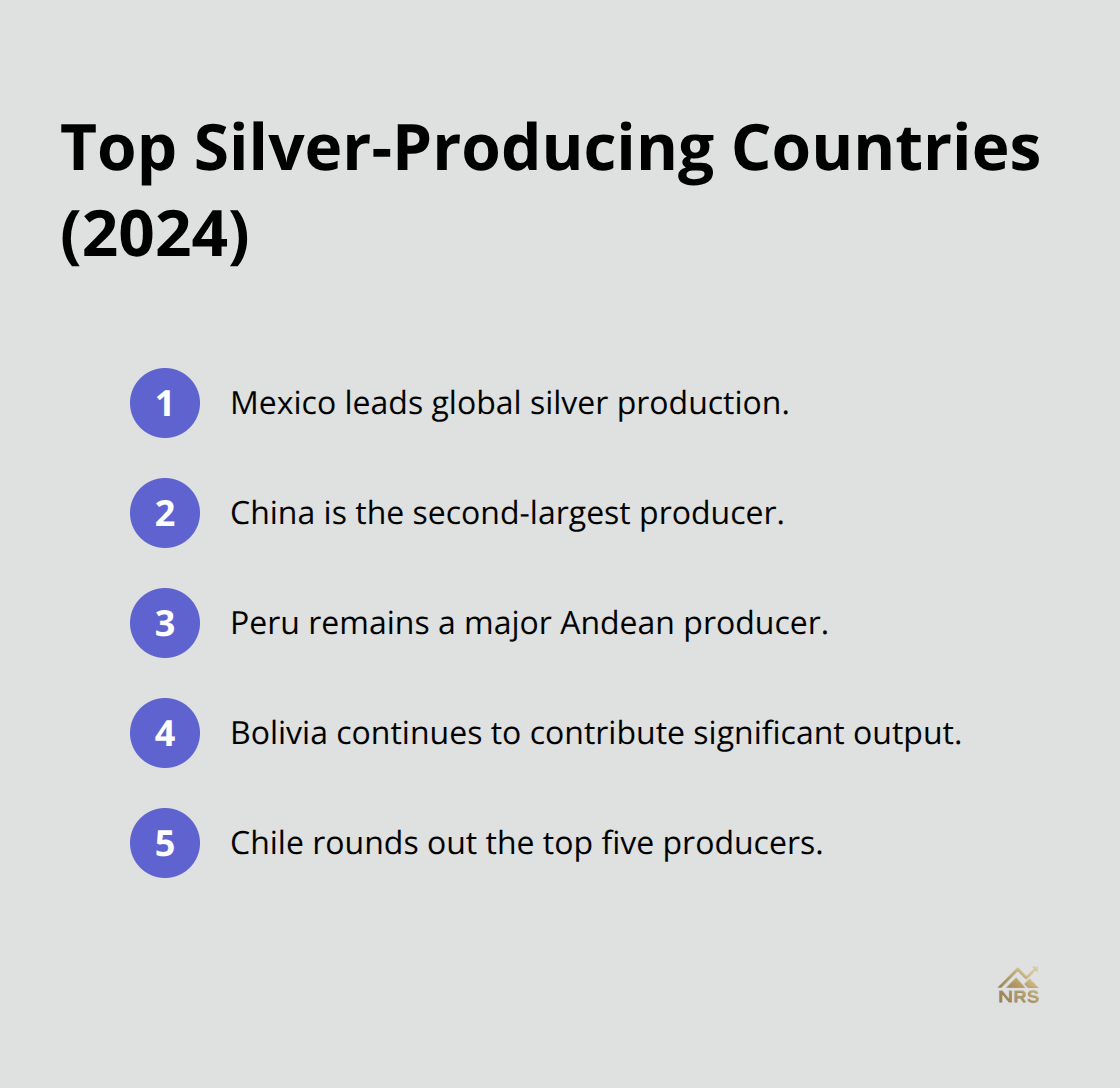
Global silver mine production reached 819.7 million ounces in 2024, up just 0.9% year-over-year according to the World Silver Survey 2025. Mexico leads as the top producer, followed by China, Peru, Bolivia, and Chile. The supply picture matters because roughly 70% of silver comes as a byproduct from copper, lead, zinc, and gold mining rather than from primary silver operations. This byproduct dynamic means silver supply remains relatively inelastic-miners cannot simply ramp up silver output without expanding their primary metal extraction. Mexico’s production recovery, driven by Newmont’s Peñasquito mine returning to full capacity, demonstrates how a single operation shifts the global supply calculus.
The Silver Institute reports a severe 2026 deficit of 46.3 million troy ounces, signaling that demand outstrips available supply at current price levels.
Industrial applications drive structural demand higher
Electronics and electrical applications hit record demand in 2024, supported by photovoltaic installations, automotive electrification, and grid infrastructure upgrades, with artificial intelligence applications providing additional momentum. Solar consumed roughly 200 million ounces in recent years, up sharply from 80 million ounces in 2016. Efficiency improvements in photovoltaic technology reduce silver loadings per watt, which could temper long-term demand growth. The risk of substitution through cadmium telluride thin-film solar technology exists, though adoption remains limited. Industrial scrap recycling climbed 6% in 2024 to 193.9 million ounces, with spent catalysts and electronic waste providing increasingly important supply channels. JPMorgan estimates that industrial demand accounts for roughly 60% of total silver consumption excluding ETF flows, making silver highly sensitive to manufacturing cycles and economic slowdowns. This structural demand from the green economy-EVs, renewable infrastructure, and battery storage-provides a floor beneath silver prices even when investment demand weakens.
Investment flows amplify price volatility in shorter timeframes
Physical investment demand fell in 2024 as investors hesitated amid uncertain interest rate trajectories, yet silver rose more than 130% during 2025, moving from roughly $29 per ounce to over $70 by year-end. This sharp rally reflects how quickly sentiment shifts when inflation concerns resurface or when central banks signal policy pivots. Silver’s smaller market size compared to gold-roughly one-tenth the physical market and about one-fifth the futures open interest-means that concentrated investor flows trigger outsized price swings. The gold-to-silver ratio swung from approximately 80:1 in November 2025 to below 50 during the rally, settling around 65:1 in early 2026, signaling periods of intense silver outperformance. Geopolitical tensions consistently push new buyers toward physical silver coins and bars as tangible assets, with affordability relative to gold making silver an accessible entry point for retail investors despite its higher volatility.
Macroeconomic headwinds test near-term price stability
The Federal Reserve’s rate trajectory and inflation expectations shape silver prices in the near term. Higher interest rates push investors toward yield-bearing assets, while lower rates make non-yielding assets like silver more attractive. Silver fell approximately 27% in January 2026 after Fed chair nomination announcements, illustrating how macro-driven volatility can erase gains quickly. Trading Economics projects silver at 65.27 USD/oz by quarter-end and 79.46 USD/oz in 12 months, signaling a bullish medium-term outlook despite near-term softness. JPMorgan projects 2026 average silver prices around $81 per ounce, roughly double 2025’s average, with volatility depending on demand and policy factors.
Understanding the supply-demand imbalance shapes investment strategy
Silver investors must distinguish between structural industrial demand driving a multi-year uptrend and shorter-term investment flows creating noise around that trend. The 46.3 million ounce deficit projected for 2026 reflects genuine supply tightness, not speculation. Above-ground silver stocks face depletion by 2030 if current demand patterns persist, supporting a bullish long-term outlook. This supply-demand imbalance sets the stage for examining how macroeconomic forces and geopolitical events influence silver valuations in real time.
What Moves Silver Prices in Real Time
Interest rates reshape silver valuations within days
Interest rate expectations dominate silver price action more than any other factor. When the Federal Reserve signals rate increases, silver sells off sharply because investors shift capital toward yield-bearing bonds and savings accounts. The effective federal funds rate climbed from near-zero in 2021 to approximately 3.64% by January 2026, yet silver still rallied from roughly $25 per ounce in 2021 to around $72.82 per ounce by January 2026, showing that industrial demand and inflation concerns can override rate pressure temporarily. Deutsche Bank and Bank of America Global Research now forecast a rate increase in September 2026, which explains the recent 2.8% daily decline in silver prices as of June 23, 2026. The upcoming US PCE price index, the Fed’s preferred inflation gauge, will provide the next catalyst for directional moves. Traders monitor Federal Reserve communications closely because policy pivots reshape silver valuations within days. JPMorgan recommends adopting a cautious stance on silver in the near term and re-engaging when froth subsides, reflecting the reality that macro uncertainty trumps fundamental supply-demand strength in shorter timeframes.
Geopolitical shifts trigger immediate market reactions
Geopolitical shifts trigger immediate market reactions that extend far beyond sentiment. The closure of the Strait of Hormuz has turned geopolitical tensions into a global energy shock, driving inflation fears and forced selling across markets. Signs of progress in US-Iran peace talks briefly supported silver moves toward the mid-60s, illustrating how geopolitical resolution can depress prices as quickly as escalation lifts them. When oil weakens, silver rallies toward the mid-60s to 66 USD/oz, reflecting how energy-market volatility influences inflation expectations and precious metals demand.
Tariff policy poses emerging supply risks
Tariff policy represents an emerging geopolitical risk that could trigger external supply tightness and revive London-to-New York metal flows if duties reappear under Section 232 provisions. A 180-day window for bilateral deals could affect silver supply security and raise volatility across COMEX and London markets. Investors holding silver should treat geopolitical headlines as price catalysts to act on rather than background noise, because concentrated flows in silver’s smaller market amplify these moves into outsized percentage gains or losses within hours. Understanding how tariffs reshape supply chains and metal flows across borders becomes essential as trade policy uncertainty persists into the second half of 2026.
Where Silver Demand Accelerates Fastest
Solar installations drive the largest industrial application
Solar energy consumption of silver reached roughly 232 million ounces in 2024, making photovoltaic installations the single largest industrial application for the metal. This explosive growth masks a critical reality: efficiency improvements in solar panel technology reduce silver loadings per watt, which means manufacturers produce more capacity while consuming less silver per installation. The risk of substitution through cadmium telluride thin-film solar technology exists, though adoption remains limited today. What matters for investors is that solar demand will continue rising through 2030 even as the per-watt consumption flattens, creating a demand ceiling that keeps silver prices stable rather than driving exponential growth.
Electric vehicles reshape silver consumption patterns
Electric vehicles use between 25-50 grams of silver per vehicle, representing the next structural demand driver as automakers scale production toward 50 million units annually by 2030. This shift to electrification adds significant annual demand as production volumes climb. Artificial intelligence applications in data centers and computing infrastructure now consume significant quantities of silver in high-performance electronics, though manufacturers treat silver usage as proprietary information. The World Silver Survey 2025 reports that electronics and electrical applications hit record demand in 2024, supported by photovoltaic installations, automotive electrification, and grid infrastructure upgrades, with AI applications providing additional momentum.
Recycling channels expand as installed base matures
Industrial scrap recycling climbed 6% in 2024 to 193.9 million ounces, with spent catalysts and electronic waste providing increasingly important supply channels that will grow as EV batteries reach end-of-life and solar panels installed in the 2010s require replacement. This secondary supply source reduces dependence on primary mining and creates a buffer against supply shocks, though recycling rates remain below optimal levels across most regions.
Emerging markets shift the jewelry demand equation
India accounted for the bulk of jewelry demand gains in 2024, contrasting sharply with China’s third consecutive year of declines according to the World Silver Survey 2025. Import duty cuts in India, a healthy rural economy, and higher purities drove Indian jewelry fabrication upward, making India the dominant regional force in silver jewelry demand rather than China. This regional shift matters because Indian demand responds differently to price movements than Chinese demand, with rural Indian consumers treating silver jewelry as a store of value during inflationary periods. Physical silver coins attract new buyers because they provide a lower entry price than gold while offering the same tangible asset protection during economic disruptions.
Investment flows reshape demand composition
Tariff uncertainty and supply chain fragmentation could accelerate physical silver accumulation among retail investors in developed markets if geopolitical tensions persist, creating a secondary demand driver beyond industrial consumption. JPMorgan projects that industrial demand accounts for roughly 60% of total silver consumption excluding ETF flows, meaning the remaining 40% flows through jewelry, coins, bars, and investment vehicles where price sensitivity and behavioral factors dominate. Investors should focus accumulation on periods when investment demand weakens rather than chasing price rallies, because the structural industrial demand ensures silver consumption remains robust regardless of sentiment cycles.
Final Thoughts
Silver’s structural supply deficit and accelerating industrial demand create a compelling case for long-term investors, yet near-term volatility demands discipline. The 46.3 million ounce deficit projected for 2026 reflects genuine supply tightness as solar installations, electric vehicle production, and grid infrastructure upgrades consume record quantities. JPMorgan projects 2026 average silver prices around $81 per ounce, with potential to exceed $100 per ounce by 2030 as industrial demand continues climbing.
Interest rate expectations and geopolitical shifts will create sharp price swings in the months ahead. The Federal Reserve’s September rate decision and upcoming PCE inflation data will reshape silver valuations within days, while tariff policy uncertainty adds another layer of complexity that potentially triggers supply chain disruptions. Investors must distinguish between structural industrial demand driving a multi-year uptrend and shorter-term investment flows creating noise around that trend.
Retail investors should focus accumulation on periods when investment demand weakens rather than chasing price rallies, and dollar-cost averaging reduces timing risk when building positions. Physical silver coins offer an accessible entry point relative to gold, though diversification matters because silver’s volatility demands that the metal represent only a small portion of a broader portfolio. At Natural Resource Stocks, we track how macroeconomic factors, geopolitical developments, and supply dynamics reshape silver valuations through our silver market analysis and expert insights.