


























Nuclear energy is experiencing a genuine resurgence. Governments worldwide are committing to new reactor builds, and energy demand continues climbing-creating real uranium investment opportunities for those paying attention.
At Natural Resource Stocks, we’ve identified three distinct paths investors can take: direct ownership vehicles, mining company stocks, and diversified ETF approaches. Each carries different risk profiles and return potential.
Why Uranium Demand Is Tightening Now
Global Demand Accelerates Across Three Fronts
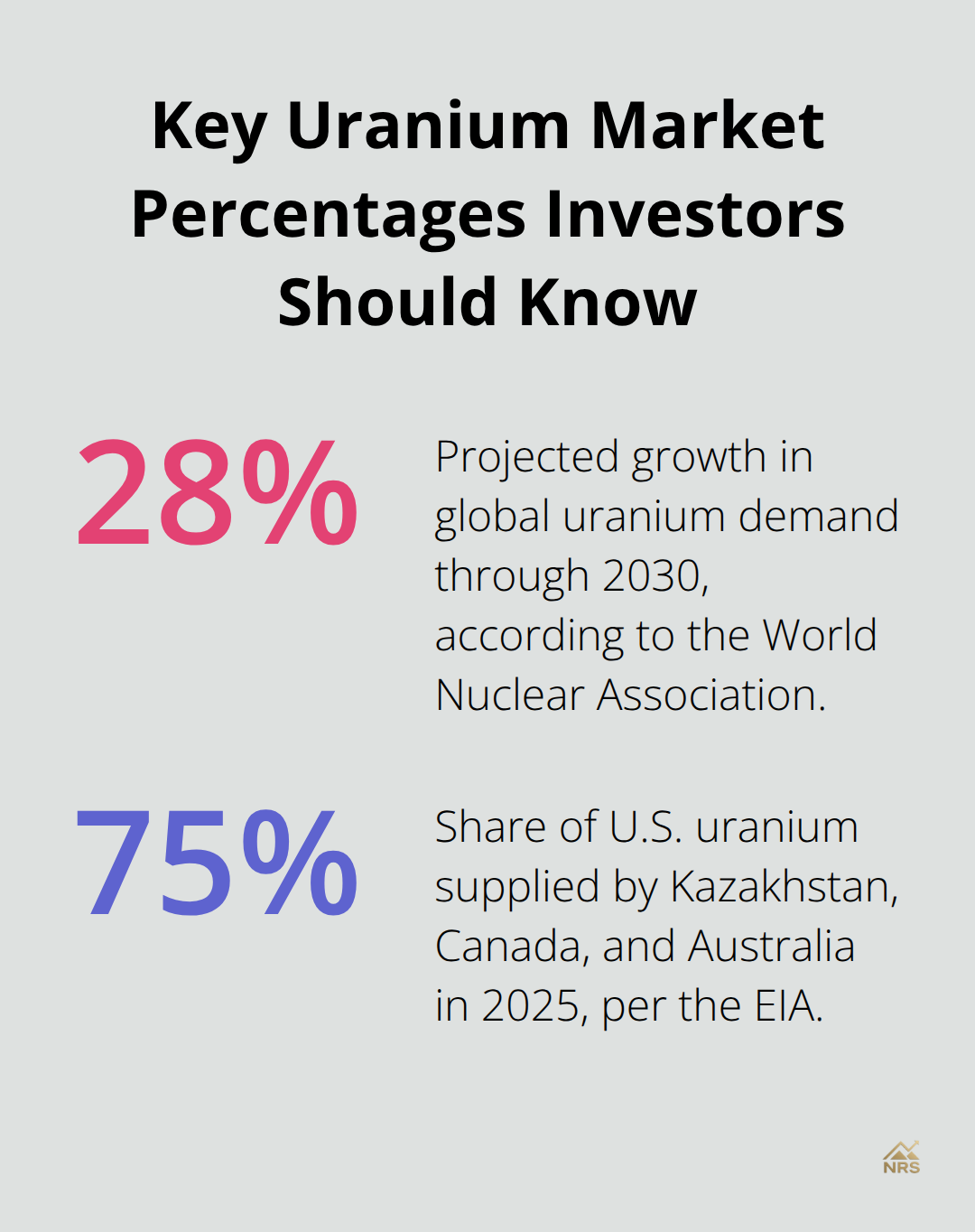
Uranium demand is accelerating faster than supply can respond, and the numbers tell a clear story. The World Nuclear Association projects roughly 28% growth in global uranium demand through 2030, driven by three concrete forces: governments extend reactor lifetimes, new reactor construction advances, and tech giants sign long-term power purchase agreements for data centers. In 2025 alone, U.S. civilian nuclear reactors purchased 46.9 million pounds of uranium at a weighted-average price of $58.46 per pound according to the Energy Information Administration. More telling, utilities signed 22 new purchase contracts in 2025 for 4 million pounds at an average of $70.46 per pound, signaling confidence in rising forward demand.
The EIA also reported that unfilled market requirements for 2025 through 2035 total 186 million pounds, and when combined with existing contract deliveries of 174 million pounds, the decade ahead demands roughly 360 million pounds of uranium. This is not theoretical-utilities are locking in supply now because they expect prices to climb.
The Supply Deficit Widens
The supply side reveals the real opportunity. Global uranium mine supply continues falling short of reactor demand, creating a structural deficit in uranium supply. Kazakhstan, Canada, and Australia supplied 75% of U.S. uranium in 2025, yet Kazakhstan cut its 2026 production guidance by roughly 10% to support pricing and maintain market discipline. Spot uranium prices hovered near $85 per pound in July 2026 after peaking at $101.41 earlier in the year, while long-term contract prices reached their highest levels since 2008 according to Bloomberg.
Price Signals Point to Upside Potential
The gap between spot and contract prices matters significantly. In 2025, spot contracts averaged $76.01 per pound versus $55.91 for long-term deals, meaning utilities that contracted forward secured meaningful discounts. This price structure creates actionable timing windows for investors-if supply tightens further, spot prices could push substantially higher. Analysts quoted by Investing News Network suggest uranium needs to sustain around $125 to $150 per pound to incentivize sufficient new mine development into the 2030s, implying substantial upside if production constraints persist. These price levels would represent a significant move from current levels and would reflect the market’s recognition of the supply-demand imbalance ahead.
How to Own Uranium: Three Distinct Paths
Investors pursuing uranium exposure face three fundamentally different approaches, each with distinct mechanics and risk characteristics. The choice depends on your conviction about uranium prices, tolerance for operational risk, and desired liquidity profile. Physical uranium and funds offer the purest price exposure without company-specific risks.
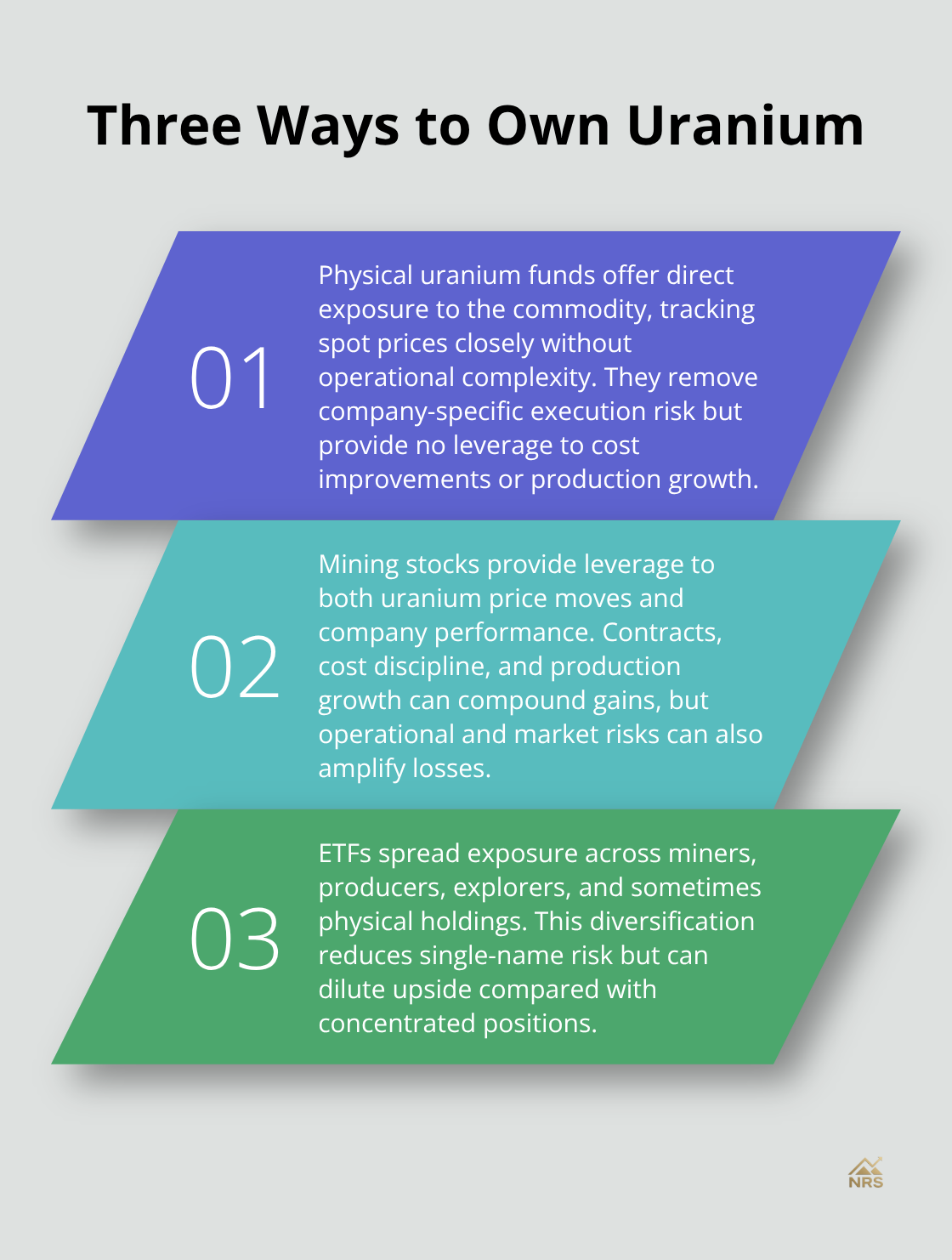
Mining stocks tie returns to both commodity prices and management execution. ETFs provide diversification but dilute concentrated upside.
Physical Uranium Funds: Pure Commodity Exposure
Physical uranium funds like Sprott Physical Uranium Trust offer direct exposure to the commodity without equity risk or the operational complexity of owning mines. The trust holds actual uranium inventory and trades on the TSX, meaning your returns track spot prices nearly one-for-one. Yellow Cake on the London Stock Exchange provides UK ISA-eligible access to physical uranium with a market cap around £1.35 billion and holds roughly 23.1 million pounds as of February 2026. The practical advantage: no mining delays, no permitting risk, no management missteps. The disadvantage: zero leverage to operational improvements or cost reductions that boost miner profitability.
Mining Stocks: Leverage to Price and Performance
Mining stocks like Cameco, the world’s largest publicly traded uranium producer with roughly $42 billion market cap, offer leverage to both price appreciation and operational performance. Cameco controls long-term contracts for approximately 230 million pounds through 2030 at higher prices than 2025 spot rates, providing earnings visibility that pure physical holders never achieve. Bernstein named Cameco the top uranium pick for 2026, citing its 49% acquisition of Westinghouse Electric, which strengthens earnings through reactor services and maintenance contracts. Kazatomprom controls over 40% of global supply and has announced plans for a roughly 10% cut in its uranium production in 2026. The trade-off: mining stocks amplify losses if uranium prices collapse and introduce operational risk that physical uranium avoids.
ETFs: Diversification Across the Sector
ETFs like URNM and URNJ provide diversified exposure across the uranium sector without concentrated bets. URNM manages over $2 billion in assets and holds uranium miners, producers, explorers, and even physical uranium in a flexible structure. URNJ focuses on smaller miners, capturing higher-risk, higher-reward opportunities among junior explorers. The Nasdaq Sprott Junior Uranium Miners Index surged 21.75% in September, demonstrating that smaller producers outperform during rallies. The practical benefit: diversification reduces single-company risk and captures exposure across the supply chain. The cost: you own winners and losers simultaneously, diluting concentrated upside from your best conviction picks.
Matching Your Strategy to Market Conditions
Each vehicle responds differently to market shifts. Physical uranium accelerates when spot prices spike. Mining stocks compound gains through both price appreciation and production growth, but they also suffer when operational challenges emerge. ETFs smooth volatility across multiple holdings, making them suitable for investors who want uranium exposure without the stress of single-stock selection. The real opportunity lies in recognizing that these three paths are not mutually exclusive-combining them creates a portfolio that captures commodity upside, operational leverage, and diversification simultaneously. What matters next is identifying which specific assets within each category offer the strongest fundamentals and positioning for the supply tightness that 2027 will likely bring.
Where Real Uranium Growth Happens Next
Arrow Project: The Supply Solution Taking Shape
NexGen Energy holds the Arrow project in Saskatchewan, widely recognized as the world’s highest-grade undeveloped uranium deposit with production targeted to start in 2027. The company’s market cap sits around CAD 9.5 billion, and Arrow’s exceptional ore grades mean lower extraction costs than competing projects once operational. This matters because lower-cost production protects profits during price downturns and amplifies returns during rallies. The EIA reported that maximum uranium deliveries for 2026 through 2035 under existing purchase contracts total 174 million pounds, and Arrow’s first full production year could supply meaningful volumes into that deficit.
Development-stage projects carry real risks including permitting delays and construction overruns, but Arrow’s advancement timeline aligns precisely with when supply tightness should peak. Investors targeting higher-conviction plays should monitor quarterly updates on permitting progress and funding rounds, as financing announcements signal management confidence in timeline execution.
Geographic Diversification: Reducing Concentration Risk
Geographic concentration in uranium supply creates both risk and opportunity. Kazakhstan, Canada, and Australia supplied 75% of U.S. uranium in 2025 according to the EIA, meaning disruptions at any single node ripple across global markets. Canada’s dominance through Cameco and NexGen offers stability through established infrastructure and political reliability, but overweighting Canadian exposure leaves portfolios vulnerable if regulatory shifts occur.
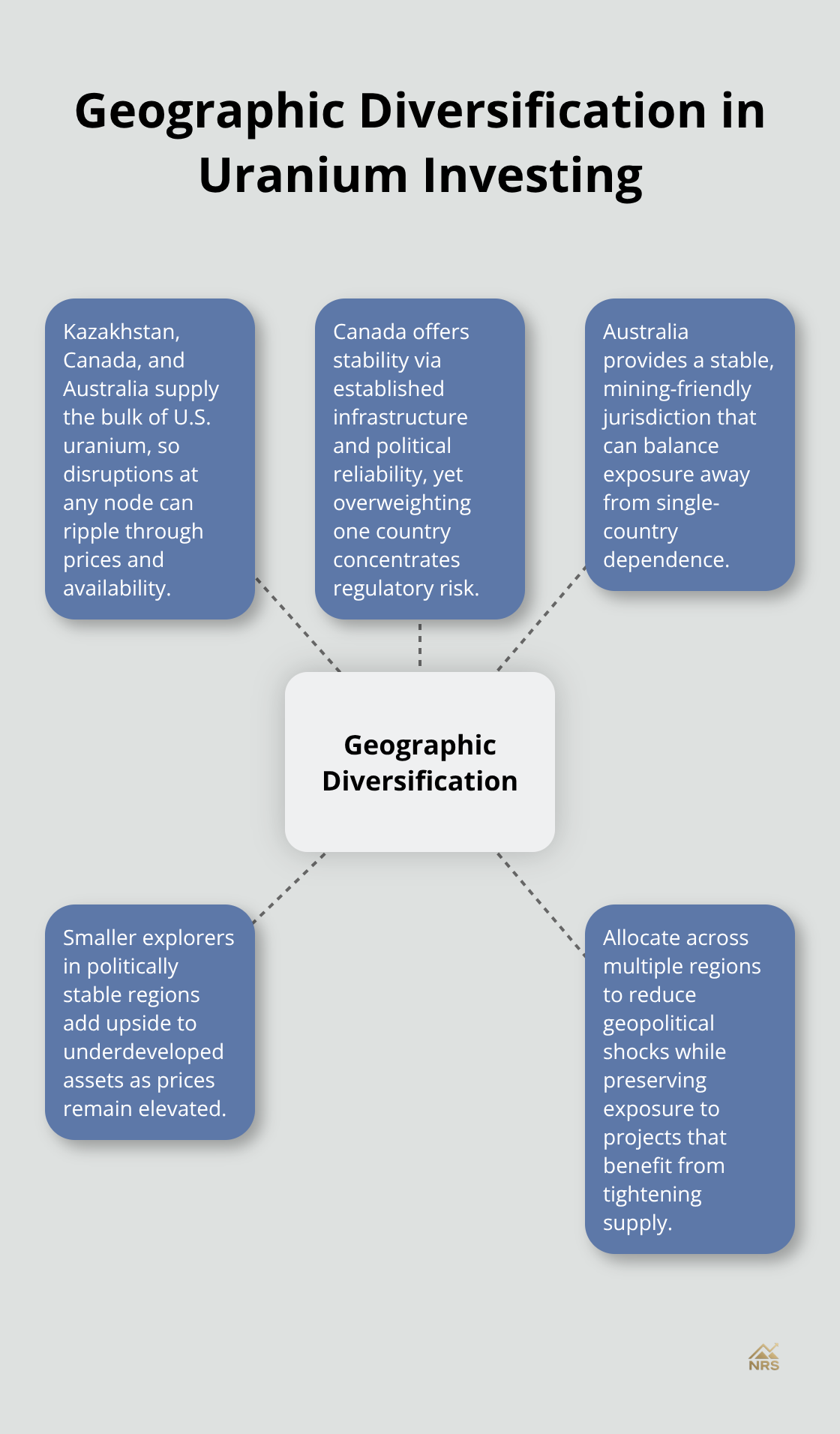
Australian producers provide geographic diversification into a stable jurisdiction with strong mining credentials. Smaller explorers operating in politically stable regions offer exposure to underdeveloped assets that could unlock significant value as uranium prices sustain above $100 per pound. The key tactical move involves building positions across geographic regions rather than concentrating capital in any single country, reducing geopolitical risk while maintaining exposure to projects that benefit directly from supply tightening.
Final Thoughts
The uranium market in 2027 presents genuine uranium investment opportunities for those willing to act on fundamentals rather than sentiment. Demand grows across three distinct drivers: government reactor extensions, new construction projects, and data center power agreements from major tech companies. Supply remains constrained, with Kazakhstan cutting production and prices demonstrating resilience near $100 per pound despite recent pullbacks.
Physical uranium funds offer pure commodity exposure without operational complexity, while mining stocks like Cameco provide leverage to both price appreciation and production growth through long-term contracts already locked in at favorable rates. ETFs deliver diversification across the sector, reducing single-company risk while capturing exposure to explorers, producers, and physical holdings simultaneously. The strongest approach combines all three, balancing commodity upside with operational leverage and risk mitigation.
Geopolitical concentration in Kazakhstan, Canada, and Australia means supply disruptions at any major node ripple globally, and development-stage projects like NexGen’s Arrow face permitting and construction timelines that could slip. At Natural Resource Stocks, we provide expert analysis and market commentary to help you build positions aligned with your risk tolerance and investment timeline. The supply deficit won’t resolve overnight, and utilities continue locking in long-term contracts as the window for positioning remains open.