

























Copper and nickel are moving in opposite directions today. Copper is higher as traders continue to focus on tightening global supply, constrained mine output, possible U.S. import tariffs, and strong long-term demand from electrification and AI data centers. Nickel is slightly lower as expectations of improved Indonesian supply and possible RKAB quota relaxation weigh on prices.
Today’s pricing snapshot
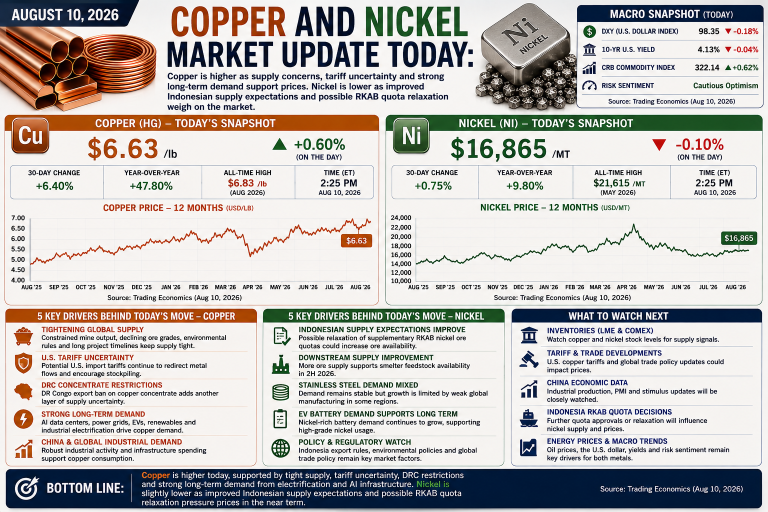
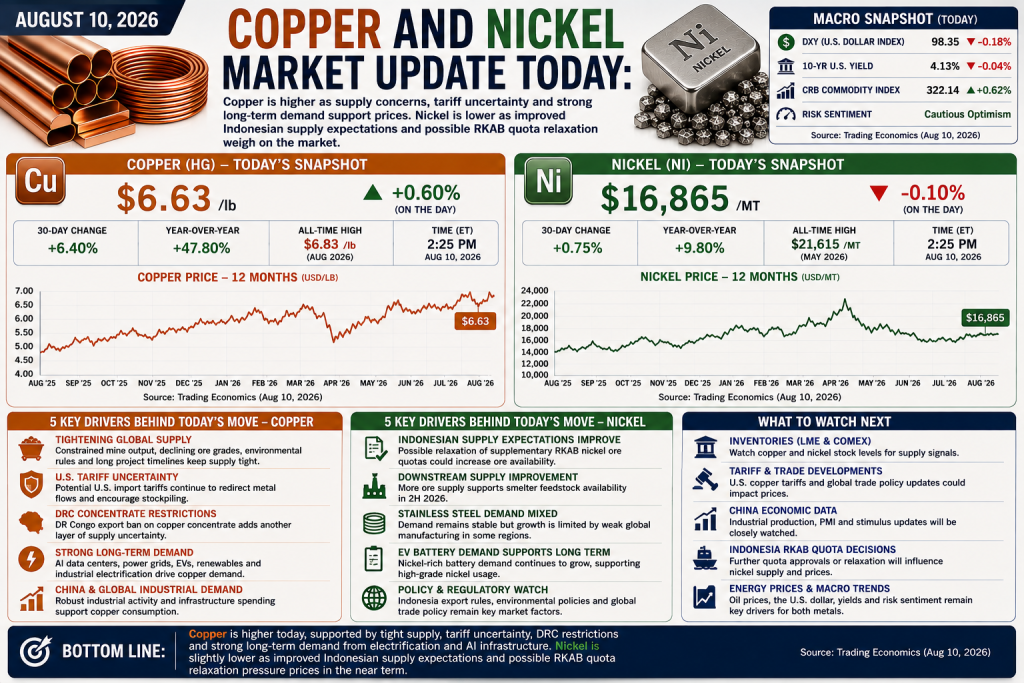
According to Trading Economics CFD benchmarks, copper traded around $6.63/lb, up roughly 0.6% on the day. Copper is also up about 6.4% over the past month and roughly 47.8% year over year, keeping the metal near historically elevated levels. Trading Economics also notes that copper recently reached an all-time high of about $6.83/lb in August 2026.
Nickel traded around $16,865/metric ton, down roughly 0.1% on the day. Nickel is still up about 0.75% over the past month and roughly 9.8% year over year, showing that the longer-term trend remains positive even as near-term pressure continues.
5 key drivers behind today’s move
1) Copper is higher as supply concerns stay in focus
Copper is rising as traders continue to price in tighter global supply. Constrained mine output, declining ore grades, environmental regulations, geopolitical risk, and long project timelines remain major support points for the market.
That matters because copper supply cannot be increased quickly. New mines take years to permit, finance, build, and ramp up, so even modest disruptions can support prices when demand is strong.
2) U.S. tariff uncertainty is still shaping copper flows
Copper traders remain cautious over potential U.S. import tariffs. Tariff uncertainty has helped redirect metal from international markets into U.S. warehouses, keeping regional supply-chain risk in focus.
That can support copper prices because traders and manufacturers may stockpile metal ahead of possible policy changes, especially when physical supply is already tight.
3) DRC copper concentrate restrictions add another supply wrinkle
The Democratic Republic of Congo recently imposed an export ban on copper concentrate. While some analysts expect the direct global impact to be limited, the move still matters because it reflects a broader trend of resource-rich countries trying to keep more processing and refining value at home.
For copper buyers, that creates another layer of uncertainty around concentrate flows, smelter supply, and global refined copper availability.
4) AI, data centers, and electrification remain major copper catalysts
Copper’s long-term demand story remains one of the strongest in the metals market. AI data centers, power grids, EVs, renewable energy, defense demand, industrial electrification, and clean-energy infrastructure all require major copper input.
That is why copper continues to attract buyers near record levels. The market is increasingly treating copper as a strategic infrastructure metal, not just a traditional construction and manufacturing commodity.
5) Nickel is lower as Indonesian supply expectations improve
Nickel is slightly lower as traders react to expectations of improved Indonesian supply. Reports suggest Indonesia may further relax supplementary RKAB nickel ore quotas, which could increase ore availability and support downstream smelter feedstock in the second half of the year.
That puts pressure on nickel because Indonesia is the biggest supply-side driver in the global nickel market. If more ore becomes available, nickel prices can weaken even when longer-term demand from stainless steel and EV batteries remains supportive.
What to watch next
Copper traders will be watching LME and COMEX inventories, U.S. copper tariff developments, DRC concentrate export restrictions, China industrial demand, mine-supply updates from Chile, Peru, Indonesia, and the Democratic Republic of Congo, AI/data-center power demand, grid investment, EV sales, U.S. dollar moves, Treasury yields, and broader risk sentiment.
Nickel traders will be watching Indonesia’s RKAB quota process, supplementary quota approvals, stainless steel demand, EV battery demand, Class 1 nickel premiums, LME inventories, Indonesian export rules, ore shipments, sulfur costs, and whether supply discipline continues through the second half of 2026.
Bottom line
On August 10, 2026, copper is higher while nickel is slightly lower. Copper is being supported by tight supply, tariff uncertainty, DRC concentrate restrictions, AI/data-center demand, electrification, and clean-energy growth. Nickel remains positive year over year, but today’s move is softer as traders focus on improved Indonesian supply expectations and possible RKAB quota relaxation.
Copper remains the cleaner long-term structural-demand story, while nickel remains the more supply-policy-sensitive trade today.