
























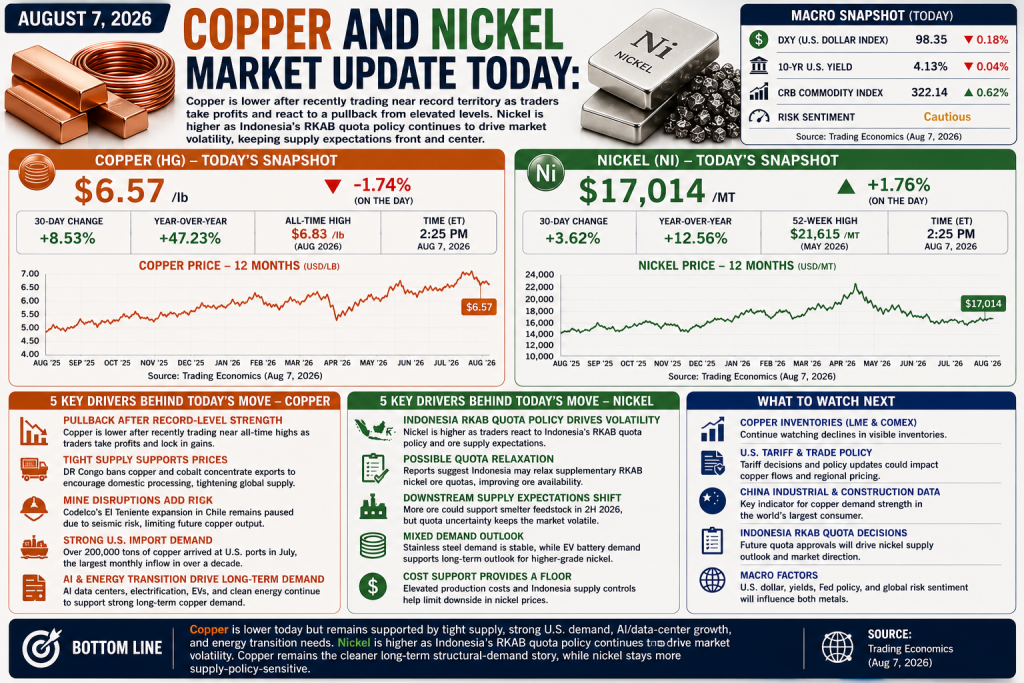
Copper and nickel are moving in opposite directions today. Copper is lower after recently trading near record territory, as traders take profits and react to a pullback from elevated levels. Nickel is higher as Indonesia’s RKAB quota policy continues to drive market volatility, keeping supply expectations front and center.
Today’s pricing snapshot
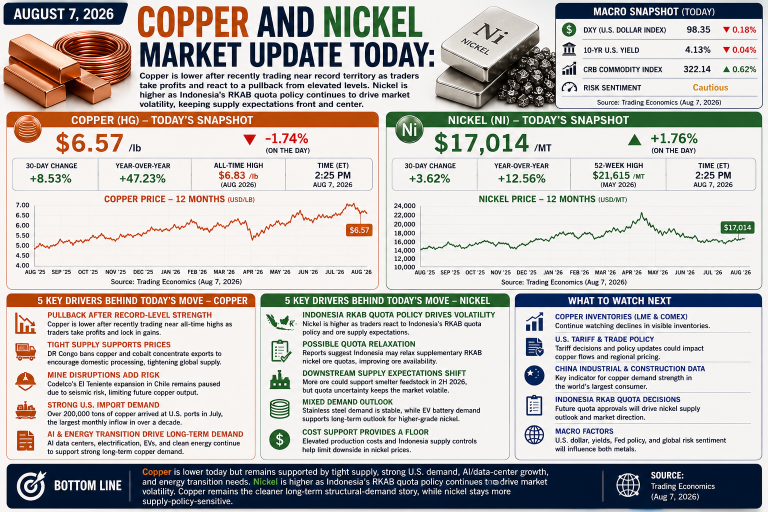
According to Trading Economics CFD benchmarks, copper fell to about $6.57/lb on August 7, 2026, down roughly 1.74% on the day. Copper is still up about 8.53% over the past month and roughly 47.23% year over year, showing that the longer-term trend remains very strong despite today’s pullback. Trading Economics also notes that copper reached an all-time high of about $6.83/lb in August 2026.
Nickel rose to about $17,014/metric ton on August 7, 2026, up roughly 1.76% on the day. Nickel is also up about 3.62% over the past month and roughly 12.56% year over year, showing that the metal remains positive on both a monthly and annual basis.
5 key drivers behind today’s move
1) Copper is pulling back after record-level strength
Copper is lower today, but the bigger picture remains strong. The metal recently traded near record highs, supported by tight supply, strong U.S. buying, and demand linked to AI infrastructure, data centers, electrification, and clean energy.
Today’s decline looks more like profit-taking after a major rally than a breakdown in the long-term copper story.
2) Tight supply is still supporting copper
Copper supply remains a major market issue. The Democratic Republic of Congo recently banned exports of copper and cobalt concentrates, a move aimed at forcing more domestic processing. That could tighten supply for global smelters and support refined copper prices over time.
At the same time, Codelco’s El Teniente mine expansion in Chile has been paused because of seismic risk, adding another supply concern in one of the world’s most important copper-producing countries.
3) AI and data-center demand remain major copper catalysts
Copper’s long-term demand story is still one of the strongest in the metals market. AI data centers, chip manufacturing, power grids, EVs, renewable energy, defense demand, and industrial electrification all require major copper input.
That is why copper continues to attract investor attention. Even when prices pull back, traders are still watching copper as a key metal tied to the AI and energy-transition buildout.
4) Nickel is higher as Indonesia policy drives volatility
Nickel is higher today as traders react to Indonesia’s RKAB quota policy. Indonesia is the biggest supply-side driver in the global nickel market, so any change in quota approvals, ore availability, or smelter feedstock expectations can quickly move prices.
Recent RKAB headlines have created major swings in nickel pricing. The market is still trying to understand whether Indonesia will keep supply tight or allow additional quota approvals that could improve ore availability.
5) Nickel demand remains mixed
Nickel’s demand picture remains more complicated than copper’s. Stainless steel is still the largest source of nickel demand, while EV batteries support the longer-term outlook for higher-grade nickel products.
However, weaker downstream demand signals and uncertainty around Indonesian smelter consumption remain headwinds. That makes nickel more policy-sensitive and demand-sensitive than copper right now.
What to watch next
Copper traders will be watching LME and COMEX inventories, U.S. copper import flows, DRC concentrate export restrictions, Codelco’s El Teniente mine updates, China industrial demand, AI/data-center power demand, grid investment, EV sales, U.S. dollar moves, Treasury yields, and broader risk sentiment.
Nickel traders will be watching Indonesia’s RKAB quota process, supplementary quota approvals, stainless steel demand, EV battery demand, Class 1 nickel premiums, LME inventories, Indonesian export rules, ore shipments, and whether supply discipline continues through the second half of 2026.
Bottom line
On August 7, 2026, copper is lower while nickel is higher. Copper is pulling back from record-level strength, but its long-term setup remains supported by tight supply, AI/data-center demand, electrification, U.S. buying, and mine-supply risks. Nickel is firmer as Indonesia’s RKAB quota policy continues to drive volatility and keep supply expectations uncertain.
Copper remains the cleaner long-term structural-demand story, while nickel remains the more supply-policy-sensitive trade today.