

























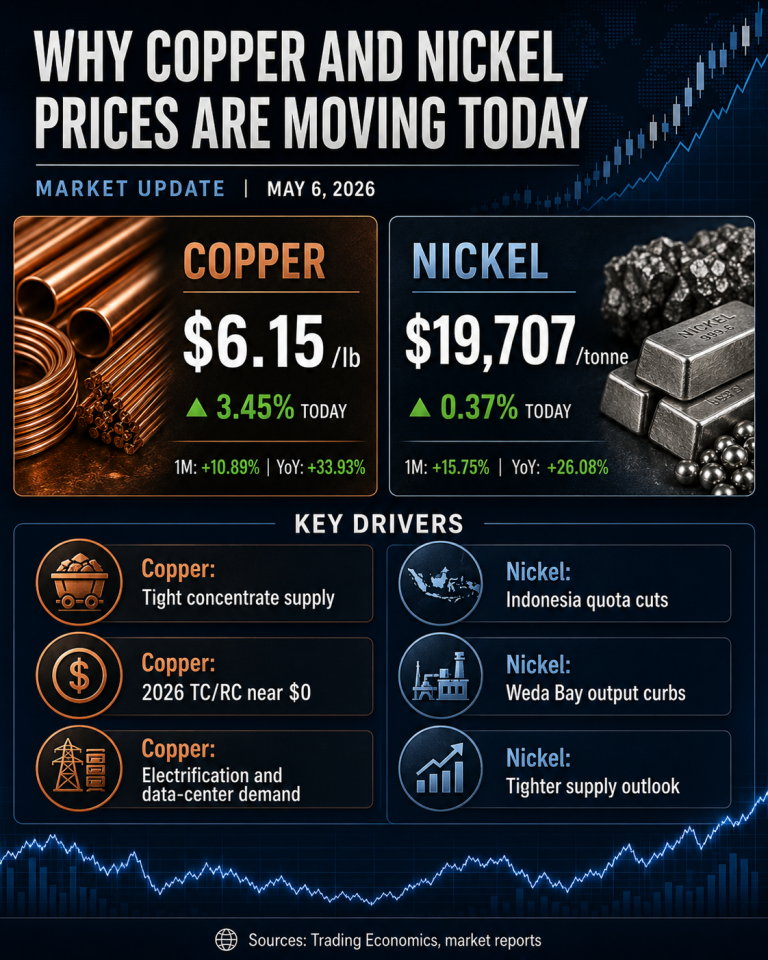
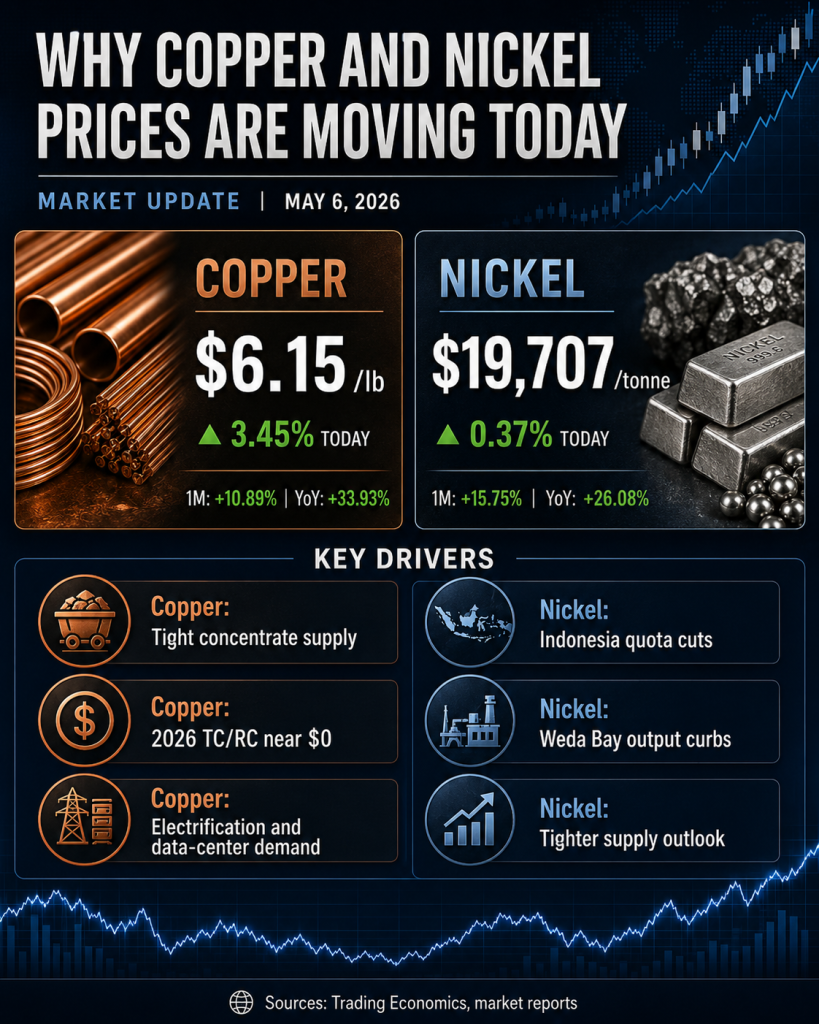
Copper and nickel are both higher on May 6, but copper is making the stronger move. Trading Economics shows copper at $6.15/lb, up 3.45% on the day, while nickel is at $19,707/tonne, up 0.37% in the latest reading. That leaves both metals firmer today, with copper showing the sharper rebound.
Today’s pricing snapshot
Over the past month, copper is up 10.89% and 33.93% year over year, according to Trading Economics. Nickel is up 15.75% over the past month and 26.08% from a year ago. So nickel still has the better one-month gain, but copper now has the stronger yearly performance and the bigger daily move.
5 key drivers behind today’s move
1) Copper still has a real concentrate shortage underneath the market
One of copper’s biggest structural supports remains the squeeze in concentrate supply. Reuters-reported coverage says Antofagasta and a Chinese smelter agreed on 2026 treatment and refining charges of $0 per metric ton and 0 cents per pound, versus $21.25/tonne and 2.125 cents/lb for 2025. That kind of TC/RC collapse is a strong sign that smelter feedstock remains extremely tight.
2) Copper’s rally suggests traders are leaning back toward that tight-supply story
Trading Economics says copper previously reached an all-time high of $6.58/lb in January 2026. With copper back up to $6.15/lb today, the market looks like it is refocusing on structural tightness rather than just short-term caution. That interpretation is an inference from today’s rebound alongside the still-extreme smelter-fee backdrop.
3) Indonesia’s quota cuts are still the main nickel story
Nickel’s core support remains Indonesia’s tighter ore policy. Argus reports Indonesia’s 2026 RKAB quota for nickel production is expected to be cut to about 260 million-270 million tonnes. Since Indonesia dominates global nickel supply growth, cuts of that size remain one of the biggest reasons nickel has stayed supported this year.
4) Weda Bay made the nickel tightening story much more credible
The nickel market took Indonesia’s policy more seriously after the government sharply reduced production at Weda Bay, the world’s biggest nickel mine, to 12 million tonnes from 42 million tonnes in 2025, according to Financial Times reporting surfaced in search results. That made the supply-tightening story more concrete for traders and helped support nickel’s rebound through 2026.
5) Both metals are strong, but through different channels
Copper’s issue is concentrate scarcity flowing through the smelting chain, while nickel’s issue is direct ore restriction from the world’s dominant producer. That helps explain why both metals are higher today, but copper is moving harder while nickel’s momentum is steadier and more policy-led. This comparison is an inference from the latest price action and supply reports.
What to watch next
For copper, the key question is whether the concentrate squeeze pushes prices closer to the January high again. For nickel, traders will keep watching whether Indonesia sticks to tighter quotas and whether actual output stays constrained enough to justify the rally. The latest Trading Economics commodity pages were updated on May 6, 2026, which supports using these as current public benchmark readings today.
Bottom line
On May 6, 2026, both copper and nickel are higher, but copper is the stronger market on the day. Copper is getting a lift from a genuine concentrate shortage, while nickel is still being supported by Indonesia’s quota discipline and supply-control story.