

























Uranium is experiencing a remarkable resurgence as governments worldwide commit to nuclear energy expansion. We at Natural Resource Stocks see this shift creating genuine uranium investment opportunities for those positioned to act.
The market dynamics are shifting fast, driven by energy security concerns and net zero commitments. This guide walks you through what’s happening, where the risks lie, and how to evaluate your options.
Why Uranium Demand Is Accelerating in 2027
Nuclear Power Anchors Global Electricity Growth
Nuclear power has moved from the margins to the center of energy strategy. The U.S. Energy Information Administration projects nuclear will maintain an 18% share of U.S. electricity generation in 2026 and 2027, anchoring a grid that absorbs record electricity demand from data centers and industrial loads. Tech giants including Google, Microsoft, and Meta have signed nuclear power agreements to fuel AI infrastructure, creating tangible near-term demand that extends visibility well into the late 2020s. These contracts represent committed electricity purchases backed by corporate capital. The World Nuclear Association reports 438 operable reactors globally as of April 2026, with 78 more under construction. China leads with 38 reactors in active development. Uranium demand will grow from roughly 68,900 metric tons in 2025 to just over 150,000 metric tons by 2040, driven by this expanding nuclear generation.
Policy Momentum Accelerates Reactor Deployment
Government action is reshaping the nuclear timeline. The ADVANCE Act of 2024 directs the Nuclear Regulatory Commission to speed licensing for advanced reactors, while 10 CFR Part 53 introduces a performance-based framework that shortens approval timelines. The DOE’s fast-track Reactor Pilot Program could allow certain advanced reactors to reach criticality at non-federal sites as early as July 4, 2026. Executive orders targeting a quadrupling of U.S. nuclear capacity to 400 GW by 2050 signal sustained government commitment to nuclear expansion, backed by funding for domestic HALEU enrichment capacity to rebuild the U.S. fuel supply chain. This policy architecture removes barriers that previously delayed reactor projects.
Supply Constraints Create Acute Investment Opportunities
The investment case sharpens when supply meets demand. In 2024, roughly 60,213 metric tons of uranium was mined, representing only 90% of demand and leaving a notable 10% supply gap. Kazakhstan produced approximately 23,270 metric tons that year, Canada roughly 14,309 metric tons, and Namibia about 7,333 metric tons.
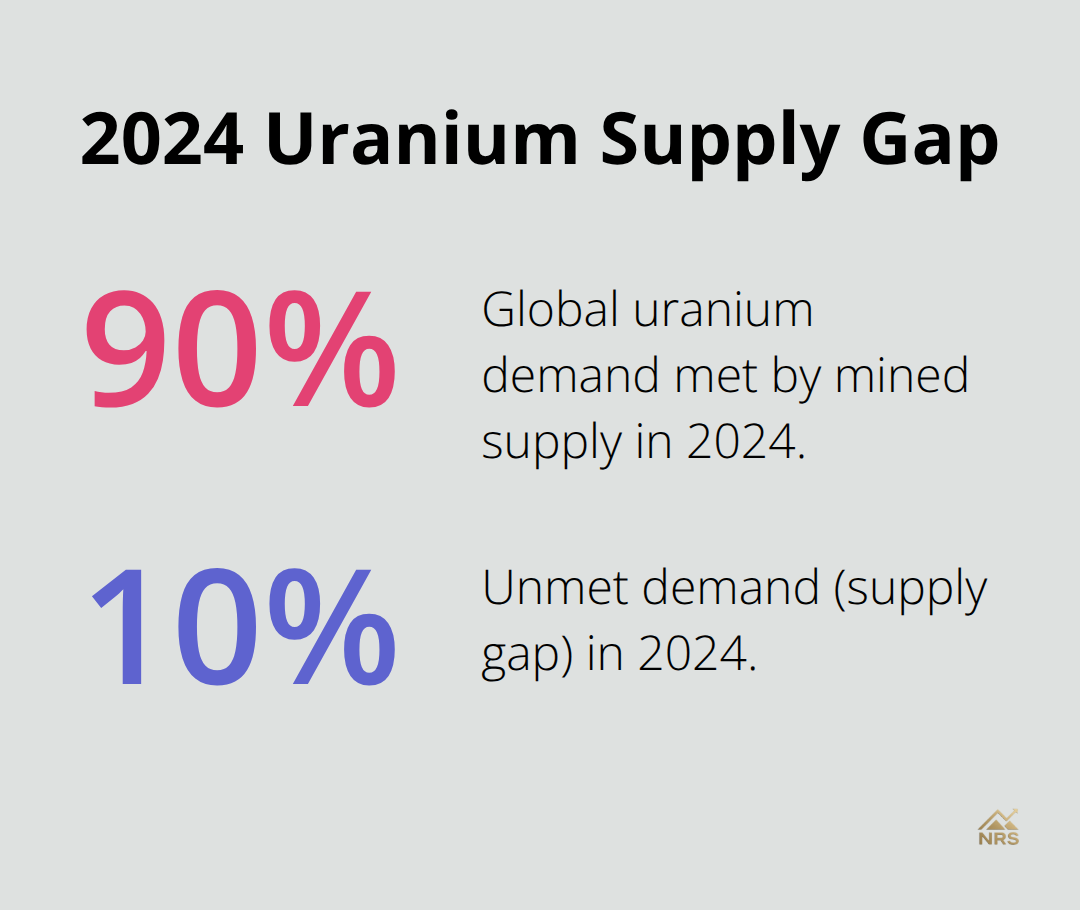
Major producers face concrete constraints. Cameco’s McArthur River experienced a 25% production shortfall, and Kazatomprom shifted from maximum production to value-based production, signaling a strategic response to tighter markets. Most uranium development projects lack firm timelines, with optimistic industry forecasts not fully accounting for funding and execution risks. Restart and development projects move beyond 2027, widening the gap between current demand and available supply. Utilities have re-entered longer-term uranium contracting to lock in supply, with long-term contract prices around $90 per pound U3O8 in early 2026-the highest level since 2008. Spot prices briefly breached $100 per pound in January 2026. This pricing environment reflects genuine scarcity, not speculation.
Geopolitical Pressure Reshapes Energy Sourcing
Energy security concerns force governments and utilities to prioritize domestic and allied uranium sources. Russia’s restrictions on enriched-uranium exports add direct supply pressure for Western utilities. The Strait of Hormuz accounts for roughly 20% of global oil supply, and elevated oil prices near $100 per barrel due to geopolitical tensions underscore the fragility of conventional energy infrastructure. Nuclear power-with its stable, multi-decade fuel supply chains-becomes strategically attractive. Australia holds about 28% of global uranium resources and hosts the world’s largest confirmed uranium resource base, positioning it as a reliable Western supply source. Japan has gradually restarted reactors to bolster energy security, and a broad coalition of banks and financial institutions publicly supports expanding nuclear energy toward 2050, signaling favorable financing conditions for nuclear projects. The World Bank ended its nuclear funding ban, expanding options for project finance in developing countries.
Market Recognition Lags Behind Fundamentals
Utilities and governments will continue prioritizing uranium supply agreements with jurisdictions perceived as stable and aligned with Western interests, creating sustained demand pressure on established producers and opening pathways for credible development projects. This structural tightness in uranium supply-combined with limited new project development and policy support for nuclear energy-sets the stage for evaluating which investment vehicles and producers offer the strongest positioning for 2027.
Uranium Market Positioning in 2027
Uranium pricing has moved decisively higher, with long-term contract prices reaching approximately $90 per pound U3O8 in early 2026-the highest level since 2008-and spot prices briefly exceeding $100 per pound in January 2026. These price signals reflect genuine market tightness rather than speculative trading. Utilities have locked in longer-term supply agreements to secure visibility through 2027 and 2028, confirming that demand expectations are concrete. Long-term uranium contracts typically contain floors in the mid-70s and ceilings as high as $150 per pound, with midpoints near $100, giving producers and utilities a defined risk framework. The challenge for investors is that price momentum alone does not guarantee sustained profitability for mining operations. Most new uranium projects require sustained prices above $85 per pound to justify development spending, and many projects currently under development lack firm timelines. This gap between current pricing and project-development thresholds matters significantly for equity selection.
Where Supply Actually Comes From
Kazakhstan dominates global production and has been the world’s leading uranium producer since 2009. Canada contributed roughly 14,309 metric tons, while Namibia added about 7,333 metric tons. Australia holds about 28% of global uranium resources but produced only around 4,598 metric tons in 2024, indicating substantial untapped capacity if prices support expanded operations. The real constraint is not geological scarcity but execution risk and capital discipline among producers. Cameco’s McArthur River and Key Lake operations in Canada’s Athabasca Basin experienced a 25% production shortfall in 2024, demonstrating that even the world’s largest mines face operational disruptions. Kazatomprom, the world’s leading producer, deliberately shifted from maximum production toward value-based production in response to tighter market conditions, choosing to maintain higher prices rather than flood markets with additional supply. This producer behavior signals confidence in sustained demand and willingness to accept lower volumes at higher margins. For investors, this means major producers will likely maintain production discipline through 2027, limiting supply response even if prices moderate.
Four Routes to Uranium Exposure
Uranium stocks offer direct exposure to production and exploration upside but carry operational and jurisdictional risks. Major producers like Kazatomprom, Cameco, Paladin Energy, Energy Fuels, and Boss Energy provide more stable entry points than junior explorers, though they move more slowly on price appreciation.
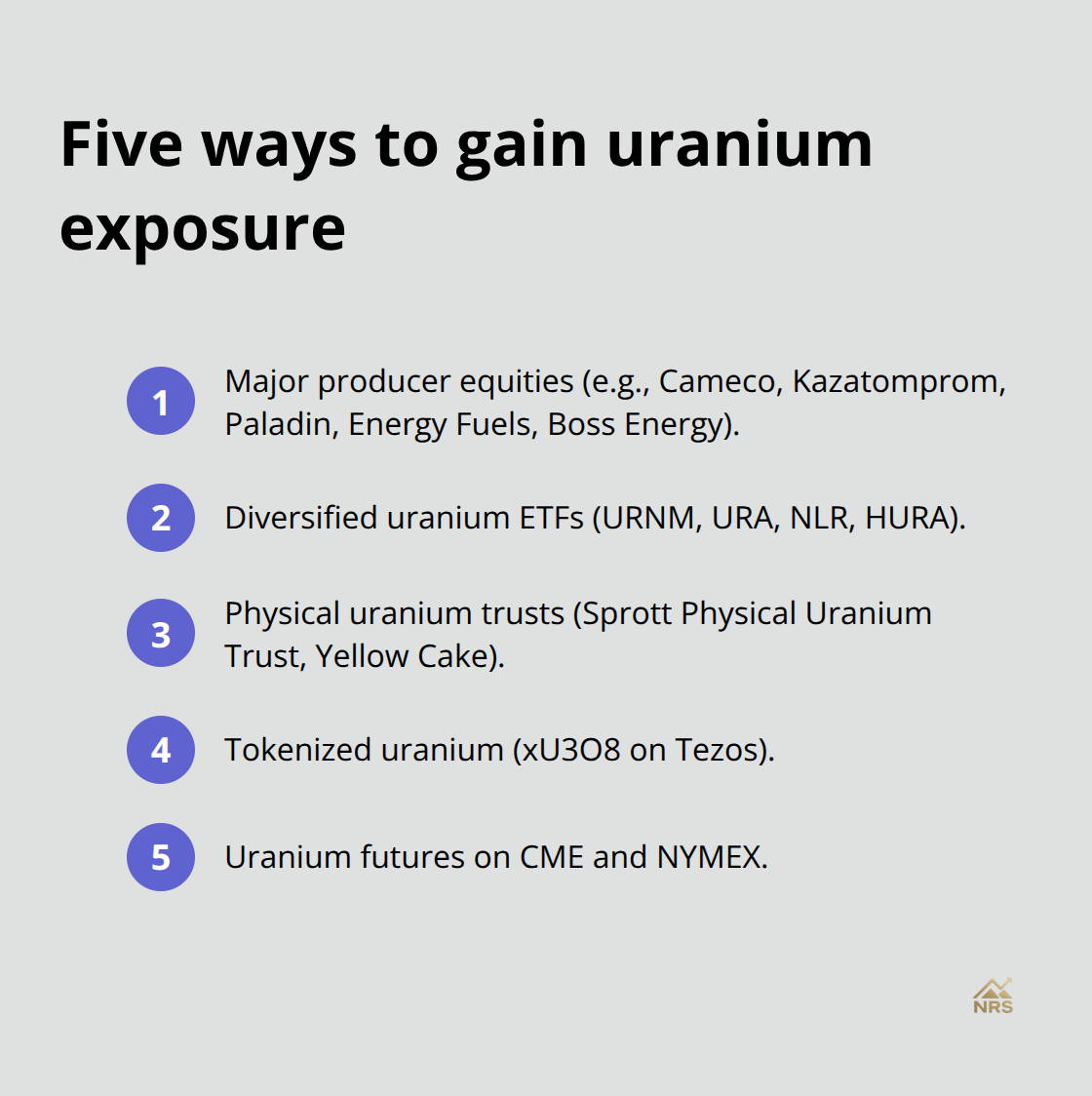
Uranium-focused ETFs including Sprott Uranium Miners ETF (URNM), Global X Uranium ETF (URA), VanEck Uranium and Nuclear ETF (NLR), and Horizons Global Uranium Index ETF (HURA) provide diversified exposure across multiple producers and development-stage companies with a single purchase. Physical uranium trusts such as Sprott Physical Uranium Trust and Yellow Cake offer direct exposure to uranium prices without mining operational risk, though they involve management fees and tax considerations. Tokenized uranium (xU3O8) on Tezos represents a newer option for fractional ownership of physical uranium backed by storage. Uranium futures on CME and NYMEX provide pure price exposure with leverage but are complex instruments best suited for experienced traders with short-term horizons.
Selecting the Right Investment Vehicle
For most investors evaluating 2027 positioning, a major-producer equity like Cameco or a diversified ETF like URNM captures upside while managing single-company and single-project risks. Avoid junior explorers unless you have deep conviction on specific project economics and management capability, as most development projects face execution delays beyond 2027. The choice between equities and ETFs depends on your risk tolerance and time commitment. Equities demand active monitoring of company fundamentals, production schedules, and jurisdictional developments. ETFs reduce this burden through diversification but dilute upside from individual winners. Physical uranium trusts suit investors seeking pure price exposure without operational complexity, though management fees (typically 0.75–1.5% annually) reduce returns over time. Futures appeal only to traders comfortable with leverage and daily mark-to-market volatility.
Evaluating Producer Quality and Project Risk
When selecting specific uranium equities, assess management track records, cash flow stability, and project pipelines rather than chasing price momentum. Producers with established operations in stable jurisdictions (Canada, Australia) carry lower geopolitical risk than those dependent on Kazakhstan or African nations facing regulatory uncertainty. Project timelines matter enormously-most development projects lack firm completion dates, and delays beyond 2027 reduce near-term supply response. Examine whether a producer maintains production discipline (as Kazatomprom demonstrated) or pursues maximum volume at any price, since disciplined operators protect margins through market cycles.
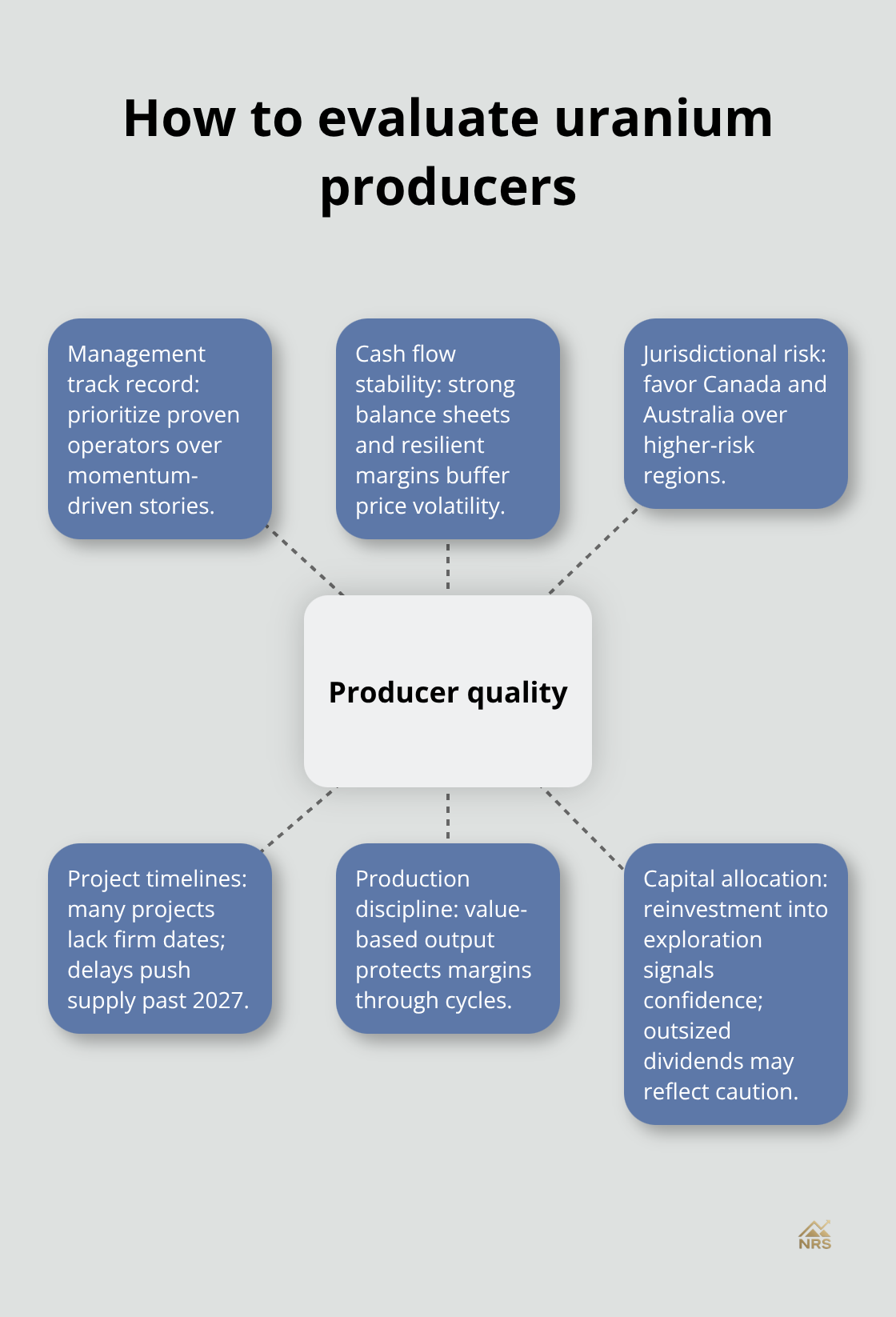
Capital allocation also signals management quality; producers that reinvest cash flow into exploration and development show confidence in sustained demand, while those prioritizing dividends may signal uncertainty about long-term fundamentals. These operational and financial metrics separate credible investment opportunities from speculative plays as uranium markets tighten through 2027 and into 2028.
What Can Go Wrong With Uranium Investments
Geopolitical Concentration Creates Supply Vulnerability
Uranium’s structural supply deficit and policy tailwinds create genuine opportunity, but execution risk remains substantial. Kazakhstan accounts for roughly 39% of global uranium production, and geopolitical instability in Central Asia directly threatens Western supply security. Russia’s restrictions on enriched-uranium exports already constrain Western utilities, and sanctions escalation could disrupt Kazakhstan’s production further if political alignments shift. Namibia and Niger face regulatory uncertainty around mining permits and environmental compliance, with Niger experiencing past uranium-sector disruptions tied to political instability. Australia’s regulatory environment remains stable, but remote operations require sustained capital investment and face permitting delays tied to environmental assessments. For equity investors, concentration risk across these jurisdictions matters enormously. A single producer like Kazatomprom accounts for disproportionate global supply, meaning operational disruptions or policy shifts cascade through the market. Evaluate your holdings across geographic exposure and avoid overweighting any single jurisdiction or producer.
Price Floors and Ceilings Limit Upside Potential
Spot prices briefly exceeded $100 per pound in January 2026, but long-term contract prices stabilized around $90 per pound, suggesting the market has priced in near-term tightness rather than sustained upside. If prices retreat below $85 per pound, most development projects become uneconomical, halting new supply additions and extending supply deficits into the 2030s. This creates a floor beneath prices but also a ceiling for equity upside unless demand accelerates beyond current forecasts. Volatility typically intensifies when spot prices deviate sharply from term-contract levels, creating whipsaw risk for traders and momentum-chasing investors.
Physical Vehicles and Derivatives Introduce Hidden Costs
Physical uranium trusts and ETFs eliminate operational risk but introduce different trade-offs. Management fees ranging from 0.75% to 1.5% annually erode returns, particularly in sideways or declining price environments. Tokenized uranium on blockchain platforms offers fractional ownership but introduces custody and regulatory risk absent from established trusts. Uranium futures provide leverage but demand active monitoring and clear exit rules, since margin calls can force liquidation at unfavorable prices.
Environmental and Safety Risks Persist Across Operations
Environmental and safety concerns surrounding uranium mining persist despite industry improvements. Tailings management remains expensive and site-specific, with costs varying dramatically based on geology and local water availability. The International Atomic Energy Agency enforces safety standards, but compliance timelines and remediation expenses can surprise investors unfamiliar with mining operations. Fukushima demonstrated that reactor safety concerns can suppress uranium demand unpredictably, even when fundamentals remain tight. Monitor regulatory developments in key jurisdictions closely and stress-test your portfolio against scenarios where prices fall 20-30% from current levels. Producers with strong balance sheets and disciplined capital allocation weather downturns better than those dependent on continuous price appreciation to fund operations.
Final Thoughts
Uranium investment opportunities rest on genuine supply constraints and sustained demand growth. The structural deficit-60,213 metric tons mined against roughly 68,900 metric tons demanded in 2025-persists because new projects lack firm timelines and most require prices above $85 per pound to justify development. Long-term contract prices around $90 per pound and spot prices briefly exceeding $100 per pound reflect this tightness, not speculation, while tech giants locking in nuclear power agreements and governments committing to reactor deployment create visibility extending well into the late 2020s.
Your positioning depends on matching your risk tolerance to the right vehicle. Major producers like Cameco and Kazatomprom offer stability but move slowly on price appreciation, while diversified ETFs like URNM capture broader upside and reduce single-company risk. Physical uranium trusts provide pure price exposure without operational complexity, though management fees erode returns over time, and you should avoid junior explorers unless you possess deep conviction on specific project economics since most development projects face delays beyond 2027. When evaluating specific equities, prioritize management track records, cash flow stability, and geographic diversification across stable jurisdictions like Canada and Australia rather than those dependent on Kazakhstan or African nations facing regulatory uncertainty.
Geopolitical concentration remains the largest risk, as Kazakhstan’s 39% share of global production means supply disruptions cascade through markets and Russia’s enriched-uranium export restrictions already constrain Western utilities. Visit Natural Resource Stocks to access expert analysis on geopolitical impacts, macroeconomic factors affecting resource prices, and emerging uranium investment opportunities for 2027 and beyond.