

























Copper and nickel are split today, with copper rebounding while nickel is slightly lower. Copper is bouncing after recent profit-taking as traders return to the long-term demand story around AI data centers, electrification, power grids, EVs, and tight mine supply. Nickel is softer, but the market remains focused on Indonesia supply risk, export controls, production quotas, and stainless steel demand.
Today’s pricing snapshot
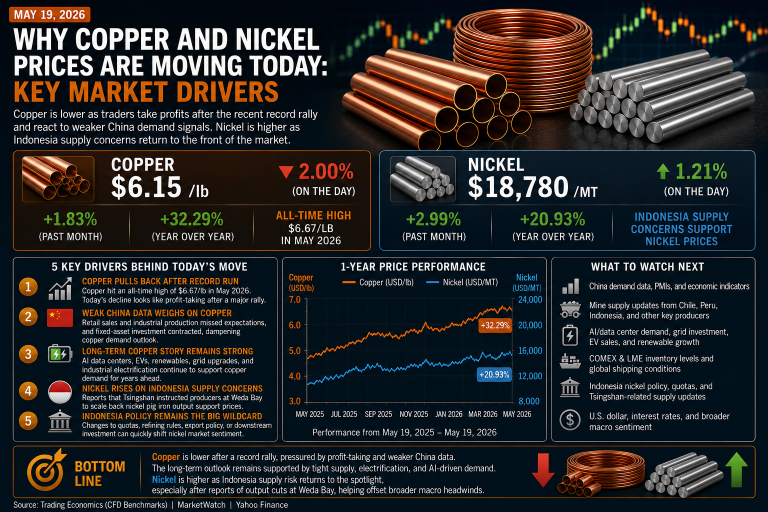
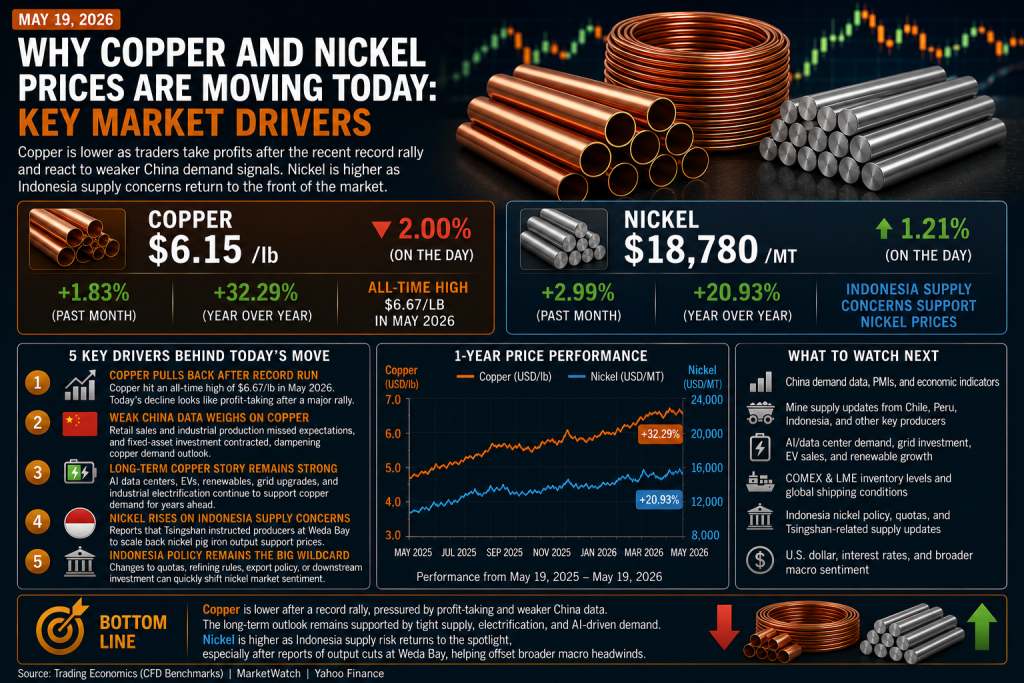
According to Trading Economics CFD benchmarks, copper rose to about $6.28/lb on May 20, 2026, up roughly 1.81% on the day. Copper is also up about 4.58% over the past month and roughly 35.68% year over year. Trading Economics also notes that copper reached an all-time high of $6.67/lb in May 2026.
Nickel fell to about $18,743/metric ton on May 20, 2026, down roughly 0.20% on the day. Nickel is still up about 3.27% over the past month and roughly 19.92% year over year, showing that the metal remains positive on a longer-term basis despite today’s small decline.
5 key drivers behind today’s move
1) Copper is rebounding after recent weakness
Copper is higher today after pulling back from its record-setting rally earlier in May. The metal recently reached an all-time high of $6.67/lb, so today’s move looks like buyers stepping back in after profit-taking.
That keeps copper near record territory and still one of the most closely watched industrial metals in the market.
2) AI, data centers, grids, and EVs remain the major copper demand story
Copper’s long-term demand story remains strong. Demand is being supported by AI data centers, electric vehicles, power grid upgrades, renewable energy, and industrial electrification. Hindustan Copper recently said it plans to raise output by nearly 30% as global copper demand rises from AI-powered data centers, EV adoption, and power-grid modernization.
That demand story is why copper remains well supported even after short-term pullbacks.
3) Copper supply remains tight
Copper supply remains a major market concern. Mine disruptions, limited new project pipelines, declining ore grades, and strong smelter demand continue to support the bullish supply-side argument. Supply Chain Digital recently described copper as being in a strategic squeeze, with mine disruptions colliding with strong demand from smelters, AI, and EVs.
That matters because copper supply cannot be increased quickly. New mines take years to permit and develop, so demand growth can tighten the market faster than new supply can respond.
4) Nickel is softer, but Indonesia remains the key wildcard
Nickel is slightly lower today, but the market is still focused on Indonesia. Trading Economics notes that Indonesia produces more than half of global nickel output, supported by major Chinese investment.
That makes nickel highly sensitive to Indonesian policy. Any changes to production quotas, export rules, refining policy, or downstream investment can quickly move prices.
5) Indonesia export-control headlines are adding uncertainty
Indonesia is becoming an even bigger focus for commodity traders. The Financial Times reported today that Indonesia plans to centralize major commodity exports through a state-run agency, starting with palm oil, coal, and ferroalloys, as part of a broader push to tighten state control over exports. The report said prices for palm oil and nickel rose amid supply concerns following the announcement.
For nickel, that adds another layer of policy risk on top of existing quota and production concerns.
What to watch next
Copper traders will be watching COMEX and LME inventories, China demand data, mine-supply updates from Chile, Peru, and Indonesia, AI/data-center demand, grid investment, EV sales, sulfuric-acid availability, U.S. dollar moves, and interest-rate expectations.
Nickel traders will be watching Indonesia export-control policy, RKAB production quotas, Tsingshan and Weda Bay supply headlines, stainless steel demand, EV battery demand, Class 1 nickel premiums, LME inventories, and broader base-metals sentiment.
Bottom line
On May 20, 2026, copper is higher while nickel is slightly lower. Copper is rebounding as buyers refocus on tight supply, AI/data-center demand, grid upgrades, EVs, and electrification. Nickel is softer on the day, but still positive over the past month and year over year, with Indonesia supply and export-policy risk remaining the biggest market catalyst.
Copper remains the cleaner long-term structural-demand story, while nickel remains the more supply-policy-sensitive trade today.