

























Copper and nickel are both lower today, with copper pulling back after a record-setting rally and nickel slipping as traders weigh Indonesia policy risk, supply uncertainty, and broader base-metals weakness. Copper still has the stronger long-term structural story, but today’s move shows that record-level pricing can create sharp short-term pullbacks.
Today’s pricing snapshot
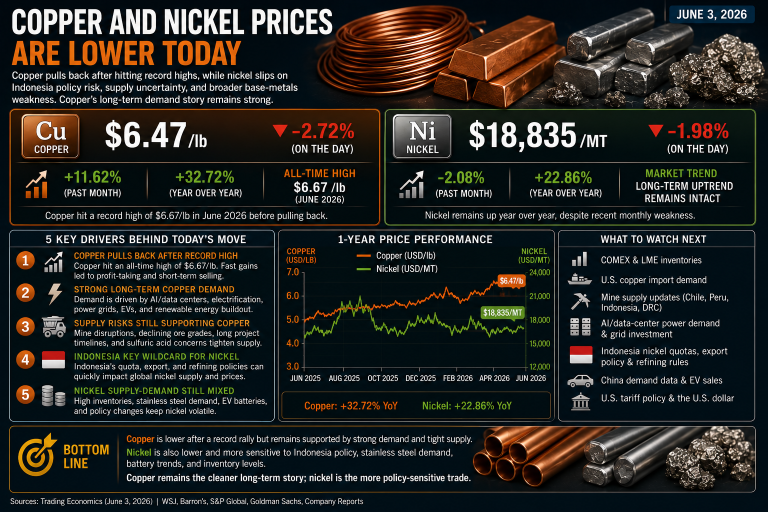
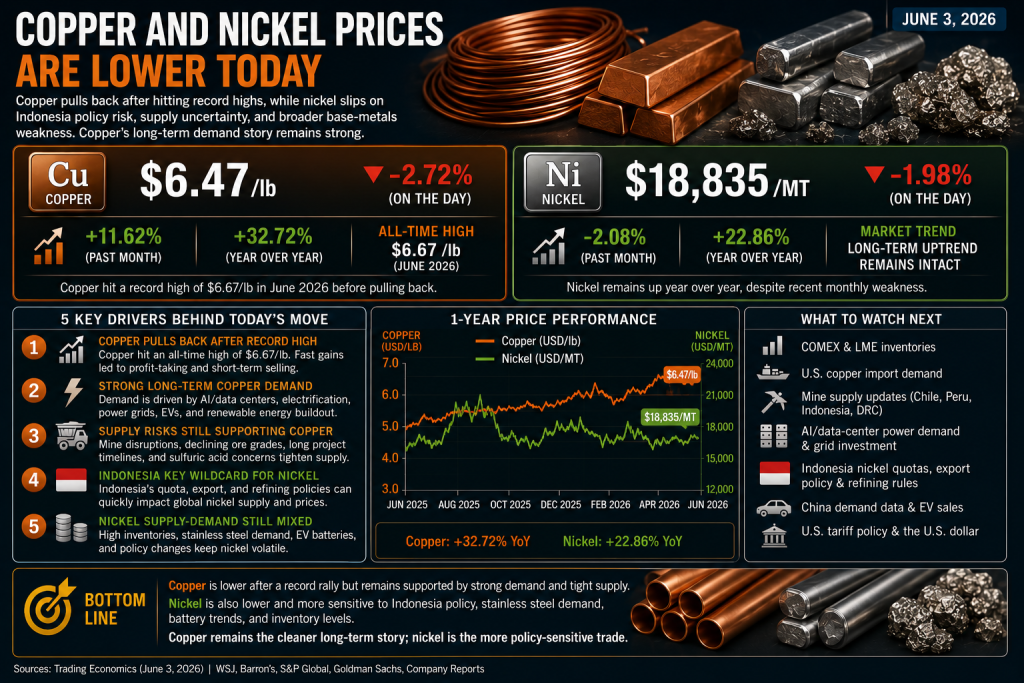
According to Trading Economics CFD benchmarks, copper fell to about $6.47/lb on June 3, 2026, down roughly 2.72% on the day. Copper is still up about 11.62% over the past month and roughly 32.72% year over year, even after today’s decline. Trading Economics also notes that copper reached an all-time high of $6.67/lb in June 2026.
Nickel fell to about $18,835/metric ton on June 3, 2026, down roughly 1.98% on the day. Nickel is down about 2.08% over the past month, but remains up roughly 22.86% year over year, showing that the longer-term trend is still positive despite recent weakness.
5 key drivers behind today’s move
1) Copper is pulling back after a record high
Copper’s decline today looks like profit-taking after a major run. Prices recently reached an all-time high of about $6.67/lb, while WSJ reported that copper futures settled at a record $6.6495/lb on June 2 after climbing 4.6% over two days.
That kind of fast move can invite short-term selling, especially when traders lock in gains after a record breakout.
2) The long-term copper demand story remains strong
Even with today’s pullback, copper’s long-term demand setup remains intact. Copper remains essential for electric infrastructure, power grids, EVs, renewable energy, and AI/data-center buildout.
Barron’s reported that Alphabet’s planned AI infrastructure spending helped reinforce the copper-demand story, with analysts pointing to rising data-center capital spending as a major driver for materials tied to electrification and power infrastructure.
3) Supply risks are still supporting copper
Copper is not only being driven by demand. Supply concerns remain a major part of the bullish case. WSJ reported that Goldman Sachs raised its 2026 copper outlook, citing supply issues and stronger U.S. import demand.
That matters because copper supply is hard to replace quickly. Mine disruptions, declining ore grades, long development timelines, and possible sulfuric-acid supply issues can all tighten the market faster than new supply can respond.
4) Nickel is weaker, but Indonesia remains the key wildcard
Nickel is lower today, but Indonesia remains the most important supply-side factor. Indonesia has been tightening its nickel policy framework, and earlier this year, production quota cuts fueled supply concerns and helped push global nickel prices higher.
Because Indonesia dominates global nickel supply growth, changes to quotas, export rules, royalty rates, refining policy, or downstream investment can quickly move the market.
5) Nickel’s supply-demand picture is still mixed
Nickel’s longer-term setup remains more complicated than copper’s. S&P Global reported that Indonesia’s mining quota policy has created both support for prices and confusion for the market, while also noting that LME nickel stocks had surged above 250,000 metric tons in late 2025.
That makes nickel more sensitive to inventory trends, stainless steel demand, EV battery demand, and Indonesian policy headlines.
What to watch next
Copper traders will be watching COMEX and LME inventories, U.S. import demand, mine-supply updates from Chile, Peru, Indonesia, and the Democratic Republic of Congo, AI/data-center power demand, grid investment, EV sales, China demand data, sulfuric-acid availability, U.S. tariff policy, and the U.S. dollar.
Nickel traders will be watching Indonesia production quotas, export policy, refining rules, royalty changes, stainless steel demand, EV battery demand, Class 1 nickel premiums, LME inventories, and broader base-metals sentiment.
Bottom line
On June 3, 2026, copper and nickel are both lower. Copper is pulling back after hitting record highs, but the long-term setup remains supported by AI/data-center demand, electrification, grid upgrades, EVs, and tight supply. Nickel is also weaker and remains more complicated because Indonesia policy, stainless steel demand, battery trends, and inventory levels can quickly shift sentiment.
Copper remains the cleaner long-term structural-demand story, while nickel is the more supply-policy-sensitive trade today.