
























Platinum and palladium are both lower today as the broader precious-metals complex comes under pressure from a stronger U.S. dollar, inflation concerns, and shifting rate expectations. Platinum is pulling back after its recent strength, but the longer-term deficit story remains intact. Palladium is also weaker as traders weigh Russia supply risk against softer monthly momentum and uncertainty around auto demand.
Today’s pricing snapshot
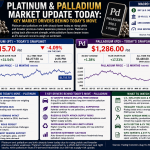
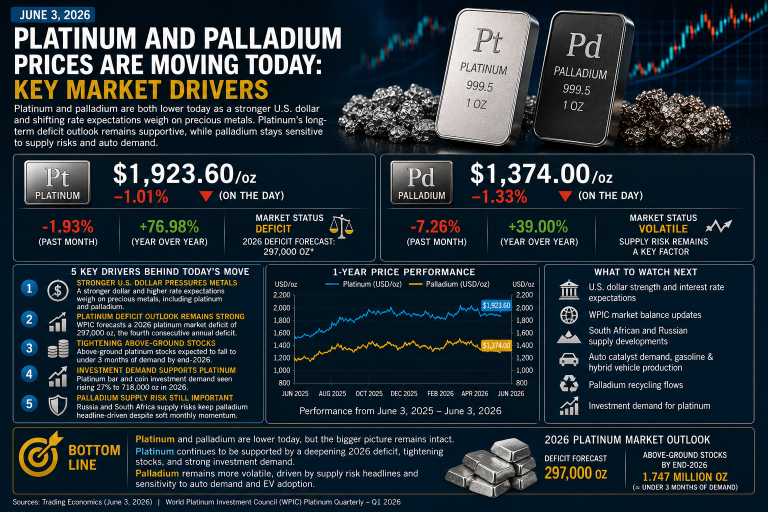
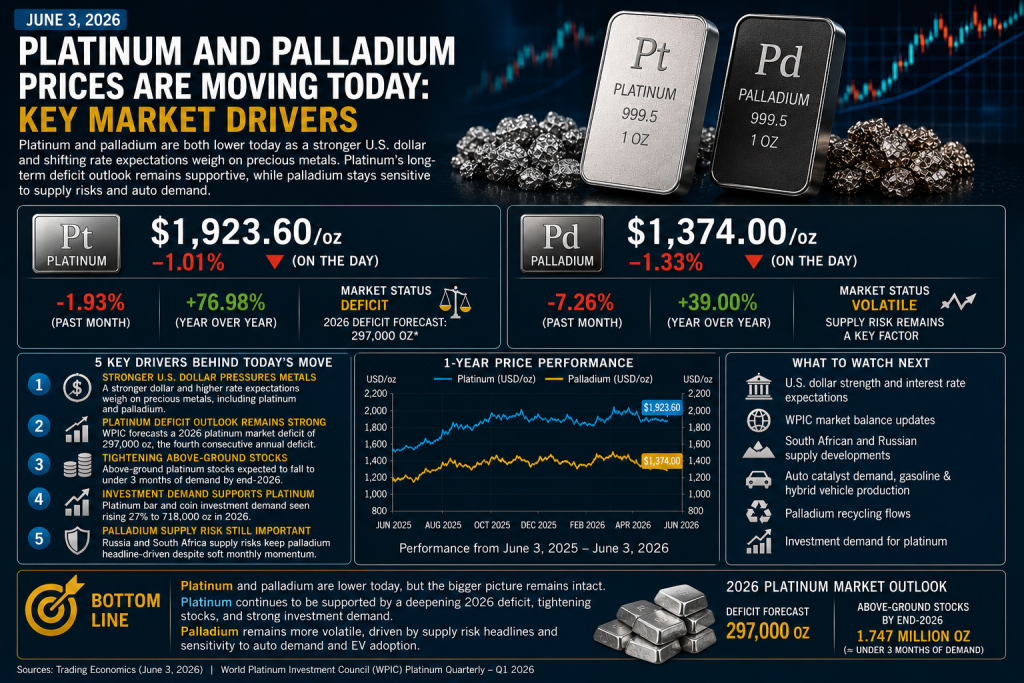
According to Trading Economics CFD benchmarks, platinum fell to about $1,923.60/oz on June 3, 2026, down roughly 1.01% on the day. Platinum is down about 1.93% over the past month, but remains up roughly 76.98% year over year, keeping its longer-term performance strong despite today’s weakness.
Palladium fell to about $1,374/oz on June 3, 2026, down roughly 1.33% on the day. Palladium is down about 7.26% over the past month, but remains up roughly 39.00% year over year, showing that supply-risk concerns still support the market even as near-term momentum fades.
5 key drivers behind today’s move
1) Precious metals are under pressure from a stronger dollar
The biggest short-term headwind today is macro pressure. A stronger U.S. dollar is weighing on precious metals, making dollar-priced commodities more expensive for foreign buyers.
Gold and silver were also lower today, showing that the pressure is not isolated to platinum-group metals. When the broader precious-metals complex weakens, platinum and palladium often get pulled lower even if their physical-market fundamentals remain supportive.
2) Platinum is lower, but the deficit story remains intact
Platinum is pulling back today, but the supply-demand picture remains tight. The World Platinum Investment Council expects the platinum market to record a 297,000-ounce deficit in 2026, marking a fourth consecutive annual shortfall.
That matters because repeated deficits reduce available stockpiles. WPIC expects above-ground platinum stocks to fall to under three months of demand by the end of 2026, keeping the physical market tight.
3) Platinum investment demand remains supportive
Investment demand is still a key support for platinum. WPIC expects total platinum bar and coin investment demand to reach 718,000 ounces in 2026, supported by a strong first quarter and growth across global markets.
That gives platinum an extra demand driver beyond auto catalysts, jewelry, and industrial uses. If investors continue looking for alternatives within the precious-metals space, platinum could remain well supported on pullbacks.
4) Palladium is weaker, but supply risk remains important
Palladium is down today and has been weaker over the past month, but the market remains sensitive to supply risks. Russia and South Africa remain key sources of palladium supply, and any disruption tied to sanctions, exports, mining issues, or logistics can quickly shift sentiment.
That keeps palladium headline-driven. Even when the daily price action is weak, traders still watch for new developments involving Russian exports, South African production, and global trade policy.
5) Auto demand remains the key swing factor
Both platinum and palladium are used in catalytic converters, but palladium remains more exposed to gasoline vehicle demand. Platinum has a broader demand base across auto catalysts, jewelry, industrial applications, investment products, and hydrogen-related uses.
If gasoline and hybrid vehicle demand stays resilient, palladium can find support. If battery-electric vehicles continue gaining share faster than expected, palladium’s long-term demand outlook remains more challenged.
What to watch next
Traders will be watching U.S. dollar strength, Treasury yields, inflation data, Federal Reserve rate expectations, platinum investment demand, WPIC market-balance updates, South African and Russian supply news, auto catalyst demand, palladium recycling flows, gasoline and hybrid vehicle production, and any new trade-policy developments involving Russian palladium.
For platinum, the key question is whether buyers step back in as the market prices a fourth straight deficit and shrinking above-ground stocks. For palladium, the key question is whether Russia supply risk and auto demand can offset weak monthly momentum.
Bottom line
On June 3, 2026, platinum and palladium are both lower as a stronger U.S. dollar and broader precious-metals weakness pressure the market. Platinum still has the stronger structural setup because the 2026 deficit forecast remains intact, above-ground stocks are expected to tighten, and investment demand remains solid. Palladium still has upside potential from Russia supply risk and trade-policy headlines, but it remains more vulnerable to auto-demand shifts, EV adoption, recycling growth, and weak recent momentum.
Platinum looks like the cleaner long-term setup today, while palladium remains the more headline-driven and demand-sensitive trade.