

























Commodity prices swing in predictable patterns, and learning to read those signals separates successful investors from those who chase trends blindly. At Natural Resource Stocks, we’ve built our analysis around macro commodity cycle analysis because understanding these cycles reveals when to buy and when to step back.
The signals are everywhere-in inflation data, interest rates, geopolitical tensions, and supply disruptions. This guide shows you exactly which ones matter and how to act on them.
Reading Cycles Through Real Market Data
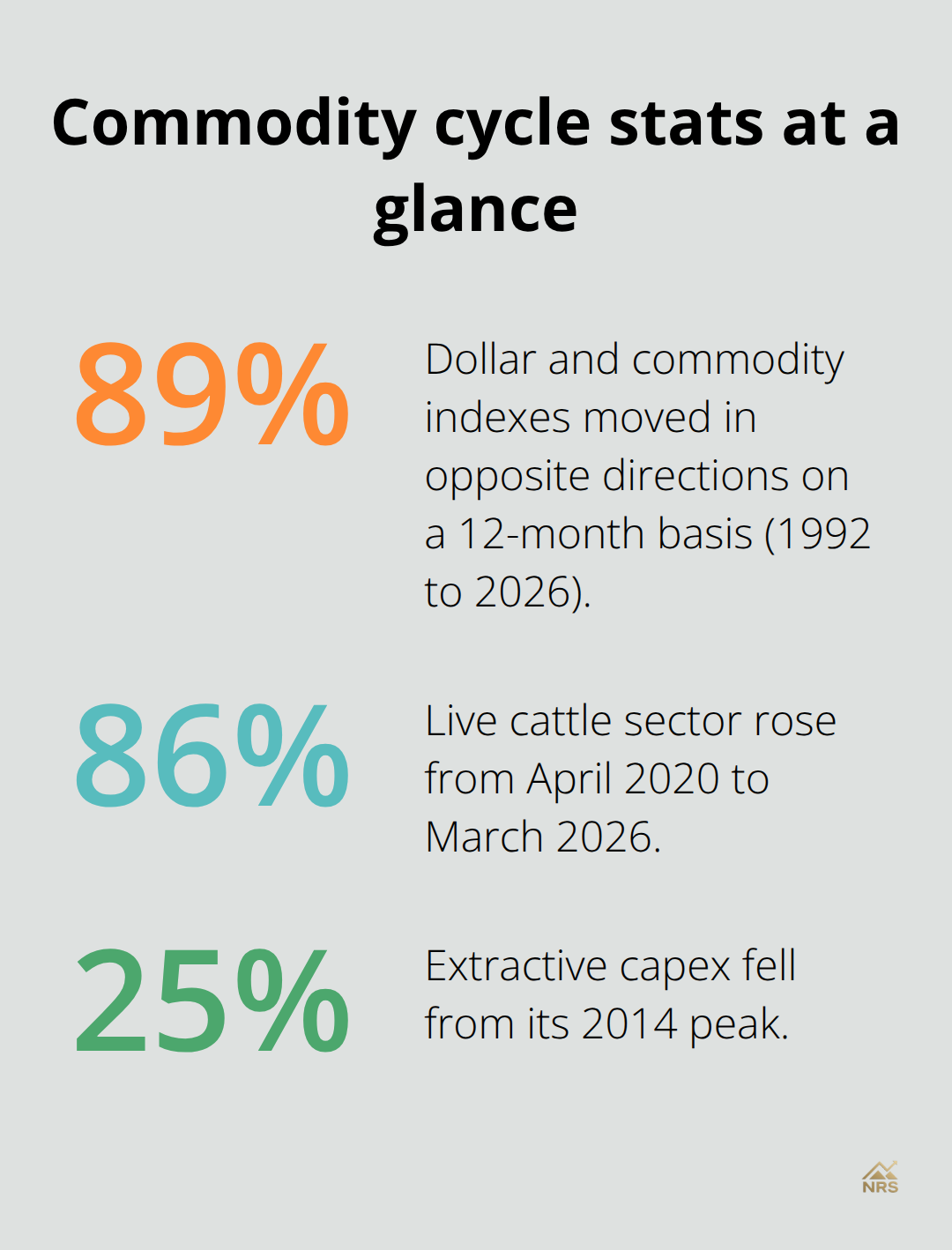
Commodity cycles move in measurable patterns, and the data proves this conclusively. Energy rallied more than 860% from February 1999 to September 2005 as China and India industrialized and oil supply shocks hit Iraq and Venezuela. Industrial metals surged about 395% from November 2001 to May 2007, driven by China’s urbanization. Precious metals have gained ground recently as geopolitical tensions and fiscal policy shifts supported gold accumulation by central banks. These moves follow predictable supply-demand mechanics that repeat across decades. The live cattle sector rose roughly 86% from April 2020 to March 2026, supported by the smallest U.S. herd since 1951 and strong consumer demand. Once you understand what drove these moves, you can position ahead of the next cycle shift rather than chasing price spikes after they’ve already happened.
The Dollar Sets the Tempo
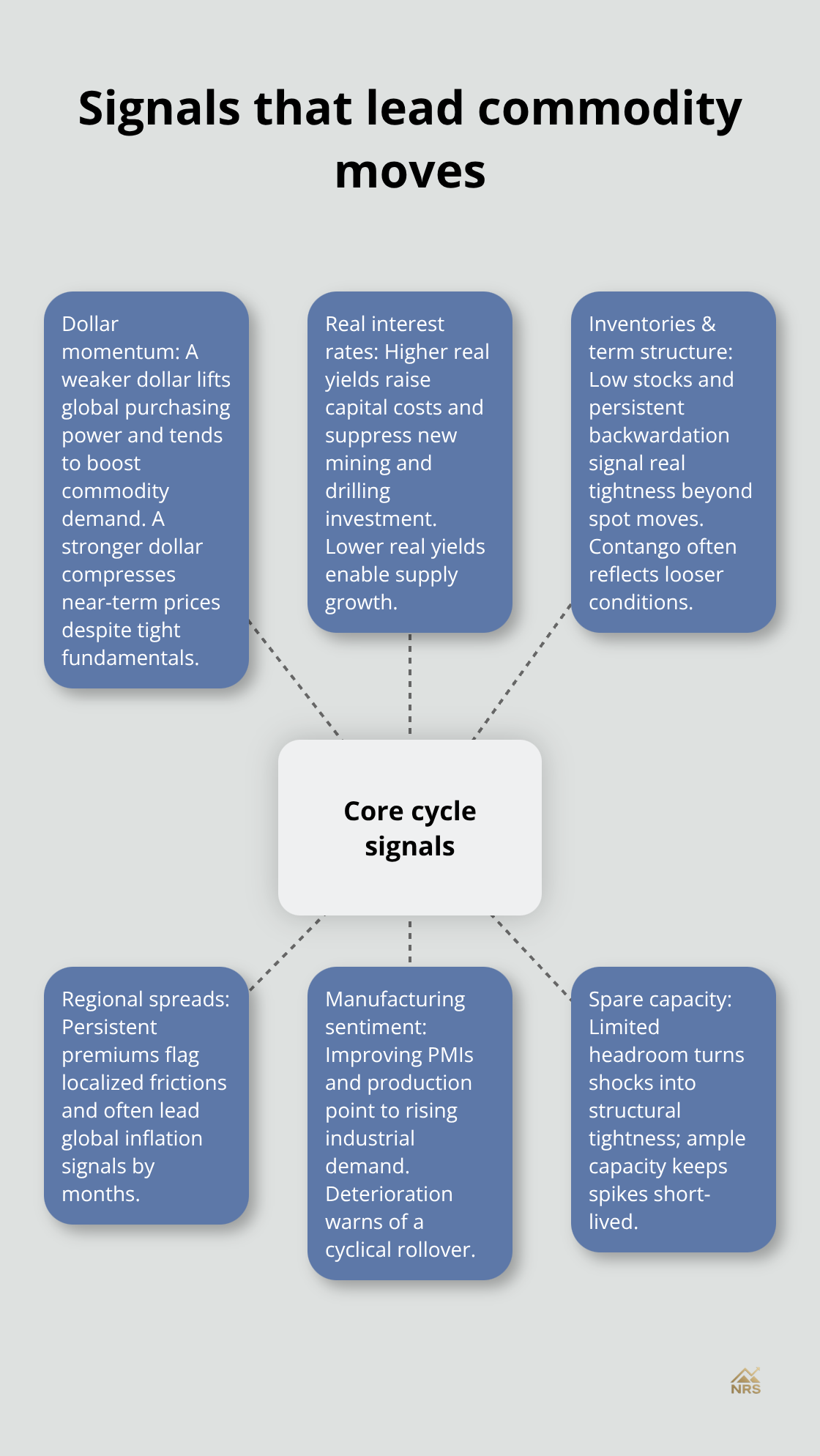
The U.S. Dollar Index acts as a pricing filter that compresses or expands real returns for commodities. From January 1992 to March 2026, the weekly correlation between the Dollar Index and the Bloomberg Commodity Index reached about negative 0.31, meaning the two move in opposite directions roughly 89% of the time on a 12-month rolling basis. When the dollar weakens, commodities become cheaper for international buyers and demand rises.
A stronger dollar suppresses global commodity inflation pressures and slows near-term prices even when physical constraints tighten underneath. This relationship matters because it separates short-term noise from real supply stress. You need to track both the dollar’s momentum and real interest rates together-higher real rates increase the cost of capital for mining and drilling projects, dampening investment regardless of spot prices. The World Bank’s Commodity Markets Outlook 2025 emphasizes that investment in transition metals like copper and lithium must triple by 2030 to meet climate targets, yet underinvestment persists even as prices stabilize. This gap between required capex and actual spending tells you far more about future tightness than today’s price action.
Inventories and Regional Spreads Signal Real Tightness
Spot prices can deceive because they reflect financial flows and dollar strength, not physical availability. Inventory scores for finished goods and base metals show strong predictive power for base metal futures returns since 2000, with effects flowing through convenience yield and restocking demand. Watch the term structure of commodity futures-persistent backwardation signals physical tightness beyond what spot prices show. Regional price spreads matter too, especially as geopolitical fragmentation persists. The same commodity now trades at different prices across regions due to supply-chain splits and sanctions, turning regional premiums into a stress signal that arrives 3 to 6 months ahead of macro data. Manufacturing sentiment shifts across major economies provide powerful directional signals for commodity futures because they reflect shifts in demand and inventory dynamics. Track EIA and IEA inventory reports weekly, not monthly, and compare contango versus backwardation patterns in the futures curve. These signals outperform headline price moves for timing entries and exits in resource stocks, and they reveal what policymakers and central banks will respond to next.
Economic Data Points That Actually Drive Commodity Prices
Commodities lead consumer price inflation by three to six months, making them early diagnostic tools for macro regimes rather than lagging indicators. This lead time matters because inflation signals in commodity markets arrive before central banks react, giving you a window to position ahead of policy shifts. The correlation between commodity prices and future inflation reaches around 0.7 in advanced economies, making this relationship robust enough to trade on. Most traders fixate on spot prices, but real rates and dollar strength determine where commodities actually head next far more than sentiment does.
Real Rates and Capital Costs Shape Investment Discipline
When real interest rates rise, the cost of capital for mining and drilling projects climbs immediately, suppressing investment even if commodity prices look stable. The World Bank Commodity Markets Outlook 2025 shows extractive capex fell roughly 25% from its 2014 peak despite similar prices today, proving that real rates kill investment discipline faster than price weakness does. Track the 10-year real yield, not nominal rates, because a 2% real rate crushes long-horizon mining projects while a 2% nominal rate with negative real yields fuels supply-side expansion. Currency movements amplify this effect because the dollar correlation with non-energy commodities sits around negative 0.5 from 2000 through 2025, meaning a 5% dollar rally suppresses commodity prices mechanically regardless of supply tightness underneath.
Manufacturing Sentiment Reveals True Demand Signals
Industrial production data from major economies tells you whether the commodity cycle accelerates or rolls over, and manufacturing sentiment shifts across the United States, Europe, China, and Asia provide powerful directional signals for base metals and energy futures. Global macro surprises aggregated across 32 economies have statistically predicted industrial commodity futures returns since 2000, meaning you should track purchasing manager indices and manufacturing output from key regions weekly rather than waiting for monthly GDP reports. China’s steel production, copper imports, and crude runs matter more than headline GDP numbers because they show real physical demand unfiltered by policy stimulus or statistical adjustments.
Supply Constraints and Demand Mismatches Create Risk
When manufacturing sentiment turns negative while prices stay elevated, you face a regime where supply investment weakens but demand destruction has not yet materialized, creating a dangerous lag period. The World Bank emphasizes that transition metals demand must triple by 2030 to meet climate targets, yet current investment trails this requirement by a wide margin, meaning any demand acceleration will hit supply constraints faster than historical cycles suggest. Watch capacity utilization rates in base metals refining and energy processing separately from headline production numbers because high utilization with flat output signals physical tightness, not equilibrium.
Regional Fragmentation Turns Supply Disruptions Into Stress Signals
Regional production data matters because geopolitical fragmentation now creates persistent regional price differentials for identical commodities, turning supply disruptions and sanctions into localized stress signals that arrive three to six months before global macro data catches up. These regional spreads reveal what policymakers will respond to next, and they often move before headline inflation data reaches central banks. The next section shows you how to translate these signals into actual positioning decisions across your resource stock portfolio.
How Geopolitical Fragmentation and Policy Shifts Reshape Commodity Markets
Geopolitical fragmentation no longer sits in the background-it actively reshapes how commodities trade and where supply tightness emerges first. Regional price spreads for identical commodities have widened dramatically as sanctions, trade restrictions, and supply-chain splits create persistent differentials that arrive ahead of global macro data. A barrel of oil or ton of copper now trades at materially different prices depending on which region it reaches, and these regional premiums signal where physical stress will hit next. When you see a Brent-WTI spread widen or regional copper premiums spike, central banks and policymakers are already behind the curve on what’s coming. The decisive move happens in the term structure and regional flows before headline inflation data confirms the problem.
Monitor Regional Spreads Weekly for Real Supply Friction
Track regional spreads across energy, metals, and grains weekly through EIA, IEA, and LME data rather than waiting for monthly reports. A widening regional premium that persists for more than two weeks signals real supply friction, not temporary logistics delays, and it typically precedes a surge in input costs that manufacturers haven’t yet passed to consumers. These regional spreads reveal what policymakers will respond to next, and they often move before headline inflation data reaches central banks.
The term structure of futures contracts and regional flows matter far more than spot prices alone because they capture the physical reality underneath financial noise.
Tariffs Redirect Supply Flows Rather Than Simply Cut Volumes
Trade tensions and tariff announcements matter less for their immediate price impact than for their effect on capex decisions and regional supply routing. When the U.S. imposes tariffs on steel or aluminum, miners and smelters don’t cut production immediately-they route supply to avoid tariffs, creating temporary regional gluts and shortages that distort pricing and inventory patterns for months. Watch where production flows redirect rather than assuming tariffs simply reduce volumes. These routing shifts create opportunities and risks that standard price analysis misses entirely because they operate through supply-chain mechanics, not headline economics.
Real Interest Rates Control Mining Investment Decisions
Central banks use tools such as interest rates to adjust the supply of money and influence mining investment decisions. Extractive capex fell significantly from its 2014 peak despite stable prices, proving real rates suppress investment faster than price weakness does. When real rates rise above 2 percent, multi-year mining projects fail their hurdle rates and get shelved, creating a supply lag that emerges two to three years later when demand accelerates into constrained capacity. This lag is non-negotiable-it takes four to seven years to build a major mine or refinery, so today’s capex decisions determine whether supply crunches emerge in 2028 or 2031. Track the 10-year real yield and central bank policy guidance obsessively because a single 50 basis point move in real rates can trigger a cascade of project deferrals that reshape commodity cycles for a decade.
Spare Capacity Determines Whether Disruptions Become Structural
Supply disruptions from political instability matter most when they occur in geographies that lack alternative suppliers or spare capacity. Venezuela’s oil production collapse or sanctions on Russian nickel create genuine supply shocks because no other region can rapidly replace those volumes, but disruptions in one region ripple through the entire market only when spare capacity is absent. The key metric is spare capacity in the commodity and whether other producers can ramp within three to six months. If spare capacity exists, a disruption triggers a price spike lasting weeks. If it doesn’t, you face a structural tightness that lasts years. Global spare crude capacity has tightened significantly, meaning any new supply disruption will hit harder than shocks from the past decade. This shift transforms geopolitical risk premiums in oil and energy metals from tactical noise into structural signals that reshape long-term positioning.
Final Thoughts
The signals arrive constantly, but most investors act only after prices have already moved. We at Natural Resource Stocks focus on macro commodity cycle analysis because reading these signals early separates profitable positioning from reactive trading. Real rates control mining investment decisions with brutal efficiency-when the 10-year real yield rises above 2 percent, multi-year projects get shelved regardless of commodity prices, creating supply lags that emerge years later. Dollar strength suppresses near-term prices mechanically, but it masks physical tightness underneath. Regional spreads reveal where supply friction will hit first, often three to six months before global inflation data confirms the problem.
Manufacturing sentiment from China, Europe, and the United States shows whether demand accelerates into constrained capacity or rolls over into weakness. These signals interact constantly, and you must read them together rather than chasing any single indicator. Build positions when real rates fall, dollar strength peaks, and manufacturing sentiment turns positive while regional spreads remain wide. Exit when real rates rise sharply, spare capacity expands, or manufacturing sentiment collapses.
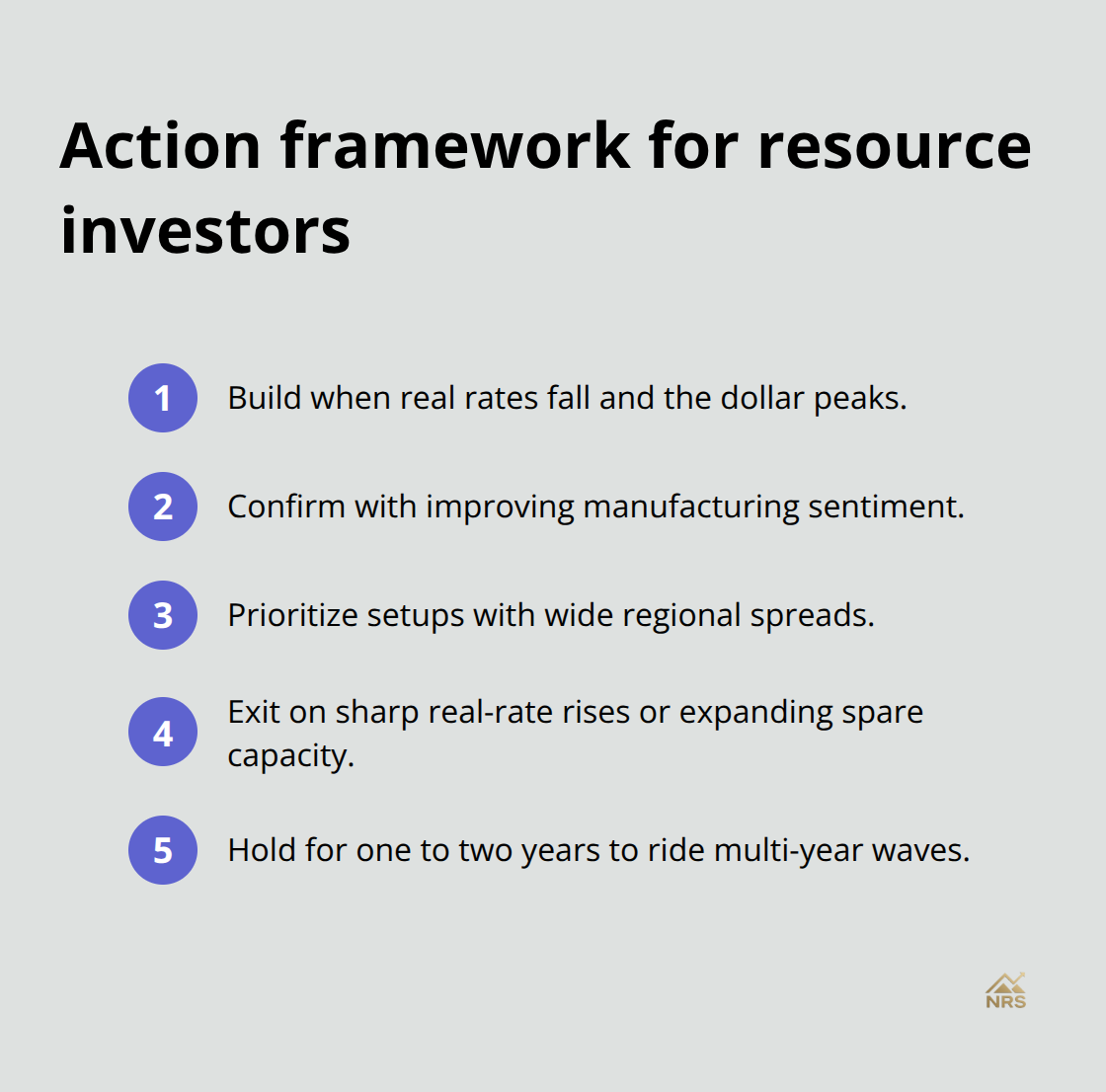
The holding period typically spans one to two years because commodity cycles move in multi-year waves, not monthly swings.
Track EIA and IEA inventory reports weekly, compare contango versus backwardation in futures curves, and reassess your macro regime view monthly as new data arrives. Natural Resource Stocks provides the expert analysis and market insights you need to execute this framework consistently. Long-term commodity analysis demands discipline, data, and conviction.