


























Rare earth elements are reshaping how investors think about commodities. These materials power everything from smartphones to wind turbines, and demand keeps climbing as clean energy and defense sectors expand globally.
At Natural Resource Stocks, we know that rare earth elements investing offers real profit potential-but it comes with serious volatility and geopolitical risks. This guide walks you through the returns you can expect, the pitfalls to avoid, and how to build a strategy that works.
What Rare Earth Elements Actually Do for Modern Technology
Rare earth elements are not rare in crustal abundance-cerium sits at about 0.5 parts per million in the Earth’s crust. What makes them valuable is that economically viable deposits scatter across the globe, and separating them from ore requires expensive, complex processing. This reality shapes every investment decision in the space. The 17 elements in this group, including neodymium, dysprosium, and terbium, power permanent magnets that drive electric vehicle motors, wind turbine generators, and military systems. F-35 fighter jets use over 400 kg of rare earth elements; a Virginia-class submarine requires about 4.6 metric tons. These applications create structural demand that won’t disappear when commodity prices spike. Electric vehicles need approximately 50% more rare earth metals than gasoline-powered cars, and that gap widens as EV adoption accelerates. Magnets represent over 80% of global rare earth demand by value, and this share is expected to exceed 50% of total demand by 2035 as high-performance motors scale across industries. Data centers add another layer of demand-cooling systems in hyperscale facilities consume about 20% of a data center’s energy, and rare earth-enabled thermal management solutions are becoming standard.
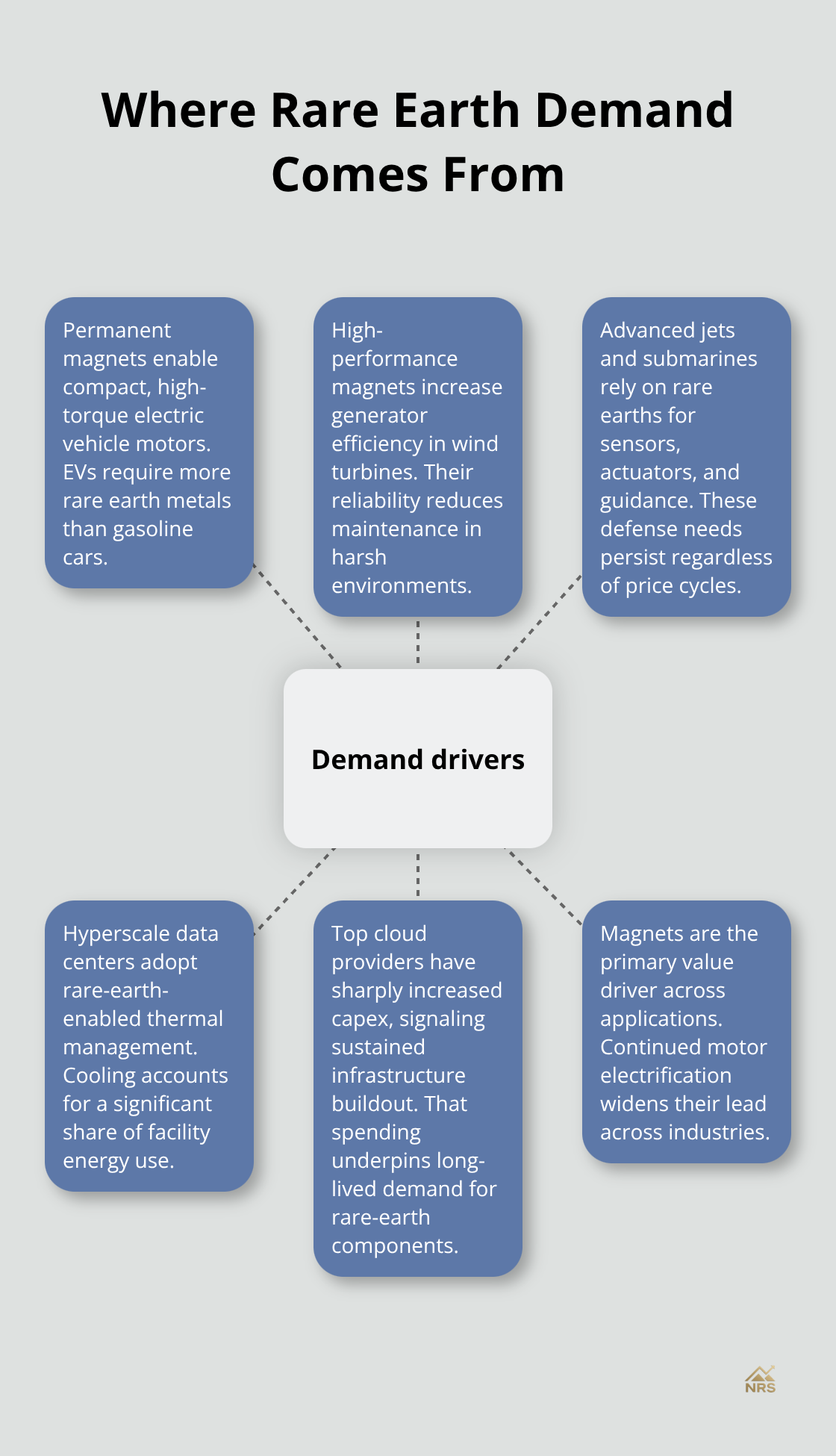
The five largest hyperscalers increased capital expenditure by 72% in 2025 to roughly 400 billion U.S. dollars, signaling sustained investment in infrastructure that depends on rare earth cooling systems.
China Controls the Processing Bottleneck
China controls approximately 60% of global mining and over 90% of processing capacity, according to data from U.S. News & World Report. Refined neodymium-praseodymium reaches roughly 92% China-controlled levels, while heavier rare earths like dysprosium and terbium reach 98–99% concentration. This concentration creates real price divergence: ex-China prices for heavy rare earths can be five times higher than Chinese prices, with four- to six-times premiums for processed material outside China. Official Chinese mining quotas sit around 120,000 tons annually, but illicit mining adds an estimated 50,000–60,000 tons to the market. If enforcement tightens and removes that illegal supply, the market could lose up to 60,000 tons, creating sharp price volatility and supply shocks. Export restrictions demonstrate China’s willingness to weaponize supply-the 2010 export ban to Japan triggered immediate price spikes and forced manufacturers to scramble for alternatives. Geopolitical risk directly correlates with rare earth prices; research shows higher geopolitical risk associates with higher rare earth prices, reflecting increased demand for these materials in energy security and defense applications. This relationship is not stable over time-wavelet analysis reveals that before 2020, rare earth prices sometimes led geopolitical risk indices, but after 2020 the relationship became mutual and dynamic in the short term.
Western Supply Chains Are Expanding Across Multiple Fronts
The U.S. invested 1.4 billion dollars to develop a vertically integrated magnet supply chain, reducing dependence on Chinese magnet production, according to U.S. News & World Report. MP Materials Corp. operates Mountain Pass in California-the only U.S.-based company currently mining and processing rare earths-with contracts from the Department of Defense and Apple. Lynas Rare Earths, an Australian producer, is building a Texas processing facility to handle light and heavy rare earths with U.S. Department of Defense backing. American Resources Corp. focuses on recycling rare earth magnets from end-of-life wind turbines and EVs, with high-purity neodymium recovered through collaboration with Purdue University. North America could account for roughly 9–10% of refined rare earth oxide supply by 2035, but higher production costs and long permitting timelines pose serious constraints. Bringing new rare earth mines online takes 15 or more years due to regulatory requirements, while downstream processing can scale faster but remains bottlenecked.
Policy Commitments Signal Long-Term Strategic Shifts
The White House’s Project Vault aims to create a strategic reserve for 60 critical minerals with 12 billion dollars in funding, signaling sustained policy commitment to supply diversification. Geopolitical realignment is shifting sourcing patterns-the U.S. and Brazil are discussing critical minerals cooperation, and Greenland’s Tanbreez deposit recently transferred to Critical Metals, opening potential western access to Arctic resources. These moves telegraph long-term supply strategy shifts, but investors should not expect quick wins; supply diversification unfolds over decades, not quarters. The concentration of processing power in China and the slow pace of western alternatives mean that price volatility tied to geopolitical events will remain a defining feature of rare earth investing for years to come.
How Rare Earth Price Swings Create Real Profit Opportunities
Volatility Rewards Investors Who Understand Price Drivers
Rare earth prices move in sharp, unpredictable cycles driven by geopolitical tensions, supply disruptions, and shifts in downstream demand. This volatility terrifies risk-averse investors but rewards those who understand what triggers price movements and position accordingly. Neodymium-praseodymium prices spiked dramatically during China’s 2010 export restrictions to Japan, and similar shocks occur whenever geopolitical risk escalates or enforcement against illegal mining tightens. Research shows that rare earth prices respond to geopolitical risk, with the relationship becoming more dynamic in recent years, meaning investors who monitor geopolitical developments gain real edge in timing entries and exits.
Higher geopolitical risk directly correlates with higher rare earth prices, reflecting increased demand for these materials in energy security and military applications. Ex-China prices for heavy rare earths trade at five times the Chinese domestic price, with four- to six-times premiums for processed material outside China, creating arbitrage opportunities as western processing capacity expands. If Chinese enforcement removes illegal supply currently flooding the market, prices could spike sharply and stay elevated for years while new western capacity comes online.
Monitor Price Signals and Supply Enforcement
Investors should track enforcement announcements from Beijing and watch ex-China price spreads as early warning signals. When those spreads widen beyond historical ranges, they signal supply tightness and potential upside ahead. The relationship between geopolitical risk and rare earth prices is not theoretical-it reflects real shifts in how governments and manufacturers prioritize supply security over cost minimization.
Integrated Producers Capture the Most Value
The companies capturing the most value are not the pure miners but the integrated producers controlling downstream processing and magnet manufacturing. MP Materials operates Mountain Pass in California with long-term contracts from the Department of Defense and Apple, securing both volume and pricing power that isolated miners cannot achieve. Lynas Rare Earths combines Australian mining with its Texas processing facility backed by U.S. Department of Defense support, positioning the company to benefit as western governments prioritize supply-chain resilience.
American Resources focuses on recycling rare earth magnets from end-of-life wind turbines and electric vehicles, a segment that scales as EV fleets age and offers higher margins than primary mining because recycled material requires less energy-intensive separation. These companies control multiple points in the supply chain, which translates to pricing power and resilience against commodity-price swings.
Government Backing Eliminates Commodity Risk
Government subsidies and strategic reserve commitments matter enormously for returns. The White House’s Project Vault commits 12 billion dollars to securing critical minerals, and the 1.4 billion dollar investment in vertically integrated magnet supply directly supports companies holding processing licenses and magnet-production contracts. Long-term purchasing agreements from government agencies eliminate commodity-price risk that crushes smaller producers, making contract visibility the single most reliable predictor of shareholder returns.
Avoid pure exploration plays and penny stocks in this space. Focus instead on producers with existing cash flow and government backing, as these companies can fund expansion to secondary mines without dilution while maintaining pricing power through strategic relationships. The next section examines the specific risks that can derail even well-positioned investments and how to identify them before they damage your portfolio.
Where Rare Earth Investing Goes Wrong
China’s Processing Dominance Creates Structural Cost Disadvantages
Rare earth investing punishes investors who ignore supply concentration and overestimate how quickly western alternatives can scale. China controls approximately 60% of global mining and over 90% of processing capacity, according to U.S. News & World Report data. Refined neodymium-praseodymium reaches roughly 92% China-controlled levels, while heavier rare earths like dysprosium and terbium reach 98–99% concentration.
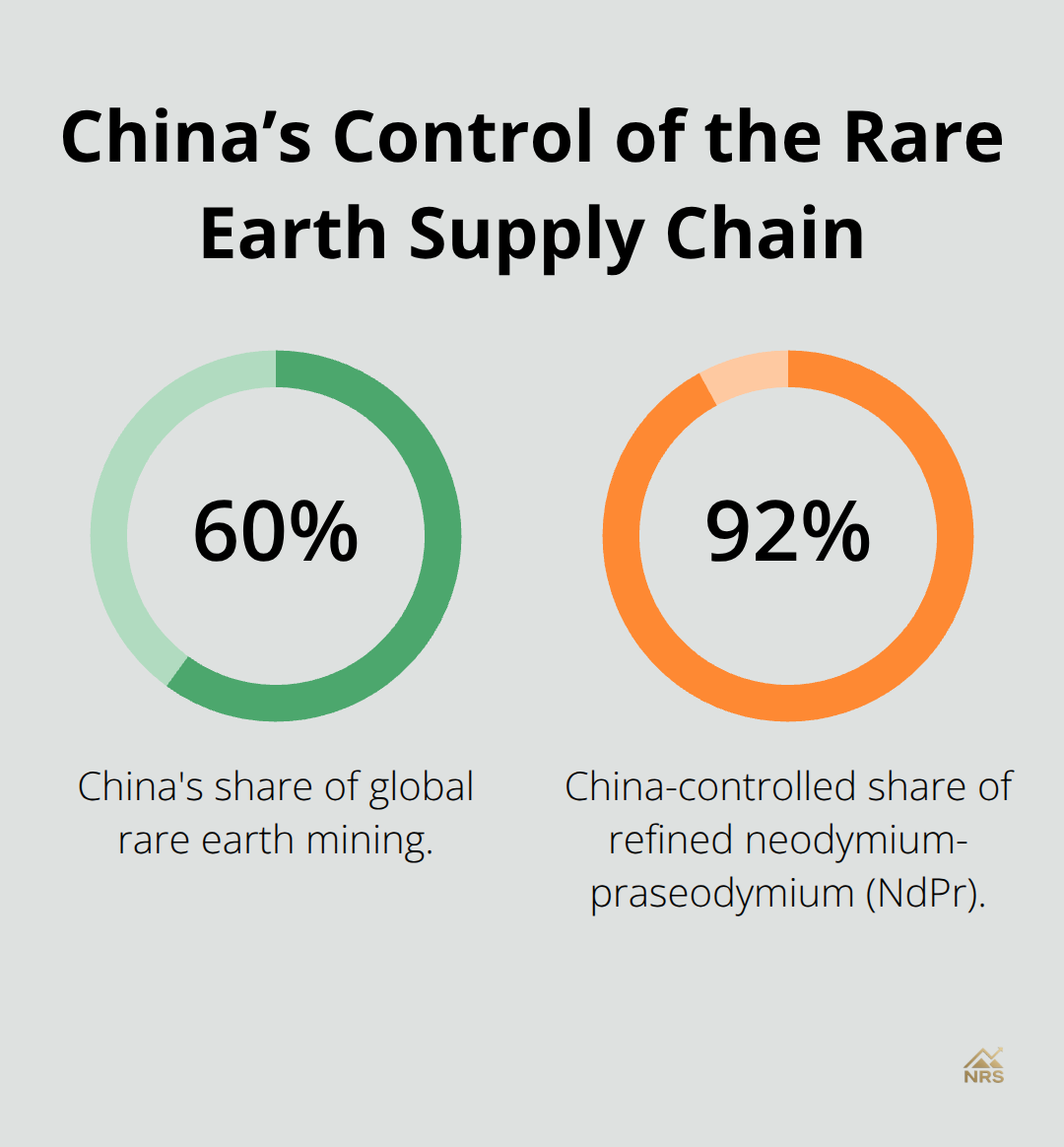
This concentration creates a structural price floor that keeps ex-China producers perpetually disadvantaged, and this gap widens whenever geopolitical tensions spike.
The math is brutal: a heavy rare earth refinery in North America costs roughly four to six times more per unit than Chinese capacity, a premium that persists even when Chinese prices rise sharply. Ex-China prices for heavy rare earths trade at five times the Chinese domestic price, with four- to six-times premiums for processed material outside China. Enforcement against China’s estimated 50,000–60,000 tons of annual illegal mining could remove that supply and spike prices temporarily, but western producers cannot capitalize because they lack the processing capacity to meet sudden demand spikes. You watch prices surge while western mines and refineries remain bottlenecked by permitting delays that stretch 15 years or longer, a dynamic that rewards traders but destroys long-term equity holders who buy western mining stocks expecting margin expansion.
Environmental Regulations and Permitting Timelines Drain Cash Reserves
Environmental regulations and permitting timelines represent the second major risk tier, one that separates viable projects from money-losing ventures. A new rare earth mine requires 15 or more years from discovery to production, and this timeline is not improving despite government pressure to accelerate permitting. Rare earth processing generates significant environmental liabilities including radioactive thorium waste and acidic leachate that regulators scrutinize intensely, making cost overruns and project delays nearly inevitable.
Companies like Lynas Rare Earths and MP Materials face constant regulatory pressure on water discharge and waste management, costs that Chinese competitors externalize through lax enforcement. Do not invest in exploration-stage companies or penny stocks in this sector regardless of geological merit, because even the best deposits fail permitting or face construction delays that drain cash reserves. Try focusing instead on producers with existing mines that generate positive cash flow and multi-year government contracts, as these companies absorb regulatory risk through established relationships and pricing power.
Geopolitical Instability and Property-Rights Risk
Avoid regions with weak governance entirely-Mongolia, Kyrgyzstan, and other politically unstable areas pose property-rights risks that no geological advantage justifies. Political instability can halt production overnight, wipe out shareholder value, and leave investors with no recourse. Western producers operating in stable jurisdictions face higher costs but eliminate this catastrophic tail risk.
Chinese Market Flooding Threatens Margin Expansion
The final risk is the one most investors underestimate: Chinese strategic response to western diversification. China could flood the market with low-priced material to collapse margins at western producers, a tactic that has worked repeatedly in rare earth history. This risk makes integrated producers with government backing and long-term contracts far safer than pure mining plays, because government purchasing agreements create price floors that commodity exposure cannot provide.
Integrated producers controlling multiple points in the supply chain (mining, processing, magnet manufacturing) capture pricing power that isolated miners cannot achieve. MP Materials operates Mountain Pass in California with long-term contracts from the Department of Defense and Apple, securing both volume and pricing stability. Lynas Rare Earths combines Australian mining with its Texas processing facility backed by U.S. Department of Defense support, positioning the company to benefit as western governments prioritize supply-chain resilience.

American Resources focuses on recycling rare earth magnets from end-of-life wind turbines and electric vehicles, a segment that scales as EV fleets age and offers higher margins than primary mining because recycled material requires less energy-intensive separation.
Final Thoughts
Rare earth elements investing succeeds when you focus on integrated producers with government backing and existing cash flow, not exploration plays or penny stocks. MP Materials, Lynas Rare Earths, and American Resources demonstrate this principle by controlling multiple points in the supply chain, from extraction through magnet production or recycling. Government contracts eliminate commodity-price risk that destroys isolated miners, making contract visibility your most reliable predictor of shareholder returns.
China’s 90% processing dominance creates a structural cost disadvantage that western producers cannot overcome quickly, and enforcement against illegal mining could spike prices temporarily while western capacity remains bottlenecked by 15-year permitting timelines. Environmental regulations drain cash reserves at exploration-stage companies, and geopolitical instability in weak-governance regions poses property-rights risks that no geological advantage justifies. Chinese market flooding remains a real threat, one that only integrated producers with long-term government purchasing agreements can withstand.
Your strategy should prioritize producers generating positive cash flow from existing operations, companies with multi-year government contracts, and businesses controlling downstream processing or recycling. Monitor geopolitical risk developments and ex-China price spreads as early warning signals for supply tightness and potential upside. Natural Resource Stocks provides expert analysis and market insights to help you navigate rare earth elements investing with confidence as global supply chains reshape over the next decade.