

























Copper and nickel are moving in different directions today. Copper is sharply higher as traders return to the record-level copper trade, supported by tight supply, AI/data-center demand, electrification, and continued uncertainty around U.S. copper tariff policy. Nickel is nearly flat, with the market still caught between Indonesia supply policy, weaker monthly momentum, and longer-term demand from stainless steel and EV batteries.
Today’s pricing snapshot
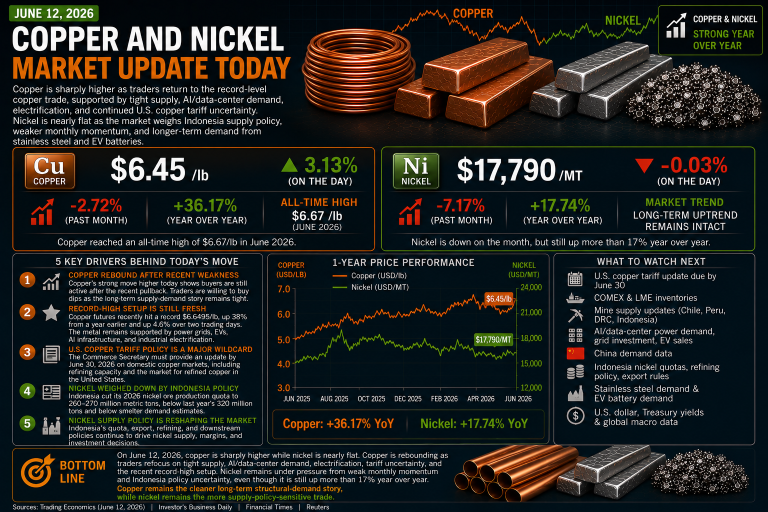
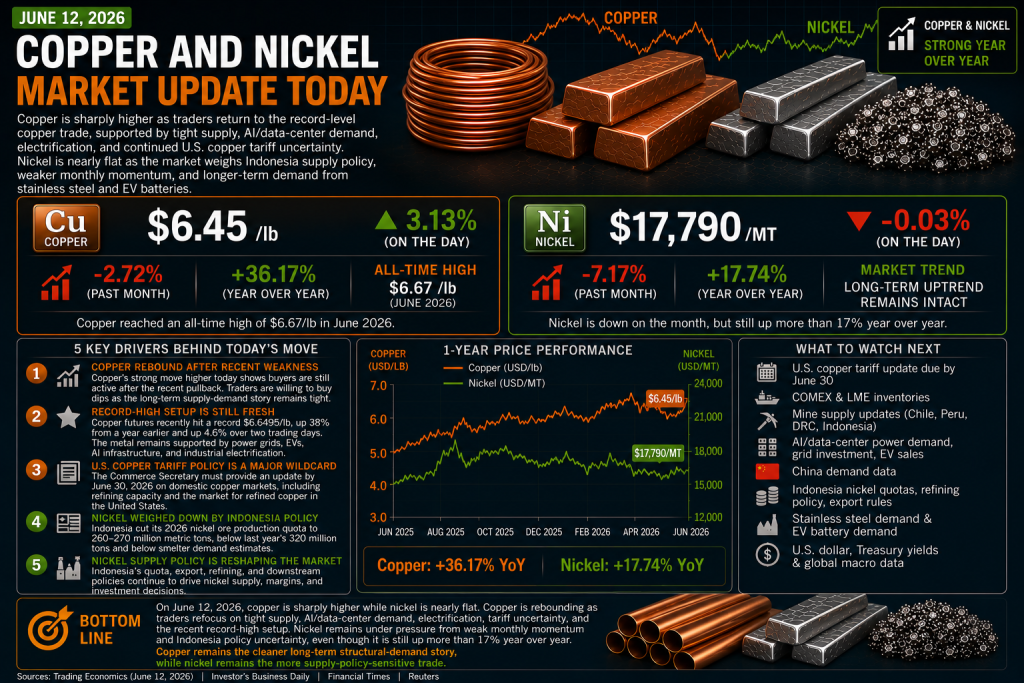
According to Trading Economics CFD benchmarks, copper rose to about $6.45/lb on June 12, 2026, up roughly 3.13% on the day. Copper is down about 2.72% over the past month, but remains up roughly 36.17% year over year. Trading Economics also notes that copper reached an all-time high of $6.67/lb in June 2026.
Nickel slipped to about $17,790/metric ton on June 12, 2026, down roughly 0.03% on the day. Nickel is down about 7.17% over the past month, but remains up roughly 17.74% year over year, showing that the longer-term trend remains positive despite recent weakness.
5 key drivers behind today’s move
1) Copper is rebounding sharply after recent weakness
Copper’s strong move higher today shows that buyers are still active after the recent pullback. Prices remain below the June record high of $6.67/lb, but today’s rally puts copper back near elevated levels.
That suggests the market is still willing to buy dips in copper because the long-term supply-demand story remains tight.
2) Copper’s record-high setup is still fresh
Copper futures recently settled at a record $6.6495/lb, up 38% from a year earlier and up 4.6% over two trading days. That record move showed how quickly copper can rally when supply concerns and demand expectations line up.
The metal remains a key focus for resource investors because it is central to power grids, EVs, AI infrastructure, renewable energy, and industrial electrification.
3) U.S. copper tariff policy remains a major wildcard
Copper traders are still watching U.S. tariff policy. A White House action on copper imports requires the Commerce Secretary to provide an update by June 30, 2026 on domestic copper markets, including refining capacity and the market for refined copper in the United States.
That matters because tariff policy could affect regional copper pricing, U.S. import demand, downstream fabricators, and copper supply chains. Any new signal before the June 30 update could move the market quickly.
4) Nickel remains weighed down by Indonesia policy uncertainty
Nickel is nearly flat today, but the broader monthly trend remains weak. Trading Economics shows nickel down more than 7% over the past month, even though it is still positive year over year.
Indonesia remains the biggest supply-side driver. Recent reporting said Indonesia cut its 2026 nickel ore production quota to 260 million–270 million metric tons, below the 320 million tons produced last year and below estimated demand from domestic smelters. That keeps nickel highly sensitive to quota, export, refining, and downstream investment headlines.
5) Nickel supply policy is reshaping the market
Indonesia’s nickel policy is not just a short-term price issue. The country has moved from being a raw ore exporter to a dominant refined nickel producer, and its production quotas are now part of a broader effort to manage supply, protect margins, and sustain domestic downstream investment.
That keeps nickel more policy-sensitive than copper. Nickel can rally quickly when Indonesia tightens supply, but it can also weaken when inventories rise, stainless steel demand softens, or EV battery demand disappoints.
What to watch next
Copper traders will be watching COMEX and LME inventories, U.S. copper tariff updates due by June 30, mine-supply updates from Chile, Peru, Indonesia, and the Democratic Republic of Congo, AI/data-center power demand, grid investment, EV sales, China demand data, sulfuric-acid availability, U.S. dollar moves, and Treasury yields.
Nickel traders will be watching Indonesia production quotas, export-governance rules, refining policy, royalty changes, stainless steel demand, EV battery demand, Class 1 nickel premiums, LME inventories, and broader base-metals sentiment.
Bottom line
On June 12, 2026, copper is sharply higher while nickel is nearly flat. Copper is rebounding as traders refocus on tight supply, AI/data-center demand, electrification, tariff uncertainty, and the recent record-high setup. Nickel remains under pressure from weak monthly momentum and Indonesia policy uncertainty, even though it is still positive year over year.
Copper remains the cleaner long-term structural-demand story, while nickel remains the more supply-policy-sensitive trade today.