

























Uranium is experiencing a genuine resurgence driven by global nuclear expansion and energy security concerns. We at Natural Resource Stocks believe investors need a clear uranium market analysis to navigate both the opportunities and real risks in this sector.
This guide breaks down current supply dynamics, identifies the geopolitical and regulatory threats, and maps out concrete investment paths from established producers to junior explorers.
Where Uranium Supply Stands Today
Production Concentration and Western Supply Shifts
Kazakhstan, Canada, and Australia control the vast majority of global uranium production. Kazakhstan alone produces roughly 40% of global uranium, making it the single largest supplier by a significant margin. This concentration creates real vulnerability.
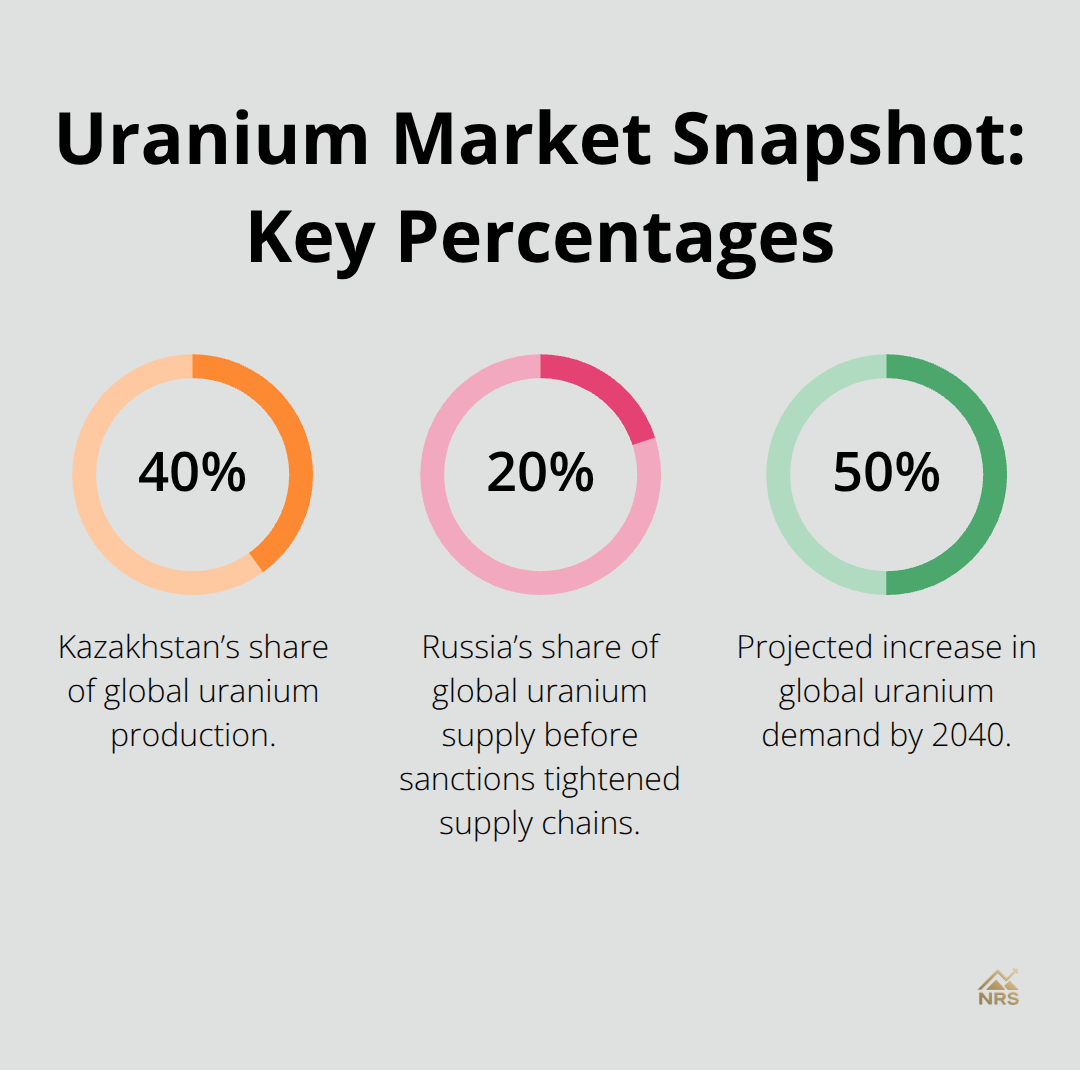
The Russia-Ukraine war tightened supply chains dramatically, and the U.S. ban on Russian uranium imports forced Western markets to rely more heavily on these three countries. Cameco, the Canadian producer, saw its stock surge over 94% in the past year because Western buyers now actively avoid Russian supply. That shift is structural, not temporary.
Corporate Demand Transforms the Market
Demand accelerated sharply from two sources that were not major players five years ago. Corporate demand for nuclear power from tech giants includes Meta’s agreements for nuclear capacity to power AI services, while Microsoft secured agreements to renew reactors supplying over 800 megawatts for datacenter operations. These represent Fortune 500 companies betting their infrastructure on nuclear power because renewables alone cannot guarantee the 24/7 baseload electricity that AI training demands. The U.S. government also reduced regulations on uranium converters and enrichers, removing permitting delays that previously took years. Centrus and two other fuel suppliers secured approximately 2.7 billion USD in contracts to boost nuclear fuel supply, partly to offset Russia-related disruptions. This policy tailwind is real and measurable.
Price Trends Within a Structural Deficit
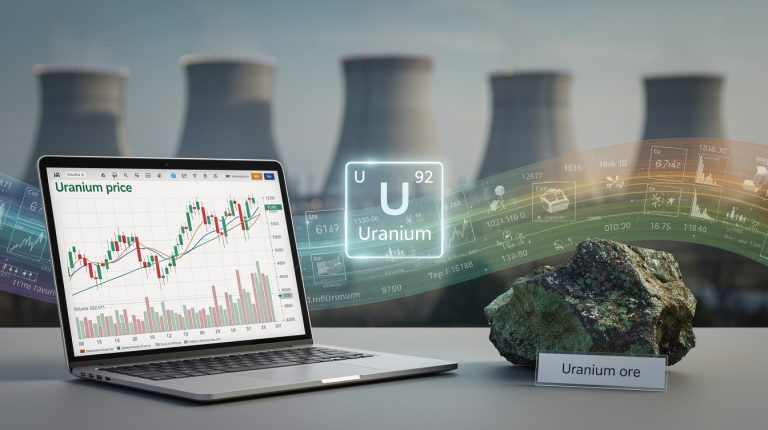
Uranium traded at 84.70 USD per pound on May 22, 2026, with futures above 86.5 USD per pound near two-month highs. Over the past month the price fell 2.81%, but it remained up 18.38% year-over-year, reflecting underlying strength despite short-term volatility. Trading Economics forecasts uranium at 86.66 USD per pound by end of quarter and 91.80 USD per pound over the next twelve months. The all-time high sits at 148 USD per pound from May 2007, meaning current prices are well below historical peaks but trending upward.
The structural supply deficit matters more than the price itself. Global uranium demand is projected to increase by about 50% by 2040, yet production capacity has not kept pace. This mismatch creates a floor under prices. When supply tightens and demand accelerates simultaneously, prices do not stay flat.
Volatility Drivers and Risk Exposure
Uranium equities show strong co-movement with global equity indices since 2010, meaning uranium stocks behave like growth assets during risk-on periods. However, geopolitical risk became increasingly influential on uranium returns since 2022, with effects magnified at both the upper and lower price extremes. Investors should expect volatility tied to geopolitical events, energy price cycles, and macro-financial conditions rather than assuming smooth upward trajectories.
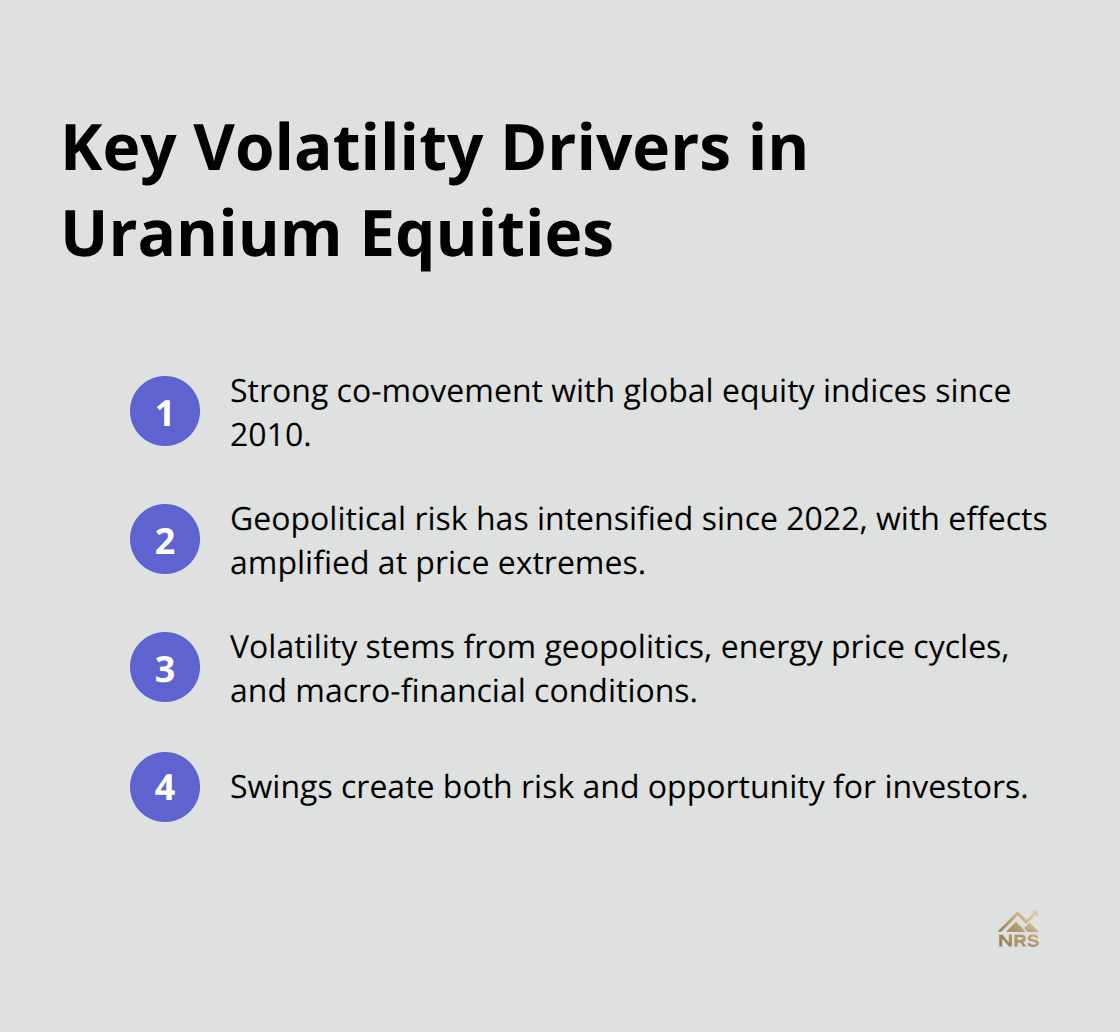
This volatility creates both the risk and the opportunity that the next section addresses directly.
What Threatens Uranium Investment Returns
Geopolitical Risk as the Primary Threat
Uranium’s structural supply deficit creates genuine upside, but geopolitical risk now dominates uranium sector returns. Peer-reviewed research published in Economics Letters in 2025 confirms that geopolitical tensions became the dominant driver of uranium returns since 2022, with effects amplified at both price extremes. The Russia-Ukraine war demonstrated this reality viscerally. Russia supplied roughly 20% of global uranium before sanctions tightened supply chains, forcing Western utilities and fuel converters to scramble for alternative sources. That disruption spiked prices and exposed how quickly political events reshape uranium markets. The U.S. ban on Russian uranium imports is now structural policy, not temporary restriction, meaning any future geopolitical flare-up involving Kazakhstan or Canada could trigger severe supply shocks.
Kazakhstan produces 40% of global uranium, and political instability there would cripple Western supply immediately. Investors holding uranium equities must monitor geopolitical risk indicators constantly, not just commodity prices. A multi-factor modeling approach matters far more than single-variable forecasts because uranium returns depend on equity market shocks, energy price cycles via oil dynamics, and geopolitical tensions simultaneously.
Regulatory Uncertainty and Policy Reversals
Regulatory uncertainty represents a second major threat, though one more manageable than geopolitics. The U.S. government reduced permitting timelines for uranium converters and enrichers, removing years of delay. However, regulatory pendulums swing. A change in administration or public backlash against nuclear expansion could reverse these gains overnight. Small modular reactor licensing depends entirely on regulatory approval from the NRC, and any licensing delays for NuScale or other SMR designs would cripple deployment timelines and uranium demand growth.
Equity Market Correlation and Cyclical Risk
Market volatility tied to cyclical downturns amplifies these risks further. Uranium equities show strong co-movement with global equity indices since 2010, meaning uranium stocks behave like growth assets during risk-off periods when equity markets crash. This creates a correlation trap: when portfolio losses mount elsewhere, uranium holdings often decline simultaneously rather than providing diversification. The all-time high for uranium at 148 USD per pound in May 2007 was followed by a severe drawdown during the 2008 financial crisis, demonstrating how quickly sentiment reversals devastate uranium equities.
Current prices at 84.70 USD per pound remain well below historical peaks, leaving room for downside if demand assumptions weaken or recession fears resurface. Stress testing your uranium exposure against geopolitical shocks, regulatory reversals, and equity market crashes is not optional-it is essential before allocating capital. Understanding these risks positions investors to identify which uranium stocks and vehicles actually withstand pressure, a distinction that separates winners from losers in the next section.
Investment Opportunities in Uranium Stocks
Cameco: The Western Supply Foundation
Cameco stands as the single best entry point for uranium exposure among established producers. The Canadian company controls roughly 20% of Western uranium supply outside Kazakhstan, and its stock gained over 94% in the past year as Western buyers actively avoided Russian supply. More importantly, Cameco signed a long-term off-take agreement with Slovakia’s primary utility, demonstrating that demand visibility extends years into the future. Analysts project Cameco’s price target around 89.55 USD per share on average, with some revisions pushing toward 104 USD, signaling upside potential as supply tightens further. The company’s foundational position in the Western supply chain means it captures margin expansion as uranium prices climb toward the 91.80 USD per pound forecast for the next twelve months.
BWX Technologies: Infrastructure and HALEU Supply
Beyond pure uranium production, BWX Technologies provides exposure to the infrastructure buildout that drives long-term sector growth. The company supplies reactor components and holds a central role in developing high-assay low-enriched uranium (HALEU) fuel for small modular reactors. BWX gained roughly 69% over the past year and beat earnings expectations in Q2 2025 with EPS of 1.02 versus 0.79 expected. The National Nuclear Security Administration awarded the company a 1.5 billion USD contract to expand HALEU supply, removing execution risk from the SMR deployment thesis. Institutional ownership sits at 94%, meaning large capital allocators have already positioned themselves heavily in this play.
Constellation Energy: Nuclear Generation Returns
Constellation Energy represents the utility angle, trading up 525% since its IPO as the largest U.S. nuclear operator with long-term power purchase agreements from tech companies desperate for 24/7 baseload electricity. The company’s return on equity reaches 21.6%, demonstrating that nuclear generation produces real cash returns, not just speculative upside. This utility exposure balances producer leverage with stable operational cash flows.
URNM and Physical Uranium: Diversified Access
For investors unwilling to pick individual stocks, the Sprott Uranium Miners ETF (URNM) delivers diversified exposure across producers and junior miners while maintaining a position in the Sprott Physical Uranium Trust, which holds over 81 million pounds of uranium. URNM generated a year-to-date return exceeding 44% and a five-year return above 285%, reflecting the sector’s structural momentum. The fund’s 0.68% management expense ratio remains competitive for commodity exposure. The Physical Uranium Trust itself trades at a 4.70% discount to net asset value as of May 22, 2026, with a NAV of 20.35 USD per unit, meaning buyers acquire physical uranium at a slight reduction to intrinsic value. This trust provides transparent daily reporting of holdings and NAV, eliminating the opacity that plagues many commodity vehicles.
Building a Synergistic Uranium Portfolio
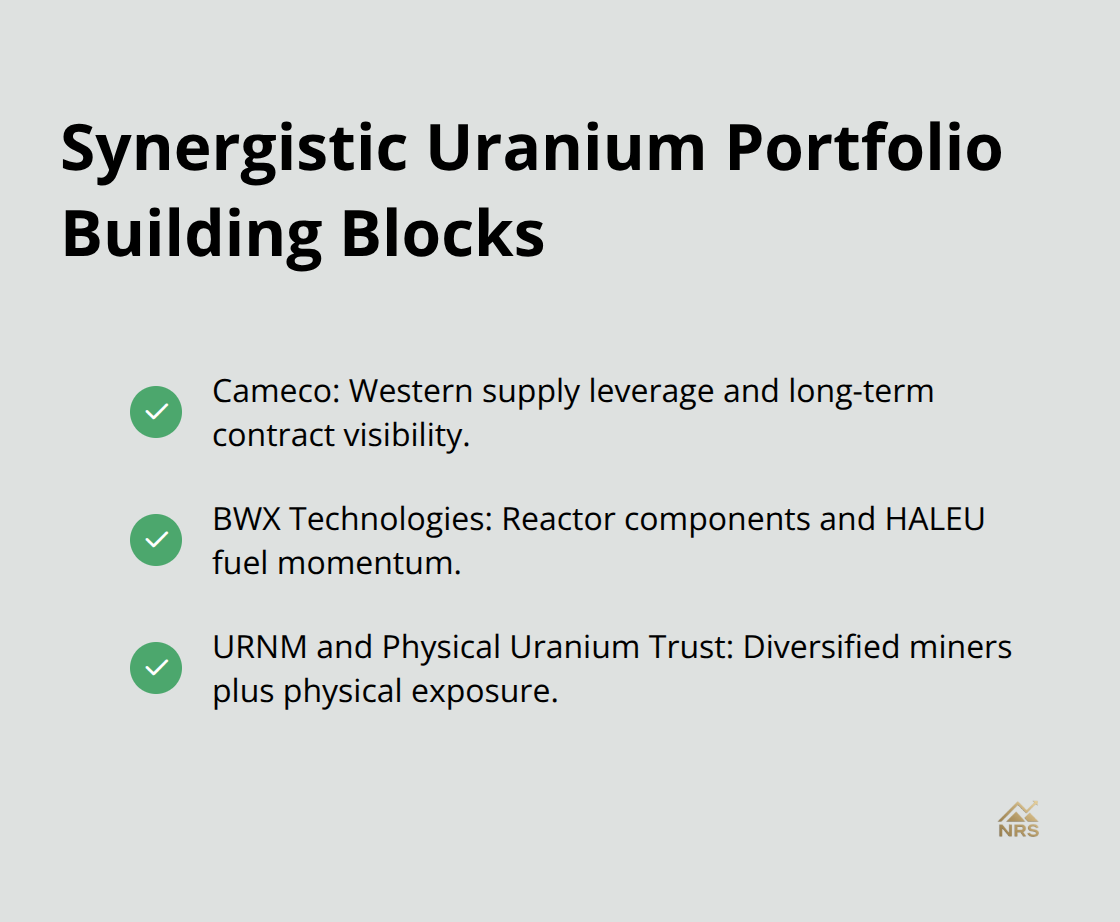
Combining Cameco for producer leverage, BWX for infrastructure exposure, and URNM for diversification creates a portfolio that captures fuel supply, component demand, and utility generation simultaneously. Each position addresses a different layer of the uranium supply chain, reducing single-company risk while maintaining concentrated exposure to the sector’s structural tailwinds.
Final Thoughts
Uranium’s structural supply deficit paired with surging corporate demand from tech giants creates a genuine investment case, but only for investors who understand and accept the risks. The uranium market analysis throughout this guide reveals a sector transformed by geopolitical tensions, regulatory tailwinds, and macro-financial forces that move in tandem. Prices at 84.70 USD per pound remain well below the 148 USD peak from 2007, yet forecasts point toward 91.80 USD within twelve months as supply tightens and demand accelerates.
The risk-reward calculation tilts favorably for investors with a multi-year horizon and the stomach for volatility. Geopolitical risk now dominates uranium sector returns, meaning your portfolio must withstand supply shocks from Kazakhstan, policy reversals in the U.S., or equity market crashes that drag uranium stocks lower alongside broader indices. Cameco’s 94% gain over the past year reflects Western supply concentration, not permanent momentum, while BWX Technologies’ 69% advance depends on SMR deployment timelines that regulators control.
Try position sizing that reflects your risk tolerance, not your conviction level. Combining producer leverage through Cameco, infrastructure exposure via BWX, and diversified access through URNM addresses multiple layers of the uranium supply chain while reducing single-company risk. Explore our in-depth market research to refine your uranium strategy with data-driven insights and expert commentary on macroeconomic factors shaping resource prices.