























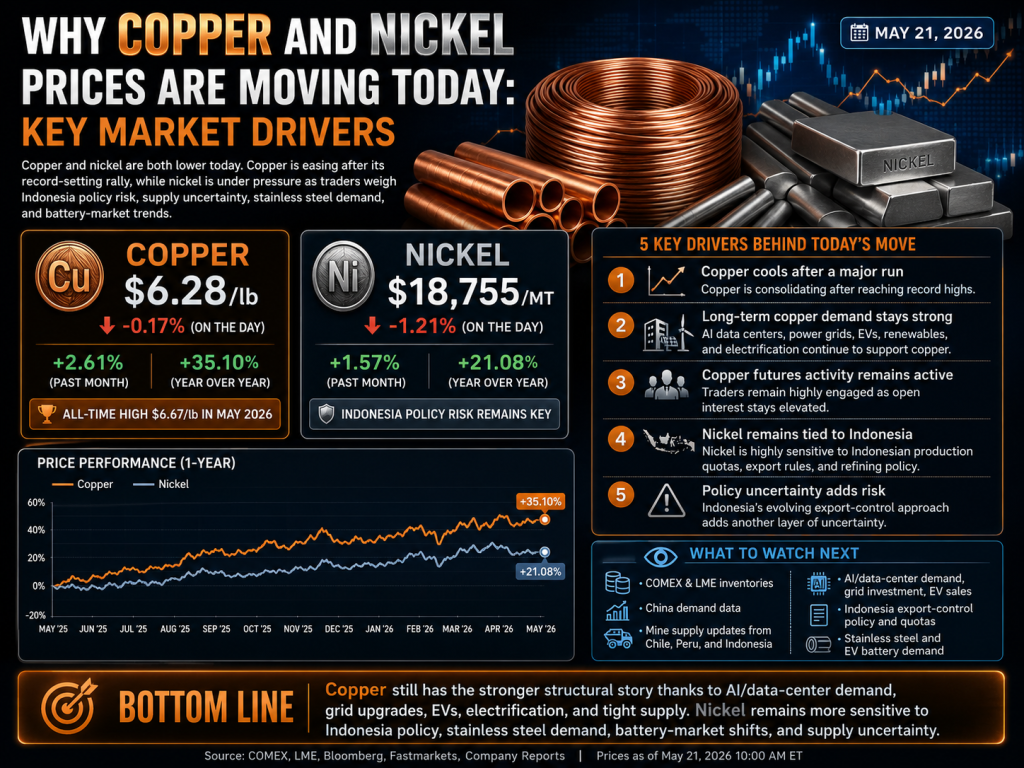
Copper and nickel are both lower today, with nickel seeing the sharper daily move. Copper is easing after its recent record-setting rally as traders balance profit-taking against the long-term demand story from AI data centers, grids, EVs, and electrification. Nickel is also lower as the market weighs Indonesia policy risk, supply uncertainty, stainless steel demand, and battery-market trends.
Today’s pricing snapshot
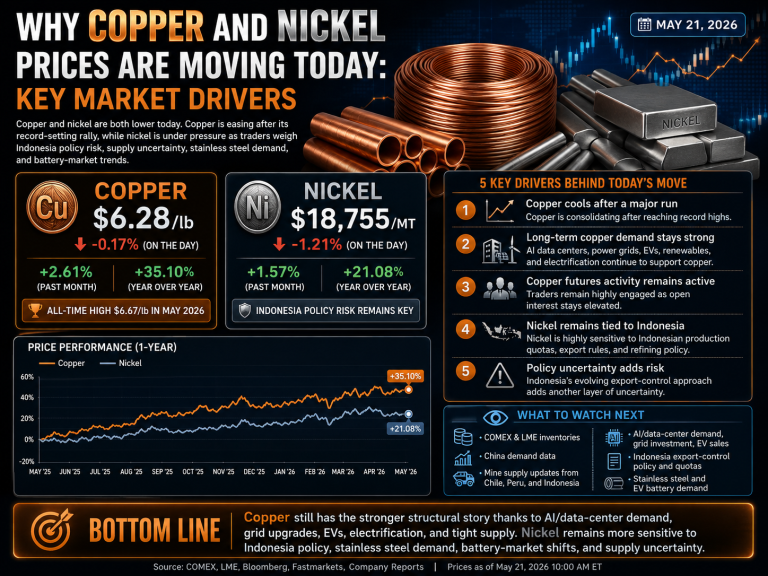
According to Trading Economics CFD benchmarks, copper fell to about $6.28/lb on May 21, 2026, down roughly 0.17% on the day. Copper is still up about 2.61% over the past month and roughly 35.10% year over year. Trading Economics also notes that copper reached an all-time high of $6.67/lb in May 2026.
Nickel fell to about $18,755/metric ton on May 21, 2026, down roughly 1.21% on the day. Nickel is still up about 1.57% over the past month and roughly 21.08% year over year, showing that the longer-term trend remains positive even with today’s weakness.
5 key drivers behind today’s move
1) Copper is cooling after a major run
Copper’s move lower today looks like consolidation after a strong rally. The metal recently hit an all-time high of $6.67/lb in May 2026, so traders may be taking profits while waiting for the next major demand or supply catalyst.
That does not erase the broader copper story, but it does show that record-level pricing can create short-term volatility.
2) Long-term copper demand remains strong
Copper is still supported by long-term demand from AI data centers, power grids, electric vehicles, renewables, and broader electrification. These themes have helped keep copper elevated even when short-term macro signals are mixed.
The key point for investors is that copper is increasingly trading as a strategic infrastructure metal, not just a traditional construction and manufacturing input.
3) Copper futures activity remains active
AP reported that COMEX copper futures had estimated volume of 42,959 contracts on May 21, with open interest rising to 257,964 contracts. That suggests copper remains heavily watched even as spot prices ease from recent highs.
High open interest matters because it shows traders are still actively positioning around copper’s next move.
4) Nickel is lower, but Indonesia remains the biggest wildcard
Nickel is under pressure today, but the market remains highly sensitive to Indonesia. Trading Economics notes that Indonesia produces more than half of global nickel output, supported by significant Chinese investment.
That makes nickel especially sensitive to any change in Indonesian production quotas, export rules, refining policy, or downstream investment.
5) Indonesia’s export-control shift is adding policy risk
Indonesia is moving to increase state control over key commodity exports. AP reported that the first phase of the new policy starts in June 2026, with full state-managed trade targeted by September 2026. The policy covers major resources such as palm oil, coal, and iron alloys, while Indonesia’s position as home to the world’s largest nickel reserves keeps nickel traders focused on possible spillover effects.
For nickel, this adds another layer of uncertainty to an already policy-sensitive market.
What to watch next
Copper traders will be watching COMEX and LME inventories, China demand data, mine-supply updates from Chile, Peru, and Indonesia, AI/data-center power demand, grid investment, EV sales, U.S. dollar moves, and interest-rate expectations.
Nickel traders will be watching Indonesia export-control policy, RKAB production quotas, Tsingshan and Weda Bay supply headlines, stainless steel demand, EV battery demand, Class 1 nickel premiums, LME inventories, and broader base-metals sentiment.
Bottom line
On May 21, 2026, copper and nickel are both lower, but copper still has the stronger structural story. Copper is easing after a record-setting rally, yet remains supported by AI/data-center demand, grid upgrades, EVs, electrification, and tight supply. Nickel is weaker today and remains more exposed to Indonesia policy, stainless steel demand, battery-market shifts, and supply uncertainty.
Copper remains the cleaner long-term demand story, while nickel is the more supply-policy-sensitive trade today.