
























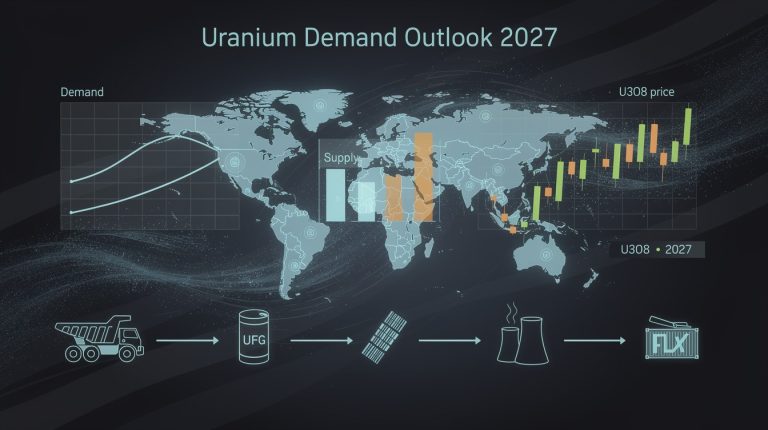
Uranium is experiencing a supply crunch while global demand accelerates. Nuclear power is expanding across developed nations, and emerging economies are racing to meet energy needs through atomic generation.
At Natural Resource Stocks, we’ve analyzed the uranium demand outlook for 2027 and identified critical market shifts. This analysis covers supply constraints, price dynamics, and where investors should focus their attention.
Where Global Uranium Demand Heads Through 2027
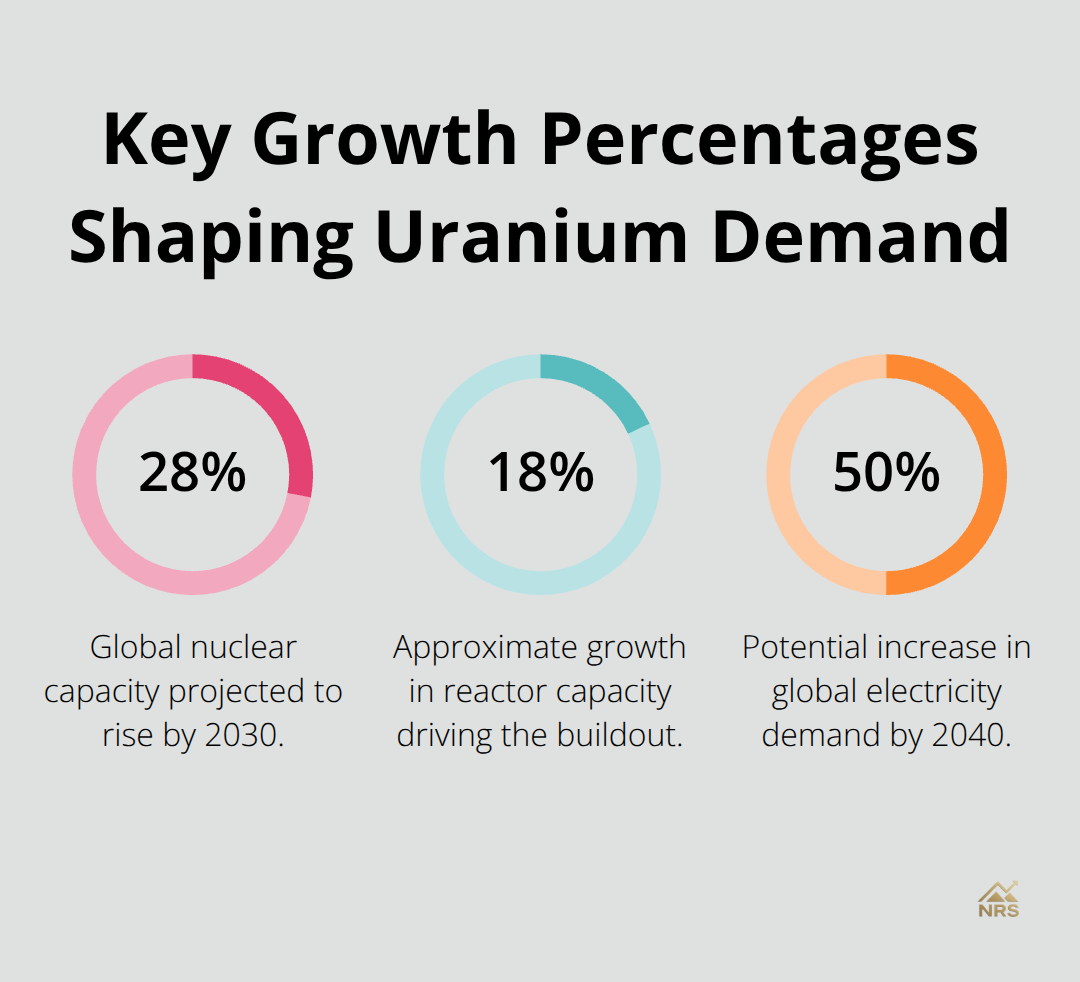
Nuclear capacity expands faster than most investors realize, and the numbers reveal compelling shifts in uranium demand. The World Nuclear Association projects nuclear capacity will rise 28 percent by 2030, driven by approximately 18 percent growth in reactor capacity. What matters more is that over 75 reactors are currently under construction across the world, with another 120 further reactors planned globally. Asia dominates this pipeline, hosting the majority of under-construction and planned capacity, which reflects rapid electricity demand growth and policy support across the region. The International Energy Agency’s World Energy Outlook 2023 estimates electricity demand could rise by up to 50 percent by 2040, which creates structural demand for nuclear baseload power. Utilities already contract for uranium volumes years in advance to secure supply as new reactors approach operation.
Corporate Demand Reshapes the Uranium Market
Tech companies including Meta, AWS, Alphabet, Microsoft, Oracle, and Equinix have accelerated nuclear-related initiatives, signing long-term power purchase agreements and making equity investments in nuclear startups. These companies require reliable, low-carbon baseload power to operate AI infrastructure and data centers, and nuclear provides exactly that. This non-utility demand represents a structural change in uranium consumption patterns and signals that uranium demand will remain elevated regardless of economic cycles. The World Nuclear Association’s Net Zero Nuclear initiative calls for tripling nuclear capacity by 2050 to meet climate goals, and corporate demand validates that trajectory.
Policy Support Drives Expansion Plans
U.S. policy, via May 2025 executive orders, aims to quadruple domestic nuclear capacity to approximately 400 GW by 2050. China, India, Russia, Turkey, and South Africa have outlined their own expansion plans to secure baseload low-carbon power. Small modular reactors advance in Europe and North America, with multiple units expected to reach commercial operation by the late 2020s. These policy commitments create additional demand pathways beyond large reactors and lock in uranium consumption for decades ahead. The convergence of utility demand, corporate power agreements, and government support establishes a multi-decade floor for uranium consumption that investors should monitor closely as 2027 approaches.
Where Uranium Supply Falls Short of Demand
Global uranium production cannot keep pace with accelerating reactor builds, and this supply deficit will intensify through 2027. The World Nuclear Association reports that mine production supplied approximately 74 percent of utilities’ annual uranium needs in 2022, with secondary sources including stockpiles and recycling covering the gap. That dependency on secondary supplies reveals a structural weakness: civil stockpiles exist but remain regionally uneven, with Europe holding around 36,000 tonnes of uranium, the USA approximately 40,000 tonnes, China roughly 132,000 tonnes, and the rest of Asia about 49,000 tonnes as of end-2022. These stockpiles cushion short-term shortfalls, yet they deplete over time and cannot sustain decades of reactor expansion. Seven major uranium producers will increase output from 58.5 million pounds in 2025 to 141.2 million pounds by 2033, representing a 2.4x increase. However, this expansion arrives too late for utilities facing immediate supply pressure. Kazatomprom and Cameco together account for roughly 86 percent of output among major producers in 2025, creating dangerous concentration risk. Kazatomprom generates approximately 91 percent of its revenue from uranium, while Cameco derives roughly 83 percent from the same source, meaning both firms face earnings volatility tied directly to uranium prices and contract renewals.
Production Ramp-Up Timelines Create a Window of Scarcity
New supply from NexGen Energy, Deep Yellow, Bannerman Energy, Lotus Resources, and Boss Energy will contribute meaningfully within three to seven years, but delays compound the problem. Denison Mines received regulatory clearance in February 2026 to advance its Wheeler River project’s Phoenix deposit in Saskatchewan, targeting first production around 2028 via in-situ recovery, yet even this timeline leaves a multi-year gap between today’s demand and available supply. Aggregate uranium capital expenditure reached approximately 704 million dollars in 2024 and will hit 969 million dollars in 2025, peaking near 1.6 billion dollars in 2027 before moderating. Front-loaded spending by NexGen, Denison, Lotus, Paladin, and Deep Yellow signals confidence in higher prices ahead, but construction delays and permitting setbacks remain constant risks. Russia’s restrictions on enriched uranium exports create near-term supply vulnerabilities for U.S. reactors and may accelerate supply-chain diversification efforts. The United States faces a potential shortfall of around 184 million pounds through 2030 if long-term contracting remains insufficient. This supply gap exists despite utilities contracting years in advance, underscoring how severe the mismatch has become.
Contract Terms Drive Realized Prices More Than Spot Markets
Cameco’s contract portfolio as of March 31, 2026 reveals how realized uranium prices depend on contract terms rather than spot prices alone. The company faces delivery commitments of approximately 28 million pounds per year from 2026 through 2030, with front-loaded volumes in 2026 through 2028 and lower volumes in 2029 through 2030. This disciplined approach allows Cameco to layer in market-related pricing mechanisms and capture upside if prices rise. At a 100 dollar per pound spot price, Cameco’s realized price for 2026 reaches 67 dollars, rising to between 74 and 87 dollars in 2027 through 2030 depending on the year. Long-term contract structures dampen spot-price volatility compared to current spot levels, meaning investors must watch contract renewal cycles closely. The realized price generally rises with higher spot prices, but the degree of increase varies each year due to contract terms and escalators built into agreements.
Geopolitical Concentration Reshapes Supply Access
Russia and China have pursued strategic equity plays in foreign uranium mines for years, including China’s positions in Niger, Namibia, Kazakhstan, Uzbekistan, and Canada. U.S. policy now prioritizes reducing reliance on Russian-origin uranium by 2028 as part of energy security measures, which may redirect supply flows and create pricing shifts. The World Bank’s decision to end its funding ban on nuclear energy could unlock financing for new reactors in developing countries, supporting uranium demand growth and potentially diversifying supply sources beyond current incumbents. These geopolitical shifts and policy changes will reshape which producers control market access and which regions secure reliable supply chains heading into the late 2020s.
Uranium Prices Face a Structural Floor Through 2027
The uranium market has entered a phase where prices will likely remain elevated regardless of short-term spot volatility. Historical uranium price weakness stemmed from oversupply and weak utility demand, but those conditions no longer exist. The World Nuclear Association projects uranium demand will rise 28 percent by 2030, yet mine production cannot satisfy that growth until the early 2030s when new mines begin scaling output. This structural floor for prices reflects a fundamental shift in market dynamics.
Aggregate uranium revenue among major producers is forecast to rise from approximately 4.7 billion dollars in 2023 to roughly 14.9 billion dollars by 2033, signaling how severely the market has tightened. Average realized uranium prices are forecast to climb from about 59.6 dollars per pound in 2023 to around 98.7 dollars per pound by 2033. These contract mechanisms lock in higher prices as spot markets rise, meaning producers benefit from upward price movements while utilities face rising fuel costs. The supply gap persists through 2028 when major producers moderate capital spending, leaving 2027 and 2028 as years of particular scarcity and pricing strength.
Contract Positioning Determines Producer Returns
Cameco’s March 2026 contract portfolio demonstrates this dynamic clearly: at a 100 dollar per pound spot price, the company’s realized price for 2026 reaches 67 dollars, rising to between 74 and 87 dollars in 2027 through 2030. Long-term contract structures dampen spot-price volatility compared to current spot levels, meaning investors must watch contract renewal cycles closely. The realized price generally rises with higher spot prices, but the degree of increase varies each year due to contract terms and escalators built into agreements. Producers with front-loaded delivery commitments in 2026 through 2028 capture near-term pricing strength, while those with flexibility in later years position themselves to benefit from sustained market tightness.
Market Concentration and Valuation Divergence
Kazatomprom and Cameco dominate production with roughly 86 percent of output among major producers, yet they trade at vastly different valuations. Cameco’s net asset value sits around 25.5 billion dollars with a price-to-NAV near 2.3x, while Kazatomprom’s NAV approximates 20.7 billion dollars but trades near 1.0x NAV due to geopolitical risk and Russian exposure. Mid-tier developers including NexGen, Denison, and Uranium Energy trade around 1.3 to 1.6x NAV, offering exposure to production growth without the concentration risk of incumbents. Deep Yellow and Boss Energy trade below NAV, presenting value for risk-tolerant investors willing to bet on execution. The market bifurcation reflects rational pricing: established producers generate cash today while developers offer optionality on 2028 and 2029 production ramps.
Supply Chain Diversification Reshapes Investment Priorities
Investors should prioritize producers with diversified supply chains outside Russia and geopolitical hotspots. Monitor quarterly contract renewal announcements closely, as these announcements reveal whether producers lock in higher prices or face pressure to accept lower terms. Realized prices matter far more than spot quotes when evaluating producer earnings, since contract terms determine actual cash flow rather than headline uranium prices. U.S. policy now prioritizes reducing reliance on Russian-origin uranium by 2028 as part of energy security measures, which may redirect supply flows and create pricing shifts that favor non-Russian producers. Producers positioned in stable jurisdictions with clear regulatory pathways will attract capital more readily than those facing geopolitical headwinds.
Final Thoughts
The uranium demand outlook 2027 rests on a straightforward reality: supply cannot match demand, and this imbalance will persist for years. Global uranium production will reach 141.2 million pounds by 2033, more than double today’s output, yet this expansion arrives too late to close the gap utilities face right now. Kazatomprom and Cameco control roughly 86 percent of current production, while new mines from NexGen, Denison, and others won’t meaningfully contribute until 2028 or later, creating a structural floor for uranium prices that extends well beyond 2027.
Nuclear capacity expansion accelerates across developed and emerging markets, with over 75 reactors under construction and another 120 planned globally. Tech giants including Meta, AWS, and Alphabet now demand reliable baseload power for AI infrastructure, adding non-utility consumption that utilities never anticipated. Government policy from the U.S., China, India, and Europe explicitly supports nuclear expansion as a low-carbon solution, which locks in decades of uranium demand regardless of economic cycles.
For investors, the uranium demand outlook 2027 presents a bifurcated opportunity: established producers like Cameco trade at premium valuations because they generate cash today and control near-term supply, while mid-tier developers including NexGen and Denison offer exposure to production growth at lower valuations (though execution risk remains real). Geopolitical factors matter enormously, as producers positioned outside Russia and unstable regions will attract capital more readily as supply-chain diversification accelerates. Monitor quarterly contract renewals closely, since realized prices depend far more on contract terms than spot quotes, and visit Natural Resource Stocks to access expert analysis and community insights that help you navigate uranium sector opportunities with confidence.