


























Uranium supply concerns heading into 2027 are reshaping how investors think about nuclear energy. Global reactor expansion is accelerating, but inventory levels and production capacity may not keep pace with rising demand.
At Natural Resource Stocks, we’re tracking the specific data points that matter: stockpile depletion rates, planned reactor builds, and price movements that signal market stress. This analysis breaks down what’s actually happening in uranium markets right now.
Where Global Uranium Inventories Stand and Why It Matters
The Hidden Gap Between Reported and Mobile Supply
Global uranium inventories are depleting faster than reported, and the gap between what utilities report and what actually trades on the market represents the critical detail nobody discusses. Utilities globally claim adequate stockpiles for the next 1–2 years according to a UxC summer survey, but this statement masks a dangerous reality: strategic reserves held by countries like China and India remain locked away from the market, and secondary supplies from reprocessing and downblending are running dry. Japan’s first uranium order in 11 years signals exhausted buffer inventories, and mobile supply available for purchase has shrunk to levels not seen in decades.
The World Nuclear Association data shows roughly 440 operating reactors globally with a combined capacity of 400 GWe, and those reactors consume fuel loaded years ago due to the 12–24 month fabrication lag between ore extraction and reactor use. This timing mismatch means current inventory depletion rates do not match current demand signals-the market already consumes fuel contracted 1–2 years prior, which is why inventory pressure builds silently before prices spike.
Production Shortfalls and Structural Deficits
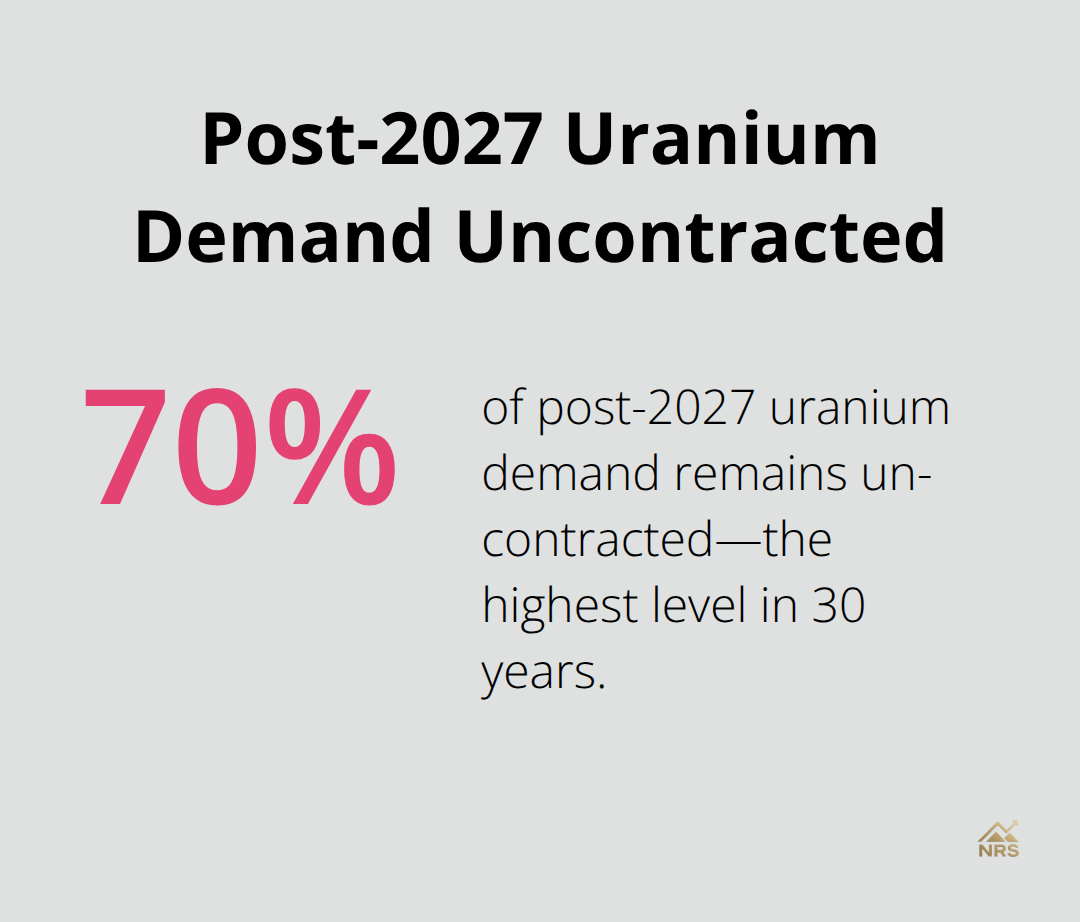
Structural uranium supply sits in deficit already, with 70% of post-2027 uranium demand remaining uncontracted-the highest level in 30 years according to industry analysis.
Mining production alone cannot close this gap. Kazakhstan’s deliberate shift from maximum production toward value-based production removes immediate deliverable pounds from the market, while a 25% production shortfall at McArthur River demonstrates that even established producers face operational constraints.
Project restart pipelines show increasing delays beyond 2027, with many lacking firm timelines due to financing and skilled-labor bottlenecks. The World Nuclear Association Red Book distinguishes between operable reactor capacity and actual production, which historically runs 70–84% of nameplate-a critical gap that inflates supply forecasts. Permitting delays, weather events, jurisdictional risks, and financing gaps compound these constraints.
Timing Signals and Market Recognition
The timing window for inventory exhaustion runs from mid-2026 through early 2027, driven by inventory opacity that delays market recognition of tightening fundamentals. Monitor producer output strategies closely and track tender volumes as leading indicators; watch long-term contract activity as the first signal that markets are pricing in scarcity.
Companies with transparent project pipelines, clear timelines, and strong capital discipline will outperform in a tightening market, while those dependent on delayed projects face margin pressure. As supply constraints tighten and utilities begin to recognize inventory pressures, uranium price dynamics will shift from gradual to rapid-a transition that creates distinct opportunities for investors positioned ahead of the market’s full recognition of the deficit.
How Many Reactors Are Actually Coming Online and When
Construction Timelines and Capacity Additions
The World Nuclear Association reports about 80 reactors under construction across the world, plus further reactors planned. Asia dominates this pipeline, with China and India accounting for the majority of near-term builds. China alone has multiple Hualong One and CAP-series units scheduled for 2026–2029, while Bangladesh’s Rooppur plant (1,200 megawatts VVER-1200) began operation with a second unit planned for 2027. Turkey’s Akkuyu facility (also VVER-1200) is under construction with additional units targeted for 2027–2030. These aren’t theoretical targets-they’re projects with active construction timelines, financing in place, and regulatory approvals moving forward.
Uranium Demand From New Reactor Builds
A single 1,200-megawatt reactor requires roughly 180–200 metric tonnes of uranium oxide annually, meaning each new build adds immediate, measurable demand to a market already running short. The timing is critical because most of these reactors come online between 2026 and 2030, exactly when inventory buffers hit their lowest point. This convergence of new capacity and depleted stockpiles creates the structural supply pinch that will define uranium markets through the decade.
Geopolitical Reversals Locking in Demand
Geopolitical shifts have accelerated this expansion significantly. Japan restarted reactors after a decade of shutdowns, South Korea extended reactor lifespans, and Europe reversed decades of anti-nuclear sentiment following energy security concerns tied to the Ukraine crisis. These reversals aren’t marginal adjustments-they represent fundamental policy shifts that lock in decades of uranium demand at the government level, not speculative investor demand.
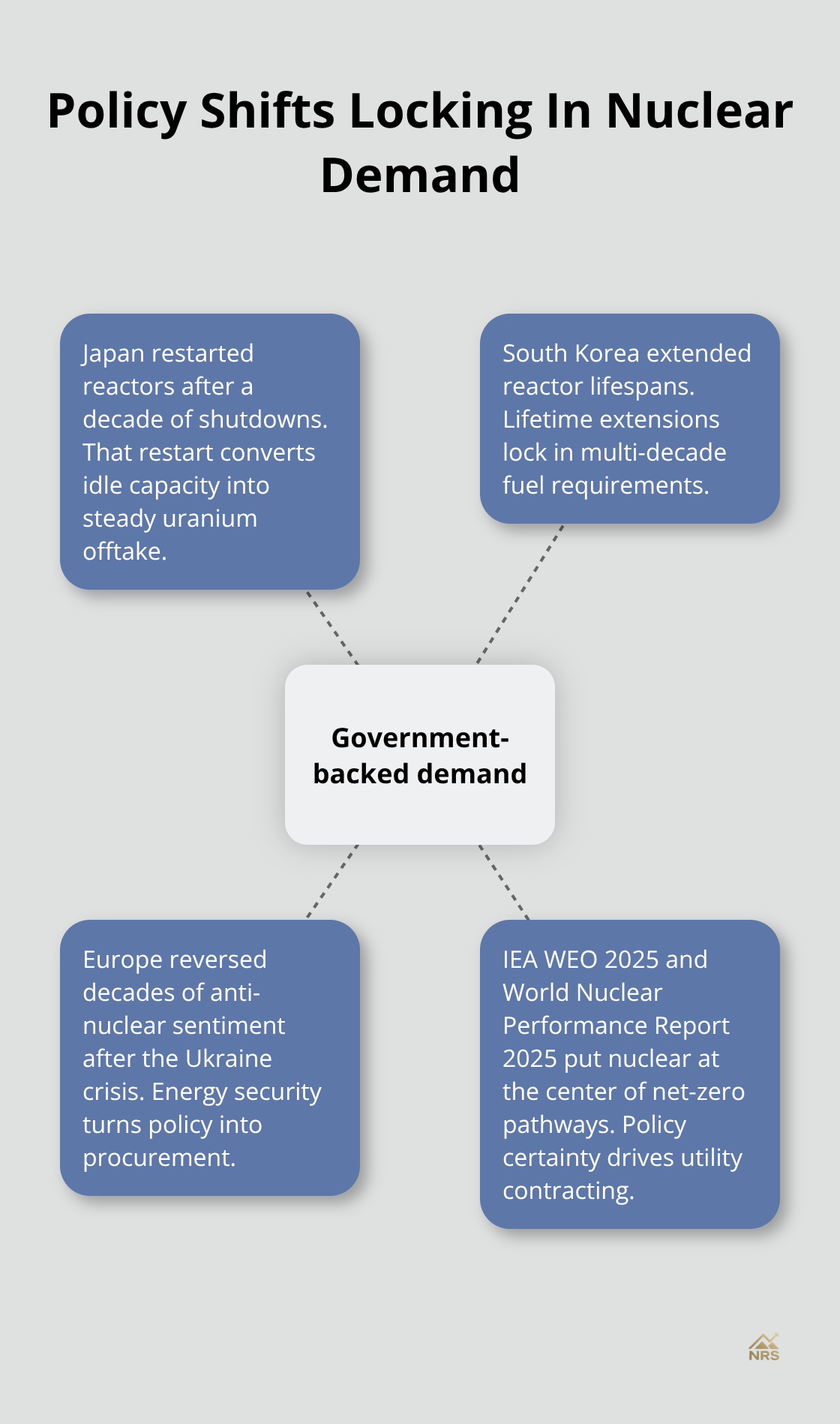
The IEA World Energy Outlook 2025 and World Nuclear Performance Report 2025 frame nuclear as central to net-zero pathways, meaning utilities now contract uranium based on policy certainty rather than economic optionality alone.
The Uncontracted Demand Problem
Roughly 70% of post-2027 uranium demand sits uncontracted, which means utilities face a genuine sourcing problem within 18 months. They cannot wait for spot prices to signal scarcity because their fuel cycle runs 12–24 months ahead of reactor consumption. Companies with production timelines aligned to 2027–2030 reactor startups-those with transparent project pipelines and no delays beyond 2027-command structural pricing power that spot prices have not yet reflected.
Signals to Watch and Investment Positioning
Track tender volumes from utilities and long-term contract activity as real-time signals of this tightening. When utilities begin aggressive procurement in late 2026 and early 2027, prices will move quickly because spot supply is already constrained. Position around producers with near-term production increases, not those betting on 2030+ restarts. The difference between a project delivering in 2027 versus 2028 is the difference between capturing margin expansion and missing it entirely. This supply-demand mismatch sets the stage for how uranium prices will respond to the specific market signals that emerge over the next 18 months.
Why Uranium Prices Haven’t Spiked Yet Despite Tightening Supply
The Spot Price Lag Behind Contract Reality
Uranium spot prices remain artificially suppressed relative to the supply-demand reality unfolding in long-term contract markets, and this disconnect creates a critical window for informed investors. The spot price sits at roughly $85 per pound as of mid-2026, but long-term contracts have already moved substantially higher. Sustained term contracting above $85 per pound and prices around $90 per pound signal a structural shift in supply security that spot markets have not yet priced in. This lag exists because enrichment accounts for almost half of the cost of nuclear fuel and about 5% of the total cost-conversion and fabrication make up the remainder. Utilities prioritize securing physical uranium through long-term contracts rather than bidding aggressively on spot markets, which means price discovery happens gradually across contract negotiations rather than through sudden spot-market spikes.
How Contract Portfolios Shape Realized Prices
Cameco’s finalized long-term contracts as of March 31, 2026, show average realized prices ranging from $55 per pound at a $40 spot scenario to $70 at $160 spot in 2026. These modeled outcomes assume contract portfolios remain unchanged and do not include volumes under negotiation. The critical insight is that a significant portion of post-2027 uranium demand remains uncontracted, forcing utilities into procurement windows starting in late 2026 and early 2027 when inventory buffers are lowest. Utilities cannot wait for spot prices to signal scarcity because their fuel cycle runs 12–24 months ahead of reactor consumption. This timing mismatch means utilities lock in volumes through long-term contracts before spot markets fully recognize the deficit.
Geopolitical Fragmentation and Regional Supply Chains
Geopolitical fragmentation has fractured global uranium supply chains into regional, non-fungible networks, reducing the fungibility that would normally drive rapid price signals across markets. Russia’s Kursk II-2 reactor and other geopolitically sensitive production sites create supply uncertainty that utilities cannot ignore. Energy security concerns tied to the Ukraine crisis have locked nuclear expansion into government policy rather than leaving it to market forces. This policy-backed demand is fundamentally different from the 2007 uranium cycle, which was driven by speculative inventory building and pure financial positioning. Today’s market tightness stems from structural deficits and geopolitical reordering, meaning price movements will reflect actual scarcity rather than sentiment shifts.
Why Investment Demand Plays a Minimal Role
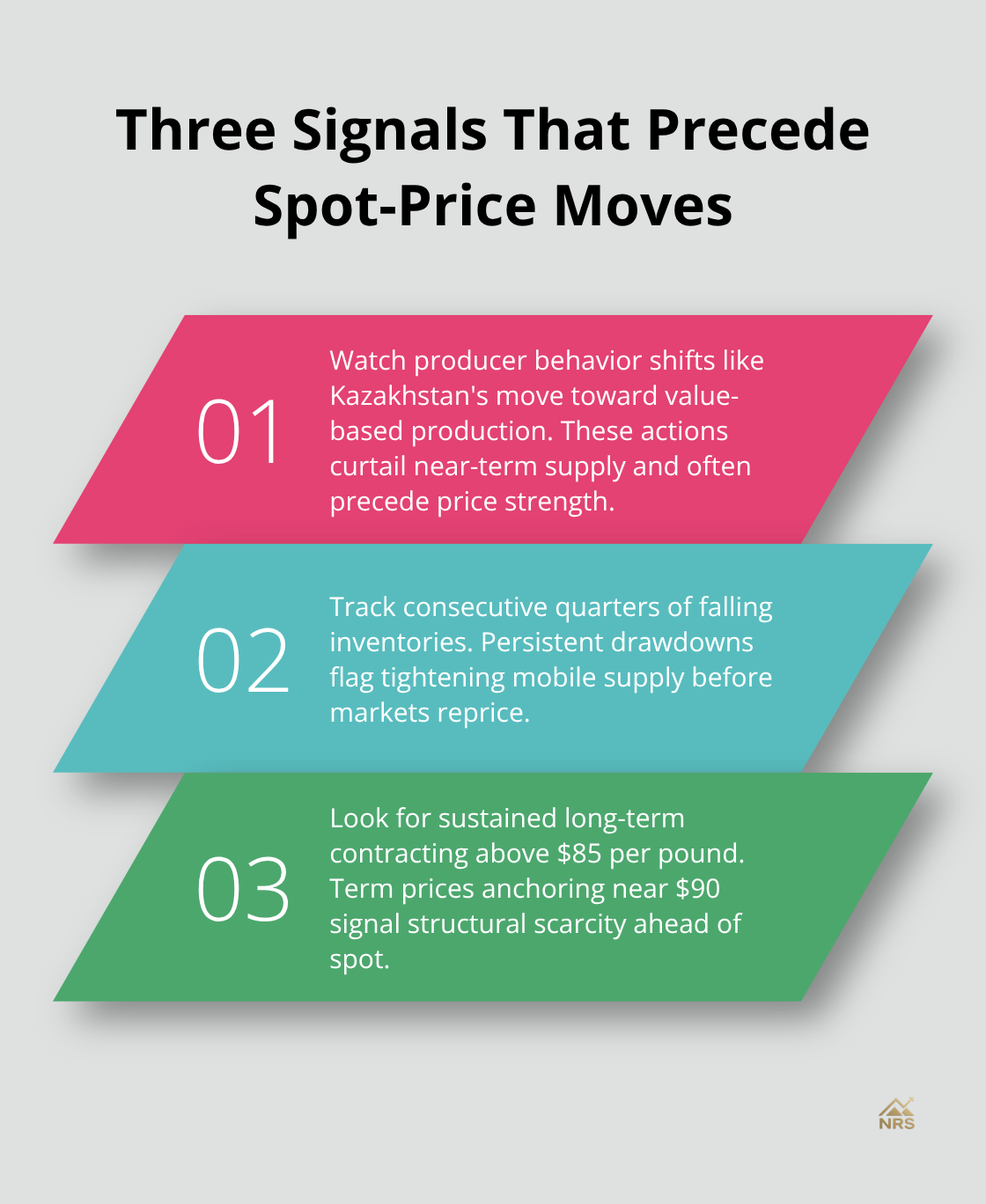
Investment demand and speculative positioning play a minimal role in current market dynamics because physical supply constraints dominate decision-making. Utilities are locking in volumes through long-term contracts before spot markets fully recognize the deficit, which means investors watching only spot prices are observing a lagging indicator. Kazakhstan’s move toward value-based production and consecutive quarters of falling inventories signal that prices are about to catch up to fundamentals. Producer behavior shifts act as leading indicators that precede spot-price movements, allowing investors to position ahead of rapid price discovery.
Final Thoughts
Uranium supply concerns heading into 2027 stem from a structural mismatch between inventory depletion and reactor demand that spot prices have not yet reflected. Global stockpiles shrink faster than utilities publicly acknowledge, while 70% of post-2027 uranium demand remains uncontracted. This gap forces utilities into aggressive procurement starting in late 2026, exactly when mobile supply hits its lowest point.
Three observable signals precede spot-price movements by months: producer behavior shifts like Kazakhstan’s move toward value-based production, consecutive quarters of falling inventories, and sustained long-term contracting above $85 per pound. Companies with transparent project pipelines, clear delivery timelines through 2027 and beyond, and strong capital discipline capture margin expansion as utilities compete for scarce supply. Those dependent on delayed projects face structural headwinds that erode competitive positioning.
Monitor tender volumes from utilities and long-term contract activity as real-time signals of market tightening, and track producer output strategies and project restart timelines closely. The difference between a company delivering uranium in 2027 versus 2028 determines whether it captures pricing power or misses the cycle entirely. Visit Natural Resource Stocks for expert analysis on uranium and other natural resource investments.