


























Uranium is experiencing a supply crunch while global demand accelerates. Nuclear energy expansion, climate commitments, and AI infrastructure buildout are driving consumption higher than production can currently meet.
At Natural Resource Stocks, we’re tracking the uranium demand outlook for 2027 and the investment opportunities emerging from this imbalance. This analysis covers the demand drivers reshaping the market and where investors should position themselves.
What’s Driving Uranium Demand Higher in 2027
Nuclear capacity expansion accelerates across the globe at a pace that catches many investors off guard. The International Atomic Energy Agency projects global nuclear capacity could reach between 561 GW and 992 GW by 2050, but the critical window opens well before then. The U.S. aims to quadruple domestic nuclear capacity to 400 GW by 2050 under May 2025 executive orders, while China, India, Russia, Turkey, and South Africa all outline aggressive expansion plans. Thirty-eight countries pledged at COP30 to triple nuclear energy capacity by 2050, signaling this commitment extends far beyond a handful of nations. The global reactor fleet currently operates at roughly 440 reactors producing about 390 GW, but this baseline shifts dramatically as new projects come online.
Each additional gigawatt of new capacity requires approximately 150 tonnes of uranium per year, plus initial fuel loads of 300 to 450 tonnes. The pipeline of announced reactors alone will consume uranium far beyond what mines currently produce. Utilities already lock in longer-term supply contracts at higher prices as supply tightness persists. In 2025, utilities signed roughly 116 million pounds of long-term uranium deals, bringing five-year contracting to about 589 million pounds. UxC estimates cumulative uncovered uranium requirements to 2045 at about 3.1 billion pounds-a gap that widens with each new reactor announcement.
Tech Giants Reshape Uranium Consumption Patterns
Data centers powering AI infrastructure reshape uranium demand in ways traditional utility forecasts never anticipated. Meta signed multi-decade power arrangements to support its AI infrastructure with nuclear energy. AWS, Microsoft, Google, and Oracle all signed power purchase agreements or made equity investments backing nuclear initiatives. These commitments carry real weight. The IEA warns electricity demand will grow by at least one-third by 2035, with much of that growth originating from hyperscalers and data-center operators rather than traditional industrial users. This shift fundamentally changes uranium demand dynamics because corporate buyers prioritize long-term certainty and carbon-free baseload power differently than utilities do. They accept decade-plus contracts at premium prices to secure supply.
Price Signals Confirm Structural Demand Shift
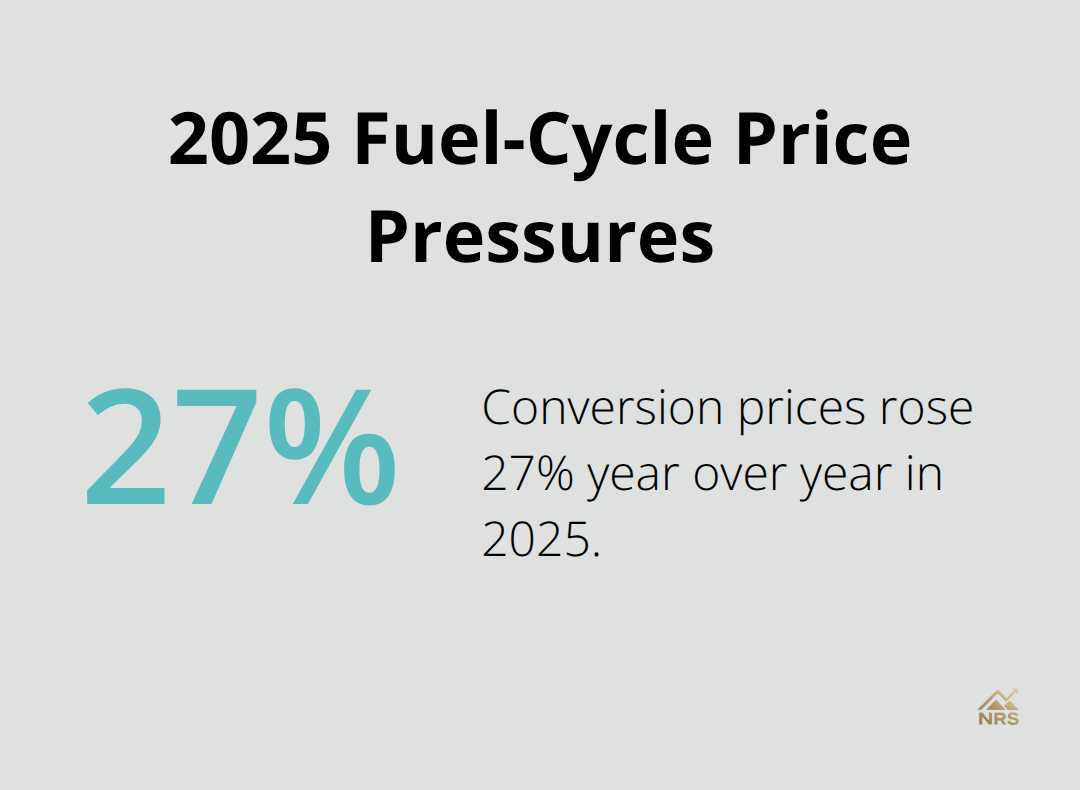
Conversion and enrichment prices reflected this pressure throughout 2025. Conversion posted a 27% average yearly price increase while enrichment spot prices rose more than 10%.
The uranium spot price averaged $73.54 per pound in 2025, peaking at $86.50 in December-a 14-year high. These price movements signal that the market already prices in the structural shift toward higher sustained demand through 2027 and beyond. Supply constraints in conversion and enrichment capacity (particularly in Western markets) amplify this pressure, as utilities and corporate buyers compete for limited downstream fuel-cycle capacity.
The combination of policy-driven reactor expansion, corporate demand from data centers, and persistent supply bottlenecks creates a multi-year tailwind for uranium prices and producer revenues. Understanding which producers benefit most from this demand surge requires examining the supply side and identifying which companies position themselves to capture margin expansion as prices rise.
Where Uranium Supply Falls Short
The Production-Demand Gap Widens
Mine production supplies roughly 74 percent of global uranium needs, with secondary sources filling the remainder through stockpiles, recycled fuel, and other non-mine supply. This split matters because secondary supplies are shrinking rapidly. Civil stockpiles that once buffered market volatility have thinned considerably as producers and financial players add to inventories rather than release material. Cameco reports that the spot market material is drying up as utilities face genuine scarcity.
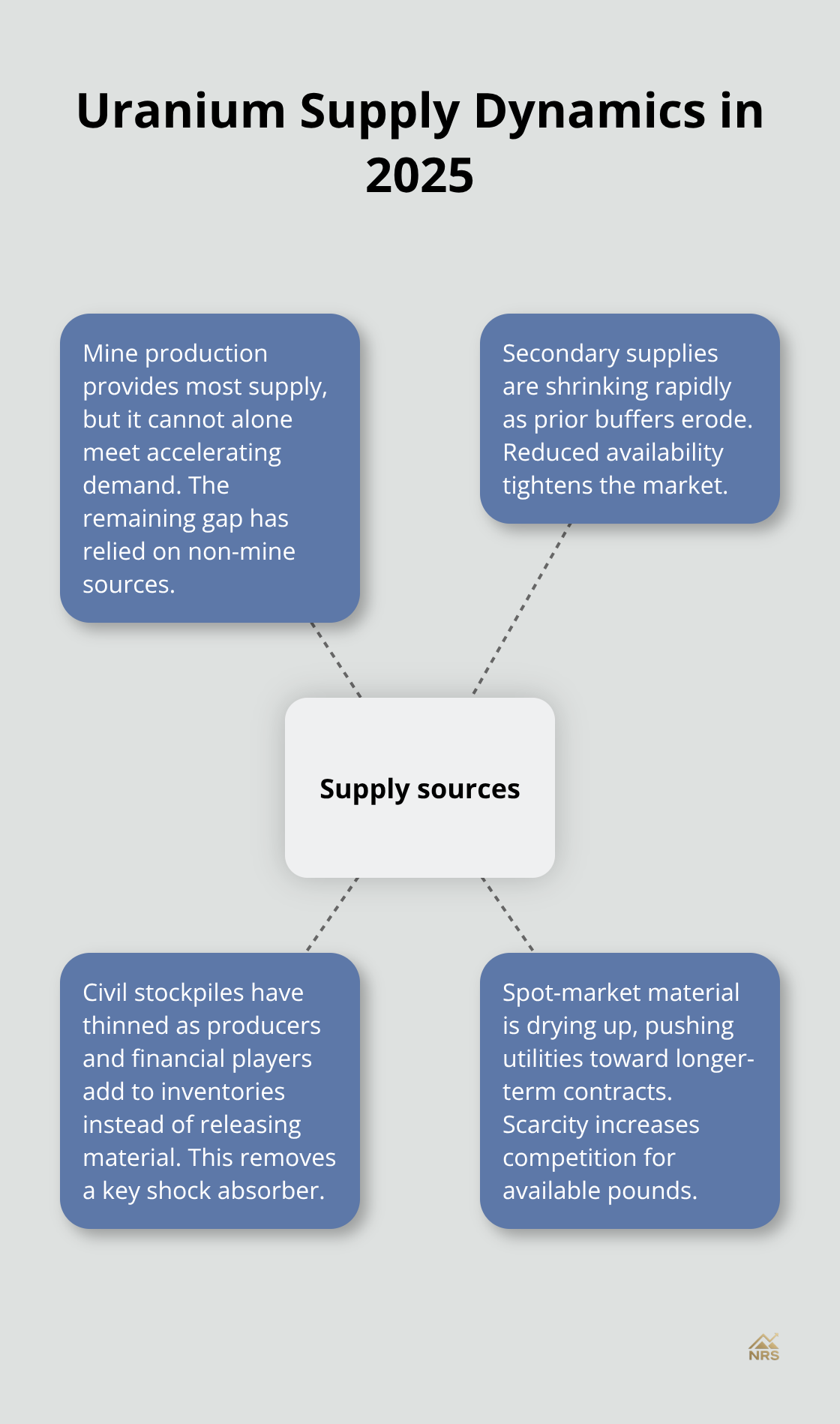
Kazatomprom and Cameco dominate 2025 production with 29.1 million pounds and 21 million pounds respectively, accounting for roughly 86 percent of total output among seven major producers tracked by Visible Alpha. Yet global demand requires roughly 80,000 tonnes of uranium oxide concentrate annually to fuel the current 440-reactor fleet. The math is unforgiving.
New Mines Face Timing Misalignment
After 2028, total uranium production across the group projects to 141.2 million pounds by 2033, up from 58.5 million pounds in 2025, but this growth trajectory assumes every development project stays on schedule and capital commitments hold firm. NexGen will exceed 500 million dollars in capex by 2028, with Denison, Lotus Resources, Paladin, and Deep Yellow all accelerating investment. These front-loaded spending cycles peak around 2027 at 1.6 billion dollars across the sector, yet production from new mines won’t materialize until 2028 or later. This timing gap creates acute supply pressure heading into 2027 precisely when demand from reactors, data centers, and government policy mandates accelerates. Utilities cannot wait for mines to ramp production; they must contract today for delivery years ahead.
Geopolitical Risk Reshapes Supply Chains
Geopolitical disruption amplifies the shortage considerably. Kazakhstan’s Kazatomprom faced production guidance challenges in 2025, and Russia’s restrictions on enriched-uranium exports to the U.S. force utilities to scramble for alternative sources. Niger-related supply disruptions in 2024 knocked material offline, and some idled mines that restarted in 2025 operated at substantially higher costs. Utilities are re-evaluating near-, mid-, and long-term fuel-supply strategies, signaling greater demand for contracts with proven, low-cost producers in geopolitically stable jurisdictions. This preference directly benefits Canadian and Australian developers while penalizing riskier regions.
Price Appreciation Reflects Supply Constraints
Visible Alpha consensus forecasts for 11 listed uranium producers show revenue climbing from 4.7 billion dollars in 2023 to 14.9 billion dollars by 2033, with average realized prices rising from 59.6 dollars per pound in 2023 to 98.7 dollars per pound by 2033. Price appreciation of this magnitude rarely materializes without genuine supply constraints backing it. Western conversion and enrichment capacity remains the critical chokepoint. France’s Orano selected Oak Ridge, Tennessee as a preferred site for a new enrichment plant, signaling that even established producers recognize existing infrastructure cannot support projected demand. Until these downstream facilities expand, utilities and corporate buyers will pay premium prices to secure allocation, and producers holding long-term contracts at higher rates will capture outsized margin expansion through 2027 and beyond.
This supply-demand imbalance creates a clear investment thesis: producers with contracts locked in at rising prices and mines positioned to deliver material when the market needs it most will outperform. The next section examines which uranium stocks position themselves to capitalize on this structural advantage.
Which Uranium Stocks Capture the Most Value from 2027 Demand
The supply-demand imbalance creates vastly different outcomes for uranium producers depending on contract positioning and production timing. Kazatomprom and Cameco dominate current production with 29.1 million pounds and 21 million pounds respectively in 2025, according to Visible Alpha consensus data, but dominance in today’s market differs sharply from positioning for 2027 upside. Cameco trades at roughly 2.3 times its net asset value while Kazatomprom trades near 1.0 times NAV, reflecting market skepticism about Kazakhstan’s production guidance and geopolitical risk. This valuation gap matters because Cameco’s Canadian assets shield it from the supply-chain disruptions affecting other regions, and its existing contracts already lock in price appreciation through the critical 2027 window. For investors seeking established producers with growth potential, Cameco offers the clearest path to margin expansion as prices rise toward $98.7 per pound that forecasts show for 2033.
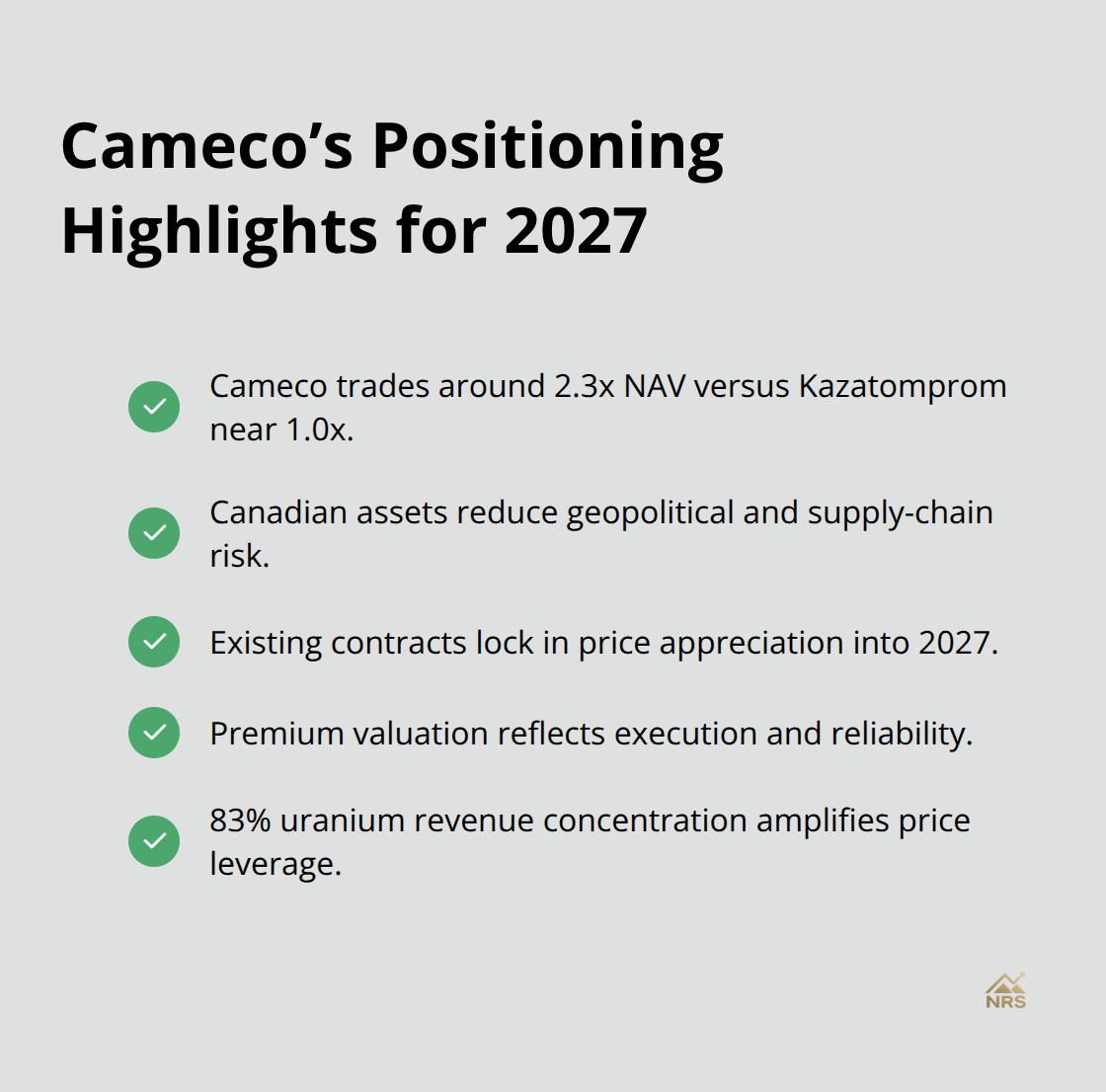
The company’s 83 percent uranium revenue concentration means leverage to price movements flows directly to shareholders without dilution from other business segments.
Established Producers Command Premium Valuations
Proven operators with geopolitically stable assets command higher valuations than emerging competitors because they deliver material when markets need it most. Cameco’s 2.3x NAV multiple reflects investor confidence in execution and supply reliability. The company’s Canadian jurisdiction protects it from the export restrictions and production disruptions that plague other regions. Utilities and corporate buyers prioritize contracts with producers they trust to meet delivery schedules, and Cameco’s track record justifies the premium valuation. This positioning translates directly into shareholder returns as prices appreciate through 2027 and contract terms reset at higher rates.
The Second Wave of Producers Entering Production
NexGen Energy, Denison Mines, and Uranium Energy represent the emerging producer tier that commands different valuation logic. NexGen projects roughly 1.3 billion dollars in uranium revenue by 2030 according to Visible Alpha, while Denison Mines and Uranium Energy expect 768 million and 548 million dollars respectively by the same year. These companies trade at 1.3 to 1.6 times NAV, reflecting market acknowledgment of production growth without the premium applied to proven operators. NexGen’s capex exceeds 500 million dollars by 2028, peaking across the sector at 1.6 billion dollars in 2027, yet production won’t materialize until 2028 or later. This timing creates acute risk for investors betting on near-term cash flow, but substantial upside for those holding through the production ramp. Denison Mines and Lotus Resources accelerate capex spending now to position for the supply crunch, meaning investors buying today fund the mines that will deliver material when utilities desperately need it. This positioning matters more than current production volumes.
ETF Exposure Captures Sector-Wide Tailwind
Sprott Uranium Miners (URNM) tracks the North Shore Global Uranium Mining Index and provides diversified exposure across the entire uranium value chain. URNM includes companies involved in mining, exploration, development, production, and those holding physical uranium or royalties. Sprott Junior Uranium Miners (URNJ) targets smaller-cap developers via the Nasdaq Sprott Junior Uranium Miners Index, offering higher volatility but potential for outsized gains as new mines transition to production between 2028 and 2030. For investors uncomfortable forecasting which emerging producer executes best or concerned about geopolitical risk concentrating in any single jurisdiction, these ETFs capture the sector-wide tailwind without betting the portfolio on individual mine success. Past performance is not indicative of future results, and diversification does not eliminate ETF risk, but the structural demand surge through 2027 supports both approaches (single-stock picks and diversified ETF exposure).
Final Thoughts
The uranium demand outlook 2027 rests on three immovable pillars: policy-driven nuclear expansion, corporate demand from data centers, and persistent supply constraints that will define producer profitability for years ahead. Governments worldwide committed to tripling nuclear capacity by 2050, with the U.S. targeting 400 GW domestically and dozens of nations announcing reactor pipelines. This policy momentum translates into immediate uranium demand that outpaces mine production by a widening margin, and utilities and tech giants competing for limited supply will pay premium prices to secure long-term contracts.
Established producers like Cameco offer stability and margin expansion as prices climb toward $98.7 per pound by 2033, with geopolitically secure assets commanding premium valuations justified by execution certainty. Emerging producers entering production between 2028 and 2030 present higher-risk, higher-reward positioning for investors comfortable funding capex cycles now in exchange for outsized gains as new mines ramp. ETF exposure through URNM and URNJ captures the sector-wide demand surge without concentrating risk in individual companies or jurisdictions, though past performance does not indicate future results.
Portfolio positioning should reflect conviction in the structural demand shift rather than short-term price volatility. Uranium supply will remain tight through 2027 as new mines struggle to reach production on schedule while demand accelerates from policy mandates and corporate commitments. We at Natural Resource Stocks recommend exploring expert insights on uranium market dynamics to refine positioning before the supply crunch intensifies further.