























Silver prices are moving in ways that matter to investors right now. At Natural Resource Stocks, we’re tracking the supply shifts, demand patterns, and macroeconomic forces reshaping the market heading into 2027.
This silver market analysis 2027 covers what’s actually driving prices, where opportunities sit, and how to position your portfolio. We’ll walk through the data that counts.
Silver Supply and Demand Dynamics
Global Mining Production and the Deficit Reality
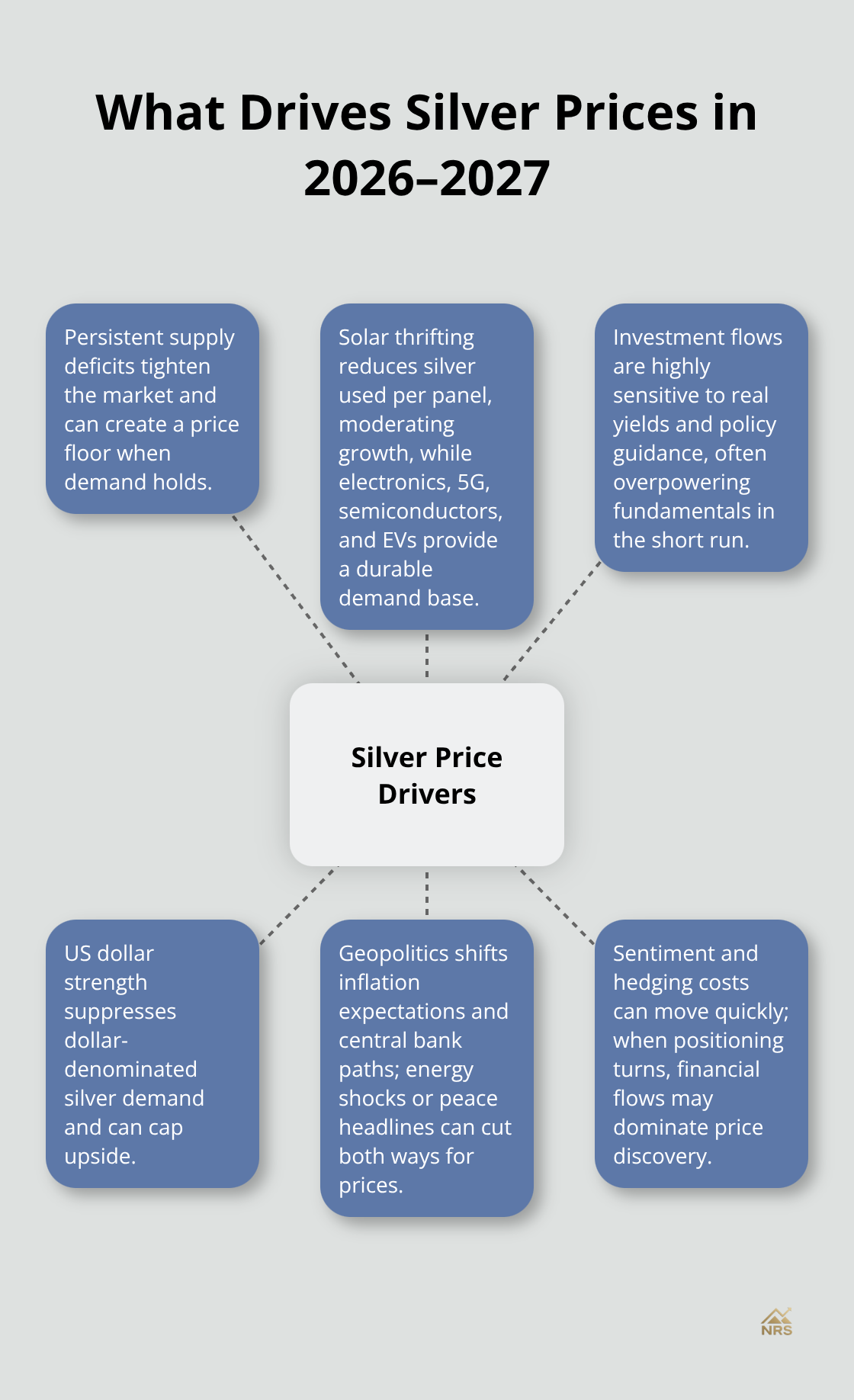
Mexico, Peru, and China lead global silver production, with Australia, Chile, Bolivia, the United States, Poland, and Russia following behind. The Silver Institute reports global silver supply deficits, with 2026 expected to continue this trend due to lagging mine output. This matters because deficits tighten the market and create upward pressure on prices. If supply continues falling short of demand into 2027, you’re looking at a structural floor beneath silver prices that speculation alone can’t override.
Industrial Demand: Solar Thrifting and Electronics
The industrial side of silver demand tells a different story than most investors realize. Solar panel manufacturing comprises a significant portion of global silver demand, but here’s the critical part: efficiency gains reduce the amount of silver needed per panel through a process called thrifting. Solar panel manufacturing silver thrifting efficiency continues to limit near-term industrial demand growth, which means you can’t count on solar expansion alone to push silver higher. Electronics, 5G infrastructure, semiconductors, and electric vehicles remain solid demand drivers, but they won’t compensate for solar thrifting losses without additional tailwinds.
Investment Demand and Currency Sensitivity
Investment demand and jewelry markets react differently to price movements than industrial demand does. When silver trades near $68 per ounce as it does in mid-June 2026, investment flows become more sensitive to interest rate expectations and dollar strength. A stronger dollar suppresses dollar-denominated demand for silver, which directly limits upside potential even when supply deficits exist. This is why you need to monitor central bank policy signals alongside supply data.
The Supply-Demand Divergence in Price Forecasts
The supply deficit situation looks bullish on paper, but deficits alone don’t guarantee price gains if investment demand weakens. Trading Economics macro models forecast silver at $82.08 per ounce in 12 months, implying meaningful upside from current levels, yet CoinCodex’s forecasting models project end-2026 prices around $47.73 per ounce-a 30 percent decline. This massive divergence exists because supply and demand dynamics interact with monetary policy and sentiment in ways that aren’t linear. You need to watch whether deficits actually translate into physical shortages that force industrial users to bid higher, or whether financial flows dominate price discovery.
Hedging Behavior and Market Volatility
Position sizing matters here because the 52-week range spans roughly $35 to $121, showing silver’s tendency toward violent swings. Industrial users hedge price risk through silver futures and options on COMEX, with standard contracts representing 5,000 troy ounces. If you’re evaluating silver exposure for 2027, understand that industrial demand provides a demand floor, but investment demand provides the volatility that creates trading opportunities. The supply deficit is real and structural, yet it’s not a guarantee of sustained price appreciation without accompanying shifts in real yields and currency dynamics. These macroeconomic forces will shape whether supply deficits translate into higher prices or whether financial headwinds override the structural case for silver.
What’s Actually Moving Silver Prices Right Now
The Rate Hike Paradox
Silver at $67.82 per ounce in mid-June 2026 sits trapped between competing forces that will determine whether 2027 brings a breakout or a breakdown. The real driver isn’t supply deficits alone-it’s how macroeconomic conditions either amplify or suppress the impact of those deficits on actual prices. The European Central Bank raised rates for the first time since 2023 and lifted inflation forecasts for 2026–2027, which directly pressures precious metals because higher rates increase the opportunity cost of holding non-yielding assets. Simultaneously, US producer prices rose 6.5% year-over-year in May, signaling inflationary pressure that should theoretically support silver as an inflation hedge. The tension here matters: inflation expectations push toward higher silver prices, but the policy response-rate hikes-pushes toward lower prices.
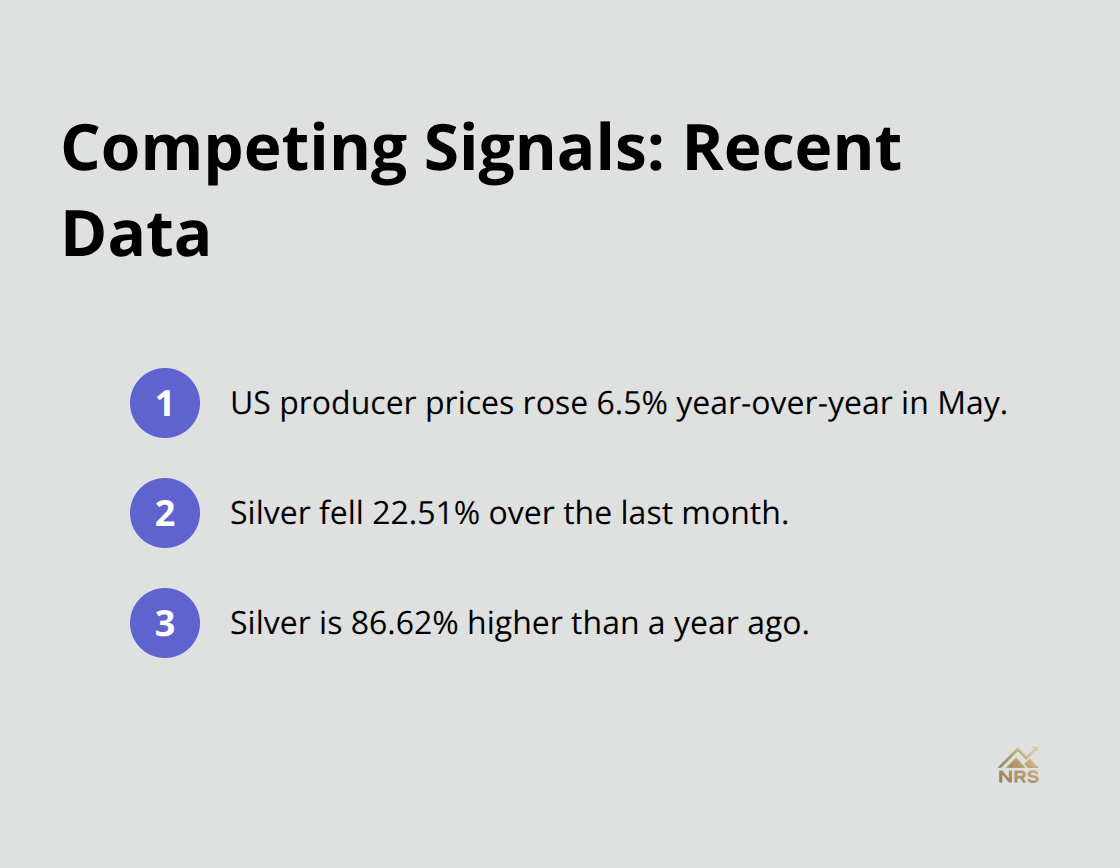
This conflict explains why silver fell 22.51% over the last month despite being 86.62% higher than a year ago.
Real Yields and Investment Flows
Real yields-the difference between nominal rates and inflation expectations-determine whether investors rotate into precious metals or away from them. When real yields turn positive, cash becomes attractive and silver loses its appeal. Right now, real yields sit elevated enough to suppress investment demand, which is why supply deficits haven’t translated into higher prices. Investment flows move prices more than fundamentals, and tracking sentiment shifts reveals when hedging costs spike or decline. If you’re planning 2027 positioning, watch whether real yields stay elevated or fall as inflation moderates.
Currency Strength and Geopolitical Tension
A stronger US dollar suppresses demand for dollar-denominated silver, which is why currency strength matters as much as interest rates. Trading Economics macro models forecast $82.08 per ounce in 12 months, but this assumes dollar weakness and rate cuts materialize. The geopolitical backdrop complicates everything: optimism about a US-Iran peace deal provides sentiment support, yet energy shocks from Middle East tensions feed directly into inflation expectations and central bank signals and rate decisions. If oil prices spike from Gulf tensions, inflation expectations rise, which pushes central banks toward higher rates, which then pressures silver downward despite the initial supply shock. This perverse relationship means geopolitical risk cuts both ways for silver investors.
Position Sizing in a Volatile Market
The practical reality is that 2027 silver prices will move on central bank signals more than on supply deficits alone. The Federal Reserve hasn’t committed to rate cuts, and sticky inflation combined with energy shocks could keep rates higher for longer than markets currently price in. Silver prices swing wildly-sometimes 5% in a single week, creating both opportunities and risks for investors. Dollar-cost averaging into silver exposure during periods of elevated real yields makes more sense than trying to time a single entry point, especially when competing forecasts range from $47.73 to $82.08 per ounce for end-2026.
What Central Banks Control
The supply deficit is real and structural, but it only drives prices higher if investment demand responds or if central banks shift toward accommodation. Watch the ECB and Federal Reserve commentary closely through the rest of 2026, because their policy paths will determine whether structural silver deficits create a price floor or whether financial headwinds override supply tightness entirely. The next section examines how technical analysis and price projections for 2027 reveal where silver could actually trade if these macroeconomic forces play out as forecasts suggest.
Where Silver Prices Head in 2027
Technical Levels and Volatility Signals
Silver’s 14-day RSI sits at 43.03, below the 50-day and 200-day simple moving averages at $75.23 and $76.67 respectively, signaling bearish momentum despite the structural supply deficit. The critical technical level to watch sits around $75–$81, where analysts identified a potential key reversal that could mark a cycle low. If silver breaks above $81 with volume confirmation, the next resistance emerges near $90–$100 per ounce, aligning with Commerzbank’s year-end 2026 target of $90 and their 2027 projection of $95. The CME CVOL Index tracks 30-day implied volatility for silver options and provides a forward-looking gauge of market risk sentiment that shifts before price moves materialize. Rising CVOL readings signal when hedging costs spike, indicating institutional positioning changes that precede directional moves. Track CVOL trends monthly through the CME Group Metals Update to time position adjustments, scaling exposure up during low volatility periods and reducing risk when implied volatility spikes above historical averages.
Forecasts and Position Sizing Strategy
The 52-week price range from $35 to $121 demonstrates why position sizing matters more than perfect timing. Trading Economics forecasts $82.08 per ounce in 12 months, yet CoinCodex models project $47.73 by end-2026, creating a $34 spread that reflects genuine uncertainty. This divergence isn’t a flaw-it’s actionable intelligence telling you that dollar-cost averaging outperforms lump-sum entries in an environment where competing forces generate $60–$100+ price swings. Try allocating monthly amounts rather than betting your entire position on a single forecast. This approach reduces the risk of entering at unfavorable prices while maintaining steady exposure as conditions evolve through 2027.
Emerging Demand and Industrial Foundations
Emerging demand from developing economies adds structural support that most investors underestimate. Industrial usage in electronics, semiconductors, 5G infrastructure, and electric vehicles concentrates in growth markets where manufacturing capacity continues expanding regardless of near-term price volatility. These sectors demand physical silver that can’t be easily substituted, creating a baseline demand floor even when investment flows weaken. The structural case for silver rests on this industrial foundation, which persists independent of financial market sentiment or rate expectations.
Diversification Across Multiple Silver Vehicles
Portfolio diversification with silver works best through multiple vehicles depending on your time horizon and risk tolerance. SLV trades around $61.29 with minimal expense ratios, making it suitable for buy-and-hold exposure without rolling futures contracts. AGQ around $90.68 provides leveraged exposure for investors comfortable with 2x daily tracking, useful during consolidation phases when silver moves sideways before directional breakouts.
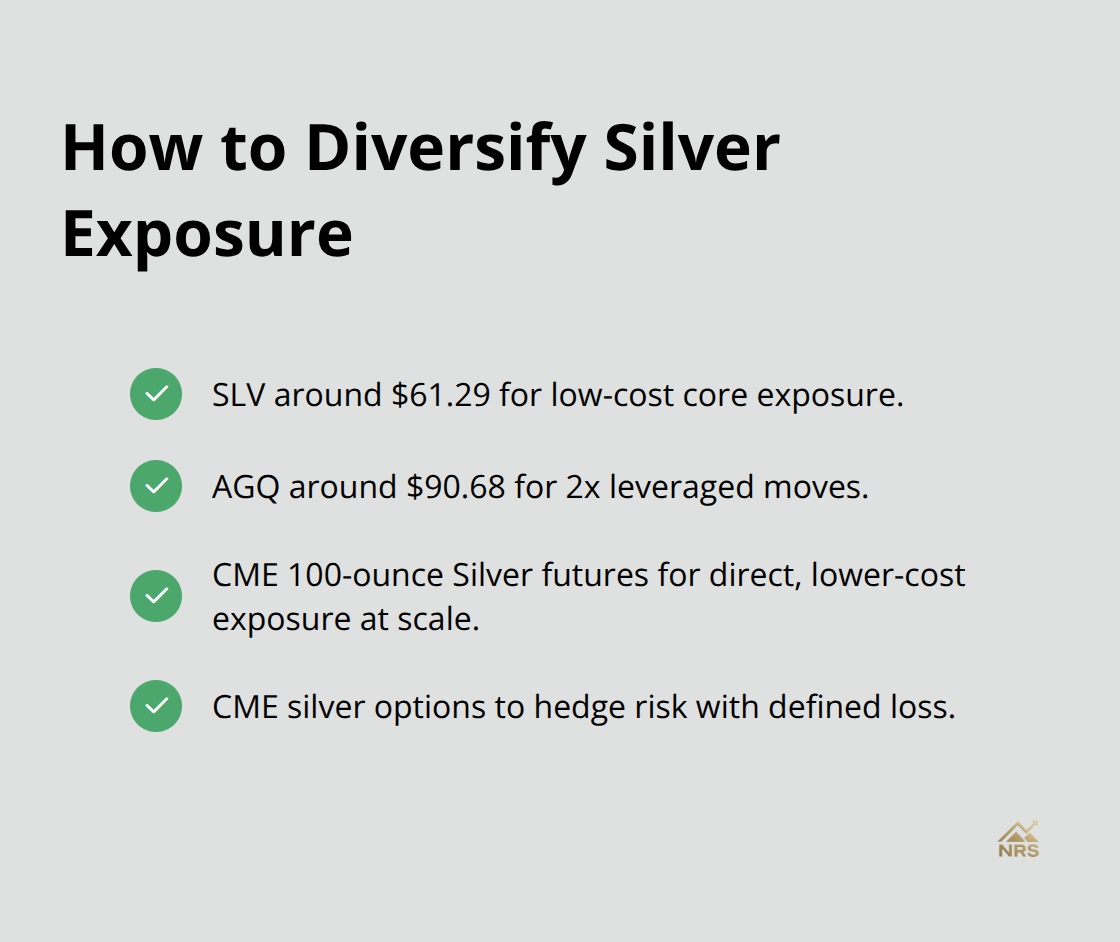
The standard 100-ounce Silver futures contract on CME offers direct price exposure with lower costs than ETFs for larger positions, though it requires active management around the July 29, 2026 settlement date and subsequent roll windows. For tactical hedging, silver options through CME’s expiration calendar enable defined-risk strategies that cap losses while maintaining upside participation.
Building Layered Silver Exposure
Don’t treat silver as a single-position play. Build exposure across ETFs for core holdings, futures for tactical entries near technical support, and options for hedging when implied volatility spikes. This approach captures upside if central banks shift toward accommodation while limiting downside if real yields stay elevated and the dollar strengthens further into 2027. Each vehicle serves a specific purpose within a broader silver allocation strategy, allowing you to respond to changing market conditions without abandoning your structural conviction about silver’s long-term prospects.
Final Thoughts
Silver’s 2027 outlook hinges on whether structural supply deficits translate into actual price support or whether macroeconomic headwinds override fundamental strength. The silver market analysis 2027 reveals competing forces at work: six consecutive global supply deficits create a structural floor, yet elevated real yields and dollar strength suppress investment demand that would normally respond to supply tightness. This tension explains why forecasts range from $47.73 to $82.08 per ounce for end-2026, and it demands that you monitor central bank policy shifts more closely than supply data alone.
The Federal Reserve and European Central Bank will determine silver’s direction through rate decisions that either support or suppress investment flows. If real yields fall and the dollar weakens in the second half of 2026, structural deficits will drive prices toward the $90–$100 range that Commerzbank projects. If rates stay elevated and inflation remains sticky, investment demand will stay suppressed regardless of supply tightness, potentially pushing silver toward the $60–$65 support zone. Energy shocks from Middle East tensions, dollar strength, and solar panel thrifting all create volatility that cuts both ways for your portfolio.
Position sizing through dollar-cost averaging into silver ETFs provides core exposure without timing pressure, while tactical entries near $75–$81 technical support capture upside if momentum shifts. Track the CME CVOL Index to hedge downside risk when implied volatility spikes, and monitor the gold-to-silver ratio around 59–61:1 as a leading indicator of relative value shifts. We at Natural Resource Stocks provide the market analysis and expert commentary you need to navigate silver’s competing forces through 2027 and beyond.